Mathematics · Ch 5 — Two Dimensional Analytical Geometry-II
Degenerate Forms
5.4.2
Degenerate Forms
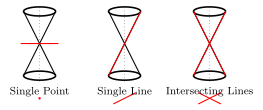
If the cutting plane is instead tilted through the vertex of the double cone, the intersection collapses to a lower-dimensional degenerate conic:
- A plane through the vertex, perpendicular to the axis, gives a single point (a degenerate circle/ellipse) — in the general equation this is the case , i.e. .
- A plane through the vertex along a generator gives a line, or (when the cone has flattened into a cylinder, plane parallel to the axis) a pair of parallel lines — the degenerate parabola, characterised by .
- A plane through the vertex containing the axis gives a pair of intersecting lines — the degenerate hyperbola, e.g. when and the rest are zero. …
Figure 5.43Degenerate conics — a plane through the vertex of a double-napped cone yields a single point, a single line, or a pair of intersecting lines
Drawn by us to help you understand the concept clearly, and verified to make sure it's accurate. For exams, practice from your textbook's own diagram.
What this figure shows. Three limiting cases — a single line, a pair of intersecting lines and a single point — obtained when the cutting plane is tilted through the vertex of the double cone instead of missing it. …