Botany · Ch 8 — Cell Cycle and Cell Division
Anaphase
Anaphase
Anaphase is the mitotic stage in which the two halves of every chromosome finally part company and travel to opposite ends of the cell. It begins the moment the chromosomes that were lined up along the metaphase plate are ready to separate.
At the very start of anaphase, each chromosome sitting on the equatorial plate splits — and this splitting happens in all of the chromosomes at the same time. The two sister chromatids that had been held together are now set free. Once separated, each chromatid is no longer called a chromatid; it is now a full-fledged daughter chromosome, because it will go on to become part of one of the two future daughter nuclei.
These daughter chromosomes then start moving apart, each set heading toward one of the two opposite poles of the cell. The way a chromosome moves is worth noting: as it slides away from the equator, its centromere stays pointed toward the pole, so the centromere travels at the front (the leading edge), while the two arms of the chromosome drag along behind it. This gives the migrating chromosomes their characteristic pulled-along, V-like or bent appearance.
The events that define anaphase can be summed up as:
- The centromeres split, and the sister chromatids of each chromosome separate from one another. …
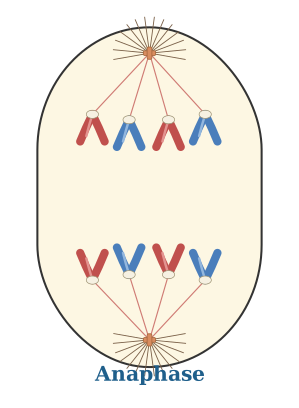
Drawn by us to help you understand the concept clearly, and verified to make sure it's accurate. For exams, practice from your textbook's own diagram.
At the onset of anaphase the centromere of every chromosome splits, so the two sister chromatids become independent daughter chromosomes. Here the two sets are shown moving apart toward opposite poles, each chromatid led by its centromere (white oval) at the front with its arms trailing …