Botany · Ch 8 — Cell Cycle and Cell Division
Prophase
Prophase
Prophase is the first stage of karyokinesis in mitosis. It follows directly after the S and G2 phases of interphase. During those earlier phases, the newly formed DNA molecules are not yet visible as separate, distinct structures — instead they lie intertwined and tangled together.
The defining event of prophase is the beginning of the condensation of the chromosomal material. As the chromatin condenses, the previously tangled DNA becomes untangled and packs itself into compact, recognisable chromosomes. At the same time, the centrosome — which had already duplicated during the S phase of interphase — starts to move towards the opposite poles of the cell.
The end of prophase can be recognised by the following characteristic events:
- The chromosomal material condenses into compact mitotic chromosomes. Each chromosome is now seen to consist of two chromatids joined together at a point called the centromere.
- The centrosome, having duplicated during interphase, begins moving towards opposite poles of the cell. From each centrosome, microtubules radiate outward as structures called asters. The two asters together with the spindle fibres make up the mitotic apparatus. …
Drawn by us to help you understand the concept clearly, and verified to make sure it's accurate. For exams, practice from your textbook's own diagram.
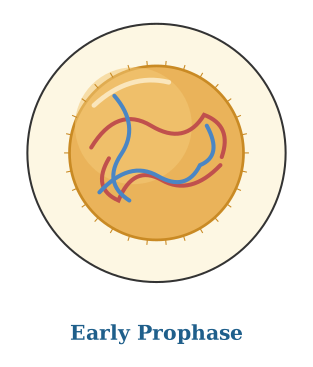
In early prophase the loosely packed chromatin of interphase begins to condense into long, thin, thread-like chromosomes (each already made of two sister chromatids from the preceding S phase). The nuclear envelope is still intact — its ring is drawn here with its nuclear pores — and the two chromatin threads (shown in red a …
Drawn by us to help you understand the concept clearly, and verified to make sure it's accurate. For exams, practice from your textbook's own diagram.
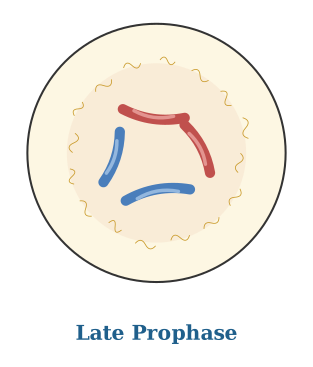
By late prophase the chromosomes have condensed into short, thick, rod-shaped bodies that can now be seen distinctly. The nuclear envelope has begun to break down — shown here as scattered fragments around the periphery — and the nucleolus, golgi complex and endoplasmic reticulum …