Q.Sodium salt of which acid will be needed for the preparation of propane ? Write chemical equation for the reaction.
🔒You're viewing a preview — the full solution, concept, methods & PYQ mapping are locked.
🔒 Start your 14-day free trial to unlock the full solution →Concept understanding — Kolbe Electrolysis
Kolbe Electrolysis: From Intuition to Precision
Imagine you have a carboxylic acid — say, vinegar (acetic acid). You know it has a carboxyl group (−COOH) at one end. Now, what if you could snap off that carboxyl group and join the two remaining hydrocarbon pieces together? That is exactly what Kolbe electrolysis does: it takes two carboxylic acid molecules, removes their CO2 groups, and couples the leftover alkyl fragments into a longer hydrocarbon chain.
The reaction happens in an electrolytic cell — the same kind of setup you use to split water into hydrogen and oxygen. But here, the "fuel" is a concentrated solution of a carboxylate salt (the conjugate base of the acid), and the electrodes are usually platinum.
The Core Idea in One Sentence
2RCOO−electrolysisR−R+2CO2+2e−
The carboxylate ions lose electrons at the anode, lose CO2, and the two alkyl radicals (R⋅) combine to form a dimer (R−R).
Step-by-Step Mechanism (Anode Only — That's Where the Action Is)
- At the anode (oxidation): The carboxylate ion RCOO− gives up one electron to the electrode, forming a carboxyl radical:
RCOO−→RCOO⋅+e−
- Decarboxylation (loss of CO2): The carboxyl radical is unstable. It immediately loses CO2 to produce an alkyl radical:
RCOO⋅→R⋅+CO2
- Dimerization: Two alkyl radicals meet and couple:
2R⋅→R−R
The net result: two carboxylate ions become one alkane (the dimer) and two molecules of CO2.
The cathode reaction is usually the reduction of water (or the solvent) to hydrogen gas and hydroxide ions. It is not special to Kolbe electrolysis — the real chemistry is at the anode.
What You Actually See in the Lab
- Starting material: A concentrated aqueous or methanolic solution of the sodium or potassium salt of a carboxylic acid (e.g., sodium acetate, CH3COONa).
- Electrodes: Inert platinum (carbon works too, but can get messy).
- Products at anode: The alkane dimer bubbles out (if short-chain) or deposits as a solid (if long-chain), along with CO2 gas.
- Products at cathode: Hydrogen gas and hydroxide ions (the solution becomes basic).
For sodium acetate (R=CH3), the product is ethane (CH3−CH3).
For sodium propionate (R=CH3CH2), the product is butane (CH3CH2−CH2CH3).
The Precise Statement (Exam-Ready)
Kolbe electrolysis is the anodic decarboxylative dimerization of carboxylate ions. When an aqueous solution of a sodium or potassium salt of a carboxylic acid is electrolysed using platinum electrodes, the carboxylate ion loses an electron at the anode, undergoes decarboxylation to form an alkyl radical, and two such radicals couple to give a symmetrical alkane (the dimer). Carbon dioxide is evolved at the anode, and hydrogen gas at the cathode.
Key Conditions and Limitations
- Concentration matters: The solution must be concentrated. In dilute solution, the carboxylate radical may instead react with water to form an alcohol or aldehyde (the Hofer–Moest reaction).
- No other oxidisable groups: If the alkyl chain has functional groups that are easier to oxidise (like −OH, −NH2, or double bonds), those will react first — the reaction fails.
- Only symmetrical dimers: You get R−R from RCOO−. If you mix two different carboxylates (RCOO− and R′COO−), you get a statistical mixture of R−R, R−R′, and R′−R′ — not useful for a single product. …
The key idea is decarboxylation with sodalime (§9.2.2, "From carboxylic acids"): heating the sodium salt of a carboxylic acid with sodalime (NaOH + CaO) removes the carboxylate carbon as carbonate, giving an alkane with one carbon fewer than the acid.
Step 1: Propane (CX3HX8) has three carbons, so the starting acid must have 3+1=4 carbons — butanoic acid, CHX3CHX2CHX2COOH. Its sodium salt is sodium butanoate, CHX3CHX2CHX2COONa.
Step 2: Heat sodium butanoate with sodalime:
CHX3CHX2CHX2COONa+NaOHCaO,ΔCHX3CHX2CHX3+NaX2COX3 …
Sodalime decarboxylation removes exactly one carbon from a carboxylic acid's sodium salt. Propane has 3 carbons, so the salt must come from the 4-carbon acid — butanoic acid: CHX3CHX2CHX2COONa+NaOHCaO,ΔCHX3CHX2CHX3+NaX2COX3.
The concept: decarboxylation
Section 9.2.2 gives a standard laboratory route from carboxylic acids to alkanes: heat the sodium salt of the acid with sodalime — a mixture of sodium hydroxide and calcium oxide, written NaOH (CaO). The carboxylate group is eliminated as carbonate, a process called decarboxylation. The essential bookkeeping is that the product alkane always contains one carbon atom fewer than the parent acid, because the carboxyl carbon is the one that leaves.
Step-by-step reasoning
-
Count the carbons the product needs. Propane is CHX3CHX2CHX3 — three carbons.
-
Work backwards to the acid. Since decarboxylation removes one carbon, the acid must have four: CHX3CHX2CHX2COOH, butanoic acid. The salt actually heated is its sodium salt, sodium butanoate, CHX3CHX2CHX2COOX−NaX+.
-
Write the reaction. The CaO does not appear in the equation — it keeps the mixture dry and porous and acts as a heat-transfer medium, which is why it is written over the arrow:
CHX3CHX2CHX2COONa+NaOHCaO,ΔCHX3CHX2CHX3+NaX2COX3 …
- TG EAPCET 2026Set eng-2026-05-09-FN1 markMCQQ.Which of the following reagent(s) will convert n-propylbromide to alkane with same number of carbon atoms? I. Zn∣H+ II. Na∣dry ether III.(i) alc.KOH(ii) H2∣Pt (A) I only (B) II, III only (C) I, III only (D) II only
›Reveal solutionSolution
The key is to identify which reagents reduce an alkyl halide to an alkane without changing the carbon skeleton. Only Zn/H⁺ (reduction) and the two-step alc. KOH then H₂/Pt (elimination then hydrogenation) achieve this; Na/dry ether gives a coupling product (Wurtz reaction) with double the carbon atoms. Thus the correct set is I and III only.
Concept & Intuition
We start with n-propyl bromide (CH₃CH₂CH₂Br) and want an alkane with the same three-carbon chain — propane (CH₃CH₂CH₃). The challenge is that many reactions of alkyl halides either replace the halogen with another group or couple two molecules together.
- Reduction (adding H in place of Br) preserves the carbon skeleton.
- Elimination followed by hydrogenation first removes HBr to give an alkene (still 3 carbons), then adds H₂ across the double bond to give the alkane.
- Wurtz reaction with Na/ether couples two alkyl halides, doubling the carbon count — that would give hexane, not propane.
Step-by-step reasoning
- Reagent I: Zn / H⁺ Zinc in acidic medium acts as a reducing agent. It replaces the bromine atom with hydrogen:
CH3CH2CH2Br+Zn+H+→CH3CH2CH3+ZnBr+
The carbon skeleton remains intact (3 carbons). So I works.
- Reagent II: Na / dry ether This is the classic Wurtz reaction. Two molecules of n-propyl bromide react with sodium metal:
2CH3CH2CH2Br+2Na→CH3CH2CH2CH2CH2CH3+2NaBr
The product is n-hexane (6 carbons), not propane. So II fails — it changes the number of carbon atoms.
- Reagent III: (i) alc. KOH, (ii) H₂ / Pt
- Step (i): Alcoholic KOH promotes dehydrohalogenation (elimination). n-Propyl bromide loses HBr to give propene (major product, Saytzeff rule): CH3CH2CH2Bralc. KOHCH3CH=CH2+HBr…
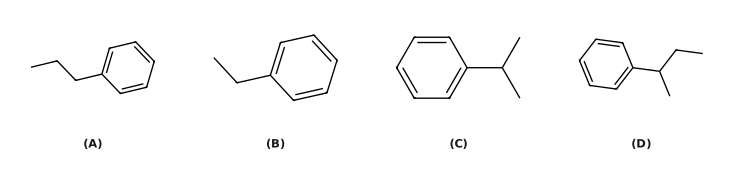
- TG EAPCET 2026Set ap-2026-05-04-FN1 markMCQQ.An alkyl halide (X) on reaction with sodium in dry ether gives 2,3-Dimethylbutane. X on reaction with sodium and chlorobenzene in dry ether gives Z as the major product. What is Z? (A) C6H5CH2CH2CH3 (n-propylbenzene) (B) C6H5CH2CH3 (ethylbenzene) (C) C6H5CH(CH3)2 (isopropylbenzene / cumene) (D) C6H5CH(CH3)CH2CH3 (sec-butylbenzene)
›Reveal solutionSolution
The alkane 2,3-dimethylbutane is a symmetrical Wurtz product, so X must be an isopropyl halide. Coupling that with chlorobenzene (Wurtz–Fittig) gives isopropylbenzene (cumene) — option (C).
The concept first
- Wurtz reaction: 2RX+2Nadry etherR−R+2NaX. Two identical alkyl fragments join, so the alkane formed always has an even, symmetrical skeleton.
- Wurtz–Fittig reaction: R−X+Ar−X+2Nadry etherR−Ar. An alkyl halide and an aryl halide are coupled to give an alkylarene.
Step-by-step
- Deduce X by cutting the product in half. 2,3-dimethylbutane is
(CH3)2CH−CH(CH3)2
Break the central C−C bond (the bond Wurtz made): each half is (CH3)2CH−, an isopropyl group.
2. Therefore X=(CH3)2CH−X (2-chloro/2-bromopropane, an isopropyl halide).
3. Check: 2(CH3)2CHCl+2Na→(CH3)2CH−CH(CH3)2+2NaCl — exactly 2,3-dimethylbutane. ✓
4. Now the cross-coupling. With sodium and chlorobenzene in dry ether: …
- TG EAPCET 2023Set ap-2023-05-11-AN1 markMCQQ.An alkyl halide ‘X’ upon reaction with sodium metal in dry ether gives 2, 5-dimethyl hexane. What is ‘X’? (A) Isopropyl bromide (B) Isobutyl bromide (C) Secondary butyl bromide (D) Secondary Pentyl bromide
›Reveal solutionSolution
The reaction of an alkyl halide with sodium in dry ether is a Wurtz reaction, which couples two identical alkyl groups to form a symmetrical alkane. By identifying the alkyl group that forms 2,5-dimethyl hexane, we find that the alkyl halide 'X' is isobutyl bromide.
The problem describes a reaction where an alkyl halide 'X' reacts with sodium metal in dry ether to produce 2,5-dimethyl hexane. This set of reagents (alkyl halide, sodium metal, dry ether) is characteristic of the Wurtz reaction.
Concept and Intuition: The Wurtz Reaction
The Wurtz reaction is a coupling reaction in organic chemistry that forms a new carbon-carbon bond between two alkyl groups. It typically involves two molecules of an alkyl halide reacting with sodium metal in the presence of dry ether as a solvent.
2R−X+2Nadry etherR−R+2NaX
Where R−X is an alkyl halide and R−R is a symmetrical alkane.
The mechanism generally proceeds via a free radical pathway or an organometallic intermediate. In essence, the sodium metal removes the halogen atom from the alkyl halide, generating an alkyl radical (or an organosodium compound). Two such alkyl radicals (or organosodium compounds) then combine to form a larger alkane.
ImportantWhen a single type of alkyl halide is used, the Wurtz reaction predominantly yields a symmetrical alkane, meaning the product alkane is formed by joining two identical alkyl groups. The carbon skeleton of the product alkane will have twice the number of carbon atoms present in the alkyl group of the reactant alkyl halide.
Our goal is to work backward from the product, 2,5-dimethyl hexane, to determine the structure of the alkyl group that must have coupled, and thus identify the original alkyl halide 'X'.
Step-by-Step Solution
-
Identify the reaction type: The reaction of an alkyl halide with sodium metal in dry ether is the Wurtz reaction. This reaction couples two alkyl groups to form a larger alkane.
-
Draw the structure of the product: The product is 2,5-dimethyl hexane.
- "Hexane" indicates a main chain of 6 carbon atoms.
- "2,5-dimethyl" indicates two methyl (−CH3) groups attached to the main chain at positions 2 and 5.
The structure of 2,5-dimethyl hexane is:
CH3−CH(CH3)−CH2−CH2−CH(CH3)−CH3
Let's visualize it:
```
      CH₃       CH₃
      |         |
CH₃ - CH - CH₂ - CH₂ - CH - CH₃
```
3. Determine the symmetry of the product: Observe the structure of 2,5-dimethyl hexane. It is a symmetrical molecule. If we imagine breaking the bond between the third and fourth carbon atoms of the main chain (the central C-C bond), we get two identical fragments. This central bond is the new C-C bond formed during the Wurtz reaction.
- Deduce the structure of the alkyl group: Since the product is symmetrical and formed from a single type of alkyl halide, the alkyl group from the reactant 'X' must be half of the product molecule. Breaking the central bond (between C3 and C4) of 2,5-dimethyl hexane:
CH3−CH(CH3)−CH2—CH2−CH(CH3)−CH3
Each fragment is: $$ \text{CH}_3 - \text{CH}(\text{CH}_3) - \text{CH}_2 - $$ … -
- TG EAPCET 2022Set ap-2022-07-31-AN1 markMCQQ.Given the standard enthalpy change of formation [ΔHf∘, in kJ mol−1] for C3H8(g), CO2(g) and H2O(l) are −105, −394 and −286, respectively. The ΔHc∘ of complete combustion of propane in oxygen is approximately (in kJ mol−1) (A) 574 (B) 2221 (C) −2221 (D) 2431
›Reveal solutionSolution
Apply Hess's law to the balanced combustion equation: ΔHc∘=∑ΔHf∘(products)−∑ΔHf∘(reactants)=−2326+105=−2221 kJ mol−1. Because burning releases heat, the answer must carry a negative sign — option (C).
The concept first
Standard enthalpy of formation, ΔHf∘, is the heat change when one mole of a compound forms from its elements in their standard states. Because enthalpy is a state function, we can build any reaction out of formation steps — this is Hess's law:
ΔHrxn∘=∑nΔHf∘(products)−∑nΔHf∘(reactants)
Two habits save you here: (i) elements in their standard state (here O2) have ΔHf∘=0, and (ii) combustion always releases energy, so a positive answer is automatically suspect.
Step-by-step
Step 1 — Write and balance the combustion reaction.
C3H8(g)+5O2(g)⟶3CO2(g)+4H2O(l)
Note the water is liquid, matching the ΔHf∘ value we were given (−286 kJ mol−1 is for H2O(l)).
Step 2 — Sum the products.
3ΔHf∘(CO2)+4ΔHf∘(H2O)=3(−394)+4(−286)
=−1182+(−1144)=−2326 kJ …
🎓Unlock everything free for 14 days
- ✓Full step-by-step solutions
- ✓Concept-first explanations
- ✓Methods, shortcuts & mistakes
- ✓PYQ mapping + timed mock tests
Full access for 14 days. No credit card required.