Chemistry · Ch 13 — Hydrocarbons
Structure of Triple Bond
Structure of Triple Bond
The Triple Bond in Ethyne: A Linear Geometry
The simplest alkyne is ethyne, . Its structure reveals the fundamental nature of the carbon-carbon triple bond. Each carbon atom in ethyne is sp-hybridised. This means that one s-orbital and one p-orbital from each carbon mix to form two equivalent sp hybrid orbitals, leaving two pure p-orbitals unhybridised.
The two sp hybrid orbitals on each carbon lie 180° apart along a straight line. This linear arrangement is the geometric foundation of the entire molecule.
Formation of the Sigma () Skeleton
The sigma framework of ethyne is built from head-on (end-to-end) overlaps:
- C–C bond: One sp hybrid orbital from the first carbon overlaps head-on with one sp hybrid orbital from the second carbon. This forms a strong carbon-carbon sigma bond along the internuclear axis.
- C–H bonds: The remaining sp hybrid orbital on each carbon overlaps head-on with the 1s orbital of a hydrogen atom. This creates two C–H sigma bonds.
Because the sp hybrid orbitals are at 180°, the entire sigma framework is linear. The H–C–C bond angle is exactly 180°.
The linear geometry of ethyne is a direct consequence of sp hybridisation. The two sp orbitals on each carbon are oriented 180° apart, forcing all four atoms to lie on a straight line.
Formation of the Two Pi () Bonds
The triple bond is not just one sigma bond. It is one sigma bond plus two pi bonds. These pi bonds arise from the unhybridised p-orbitals.
Each carbon atom has two unhybridised 2p orbitals. These two p-orbitals are perpendicular to each other, and both are perpendicular to the plane of the C–C sigma bond. Crucially, the 2p orbitals on one carbon are parallel to the corresponding 2p orbitals on the other carbon.
This parallel alignment allows for lateral (sideways) overlapping:
- One pair of parallel p-orbitals (one from each carbon) overlaps sideways to form one bond.
- The other pair of parallel p-orbitals (also one from each carbon) overlaps sideways to form a second bond.
These two bonds are perpendicular to each other. The electron cloud from these two bonds, together with the sigma bond, creates a cylindrically symmetrical electron distribution around the C–C internuclear axis.
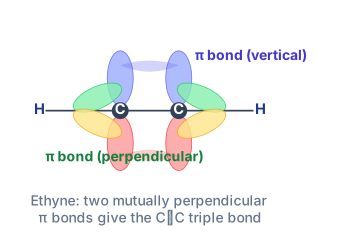
Drawn by us to help you understand the concept clearly, and verified to make sure it's accurate. For exams, practice from your textbook's own diagram.
Fig. 9.6 is a three-dimensional orbital diagram of the ethyne molecule (C₂H₂). It does not have axes or curves — it is a spatial model showing the shapes and orientations of the atomic orbitals that form the triple bond. The figure uses two different representations for the orbitals: the sp hybrid orbitals are drawn as elongated lobes (like dumbbells with one lobe much larger than the other), and the unhybridised p orbitals are drawn as the familiar two-lobed dumbbells. The carbon atoms are placed at the centre of the diagram, with the hydrogen atoms at the two ends.
The key visual feature is the linear arrangement of the atoms. The two carbon atoms are joined by a sigma bond formed from the head-on overlap of their sp hybrid orbitals, and each carbon also uses its remaining sp hybrid to bond to a hydrogen atom. This gives a straight line of atoms: H–C–C–H, with a bond angle of exactly 180°. The figure makes this linearity obvious — the entire σ-bond framework lies along a single straight line.
The real teaching point of the diagram is the two π bonds. Each carbon atom has two unhybridised p orbitals (2p and 2p). In the figure, these are drawn perpendicular to each other and also perpendicular to the line of the σ bonds. One set of p orbitals (say, the 2p on each carbon) is shown parallel to each other, overlapping sideways above and below the molecular axis to form one π bond. The other set (2p) is perpendicular to the first, overlapping in front of and behind the molecular axis to form the second π bond. The result is a cylindrical electron cloud around the C–C axis — the figure often indicates this by showing the two π bonds as two separate sets of overlapping lobes, one in the vertical plane and one in the horizontal plane.
The two π bonds in ethyne are mutually perpendicular — they lie in planes at 90° to each other. This is a direct consequence of the two unhybridised p orbitals on each carbon being perpendicular to each other.
The physical idea the figure teaches is that a triple bond is not three equivalent bonds. It is one strong σ bond plus two weaker π bonds. The σ bond is formed by end-on overlap and is cylindrically symmetric about the internuclear axis. The π bonds are formed by sideways overlap and are concentrated above and below (or in front of and behind) that axis. Together, they create a very short, very strong bond.
The textbook uses this orbital picture to explain the measured properties of the triple bond. The key data are:
| Property | C–C (single) | C=C (double) | C≡C (triple) |
|---|---|---|---|
| Bond length (pm) | 154 | 134 | 120 |
| Bond enthalpy (kJ mol⁻¹) | 348 | 681 | 823 |
The sideways overlap in a bond is less effective than the head-on overlap in a bond. This is why bonds are generally weaker than bonds. However, having two of them contributes significantly to the overall strength of the triple bond.
Summary of Bonds in Ethyne
The ethyne molecule contains:
- One C–C bond
- Two C–H bonds
- Two C–C bonds
This combination of one and two bonds constitutes the carbon-carbon triple bond ().
Quantitative Properties of the Triple Bond
The textbook provides specific numerical data to compare the triple bond with double and single bonds.
Bond Enthalpy Comparison
The triple bond has the highest bond enthalpy, meaning it requires the most energy to break. This is consistent with it being composed of three bonds (one and two ). …