Q.Nucleophile is a species that should have (Note: more than one of the given options may be correct.)
🔒You're viewing a preview — the full solution, concept, methods & PYQ mapping are locked.
🔒 Start your 14-day free trial to unlock the full solution →Concept understanding — Electrophile Nucleophile Concept
The Electrophile–Nucleophile Concept: A First Look
Imagine you are in a crowded room. Some people are constantly reaching out to shake hands — they want to connect, to grab something. Others are holding their hands close, waiting for someone to come to them. In organic chemistry, molecules behave the same way.
The Intuition
Every chemical reaction is about electron movement. Some species are electron-poor — they want to accept electrons to become stable. Others are electron-rich — they have extra electrons and are happy to donate them.
- Electrophile (from Greek philos = loving, electron = electron): "Electron-loving" — a species that loves electrons and seeks them out. It is electron-deficient (positive charge, partial positive charge, or an empty orbital).
- Nucleophile (from Greek nucleus = nucleus, philos = loving): "Nucleus-loving" — a species that loves positive nuclei because it has excess electrons to donate. It is electron-rich (negative charge, lone pairs, or pi bonds).
Think of an electrophile as a hungry guest at a party (wants food = electrons) and a nucleophile as a generous host (has food to give). The reaction happens when the host offers food to the hungry guest.
The Precise Statement
Electrophile: Any atom, ion, or molecule that accepts a pair of electrons to form a new covalent bond. It is Lewis acid (electron-pair acceptor).
Nucleophile: Any atom, ion, or molecule that donates a pair of electrons to form a new covalent bond. It is Lewis base (electron-pair donor).
How to Identify Them
| Feature | Electrophile | Nucleophile |
|---|---|---|
| Charge | Often positive or neutral (with empty orbital) | Often negative or neutral (with lone pair) |
| Examples | HX+, AlClX3, BFX3, CHX3X+ (carbocation), COX2 | OHX−, NHX3, HX2O, ClX−, CHX3OX− |
| Orbital | Empty orbital (can accept electrons) | Filled orbital (lone pair or pi bond) |
| Reaction type | Attacked by nucleophile | Attacks electrophile |
The Arrow-Pushing Convention
In organic chemistry, we show electron movement with curved arrows:
- Arrow starts at the nucleophile (where electrons come from) — usually a lone pair or a pi bond.
- Arrow ends at the electrophile (where electrons go) — usually at a positive charge or an empty orbital.
Example: Reaction of hydroxide ion with methyl bromide
HOX−+CHX3BrHO−CHX3+BrX−
The arrow goes from the lone pair on O (nucleophile) to the carbon atom in CHX3Br (electrophile, because Br pulls electron density away, making carbon partially positive). …
Concept: Nucleophile–Electrophile Theory
A nucleophile ("nucleus-loving") is a chemical species that seeks positively charged or electron-deficient centres. To form a bond, it must donate an electron pair to the electrophile.
Essential characteristics:
-
Electron-pair donor: Every nucleophile carries at least one lone pair or a π-bond that it can donate. This is the defining feature—without electrons to share, no nucleophilic attack is possible.
-
Charge considerations: Negatively charged species (anions like OHX−, CNX−, ClX−) are excellent nucleophiles because the excess electron density makes them eager donors. However, neutral molecules with lone pairs (HX2O, NHX3, R−O−R) are also nucleophiles. …
A nucleophile is "nucleus-loving" and must possess electrons to donate to electron-deficient centres. The defining requirement is a pair of electrons to donate, though negative charge often enhances nucleophilicity.
The term nucleophile comes from "nucleus-loving"—a species attracted to positive or electron-poor regions. To understand what makes something a nucleophile, we need to think about what happens during bond formation.
When a nucleophile attacks an electrophile, it forms a new covalent bond. A covalent bond requires two electrons, and in a nucleophilic attack, both electrons come from the nucleophile. This is the heart of nucleophilicity: the ability to donate an electron pair.
Let's examine each option:
-
Option (i): A pair of electrons to donate
This is the fundamental requirement. A nucleophile must have a lone pair or a π-bond that can be donated to form a new σ-bond with an electrophile. Examples include:
- OHX− (hydroxide ion with three lone pairs)
- NHX3 (ammonia with one lone pair)
- HX2O (water with two lone pairs)
- CNX− (cyanide ion)
Without an electron pair to donate, a species cannot act as a nucleophile. This is essential.
-
Option (ii): Positive charge
A positively charged species has lost electrons, making it electron-deficient. Such species are electrophiles, not nucleophiles. For instance, HX+, NOX2X+, and carbocations are all electrophiles that accept electron pairs rather than donate them.
This is incorrect.
-
Option (iii): Negative charge
Negatively charged species have extra electrons, making them excellent electron donors. Anions like ClX−, BrX−, OHX−, and CNX− are strong nucleophiles. The negative charge increases electron density and enhances the tendency to donate electrons.
However, this is not required. Neutral molecules like NHX3, HX2O, and R−NHX2 are also nucleophiles because they possess lone pairs. Negative charge makes a species a better nucleophile but is not mandatory.
This is often true but not necessary.
-
Option (iv): Electron deficient species …
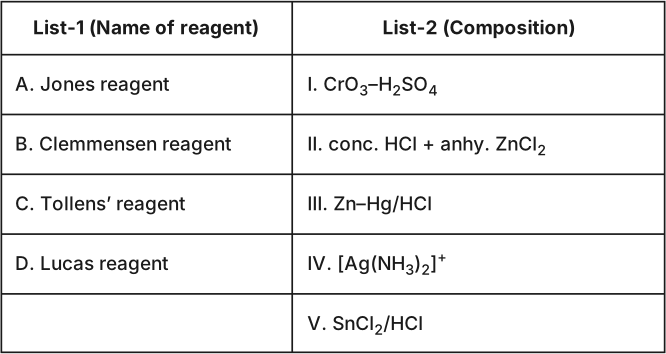
- TG EAPCET 2026Set eng-2026-05-10-FN1 markMCQQ.Match the following List-1 (Name of reagent) A. Jones reagent B. Clemmensen reagent C. Tollens' reagent D. Lucas reagent List-2 (Composition) I. Zn−Hg/HCl II. conc. HCl + anhy. ZnCl2 III. CrO3−H2SO4 IV. [Ag(NH3)2]+ V. SnCl2/HCl The correct answer is (A) A – III, B – IV, C – V, D – II (B) A – III, B – I, C – IV, D – II (C) A – II, B – I, C – IV, D – III (D) A – V, B – III, C – II, D – I
›Reveal solutionSolution
Jones = CrO3-H2SO4 (III), Clemmensen = Zn-Hg/HCl (I), Tollens = [Ag(NH3)2]+ (IV), Lucas = conc. HCl+ZnCl2 (II). That is A–III, B–I, C–IV, D–II — option (B).
The concept first
Match-the-following questions on reagents are not memory tests if you know what each reagent is for — the function reveals the composition.
Step-by-step
A. Jones reagent → III (CrO3-H2SO4).
Jones' job is oxidation: a primary alcohol goes all the way to a carboxylic acid, a secondary alcohol to a ketone.
R2CH−OH CrO3/H2SO4acetone R2C=O
Any strong oxidation in organic chemistry points to chromium(VI) in acid — hence CrO3-H2SO4.
B. Clemmensen reagent → I (Zn-Hg/HCl).
The Clemmensen reduction strips a carbonyl right down to a methylene group:
R−CO−R′ Zn-Hg, conc. HCl R−CH2−R′
Remember it as the acidic partner of the Wolff–Kishner reduction (NH2NH2/KOH, which is the basic route to the same product). Zinc amalgam supplies the electrons; concentrated HCl supplies the protons.
C. Tollens' reagent → IV ([Ag(NH3)2]+).
Ammoniacal silver nitrate — the silver-mirror test for aldehydes:
RCHO+2[Ag(NH3)2]++3OH− → RCOO−+2Ag↓+4NH3+2H2O
The aldehyde is oxidised while Ag+ is reduced to metallic silver, which plates the tube.
D. Lucas reagent → II (conc. HCl + anhydrous ZnCl2). …
- TG EAPCET 2025Set eng-2025-05-04-AN1 markMCQQ.Consider the following set of reactions. YBC6H5CNAX Y (reacts with 2,4-DNP); X (dissolves in dil. HCl) What are A and B respectively? (A) LiAlH4, H2O ; H2/Ni (B) Na/Hg, C2H5OH ; DIBAL-H, H2O (C) DIBAL-H, H2O ; LiAlH4, H2O (D) Na/Hg, C2H5OH ; H2/Ni
›Reveal solutionSolution
"Dissolves in dil. HCl" = amine (full reduction, reagent A) and "reacts with 2,4-DNP" = aldehyde (partial reduction, reagent B). Only option (B) pairs a complete reducing agent (Na/Hg, EtOH) with a partial one (DIBAL-H).
The concept first
A nitrile, R−C≡N, sits at a useful crossroads: reduce it partially and you stop at the aldehyde; reduce it fully and you arrive at the primary amine. The exam does not tell you the products — it gives you two chemical tests instead, and you must decode them:
- Solubility in dilute HCl is the classic test for a base. Among ordinary organic compounds that means an amine (RNH2+HCl→RNH3+Cl−, water-soluble).
- 2,4-Dinitrophenylhydrazine (Brady's reagent) gives an orange/red precipitate only with an aldehyde or ketone — it is the carbonyl test.
So X = benzylamine and Y = benzaldehyde, and the question reduces to: which reagent over-reduces and which under-reduces?
- LiAlH4 and H2/Ni are complete reducers → amine.
- Na/Hg (sodium amalgam) with ethanol is also a complete reducing system → amine.
- DIBAL-H (di-isobutylaluminium hydride) is bulky and delivers one hydride; the intermediate metallated imine survives at low temperature and only on aqueous work-up collapses to the aldehyde. (Stephen's reduction, SnCl2/HCl, does the same job.)
Step-by-step
- Decode X. X dissolves in dil. HCl → basic → amine:
C6H5C≡N A C6H5CH2NH2(benzylamine)
- Decode Y. Y reacts with 2,4-DNP → carbonyl → aldehyde: …
- TG EAPCET 2025Set eng-2025-05-04-FN1 markMCQQ.Observe the following set of reactions
[!FORMULA] CX6HX5COClXCX6HX5CHOYCX6HX5COCHX3
[!FORMULA] CX6HX5COClYCX6HX5COCHX3
[!FORMULA] CX6HX5CHOOHX−/293KZ(Major product)
What are X, Y and Z respectively? (A) HX2∣Pd−BaSOX4;(CHX3)X2Cd;CX6HX5CH=CH−CO−CX6HX5 (B) HX2∣Pd−BaSOX4;CHX3MgBr;CX6HX5CH=CH−CO−CX6HX5 (C) LiAlHX4,HX3OX+;CHX3MgBr;CX6HX5−C(CHX3)=CH−CO−CX6HX5 (D) HX2∣Pd;(CHX3)X2Cd;CX6HX5CH=CH−CO−CX6HX5›Reveal solutionSolution
The key is recognising the selective reduction of acid chloride to aldehyde (Rosenmund reduction, X = HX2∣Pd−BaSOX4), the conversion of acid chloride to ketone using a dialkylcadmium (Y = (CHX3)X2Cd), and the crossed aldol condensation between benzaldehyde and acetophenone under basic conditions giving chalcone (Z = CX6HX5CH=CH−CO−CX6HX5). The correct option is (A).
The problem tests your command of three distinct organic transformations, each with a specific reagent that avoids over-reaction. Let's break them down one by one.
-
First conversion: CX6HX5COClXCX6HX5CHO
An acid chloride must be reduced to an aldehyde without going further to the alcohol. The classic reagent for this is Rosenmund reduction: hydrogen gas over palladium catalyst poisoned with barium sulfate (HX2∣Pd−BaSOX4). The poison deactivates the catalyst just enough to stop reduction at the aldehyde stage.
LiAlHX4 would reduce all the way to benzyl alcohol, so option (C) is wrong. Plain HX2∣Pd (unpoisoned) would also over-reduce, so (D) is out.
Hence X = HX2∣Pd−BaSOX4.
-
Second conversion: CX6HX5COClYCX6HX5COCHX3
Here an acid chloride is turned into a methyl ketone. Grignard reagents (CHX3MgBr) react with acid chlorides, but they are so reactive that they usually add twice, giving a tertiary alcohol after work-up — not a ketone. To stop at the ketone, we need a milder organometallic: dialkylcadmium ((CHX3)X2Cd). It reacts only once with the acid chloride, replacing Cl with the alkyl group cleanly.
So Y = (CHX3)X2Cd, not CHX3MgBr. This eliminates (B) and (C).
-
Third conversion: CX6HX5CHOOHX−/293KZ (Major product) …
-
- TG EAPCET 2024Set eng-2024-05-09-AN1 markMCQQ.Assertion (A) : Aldehydes are more reactive than ketones towards nucleophilic addition reactions Reason (R) : In aldehydes, carbonyl carbon is less electrophilic compared to ketones The correct answer is (A) (A) and (R) are correct. (R) is the correct explanation of (A) (B) (A) and (R) are correct, but (R) is not the correct explanation of (A) (C) (A) is correct but (R) is not correct (D) (A) is not correct but (R) is correct
›Reveal solutionSolution
Aldehydes are more reactive than ketones in nucleophilic addition, but that is because their carbonyl carbon is more electrophilic (and less hindered) — the reason as printed says "less", which is wrong. (A) true, (R) false — option (C).
The concept first
Nucleophilic addition begins with the nucleophile attacking the electrophilic carbonyl carbon, CXδ+=OXδ−, converting it from sp2 (planar, 120°) to sp3 (tetrahedral, 109.5°). Two factors decide the rate:
-
Electronic (+I effect). Alkyl groups push electron density towards the carbonyl carbon, reducing its positive character. A ketone has two alkyl groups; an aldehyde has one alkyl and one H (which has negligible +I). So the aldehyde's carbonyl carbon retains more δ+ — it is more electrophilic.
-
Steric crowding. Two bulky groups in a ketone hinder the nucleophile's approach and also destabilise the crowded tetrahedral product. An aldehyde, with a small H, is much more open.
Both effects point the same way, and the observed order is
HCHO>RCHO>RX2CO.
Step-by-step evaluation
- Test the Assertion. "Aldehydes are more reactive than ketones towards nucleophilic addition." — True, for the two reasons above. …
-
- TG EAPCET 2022Set ap-2022-07-31-FN1 markMCQQ.The displacement of shared pair of π-electrons in a multiple bond in the presence of an attacking reagent is called (A) Inductive effect (B) Electromeric effect (C) Resonance (D) Hyperconjugation
›Reveal solutionSolution
The question asks for the term describing the displacement of a shared pair of π‑electrons in a multiple bond when an attacking reagent approaches. The correct answer is the electromeric effect, which is a temporary, complete shift of π‑electrons to one atom under the influence of an approaching reagent.
The key here is to distinguish between effects that involve permanent electron shifts (like inductive effect and resonance) and those that are temporary and triggered by an external reagent. The electromeric effect is exactly that: a complete transfer of a π‑electron pair to one of the bonded atoms, occurring only at the moment of attack.
-
Understand the definition in the question
The phrase “displacement of shared pair of π‑electrons in a multiple bond in the presence of an attacking reagent” tells us two things:
- The electrons involved are π‑electrons (not σ‑electrons).
- The displacement happens only when a reagent approaches — it is not a permanent feature of the molecule.
-
Eliminate options that are permanent or do not involve π‑electron displacement
- (A) Inductive effect: This is a permanent shift of σ‑electrons along a chain due to electronegativity differences. It does not involve π‑electrons and is not triggered by an attacking reagent.
- (C) Resonance: This is a permanent delocalization of π‑electrons (or lone pairs) over a conjugated system. It exists even without any reagent.
- (D) Hyperconjugation: This involves delocalization of σ‑electrons (usually C–H bonds) into an adjacent empty or partially filled p‑orbital. It is also a permanent effect, not triggered by an attacking reagent.
-
Identify the correct option …
-
- TG EAPCET 2021Set ap-2021-08-10-AN1 markMCQQ.Which of the following pair shows a positive deviation from Raoult’s law? (A) H2O−HNO3 (B) CH3COCH3−CHCl3 (C) C6H6−CH3OH (D) H2O−HCl
›Reveal solutionSolution
Positive deviation from Raoult’s law occurs when A–B interactions are weaker than A–A and B–B interactions, leading to higher vapor pressure. The pair that shows this is benzene–methanol, option (C).
Concept and Intuition
Raoult’s law says that for an ideal solution, the partial vapor pressure of each component is proportional to its mole fraction. Real solutions deviate from this because the intermolecular forces between unlike molecules (A–B) differ from those between like molecules (A–A and B–B).
- Positive deviation: A–B interactions are weaker than A–A and B–B. Molecules “escape” more easily into vapor, so the total vapor pressure is higher than predicted. This often happens when one component is polar and the other is nonpolar, or when hydrogen bonding is disrupted.
- Negative deviation: A–B interactions are stronger than A–A and B–B. Molecules are held more tightly in solution, so vapor pressure is lower than predicted. This occurs when strong new interactions (like hydrogen bonds or acid–base complexes) form.
So to answer, we need to check each pair: do the components form weaker interactions with each other than with themselves?
Step-by-step analysis
-
Option (A): H2O−HNO3
Water and nitric acid both form strong hydrogen bonds. When mixed, they can form even stronger interactions (e.g., H3O+ and NO3− ions). This strengthens A–B interactions → negative deviation. Not correct.
-
Option (B): CH3COCH3−CHCl3
Acetone is a polar molecule with a carbonyl group; chloroform has a slightly acidic hydrogen. They form a weak hydrogen bond (C–H···O). This A–B interaction is stronger than the dipole–dipole interactions in pure acetone or pure chloroform → negative deviation. Not correct.
-
Option (C): C6H6−CH3OH …
- TG EAPCET 2021Set ap-2021-08-10-FN1 markMCQQ.Which of the following pair shows a positive deviation from Raoult’s law? (A) H2O−HNO3 (B) CH3COCH3−CHCl3 (C) C6H6−CH3OH (D) H2O−HCl
›Reveal solutionSolution
Positive deviation from Raoult’s law occurs when the A–B interactions are weaker than the A–A and B–B interactions, leading to a higher total vapour pressure. Among the given pairs, benzene–methanol (C₆H₆–CH₃OH) shows such behaviour, so the correct option is (C).
Concept & Intuition
Raoult’s law states that for an ideal solution, the partial vapour pressure of each component is proportional to its mole fraction. A positive deviation means the actual vapour pressure is higher than predicted. This happens when the intermolecular forces between unlike molecules (A–B) are weaker than those between like molecules (A–A and B–B). The weaker A–B attraction makes it easier for molecules to escape into the vapour phase, raising the pressure. In contrast, negative deviation occurs when A–B forces are stronger, lowering the vapour pressure.
Now, let’s examine each pair:
-
H₂O–HNO₃: Water and nitric acid form strong hydrogen bonds between their molecules. The H₂O–HNO₃ interaction is even stronger than water–water or acid–acid interactions (due to acid–base character). This leads to negative deviation, not positive. ✗
-
CH₃COCH₃–CHCl₃: Acetone and chloroform engage in dipole–dipole interactions, and importantly, the hydrogen of CHCl₃ can form a weak hydrogen bond with the oxygen of acetone. This makes A–B interactions stronger than the pure components’ interactions, giving negative deviation. ✗
-
C₆H₆–CH₃OH: Benzene is nonpolar (only weak London forces), while methanol is polar and hydrogen‑bonded. When mixed, the strong methanol–methanol hydrogen bonds are disrupted, and the benzene–methanol interactions are much weaker (only dispersion forces). Thus, molecules escape more easily → vapour pressure is higher than Raoult’s law predicts → positive deviation. ✓ …
-
🎓Unlock everything free for 14 days
- ✓Full step-by-step solutions
- ✓Concept-first explanations
- ✓Methods, shortcuts & mistakes
- ✓PYQ mapping + timed mock tests
Full access for 14 days. No credit card required.