Q.Assertion (A): All the carbon atoms in H2C=C=CH2 are sp2 hybridised.
Reason (R): In this molecule all the carbon atoms are attached to each other by double bonds.
🔒You're viewing a preview — the full solution, concept, methods & PYQ mapping are locked.
🔒 Start your 14-day free trial to unlock the full solution →Concept understanding — Hybrid Orbital Overlap
The Intuition: Why Atoms Don't Just Use Their "Natural" Orbitals
Imagine you're trying to build a stable molecule. Carbon has four valence electrons — two in the 2s orbital and two in the 2p orbitals. If carbon used its pure s and p orbitals to form bonds, you'd expect two identical bonds (from the two p electrons) and two different, weaker bonds (from the s electrons). But experiment shows methane (CH4) has four identical bonds, all at 109.5∘ angles.
Nature has a trick: before bonding, the atom's orbitals mix — like blending primary colours to get new shades. This mixing is called hybridisation, and the resulting orbitals are hybrid orbitals.
Hybridisation is a mathematical model, not a physical event. The atom doesn't "decide" to hybridise — we use hybrid orbitals to explain the observed geometry and bond equivalence.
The Precise Statement
Hybrid orbital overlap is the process where two atoms form a covalent bond by overlapping their hybrid orbitals along the internuclear axis. The strength of the bond depends on how well the orbitals overlap — more overlap means a stronger bond.
The key idea: hybrid orbitals are directional and concentrated in specific regions of space, which allows them to overlap more effectively than pure s or p orbitals.
How Hybrid Orbitals Are Constructed
Take sp3 hybridisation (as in methane):
- One 2s orbital + three 2p orbitals → four equivalent sp3 hybrid orbitals
- Each sp3 orbital has 25% s-character and 75% p-character
- They point toward the corners of a tetrahedron (109.5∘ apart)
The mathematical form for an sp3 hybrid orbital is:
ψsp3=21ψ2s+21ψ2px+21ψ2py+21ψ2pz
General hybridisation: spn means one s orbital mixes with n p orbitals.
sp (linear, 180∘), sp2 (trigonal planar, 120∘), sp3 (tetrahedral, 109.5∘)
Overlap in Action: Methane
When a hydrogen 1s orbital approaches a carbon sp3 hybrid orbital along the line joining the nuclei:
- The sp3 lobe points directly at the hydrogen — maximum overlap
- The electron density concentrates between the nuclei
- A sigma (σ) bond forms — cylindrical symmetry about the bond axis
Compare this to using a pure carbon 2p orbital: the p orbital has a node at the nucleus and lobes pointing in two opposite directions. Overlap with hydrogen would be weaker and less directional.
Hybrid orbitals do not exist in isolated atoms. They are a mathematical convenience for bonded atoms. An isolated carbon atom has pure s and p orbitals — hybridisation only makes sense in the context of bonding.
Why Hybridisation Matters for Overlap
| Property | Pure p orbital | sp3 hybrid |
|---|---|---|
| Shape | Dumbbell (two lobes) | One large lobe, one small lobe |
| Directionality | Two opposite directions | One concentrated direction |
| Overlap with H 1s | Moderate (sideways) | Maximum (head-on) |
| Bond strength | Weaker | Stronger |
Concept: Hybrid Orbital Overlap – The hybridisation of each carbon is determined by the number of sigma bonds and lone pairs it forms, not merely by the presence of double bonds.
Step 1 – Count sigma bonds for each carbon in H2C=C=CH2:
- Terminal carbons (C1 and C3): each forms 2 sigma bonds (one to H, one to the adjacent C) → sp² hybridised.
- Central carbon (C2): forms 2 sigma bonds (one to each terminal carbon) → sp hybridised.
Step 2 – Evaluate Assertion (A):
A says all carbons are sp², but the central carbon is sp. Hence A is false. …
The central carbon in allene (H2C=C=CH2) is sp-hybridised, not sp², so Assertion (A) is false. Reason (R) is true but irrelevant. The correct choice is (iv).
The question tests your understanding of hybridisation in cumulated dienes — molecules with consecutive double bonds. The key is to recognise that the central carbon in allene forms two sigma bonds (one to each adjacent carbon) and has two perpendicular pi bonds, which forces sp hybridisation, not sp².
Let’s break it down step by step.
-
Identify the bonding pattern in allene.
The molecule is H2C=C=CH2. The two terminal carbons each have two C–H sigma bonds and one C=C sigma bond, plus one pi bond to the central carbon. The central carbon has two C=C sigma bonds (one to each terminal carbon) and two pi bonds — one to each terminal carbon, but these pi bonds lie in perpendicular planes.
-
Determine hybridisation of the terminal carbons.
Each terminal carbon is bonded to three atoms (two H and one C) and has no lone pairs. Three sigma bonds means three hybrid orbitals are needed, so the terminal carbons are sp² hybridised. This is correct.
-
Determine hybridisation of the central carbon.
The central carbon is bonded to only two atoms (the two terminal carbons) via sigma bonds. It has no lone pairs. Two sigma bonds require two hybrid orbitals, so the central carbon is sp hybridised. The two remaining p orbitals on the central carbon (pure p) form the two pi bonds — one with each terminal carbon’s p orbital.
A common mistake is to assume that because all bonds are double bonds, every carbon must be sp². But the central carbon in a cumulated diene uses sp hybridisation — it has two sigma bonds and two pi bonds, not three sigma bonds.
- Evaluate Assertion (A). …
Showing the 12 most recent of 23 on this concept.
- TG EAPCET 2026Set eng-2026-05-09-FN1 markMCQQ.Identify the correct orders for the given property I. C−H<N−O<C−O<C−C - bond length II. H2S<O3<NO2<CO2 - bond angle III. He2+<B2<C2<N2 - bond order The correct answer is Options : (A) I, II only (B) I, III only (C) II, III only (D) I, II, III
›Reveal solutionSolution
This question tests understanding of trends in bond length, bond angle, and bond order. All three given statements are correct: bond lengths increase from C-H to C-C, bond angles increase from H2S to CO2, and bond orders increase from He2+ to N2. The correct option is (D).
Chemical properties like bond length, bond angle, and bond order are fundamental to understanding molecular structure and reactivity. These properties are governed by principles such as atomic size, electronegativity, electron pair repulsion (VSEPR theory), and molecular orbital theory. Let's analyze each statement by applying these concepts.
Concept and Intuition
- Bond Length: The distance between the nuclei of two bonded atoms. It is primarily influenced by the size of the atoms involved and the bond order (single, double, triple). Generally, larger atoms form longer bonds, and higher bond orders lead to shorter bonds.
- Bond Angle: The angle formed by the nuclei of two atoms with the nucleus of a central atom. It is determined by the repulsion between electron pairs (both bonding and non-bonding) around the central atom, as described by VSEPR theory. Lone pairs exert more repulsion than bonding pairs, compressing bond angles.
- Bond Order: A measure of the number of chemical bonds between a pair of atoms. It is calculated using molecular orbital theory as half the difference between the number of electrons in bonding molecular orbitals and antibonding molecular orbitals. Higher bond order indicates greater bond strength and shorter bond length.
Let's evaluate each statement.
1. Statement I: C−H<N−O<C−O<C−C - bond length
This statement proposes an increasing order of bond lengths. Bond length is primarily determined by the size of the atoms and the bond order. Assuming these are typical single bonds:
- C-H bond: Carbon and hydrogen are relatively small atoms. The C-H bond length is typically around 109 pm.
- N-O bond: Nitrogen and oxygen are second-period elements. A typical N-O single bond length (e.g., in hydroxylamine, H2N−OH) is about 140 pm.
- C-O bond: Carbon and oxygen are also second-period elements. A typical C-O single bond length (e.g., in methanol, CH3−OH) is about 143 pm.
- C-C bond: Two carbon atoms. A typical C-C single bond length (e.g., in ethane, CH3−CH3) is about 154 pm.
Comparing these values:
109 pm(C−H)<140 pm(N−O)<143 pm(C−O)<154 pm(C−C)
The given order is consistent with typical single bond lengths.
ImportantWhen comparing bond lengths without specifying the molecule, it is generally assumed that single bonds are being compared unless context suggests otherwise (e.g., resonance structures or multiple bonds).
Therefore, statement I is correct.
2. Statement II: H2S<O3<NO2<CO2 - bond angle
This statement proposes an increasing order of bond angles. We use VSEPR theory to predict bond angles.
-
H2S (Hydrogen Sulfide):
- Central atom: Sulfur (S).
- Valence electrons of S: 6.
- Bonded atoms: 2 Hydrogen (H).
- Lone pairs on S: (6−2×1)/2=2.
- Steric number: 2 (bond pairs)+2 (lone pairs)=4.
- Geometry: Tetrahedral electron geometry, bent molecular geometry.
- The two lone pairs exert significant repulsion, compressing the H-S-H bond angle. Due to the larger size of S compared to O (in H2O), the lone pair-bond pair repulsion is slightly less effective, resulting in a smaller angle than water. The bond angle is approximately 92∘.
-
O3 (Ozone):
- Central atom: Oxygen (O).
- Valence electrons of O: 6.
- Bonded atoms: 2 Oxygen (O).
- Resonance structures indicate partial double bond character for both O-O bonds.
- The central oxygen has one lone pair and two bonding regions (one single, one double, or two partial double bonds due to resonance).
- Steric number: 2 (bond regions)+1 (lone pair)=3.
- Geometry: Trigonal planar electron geometry, bent molecular geometry.
- The lone pair compresses the O-O-O bond angle. The bond angle is approximately 117∘.
-
NO2 (Nitrogen Dioxide):
- Central atom: Nitrogen (N).
- Valence electrons of N: 5.
- Bonded atoms: 2 Oxygen (O).
- NO2 is a radical with an odd number of valence electrons (5+2×6=17). The central nitrogen has one unpaired electron and two bonding regions (due to resonance, partial double bonds).
- The unpaired electron occupies a hybrid orbital and exerts less repulsion than a lone pair but more than a bonding pair.
- Steric number: 2 (bond regions)+1 (unpaired electron region)=3.
- Geometry: Trigonal planar electron geometry, bent molecular geometry.
- The bond angle is approximately 134∘. The repulsion from the single unpaired electron is less than that from a lone pair, leading to a larger angle than in O3.
-
CO2 (Carbon Dioxide):
- Central atom: Carbon (C).
- Valence electrons of C: 4.
- Bonded atoms: 2 Oxygen (O).
- The carbon atom forms two double bonds with the oxygen atoms.
- Lone pairs on C: (4−2×2)/2=0.
- Steric number: 2 (bond regions)+0 (lone pairs)=2. …
- TG EAPCET 2026Set eng-2026-05-09-FN1 markMCQQ.The allotrope of carbon with aromatic character is (A) Diamond (B) Graphite (C) Coke (D) Fullerence
›Reveal solutionSolution
The key idea is that aromatic character requires a planar, cyclic, conjugated π‑system with (4n+2) π electrons (Hückel’s rule). Among the allotropes, only fullerene (C₆₀) has such delocalised π‑electron clouds on its curved surface, giving it aromatic properties. The correct option is (D).
Why this approach works
Aromaticity is a special stability found in certain cyclic, planar molecules with a continuous ring of overlapping p‑orbitals containing 4n+2 π electrons. Diamond and graphite are both giant covalent networks, but diamond has no π‑system (all sp³ carbons), and graphite, while having delocalised π‑electrons in flat sheets, is not a single molecule—it’s an infinite layer. Coke is an impure form of carbon with no defined molecular structure. Fullerene (C₆₀) is a discrete molecule with a soccer‑ball shape, where each carbon is sp²‑hybridised and the π‑electrons are delocalised over the entire cage, satisfying the conditions for aromaticity (though curved, it still follows a modified Hückel rule).
Step‑by‑step reasoning
-
Recall the definition of aromaticity
A compound is aromatic if it is cyclic, planar (or nearly so), fully conjugated (every atom in the ring has a p‑orbital), and obeys Hückel’s rule: the number of π electrons equals 4n+2 (n = 0,1,2,…). This gives extra thermodynamic stability.
-
Examine each allotrope
- (A) Diamond: All carbons are sp³‑hybridised, forming a tetrahedral lattice. No π‑bonds, no conjugation → not aromatic.
- (B) Graphite: Each carbon is sp²‑hybridised, forming flat hexagonal sheets with delocalised π‑electrons. However, graphite is an infinite network, not a discrete molecule; its π‑system is not a closed loop but extends infinitely. While it shows some “graphitic” aromaticity, it does not fit the classical definition for a single molecule.
- (C) Coke: A porous, impure carbon material from coal; no defined molecular structure → not aromatic. …
-
- TG EAPCET 2026Set eng-2026-05-10-AN1 markMCQQ.The set of molecules with different geometry and same type of hybridization is (A) CH4, PCl5, SF6 (B) H2O, BeF2, PCl3 (C) CH4, NH3, H2O (D) CO2, SO2, SO3
›Reveal solutionSolution
The key idea is that molecules with the same hybridization can have different geometries due to lone pairs. The set that fits is CH4,NH3,H2O — all sp3 hybridized, but with tetrahedral, trigonal pyramidal, and bent shapes respectively. The correct option is (C).
Concept & Intuition
Hybridization tells us how many atomic orbitals mix to form equivalent hybrid orbitals, which determines the electron-pair geometry (the arrangement of all electron domains around the central atom). However, the molecular geometry (the shape formed by atoms only) can differ when lone pairs are present. Lone pairs occupy space but are invisible in the molecular shape. So two molecules can share the same hybridization yet have different molecular geometries — that’s exactly what this question tests.
Step-by-step reasoning
-
Identify hybridization for each molecule in every option.
- For a central atom, hybridization = number of sigma bonds + number of lone pairs (steric number).
- Let’s compute:
Option (A): CH4 (C: 4 bonds, 0 lone pairs → sp3), PCl5 (P: 5 bonds → sp3d), SF6 (S: 6 bonds → sp3d2).
→ Hybridizations are all different. So they cannot have “same type of hybridization.” Eliminate.
Option (B): H2O (O: 2 bonds + 2 lone pairs → sp3), BeF2 (Be: 2 bonds, 0 lone pairs → sp), PCl3 (P: 3 bonds + 1 lone pair → sp3).
→ Hybridizations: sp3, sp, sp3 — not all the same. Eliminate.
Option (C): CH4 (C: sp3), NH3 (N: 3 bonds + 1 lone pair → sp3), H2O (O: 2 bonds + 2 lone pairs → sp3).
→ All three are sp3 hybridized. Now check geometries:
- CH4: 0 lone pairs → tetrahedral molecular geometry.
- NH3: 1 lone pair → trigonal pyramidal.
- H2O: 2 lone pairs → bent (V-shaped). → Same hybridization, different geometries. This fits. …
-
- TG EAPCET 2025Set eng-2025-05-03-AN1 markMCQQ.If the sum of bond orders of O2− and O22− is x, then bond order of O22+ will be (A) 1.20x (B) 1.33x (C) 1.50x (D) 2.50x
›Reveal solutionSolution
The sum x=1.5+1.0=2.5, and the bond order of O22+ is 3=1.20x — option (A).
Concept
Bond order =2Nb−Na, where Nb and Na are the electrons in bonding and antibonding MOs. Neutral O2 (16 electrons) has bond order 2, with two electrons in the antibonding π∗ set. Adding an electron to π∗ lowers the bond order by 0.5; removing one raises it by 0.5.
Solution
O2− (17 e): one extra electron enters π∗:
Bond order=2−0.5=1.5
O22− (18 e): two extra π∗ electrons:
Bond order=2−1.0=1.0
Sum: …
- TG EAPCET 2025Set eng-2025-05-03-AN1 markMCQQ.Which of the following is not an aromatic species? (A) Six-membered ring with two double bonds and a positive charge (cyclohexadienyl cation) (B) Five-membered ring with two double bonds bearing a lone pair and a negative charge (cyclopentadienyl anion) (C) Seven-membered ring with three double bonds bearing a positive charge (tropylium cation) (D) Naphthalene (two fused benzene rings) 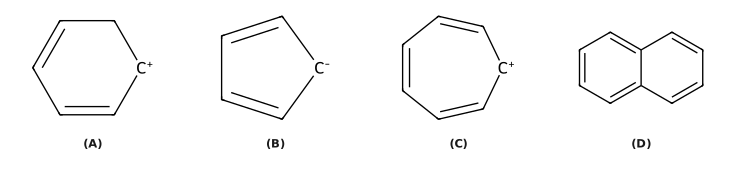
›Reveal solutionSolution
Aromaticity demands an unbroken loop of p orbitals holding (4n+2)π electrons. The cyclohexadienyl cation has an sp3 CHX2 that breaks the loop, so it alone is not aromatic — option (A).
The concept first
A species is aromatic only if it meets all of Hückel's criteria:
- it is cyclic;
- it is planar;
- it is completely conjugated — every atom of the ring must carry a p orbital (an sp2 or sp centre), so the π cloud runs all the way round with no break;
- the number of delocalised π electrons is (4n+2), i.e. 2,6,10,…
Criterion 3 is the one this question is really testing: a single sp3 carbon anywhere in the ring destroys aromaticity, however many π electrons happen to be present.
Step 1 — Cyclopentadienyl anion (option B)
Five carbons; four are part of two C=C bonds, and the fifth carries the negative charge as a lone pair in a p orbital. That gives 4+2=6 π electrons in a closed, planar loop: 4n+2 with n=1. Aromatic.
Step 2 — Tropylium (cycloheptatrienyl) cation (option C)
Seven carbons; three C=C give 6 π electrons, and the cationic carbon contributes an empty p orbital that completes the ring of p orbitals. 6=4(1)+2. Aromatic — and famously stable.
Step 3 — Naphthalene (option D) …
- TG EAPCET 2025Set eng-2025-05-03-FN1 markMCQQ.Which of the following is not an aromatic species? (A) Cycloheptatrienyl (tropylium) cation — seven-membered ring with three C=C double bonds carrying a positive charge (B) Cyclopentadienyl anion — five-membered ring with two C=C double bonds carrying a lone pair and a negative charge (C) Naphthalene (fused bicyclic aromatic ring) (D) Cyclohexadienyl cation — six-membered ring with two C=C double bonds carrying a positive charge 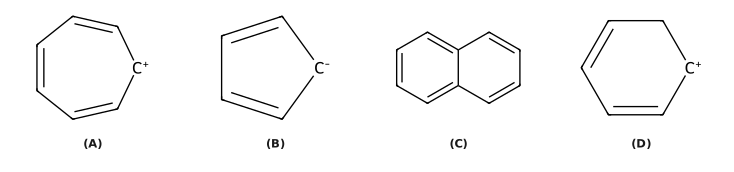
›Reveal solutionSolution
Aromaticity needs a planar, cyclic, completely conjugated system with (4n+2)π electrons. The cyclohexadienyl cation contains an sp3 CH2 that breaks the conjugation, so it alone is non-aromatic — option (D).
The concept first
Hückel's criteria — all four must hold together:
- the species is cyclic;
- it is planar;
- every ring atom carries a p orbital in the ring plane's perpendicular direction (each is sp2, or holds a lone pair in a p orbital) so the p orbitals form an unbroken loop — complete conjugation;
- the loop contains (4n+2) π electrons: 2,6,10,…
Most students check only rule 4. The trap in this question is rule 3.
Step-by-step
(A) Cycloheptatrienyl (tropylium) cation, C7H7+. Three C=C bonds give 6 π electrons; the seventh carbon bears the positive charge and is sp2 with an empty p orbital that slots into the loop. Conjugation is complete and 6=4(1)+2. Aromatic — which is why tropylium salts are stable ionic solids.
(B) Cyclopentadienyl anion, C5H5−. Two C=C bonds give 4 π electrons; the anionic carbon rehybridises to sp2 and places its lone pair in a p orbital, adding 2 more:
π electrons=4+2=6=4(1)+2.
Complete conjugation. Aromatic — which is exactly why cyclopentadiene is so unusually acidic for a hydrocarbon (pKa≈16).
(C) Naphthalene, C10H8. Planar, fully conjugated, five C=C bonds ⇒10 π electrons =4(2)+2. Aromatic. …
- TG EAPCET 2025Set eng-2025-05-04-AN1 markMCQQ.The atomic numbers of the elements X, Y, Z are a, a+1, a+2 respectively. Z is an alkali metal. The nature of bonding in the compound formed by X and Z is (A) Covalent (B) Metallic (C) Ionic (D) Coordinate covalent
›Reveal solutionSolution
The key is that Z is an alkali metal (group 1), so its atomic number is odd; with consecutive atomic numbers, X must be a halogen (group 17) and Y a noble gas. The compound formed between a halogen and an alkali metal is ionic, so the correct option is (C).
Concept & Intuition
The problem gives three elements X, Y, Z with atomic numbers a, a+1, a+2. The critical clue is that Z is an alkali metal. Alkali metals (group 1) have atomic numbers that are all odd: 3 (Li), 11 (Na), 19 (K), 37 (Rb), 55 (Cs), 87 (Fr). So a+2 must be odd, meaning a is odd as well. Since atomic numbers increase by 1, the three elements are consecutive in the periodic table. If Z is an alkali metal, then Y (atomic number a+1) is the next element to its left — a noble gas — and X (atomic number a) is the element two steps left of Z — a halogen. Halogens (group 17) and alkali metals form ionic compounds via electron transfer.
Step-by-step reasoning
-
Identify the group of Z
Z is an alkali metal → group 1. Alkali metals have one valence electron and are highly electropositive.
-
Determine the pattern of consecutive atomic numbers
Since atomic numbers increase by 1, the three elements lie in the same row of the periodic table. For Z to be in group 1, the element with atomic number a+1 (Y) must be in group 18 (noble gas), and the element with atomic number a (X) must be in group 17 (halogen).
Example: if Z is Na (a+2=11), then a=9 (F, a halogen) and a+1=10 (Ne, a noble gas).
-
Predict the bonding between X and Z
X is a halogen (group 17) — it has 7 valence electrons and a high electronegativity. Z is an alkali metal (group 1) — it has 1 valence electron and very low electronegativity. The large difference in electronegativity (typically >1.7 on the Pauling scale) means that Z will donate its electron to X, forming a cation (Z+) and an anion (X−). The electrostatic attraction between oppositely charged ions is an ionic bond.
-
Eliminate other options …
-
- TG EAPCET 2025Set eng-2025-05-04-AN1 markMCQQ.The number of lone pairs of electrons on the central atom of XeO3, XeOF4 and XeF6 respectively is (A) 1, 1, 1 (B) 3, 2, 1 (C) 2, 1, 0 (D) 1, 2, 1
›Reveal solutionSolution
The number of lone pairs on the central atom in XeO₃, XeOF₄, and XeF₆ is determined by counting valence electrons and applying VSEPR theory; the correct counts are 1, 1, and 1 respectively, so option (A) is correct.
Concept & Intuition
The key is to treat xenon as the central atom and count its total valence electrons (8 for Xe), then add electrons from bonded atoms (each bond contributes 1 electron from the other atom), and finally subtract electrons used in bonding to find remaining lone pairs. VSEPR theory then helps confirm the geometry, but the lone-pair count comes directly from electron accounting.
-
XeO₃
- Xenon has 8 valence electrons.
- Each oxygen forms a double bond (Xe=O) — in such a bond, oxygen contributes 2 electrons, but we count only the electrons that become part of the central atom’s valence shell. A simpler method: treat each bond as using 1 electron from Xe and 1 from the other atom. For three double bonds, Xe uses 3 × 2 = 6 electrons in bonding.
- Remaining electrons on Xe: 8 − 6 = 2 electrons → 1 lone pair.
- Check: XeO₃ has a trigonal pyramidal shape (like ClO₃⁻), consistent with 1 lone pair.
-
XeOF₄
- Xenon: 8 valence electrons.
- One double bond to oxygen (uses 2 Xe electrons) and four single bonds to fluorine (each uses 1 Xe electron). Total bonding electrons from Xe: 2 + 4 = 6.
- Remaining: 8 − 6 = 2 electrons → 1 lone pair.
- Check: The molecule is square pyramidal (like BrF₅), which has 1 lone pair.
-
XeF₆
- Xenon: 8 valence electrons.
- Six single bonds to fluorine (each uses 1 Xe electron) → 6 electrons used. …
-
- TG EAPCET 2025Set ap-2025-04-30-FN1 markMCQQ.The correct order of bond angle of HgCl2(A), NH3(B), H2O(C) is (A) A > C > B (B) B > A > C (C) B > C > A (D) A > B > C
›Reveal solutionSolution
The bond angle depends on the central atom’s hybridization and lone pairs. HgCl2 is linear (sp, 180°), NH3 is pyramidal (sp3, ~107°), H2O is bent (sp3, ~104.5°). So the order is A > B > C, which is option (D).
The key to comparing bond angles across different molecules is to first identify the hybridization of the central atom and then account for the repulsion hierarchy: lone pair–lone pair > lone pair–bond pair > bond pair–bond pair. Let’s apply this to each molecule.
-
HgCl2 (A) — Mercury(II) chloride. Mercury is in group 12 and here it forms two sigma bonds with no lone pairs on the central atom. The steric number is 2, giving sp hybridization. The geometry is linear, and the bond angle is exactly 180°. There is no lone-pair repulsion to distort it.
-
NH3 (B) — Ammonia. Nitrogen has 5 valence electrons; three are used in N–H bonds, and one lone pair remains. Steric number = 4 (three bonds + one lone pair), so hybridization is sp3. The ideal tetrahedral angle is 109.5°, but the lone pair exerts stronger repulsion than a bond pair, compressing the H–N–H angles to about 107°.
-
H2O (C) — Water. Oxygen has 6 valence electrons; two are used in O–H bonds, and two lone pairs remain. Steric number = 4 again (two bonds + two lone pairs), so sp3 hybridization. With two lone pairs, the repulsion is even greater than in NH3, squeezing the H–O–H angle further down to about 104.5°. …
-
- TG EAPCET 2024Set ap-2024-05-07-AN1 markMCQQ.The drug which is obtained from opium poppy and its use are respectively (A) Heroin, antiseptic (B) Codeine, hypnotic (C) Morphine, analgesic (D) Aspirin, analgesic
›Reveal solutionSolution
The question asks for a drug obtained from opium poppy and its primary medical use. Morphine is a natural alkaloid from opium poppy and is a powerful analgesic (painkiller), making option (C) correct.
Concept & Intuition
The opium poppy (Papaver somniferum) yields several alkaloids, including morphine, codeine, and heroin. Each has distinct medical uses:
- Morphine is the principal active compound and is a narcotic analgesic (pain reliever).
- Codeine is a milder derivative used as an antitussive (cough suppressant) and mild analgesic.
- Heroin (diacetylmorphine) is a semi-synthetic derivative with no accepted medical use in most countries (it is a controlled substance).
- Aspirin is not from opium; it is a synthetic salicylate used as an analgesic and antipyretic.
The key is to match the correct plant source with the correct therapeutic category.
Step-by-step reasoning
-
Identify the source – The phrase “obtained from opium poppy” limits candidates to natural or semi-synthetic opiates. Heroin, codeine, and morphine all derive from opium poppy; aspirin does not (it comes from willow bark or is synthesized). So option (D) is eliminated.
-
Evaluate each remaining option’s use
- (A) Heroin, antiseptic – Heroin is not an antiseptic; it is a potent narcotic with high abuse potential. Incorrect.
- (B) Codeine, hypnotic – Codeine is primarily an antitussive and mild analgesic, not a hypnotic (sleep-inducing drug). Hypnotics are barbiturates or benzodiazepines. Incorrect. …
- TG EAPCET 2023Set ap-2023-05-10-FN1 markMCQQ.Isostructural pair among the following is (A) SO2,CO2 (B) SO3,XeO3 (C) SnCl2,CO2 (D) CH4,NH4+
›Reveal solutionSolution
The concept is isostructural means same shape (geometry) and hybridisation. The pair CH4 and NH4+ both have tetrahedral geometry with sp3 hybridisation, making them isostructural.
The word "isostructural" simply means "same structure" — same shape and same hybridisation of the central atom. To check this, we need to determine the geometry of each molecule or ion using VSEPR theory (Valence Shell Electron Pair Repulsion). The key is to count the total number of electron pairs (bonding + lone pairs) around the central atom, then predict the shape.
Let’s examine each option step by step.
-
Option (A): SO2 and CO2
- CO2: Central carbon has 4 valence electrons, forms two double bonds with oxygens, and has no lone pairs. Electron pairs = 2 (both bonding). Geometry: linear, sp hybridisation.
- SO2: Central sulfur has 6 valence electrons, forms one double bond and one single bond (with a lone pair on sulfur), plus one lone pair. Total electron pairs = 3 (2 bonding + 1 lone). Geometry: bent (V-shaped), sp2 hybridisation.
- They are not isostructural (linear vs bent).
-
Option (B): SO3 and XeO3
- SO3: Central sulfur has 6 valence electrons, forms three double bonds with oxygens, no lone pairs. Electron pairs = 3 (all bonding). Geometry: trigonal planar, sp2 hybridisation.
- XeO3: Central xenon has 8 valence electrons, forms three double bonds with oxygens, and has one lone pair. Total electron pairs = 4 (3 bonding + 1 lone). Geometry: trigonal pyramidal, sp3 hybridisation.
- They are not isostructural (trigonal planar vs trigonal pyramidal).
-
Option (C): SnCl2 and CO2
- SnCl2: Central tin has 4 valence electrons, forms two single bonds with chlorines, and has one lone pair. Total electron pairs = 3 (2 bonding + 1 lone). Geometry: bent, sp2 hybridisation.
- CO2: As above, linear, sp hybridisation.
- They are not isostructural (bent vs linear).
-
Option (D): CH4 and NH4+ …
-
- TG EAPCET 2023Set eng-2023-05-12-AN1 markMCQQ.What is the major product ‘C’ in the following sequence of reactions? CX2HX4BrX2(i) alcohol KOH(ii) NaNH2AHX2O,HgX2+,HX+,333K[B]→C (A) CHX2=CH∣OH (B) CHX3∣C=O (C) CHX3∣CH=CH∣OH (D) H∣C=O
›Reveal solutionSolution
Double dehydrohalogenation gives acetylene; Hg2+-catalysed hydration gives vinyl alcohol, which tautomerises to acetaldehyde (CH3CHO).
Concept. A vicinal dihalide undergoes two successive eliminations to an alkyne; hydration of a terminal alkyne under Kucherov conditions follows Markovnikov addition to give an enol that keto–enol tautomerises to a carbonyl compound.
Step 1 — first elimination. BrCHX2−CHX2Br with alcoholic KOH loses one HBr to give vinyl bromide, CHX2=CHBr.
Step 2 — second elimination. The stronger base NaNH2 removes the second HBr, giving ethyne (acetylene): A=HC≡CH.
Step 3 — Kucherov hydration. With HX2O, HgX2+, HX+ at 333 K, water adds across the triple bond (Markovnikov) to give the enol vinyl alcohol:
[B]=CHX2=CH−OH (unstable enol). …
🎓Unlock everything free for 14 days
- ✓Full step-by-step solutions
- ✓Concept-first explanations
- ✓Methods, shortcuts & mistakes
- ✓PYQ mapping + timed mock tests
Full access for 14 days. No credit card required.