Question of 46
Q.Explain the structure of Diborane.
Telangana TsbieTelangana Board of Intermediate Education (Intermediate 1st Year) 2018Subjective· 4mImportance★★★★★
0% · 0/46 Questions
You're viewing a preview — the full solution, concept, methods & PYQ mapping are locked.
Start your 14-day free trial to unlock the full solution →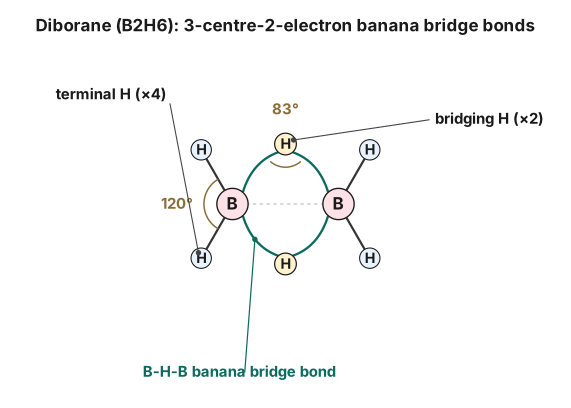
Diborane is electron-deficient and cannot be described by simple 2-centre-2-electron bonds alone; its bridging B-H-B bonds are 3-centre-2-electron bonds.
Electron deficiency: has a total of valence electrons, but 8 normal covalent (2-centre-2-electron) B-H/B-B bonds would require 16 electrons. This shortfall makes diborane an electron-deficient molecule, which it resolves using unusual 3-centre-2-electron bonds.
Structure:
- Each boron atom is hybridized.
- The molecule has 4 terminal hydrogen atoms (2 on each boron) that form normal 2-centre-2-electron (2c-2e) B-H bonds. These 4 terminal H atoms and the 2 B atoms all lie in one plane.
- The remaining 2 hydrogen atoms are bridging hydrogens, lying one above and one below this plane, each bonded simultaneously to both boron atoms.
- Each bridge is a 3-centre-2-electron (3c-2e) bond (also called a "banana bond" or "B-H-B bridge bond"): a single pair of electrons is delocalized over three atoms (B, H, B) instead of being localized between just two. …
Unlock everything free for 14 days
- Full step-by-step solutions
- Concept-first explanations
- Methods, shortcuts & mistakes
- PYQ mapping + timed mock tests
Full access for 14 days. No credit card required.