Question of 46
Q.Explain the structure of diborane.
Telangana TsbieTelangana Board of Intermediate Education (Intermediate 1st Year) 2026Subjective· 4mImportance★★★★★
0% · 0/46 Questions
You're viewing a preview — the full solution, concept, methods & PYQ mapping are locked.
Start your 14-day free trial to unlock the full solution →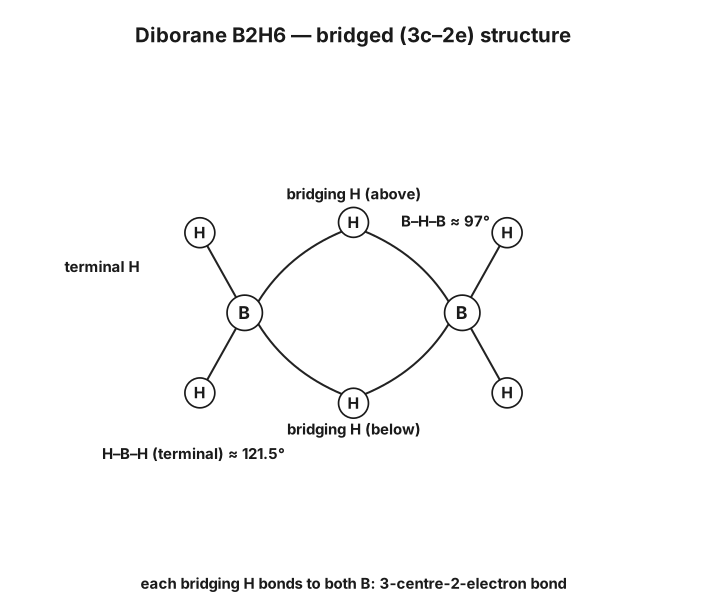
Diborane (B2H6) has four terminal B-H bonds (normal 2-centre-2-electron) and two bridging B-H-B bonds (3-centre-2-electron 'banana' bonds); it is an electron-deficient molecule.
Why diborane is unusual: Diborane, B2H6, has only 12 valence electrons (each B contributes 3, each of 6 H contributes 1 = 6 + 6 = 12). To join 8 atoms by normal bonds would need 16 electrons, so the molecule is electron-deficient and cannot be represented by ordinary covalent bonds alone.
Structure: The molecule contains two kinds of hydrogen atoms:
- Four terminal hydrogens: two attached to each boron atom by ordinary two-centre, two-electron (2c-2e) covalent bonds. These four B-H bonds and the two boron atoms lie in one plane.
- Two bridging hydrogens: these lie one above and one below the plane and each is bonded simultaneously to both boron atoms. …
Unlock everything free for 14 days
- Full step-by-step solutions
- Concept-first explanations
- Methods, shortcuts & mistakes
- PYQ mapping + timed mock tests
Full access for 14 days. No credit card required.