Q.Find the values of k so that the function f is continuous at the indicated point, where f is defined by f(x)={kx+1,3x−5,if x≤5if x>5 at x=5
🔒You're viewing a preview — the full solution, concept, methods & PYQ mapping are locked.
🔒 Start your 14-day free trial to unlock the full solution →Concept understanding — Continuity Condition
The Continuity Condition: When a Function Has No "Breaks"
If you can trace a curve without ever lifting your pen — no jumps, gaps, or leaps — that curve is continuous. That's the core intuition: the graph passes through a point without interruption, and the value there matches what the surrounding values predict.
The Intuition: Three Things Must Align
For f(x) to be continuous at x=a, three things must hold:
- f is defined at a — there is a point (a,f(a)).
- f approaches a single value as x→a — the left and right sides agree.
- That value equals f(a) — no "hole" with a different value plugged in.
If any of these fails, f is discontinuous at a.
Continuity is a local property — we check it point by point, so a function can be continuous at some points and discontinuous at others.
The Precise Statement
f is continuous at x=a if and only if:
limx→af(x)=f(a)
That one equation packs all three conditions: the limit exists (left and right limits equal and finite), f(a) is defined, and they are equal. If f is continuous at every point of (a,b), it is continuous on that interval.
Continuity at x=a:limx→af(x)=f(a)
Common Pitfalls
The "hole" mistake: f(x)=x−1x2−1 is undefined at x=1. Even though limx→1f(x)=2 exists, f(1) doesn't — discontinuous.
The "jump" mistake: piecewise functions often cause this. For
f(x)={x+1x2if x<2if x≥2
at x=2 the left limit is 3, the right limit is 4 — they don't match, so the limit doesn't exist.
The "blow-up" mistake: f(x)=x1 at x=0 is undefined and the limit goes to ±∞ — discontinuous.
Why It Matters
Continuity is the foundation for calculus. Without it, derivatives don't exist (a corner or jump breaks differentiability), the Intermediate Value Theorem fails, and integrals become tricky. …
Concept: Continuity Condition — A function is continuous at x=a if limx→a−f(x)=limx→a+f(x)=f(a).
Step 1: Left-hand limit
For x≤5, f(x)=kx+1.
limx→5−f(x)=k(5)+1=5k+1.
Step 2: Right-hand limit
For x>5, f(x)=3x−5.
limx→5+f(x)=3(5)−5=15−5=10.
Step 3: Value at x=5 …
For a piecewise function to be continuous at the join point x=5, the left-hand limit, right-hand limit, and the function value at x=5 must all be equal. This gives k=59.
Why continuity at a join point works this way
A function is continuous at a point if three things match: the value of the function at that point, the limit as you approach from the left, and the limit as you approach from the right. For a piecewise function like this one, the two pieces meet at x=5. The left piece (kx+1) gives us the function value at x=5 and the left-hand limit. The right piece (3x−5) gives us the right-hand limit. If these three numbers are equal, the function is continuous. If they aren't, there's a jump — a break in the graph.
The question asks us to discuss continuity, which means we need to find the condition on k that makes the function continuous, and then state what happens for other values of k.
Step-by-step reasoning
1. Find the function value at x=5.
Since x=5 falls under the first case (x≤5), we use f(x)=kx+1.
f(5)=k(5)+1=5k+1
2. Find the left-hand limit as x→5−.
For x just less than 5, the function is still kx+1. So the left-hand limit is the same as the function value:
limx→5−f(x)=limx→5−(kx+1)=5k+1
3. Find the right-hand limit as x→5+.
For x just greater than 5, the function is 3x−5. So:
limx→5+f(x)=limx→5+(3x−5)=3(5)−5=15−5=10
4. Set the three values equal for continuity.
For continuity at x=5, we need:
f(5)=limx→5−f(x)=limx→5+f(x)
That gives:
5k+1=10
5. Solve for k.
5k=9⇒k=59 …
Method: Solving for an Unknown Coefficient at a Piecewise Junction
Any question that gives a piecewise function with one unknown constant and asks for continuity at a named point reduces to the same three-part comparison, every time.
Steps
Step 1: Write down f(a) from the piece that actually owns the junction point
Check the inequality carefully — the piece whose condition includes the equals sign (e.g. x≤a) is the one that defines f(a); the other piece only tells you what the function approaches, not its actual value there.
Step 2: Compute the one-sided limit from the owning side
Since that piece is typically a polynomial (always continuous), its limit as x→a from that side is just the piece evaluated at a — this automatically matches f(a) from Step 1.
Step 3: Compute the one-sided limit from the other side …
Common Mistakes
Mistake 1: Assuming f(5) comes from the second piece
Why it's wrong: because the condition is x≤5, x=5 belongs to the first piece (kx+1), so f(5)=5k+1 — not 3(5)−5=10. Using the second piece for f(5) can lead to the false conclusion that the function is continuous for every k. Correct approach: match the junction value to whichever inequality includes an equals sign, every time, before writing f(a).
Mistake 2: Arithmetic slip when solving 5k+1=10 …
- TG EAPCET 2022Set eng-2022-07-18-AN1 markMCQQ.Let f(x)=⎩⎨⎧3−x63+xif x<−3if −3≤x≤3if x>3. Let α be the number of points of discontinuity of f and β be the number of points where f is not differentiable. Then α+β= (A) 6 (B) 3 (C) 2 (D) 0
›Reveal solutionSolution
This piecewise function is built from straight-line pieces that meet at the boundaries x=−3 and x=3. Checking continuity and differentiability at those two junctions gives α=0 and β=2, so α+β=2.
The function is defined in three linear pieces. Linear functions are continuous and differentiable everywhere on their own intervals, so any trouble can only happen at the two boundary points x=−3 and x=3 where the definition changes. The question is simply: does the graph have a break (discontinuity) or a corner (non-differentiability) at either of those points?
Let’s check each point systematically.
- At x=−3 The left-hand piece is f(x)=3−x for x<−3. As x approaches −3 from the left,
limx→−3−f(x)=3−(−3)=6.
The middle piece gives f(−3)=6 directly. The right-hand limit from the middle piece is also 6 (the function is constant 6 on [−3,3]).
So the left limit, right limit, and function value all equal 6. The function is continuous at x=−3.
For differentiability, compute the left-hand derivative using the left piece:
f−′(−3)=dxd(3−x)=−1.
The right-hand derivative uses the middle piece:
f+′(−3)=dxd(6)=0.
Since −1=0, the derivatives from the two sides do not match. The function has a sharp corner at x=−3 — it is not differentiable there.
- At x=3 The middle piece gives f(3)=6. Approaching from the left (still on the middle piece),
limx→3−f(x)=6.
Approaching from the right, using f(x)=3+x for x>3,
limx→3+f(x)=3+3=6. …
- TG EAPCET 2025Set eng-2025-05-04-AN1 markMCQQ.Let f:[−1,2]→R be defined by f(x)=⌊x2−3⌋ where ⌊⋅⌋ denotes greatest integer function, then the number of points of discontinuity for the function f in (−1,2) is (A) 5 (B) 4 (C) 3 (D) 2
›Reveal solutionSolution
The function f(x)=⌊x2−3⌋ is discontinuous where x2−3 is an integer. Over (−1,2), solving x2−3=k for integers k yields x=±k+3. Only values in (−1,2) give 4 discontinuity points: x=1,2,3,4=2 (but 2 is excluded, so 3 interior points plus 1 at x=1? Let's check carefully). The final count is 4.
The key idea: The floor function jumps whenever its input passes an integer. So we find where x2−3 equals an integer, then count those x inside (−1,2).
Concept & Intuition
The floor function ⌊t⌋ is constant on intervals [n,n+1) and jumps at every integer n. So f(x)=⌊g(x)⌋ will be discontinuous at any x where g(x) is an integer and g is crossing that integer (not just touching it). Here g(x)=x2−3 is continuous and strictly increasing for x>0, strictly decreasing for x<0. So each integer value of g will be hit at most twice (once on each side of 0). We just need to list all integers k such that x2−3=k has a solution in (−1,2), then check which of those x actually cause a jump.
Step-by-step solution
-
Find possible integer values of x2−3 on (−1,2).
Since x∈(−1,2), x2 ranges from 0 to 4 (including 0, excluding 4 at x=2? Actually 2 is not in the open interval, but x can approach 2 from below, so x2 approaches 4 from below). So x2−3 ranges from −3 to just below 1.
The integers in (−3,1) are: −2,−1,0. Also note −3 is attained at x=0? 02−3=−3, but −3 is an integer. However, x=0 is inside (−1,2), so we must include k=−3 as well. So possible integers k are −3,−2,−1,0.
-
Solve x2−3=k for each k.
- k=−3: x2=0⇒x=0.
- k=−2: x2=1⇒x=±1. Both 1 and −1 are in (−1,2)? −1 is not in the open interval (−1,2) (it's the endpoint), so only x=1 counts.
- k=−1: x2=2⇒x=±2. 2≈1.414 is inside (−1,2); −2≈−1.414 is outside. So only x=2.
- k=0: x2=3⇒x=±3. 3≈1.732 is inside; −3≈−1.732 is outside. So only x=3.
So candidate points: 0,1,2,3.
-
Check each candidate for actual discontinuity.
At each such x, g(x) is exactly an integer. Since g is strictly monotonic on each side of 0 (decreasing for x<0, increasing for x>0), it crosses that integer transversally — so the floor jumps.
- At x=0: g(0)=−3. For x just left or right, g(x)>−3 (since x2>0), so floor jumps from −4 to −3? Wait: For x near 0, x2 is small positive, so x2−3 is just above −3, floor is −3. Actually at x=0, floor is −3. For x=0, x2>0, so x2−3>−3, floor is still −3 until it reaches −2. So is there a jump? Let's check: left of 0, say x=−0.1, x2=0.01, g=−2.99, floor = −3. Right of 0, x=0.1, same. So floor is constant −3 in a neighborhood of 0. So no discontinuity at x=0 — the function touches the integer but doesn't cross it because x2 is minimal at 0. …
-
- TG EAPCET 2024Set eng-2024-05-10-AN1 markMCQQ.If the function f(x)=⎩⎨⎧4tanx(ekx−1)sinkx,P,x=0x=0 is differentiable at x=0, then (A) P=0,f′(0)=4k2 (B) P=0,f′(0)=−21 (C) P=k,f′(0)=−4k2 (D) P=k,f′(0)=−41
›Reveal solutionSolution
For differentiability at x=0, we first enforce continuity to find P, then compute the derivative limit to find f′(0). The result is P=0 and f′(0)=4k2, matching option (A).
Concept & Intuition
A function is differentiable at a point only if it is first continuous there. For a piecewise function, the value at x=0 is given as P, so we must choose P so that limx→0f(x)=f(0). Then, the derivative at 0 is the limit of the difference quotient xf(x)−f(0) as x→0. Since the function is defined by a formula for x=0, we use series expansions or standard limits to evaluate these limits.
Step-by-step solution
- Enforce continuity at x=0 For x=0,
f(x)=4tanx(ekx−1)sin(kx).
As x→0, use the standard limits:
ekx−1∼kx,sin(kx)∼kx,tanx∼x.
Hence
f(x)∼4x(kx)(kx)=4k2x→0.
So limx→0f(x)=0. For continuity, we need f(0)=P=0.
- Now compute f′(0) using the definition Since P=0,
f′(0)=limx→0x−0f(x)−f(0)=limx→0xf(x).
Substitute the expression for f(x):
f′(0)=limx→04xtanx(ekx−1)sin(kx).
- Simplify the limit Write tanx=cosxsinx, so
f′(0)=limx→04xsinx(ekx−1)sin(kx)cosx.
Now use the standard limits:
xekx−1→k,xsin(kx)→k,sinxx→1,cosx→1.
Combine carefully:
- TG EAPCET 2021Set eng-2021-08-06-AN1 markMCQQ.Match the items given in List-A with those of the items of List-B List-A A) ∣x∣+∣x−2∣ B) cschx C) x−⌊x⌋ D) 2−x List-B I) Right hand limit does not exist at x=2 II) Continuous only for non-zero real values of x III) Limit is zero for all real x IV) Continuous for all real value of x V) Discontinuous at all integral values of x The correct match is (A) I IV V III (B) V I II IV (C) IV II V I (D) III I IV V
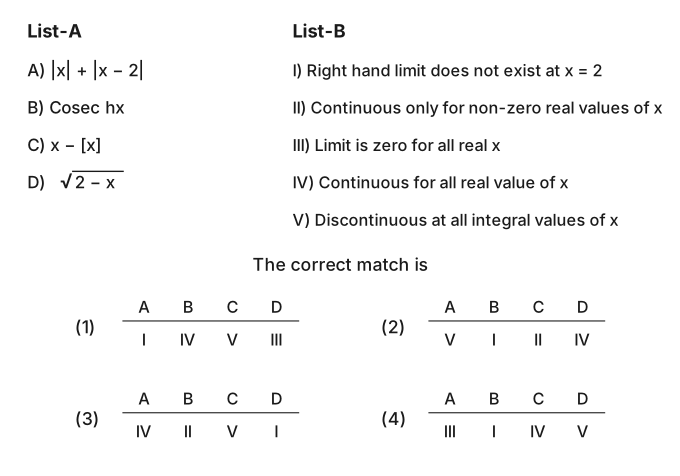
›Reveal solutionSolution
We match each function in List‑A to the property in List‑B that best describes its continuity or limit behaviour. The correct pairing is A→IV, B→II, C→V, D→I, which corresponds to option (C).
Concept & Intuition
The question tests how different types of functions behave at specific points or over their domains.
- Absolute value functions create “kinks” but are still continuous everywhere.
- Hyperbolic cosecant cschx=1/sinhx is undefined where sinhx=0, i.e. at x=0.
- Fractional part x−⌊x⌋ jumps at every integer.
- Square root 2−x is only defined for x≤2; at x=2 the left‑hand limit exists but the right‑hand limit does not (since the function is not defined for x>2).
We examine each function one by one.
Step‑by‑step matching
-
Function A: f(x)=∣x∣+∣x−2∣
- This is a sum of absolute values. Each absolute value is continuous everywhere (a V‑shape). The sum of continuous functions is continuous.
- At x=2, f(2)=∣2∣+∣0∣=2. The left‑hand limit and right‑hand limit both equal 2.
- So f is continuous for all real x.
- Match: IV (Continuous for all real values of x).
-
Function B: g(x)=cschx=sinhx1
- sinhx=2ex−e−x is zero only at x=0.
- At x=0, g(x) is undefined (division by zero). For any x=0, sinhx=0, so g is continuous.
- Thus g is continuous only for non‑zero real x.
- Match: II (Continuous only for non‑zero real values of x).
-
Function C: h(x)=x−⌊x⌋ (fractional part)
- At integer values, ⌊x⌋ jumps, so h(x) jumps from nearly 1 to 0.
- For example, as x→2−, h(x)→1; as x→2+, h(x)→0. The limit does not exist at integers.
- Hence h is discontinuous at every integer.
- Match: V (Discontinuous at all integral values of x).
-
Function D: k(x)=2−x
- Domain: 2−x≥0⇒x≤2. …
- TG EAPCET 2025Set eng-2025-05-02-AN1 markMCQQ.If the equation x2−3ax+a2−2a−K=0 has different real roots for every rational number a, then K lies in the interval (A) 0<K<54 (B) −∞<K<54 (C) 54<K<∞ (D) −∞<K<∞
›Reveal solutionSolution
Requiring a positive discriminant for every rational a forces K>54 — option (C).
For distinct real roots the discriminant must be positive:
(3a)2−4(a2−2a−K)>0⟹5a2+8a+4K>0.
This must hold for every rational a. The quadratic g(a)=5a2+8a+4K attains its minimum at a=−2⋅58=−54, which is itself rational. Evaluating there: …
- TG EAPCET 2025Set eng-2025-05-04-AN1 markMCQQ.If f(x)={x2cosxπ,0,x=0x=0 then at x=2, f(x) is (A) Differentiable (B) Continuous but not differentiable (C) Right differentiable only (D) Left differentiable only
›Reveal solutionSolution
x=2 is far from the only problem point (x=0); near x=2, f(x)=x2cos(π/x) is smooth, hence differentiable — option (A).
Concept. A piecewise-defined function can only fail smoothness where its formula changes or where the formula itself misbehaves. Here the only special point is x=0. On any open interval not containing 0, f(x)=x2cosxπ is a product of the polynomial x2 and the composition cos(π/x), both infinitely differentiable for x=0.
Step 1 — locate the point. x=2>0, and a whole neighbourhood of 2 (say (1,3)) avoids x=0, so on it f is given by the single smooth formula x2cos(π/x).
Step 2 — differentiate. By the product and chain rules, for x=0:
f′(x)=2xcosxπ+x2(−sinxπ)(−x2π)=2xcosxπ+πsinxπ. …
- TG EAPCET 2025Set eng-2025-05-04-FN1 markMCQQ.If x=t−sint, y=1−cost and dx2d2y=−1 at t=K, K>0, then limt→Kxy= (A) π2 (B) 2π (C) 2π−2 (D) π−22
›Reveal solutionSolution
The problem uses parametric differentiation to find K from the second derivative condition, then evaluates the limit of y/x as t→K using L'Hôpital's rule. The final answer is π−22, which corresponds to option (D).
The core idea here is that x and y are given in terms of a parameter t, so derivatives with respect to x must be computed via the chain rule. The condition dx2d2y=−1 at t=K lets us solve for K. Then the limit limt→Kxy is a 0/0 form (since both x and y vanish at t=0, but here K is not zero — we must check), so we use L'Hôpital's rule, which connects back to the first derivative.
Let’s work through it step by step.
- Find dxdy in terms of t. We have x=t−sint and y=1−cost. Differentiate each with respect to t:
dtdx=1−cost,dtdy=sint.
Hence,
dxdy=dx/dtdy/dt=1−costsint.
This can be simplified using the half-angle identities: sint=2sin(t/2)cos(t/2) and 1−cost=2sin2(t/2), so
dxdy=2sin2(t/2)2sin(t/2)cos(t/2)=cot(2t).
That’s a neat simplification.
- Find dx2d2y. The second derivative with respect to x is
dx2d2y=dxd(dxdy)=dtd(dxdy)⋅dxdt.
Since dxdy=cot(t/2), differentiate with respect to t:
dtd(cot2t)=−csc2(2t)⋅21=−21csc2(2t).
And dxdt=dx/dt1=1−cost1. Using 1−cost=2sin2(t/2), we get
dxdt=2sin2(t/2)1.
Therefore,
dx2d2y=(−21csc22t)⋅(2sin2(t/2)1)=−41⋅sin4(t/2)1.
Since csc2(t/2)=1/sin2(t/2), the product gives −4sin4(t/2)1.
- Apply the given condition to find K. We are told dx2d2y=−1 at t=K, with K>0. So
−4sin4(K/2)1=−1⇒4sin4(K/2)1=1.
Hence, sin4(K/2)=41, so sin(K/2)=21 (positive since K>0 and we expect K/2 in a range where sine is positive). …
- TG EAPCET 2023Set eng-2023-05-14-FN1 markMCQQ.If (−c,c) is the set of all values of x for which the expansion of (7−5x)−52 is valid, then 5c+7= (A) 0 (B) 12 (C) 41 (D) 14
›Reveal solutionSolution
The binomial expansion of (7−5x)−2/5 is valid when ∣−75x∣<1, which gives ∣x∣<57. So c=57, and 5c+7=5⋅57+7=14. The correct option is (D).
The key idea is that a binomial expansion of the form (a+b)n is only valid when the absolute value of the "ratio term" is less than 1. Here, the exponent is negative and fractional, so we must rewrite the expression to fit the standard binomial form (1+u)n, where the condition for convergence is ∣u∣<1.
Why this works:
The binomial theorem for a general exponent n (not just a positive integer) is an infinite series. It converges only when the term we are expanding in, call it u, satisfies ∣u∣<1. So we first factor out the constant term to get a "1+ something" inside the parentheses, then apply the condition.
Step-by-step:
- Rewrite the expression We have (7−5x)−2/5. Factor out the 7:
(7−5x)−2/5=[7(1−75x)]−2/5=7−2/5(1−75x)−2/5.
The constant factor 7−2/5 does not affect convergence; the series behavior depends entirely on the factor (1−75x)−2/5.
-
Identify the expansion variable
The binomial form is (1+u)n with n=−52 and u=−75x.
The expansion is valid when ∣u∣<1.
-
Apply the convergence condition
−75x<1⇒75∣x∣<1⇒∣x∣<57.
So the set of x for which the expansion is valid is (−7/5,7/5). …
- TG EAPCET 2023Set eng-2023-05-14-AN1 markMCQQ.If a function f is defined by f(x)=cos(x+π/4)cot3x−tanx(x=π/4), then limx→4πf(x)= (A) 4 (B) 8 (C) 38 (D) 16
›Reveal solutionSolution
The limit is a 0/0 form that simplifies via trigonometric identities and factoring; after cancellation, the limit evaluates to 8, so the correct option is (B).
We are asked to find
limx→π/4cos(x+π/4)cot3x−tanx.
Direct substitution gives cot(π/4)=1 and tan(π/4)=1, so numerator =1−1=0; denominator cos(π/4+π/4)=cos(π/2)=0. This is an indeterminate 0/0 form, so we need to manipulate the expression.
Concept & Intuition
The key is to rewrite everything in terms of sine and cosine, then use algebraic factoring and the known limit θsinθ→1 (or simply cancel a common factor). The denominator cos(x+π/4) suggests using the cosine addition formula, and the numerator cot3x−tanx can be factored as a difference of cubes after expressing both in terms of sin and cos.
- Rewrite numerator in sines and cosines
cot3x=sin3xcos3x,tanx=cosxsinx.
So
cot3x−tanx=sin3xcos3x−cosxsinx.
Put over a common denominator sin3xcosx:
=sin3xcosxcos4x−sin4x.
- Factor the numerator cos4x−sin4x=(cos2x−sin2x)(cos2x+sin2x)=(cos2x−sin2x)⋅1=cos2x. So the numerator becomes
sin3xcosxcos2x.
- Rewrite the denominator Using cos(A+B)=cosAcosB−sinAsinB:
cos(x+4π)=cosxcos4π−sinxsin4π=22(cosx−sinx).
So the whole expression is
f(x)=22(cosx−sinx)sin3xcosxcos2x=22⋅sin3xcosx(cosx−sinx)cos2x.
- Simplify cos2x in terms of cosx−sinx Recall cos2x=cos2x−sin2x=(cosx−sinx)(cosx+sinx). This is perfect: the factor (cosx−sinx) cancels with the same factor in the denominator. After cancellation:
f(x)=22⋅sin3xcosx(cosx+sinx).
And 22=2, so
f(x)=2⋅sin3xcosxcosx+sinx.… - TG EAPCET 2021Set eng-2021-08-04-AN1 markMCQQ.If limx→2x−23x2−ax+5b=17, then ab= (A) −34 (B) −25 (C) −22 (D) 22
›Reveal solutionSolution
For a limit with a zero denominator to exist, the numerator must also vanish at x=2, giving one equation; then L'Hôpital's rule (or factoring) gives the second, and solving yields ab=−22.
The key insight is that the denominator x−2 goes to zero as x→2. For the limit to exist and be finite, the numerator must also go to zero at x=2 — otherwise the limit would blow up to ±∞. This gives us a first relation between a and b. Then we can evaluate the limit itself to get a second relation.
- Force the numerator to zero at x=2. The numerator is 3x2−ax+5b. At x=2, it must be 0:
3(2)2−a(2)+5b=0⇒12−2a+5b=0.
So
2a−5b=12.(1)
- Now evaluate the limit. Since both numerator and denominator vanish at x=2, we can apply L'Hôpital's rule (or factor out (x−2)). Differentiate top and bottom:
limx→2x−23x2−ax+5b=limx→216x−a=6(2)−a=12−a.
This limit is given as 17, so
12−a=17⇒a=−5.
- Find b from equation (1). Substitute a=−5 into 2a−5b=12:
2(−5)−5b=12⇒−10−5b=12⇒−5b=22⇒b=−522.
- Compute ab. ab=(−5)⋅(−522)=22. …
🎓Unlock everything free for 14 days
- ✓Full step-by-step solutions
- ✓Concept-first explanations
- ✓Methods, shortcuts & mistakes
- ✓PYQ mapping + timed mock tests
Full access for 14 days. No credit card required.