Mathematics · Ch 4 — Straight Lines
Slope of a Line
Slope of a Line
Inclination of a Line
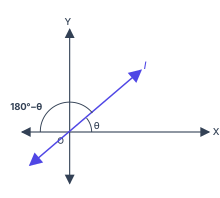
When a line is drawn in a coordinate plane, it makes two angles with the x‑axis — one acute and one obtuse, which are supplementary (they add up to ). The smaller of these, measured from the positive direction of the x‑axis in the anti‑clockwise sense, is called the inclination of the line. We denote it by .
By definition, .
A line parallel to the x‑axis (or coinciding with it) has inclination . A vertical line — parallel to or coinciding with the y‑axis — has inclination .
Inclination is always measured anti‑clockwise from the positive x‑axis. Clockwise measurement gives the supplementary angle, which is not the inclination.
Slope (or Gradient) of a Line
Definition. If is the inclination of a line , then is called the slope (or gradient) of the line . The slope is denoted by .
When , is not defined. Therefore, the slope of a vertical line is not defined.
From this definition, two immediate consequences follow:
- The slope of the x‑axis is .
- The slope of the y‑axis is not defined (since its inclination is ).
A common mistake is to say the slope of a vertical line is "infinite" or "undefined" in a casual sense. In coordinate geometry, it is strictly not defined — you cannot assign any real number to it. Never write .
Geometric Meaning of Slope
The slope tells us how steep the line is and in which direction it tilts.
- If , then — the line rises as we move to the right.
- If , then — the line falls as we move to the right. …
The inclination of a line is the angle that the line makes with the positive direction of the -axis, measured anticlockwise. By convention, .
Definition. If is the inclination of a line , then is called the slope (or gradient) of the line . The slope is denoted by .
Thus,
Two special cases are included in the definition:
- The slope of the -axis (or any line parallel to it) is , because its inclination is and .
- The slope of the -axis (or any vertical line) is not defined, because its inclination is and is undefined.
A line makes two supplementary angles with the -axis. The definition picks the one measured anticlockwise from the positive -axis. …
Drawn by us to help you understand the concept clearly, and verified to make sure it's accurate. For exams, practice from your textbook's own diagram.
Fig. 9.2 is a simple but essential diagram: it shows a single straight line drawn through the origin of a standard -coordinate plane. The line rises from the lower-left quadrant to the upper-right quadrant — it is not horizontal and not vertical. The -axis and -axis are drawn as full lines crossing at , with arrows at their positive ends.
The key visual element is the inclination angle . An arc starts at the positive -axis (the ray pointing right from ) and sweeps anticlockwise until it meets the line . This arc is labelled . Because the line also makes an angle with the negative -axis (the ray pointing left from ), a second arc is shown on the left side, labelled . This second arc sweeps anticlockwise from the negative -axis up to the same line . The figure thus makes it clear that a line and the -axis always form two supplementary angles: and .
The figure deliberately shows both angles to reinforce that the inclination is defined as the smaller (or the one measured from the positive direction) — never the larger one. The line itself is the same; only the starting ray changes.
What the diagram teaches is that every non-vertical line has a unique inclination between and , measured anticlockwise from the positive -axis. A horizontal line has ; a vertical line has . The slope is then defined as the tangent of this angle:
Here is the slope (or gradient) of the line, and is its inclination. The condition is critical: is undefined, so the slope of a vertical line does not exist. For , , so the slope of the -axis (or any horizontal line) is zero.
A common mistake is to think the slope is instead of . The figure's two arcs show that and are supplementary, and . The slope uses the anticlockwise angle from the positive -axis — that is , not its supplement. …