Mathematics · Ch 3 — Trigonometric Functions
Angles
Angles
Angle as a Measure of Rotation
An angle is not merely a static shape formed by two rays meeting at a point. In trigonometry, we treat an angle dynamically — as the measure of rotation of a given ray about its fixed endpoint.
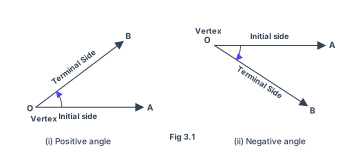
Consider a ray starting from a fixed point. Its initial position is called the initial side. When the ray rotates about the fixed point (the vertex), its final position is called the terminal side. The amount of rotation performed to go from the initial side to the terminal side is the measure of the angle.
The direction of rotation matters. If the rotation is anticlockwise, the angle is taken as positive. If the rotation is clockwise, the angle is taken as negative.
This sign convention is universal in trigonometry. A positive angle means you turn counter‑clockwise from the initial side; a negative angle means you turn clockwise.
The vertex is the common point about which the rotation happens — it is the fixed endpoint of the ray.
Units of Measurement
The definition of an angle naturally suggests one unit: one complete revolution. For example, we might say a spinning wheel makes an angle of 15 revolutions per second. This unit is convenient for very large angles, but for most mathematical work we use two other, more practical units: degree measure and radian measure.
Degree Measure
A degree is defined as of a complete revolution. So one full rotation corresponds to .
- complete revolution
- revolution
- revolution
Degrees can be further subdivided into minutes and seconds:
- (minutes)
- (seconds)
Radian Measure
The radian is a more natural unit for calculus and higher mathematics. One radian is the angle subtended at the centre of a circle by an arc whose length is equal to the radius of the circle.
If the arc length equals the radius , the angle is exactly radian. In general, for a circle of radius , an angle of radians subtends an arc of length .
Do not confuse "radian" with "degree". They are different units. When no unit is written for an angle, it is usually understood to be in radians. For example, means , not .
Relationship Between Degrees and Radians
Since a complete revolution is and also radians (because the circumference of a unit circle is ), we have:
From this we derive the conversion factors: …
Drawn by us to help you understand the concept clearly, and verified to make sure it's accurate. For exams, practice from your textbook's own diagram.
Fig. 3.1 is not a graph with axes or curves. It is a simple pair of ray diagrams, each showing the same vertex O with a horizontal ray pointing right (the initial side OA) and a second ray (the terminal side OB) rotated away from OA. In the left panel, OB lies somewhere in the first quadrant (up-right) and a small curved arrow runs anticlockwise from OA to OB. In the right panel, OB lies in the fourth quadrant (down-right) and the curved arrow runs clockwise.
The figure’s entire purpose is to establish the sign convention for rotation. An angle is not a static wedge; it is the amount of turning a ray undergoes. The initial side is the starting position, the terminal side is where the ray stops, and the vertex is the pivot point. The direction of the turn determines the sign: anticlockwise rotation gives a positive angle, clockwise rotation gives a negative angle. There is no formula here — the figure is purely conceptual, laying the groundwork for all angle measurement that follows.
The textbook explicitly states that the measure of an angle is “the amount of rotation performed to get the terminal side from the initial side.” This means an angle can be larger than (or radians) if the ray completes more than one full turn. Fig. 3.1 only shows a single partial rotation, but the definition allows for multiple revolutions. …
Drawn by us to help you understand the concept clearly, and verified to make sure it's accurate. For exams, practice from your textbook's own diagram.
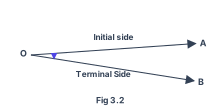
Fig. 3.2 is a simple but essential diagram. It shows a vertex labelled O at the left, with two rays extending to the right. The first ray, the initial side, goes to a point A that is slightly above the horizontal. The second ray, the terminal side, goes to a point B that is slightly below the horizontal. A small curved arrow is drawn at O, sweeping from the initial side down to the terminal side.
The figure has no axes or grid. Its purpose is purely conceptual: it illustrates that an angle is not a static wedge between two lines, but a rotation from one ray to another. The small arc at O is the key — it represents the amount of turning, not the gap between the rays. The initial side is where the rotation starts; the terminal side is where it stops. Because the arc goes from A (above) down to B (below), the direction of rotation is clockwise. According to the textbook’s convention, this makes the angle negative.
The vertex O is the fixed point of rotation. The rays OA and OB are not fixed in space — they are defined by the rotation itself. If the rotation were anticlockwise (from A up and around), the angle would be positive.
The physical idea is that an angle measures how much a ray has turned, not where it ends up. This is why the same terminal side can correspond to many different angles (e.g., and both end at the same ray after one full extra revolution). The figure grounds this by showing only a single, small rotation — the simplest case.
The textbook uses this figure to introduce the concept of a revolution as a unit of angle. One complete revolution is the rotation that brings the terminal side back to the initial side. From this, the two standard units are defined:
…