Q.Represent graphically a displacement of 40 km, 30∘ west of south.
Concept understanding — Vector Displacement
Vector Displacement
Displacement is the straight-line change in position from a starting point to an ending point — captured as a single vector that carries both how far and in which direction. Unlike distance travelled (which counts every wiggle of the path), displacement cares only about where you began and where you ended.
From Two Points
Suppose a particle moves from point A to point B. Its displacement is the vector AB drawn from A (tail) to B (head). If A and B have position vectors a and b (measured from the origin), then travelling from the origin to A and then along the displacement must land you at B: a+AB=b. Rearranging:
AB=b−a(position vector of head−position vector of tail)
A handy memory aid: "head minus tail."
Its Magnitude Is the Distance
The length of the displacement vector is the straight-line distance between the two points:
∣AB∣=∣b−a∣.
In coordinates, if A=(x1,y1,z1) and B=(x2,y2,z2), then
AB=(x2−x1)i^+(y2−y1)j^+(z2−z1)k^,
and its magnitude is the familiar distance formula (x2−x1)2+(y2−y1)2+(z2−z1)2.
Displacement vs. Distance
Distance travelled is a scalar that depends on the whole route; displacement is a vector that depends only on the endpoints. Walk a full loop and return home: the distance is large, but the displacement is the zero vector.
Quick Example
A point moves from A(1,−2,3) to B(4,0,−1).
AB=(4−1)i^+(0−(−2))j^+(−1−3)k^=3i^+2j^−4k^.
The distance covered in a straight line is ∣AB∣=32+22+(−4)2=29 units.
Always subtract tail from head in the right order: AB=b−a, not a−b. Reversing it points the displacement the wrong way (though the magnitude is the same).
"Vector displacement formula class 12 maths" and "position vector to displacement vector" are common queries on this topic, which is introduced in the Vector Algebra chapter of the NCERT/CBSE Class 12 Mathematics curriculum. The same head-minus-tail idea reappears in Physics kinematics problems tested in JEE Main and NEET.
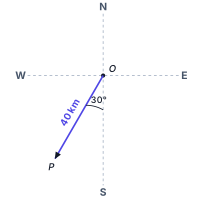
A displacement is drawn as an arrow: its length (to a chosen scale) shows the magnitude, and its slant shows the direction.
Step 1 — Reference direction. "30∘ west of south" means: face south, then turn 30∘ towards the west.
Step 2 — Scale. Take 1 cm=10 km, so 40 km is a 4 cm arrow.
Step 3 — Draw. From a point O, draw the due-south line (straight down). Rotate 30∘ from it towards the west (to the left of the southward line) and draw the arrow 4 cm long with the arrowhead at the tip. Mark the 30∘ angle at O and label the arrow "40 km".
A 4 cm arrow (scale 1 cm=10 km) drawn from O, making a 30∘ angle with the due-south direction on its western side, represents the displacement of 40 km, 30∘ west of south.
Draw an arrow 4 cm long (scale 1 cm=10 km) from a point O, pointing 30∘ to the west of the due-south direction. That arrow represents the 40 km displacement.
Reading the direction: "west of south"
In a phrase like "30∘ west of south", the second word is the reference you start from, and the first tells you which way to swing. So you face south first, then rotate 30∘ towards the west. The final arrow lies in the south-west region, but nearer to south than to west.
Do not confuse "30∘ west of south" with "30∘ south of west". The reference (starting) direction is the second word — here it is south, so measure the 30∘ from the south line.
Construction
1. Choose a scale. A displacement of 40 km is convenient at 1 cm=10 km, giving a 4 cm arrow.
2. Set up the compass directions. Mark a point O. Take north as up, south as down, east as right and west as left. Draw the due-south line vertically downward from O.
3. Measure the angle. Place a protractor at O with its 0∘ along the south line and mark 30∘ on the west (left) side.
4. Draw the arrow. From O, draw a straight 4 cm segment through the 30∘ mark and put an arrowhead at the far end. Label the length "40 km" and show the 30∘ angle between the arrow and the south line.
What the diagram shows
The arrow points down and slightly to the left of straight-down: it makes a 30∘ angle with due south, opening towards the west. Its 4 cm length stands for the 40 km magnitude.
A 4 cm arrow (scale 1 cm=10 km) from O, making a 30∘ angle with the due-south direction on its western side, represents the displacement of 40 km, 30∘ west of south.
Method: Representing a displacement vector graphically
Use this for any "draw a displacement of magnitude M, direction stated in compass words" problem.
Steps
Step 1: Decode the compass phrase "α of Y".
The second word (Y) is the reference direction you start from; the first word tells you which way to rotate through the angle α. So "30∘ west of south" means: face south, then swing 30∘ toward the west.
Step 2: Choose a convenient scale.
Pick a scale that turns the magnitude into a comfortable arrow length, e.g. 1 cm=10 km makes 40 km a 4 cm arrow. State the scale explicitly.
Step 3: Draw and annotate.
Mark north-up/south-down, draw the reference (south) line, use a protractor to lay off α on the correct side, then draw the scaled arrow with the head at the tip. Label the magnitude and mark the angle — the length encodes magnitude, the slant encodes direction.
Common Mistakes
Mistake 1: Confusing "30∘ west of south" with "30∘ south of west".
Why it's wrong: the second word is the reference direction, so here you measure 30∘ from the south line toward the west — "south of west" would measure from the west line and point differently. Correct approach: start from the second-word direction and rotate through the angle toward the first word.
Mistake 2: Drawing the arrow without stating a scale.
Why it's wrong: a displacement's magnitude is encoded by the arrow's length, which is meaningless without a stated scale. Correct approach: fix a scale (e.g. 1 cm=10 km), draw the arrow to that scale (4 cm), and label both the length and the 30∘ angle.
- TG EAPCET 2021Set eng-2021-08-06-FN1 markMCQQ.Suppose ABCDE is a pentagon. The resultant vector of the vectors AB, AE, BC, DC, ED and AC is (A) 3AC (B) 3AD (C) 3AE (D) 2AB
›Reveal solutionSolution
The problem asks for the resultant of six vectors in a pentagon. By strategically grouping and applying the triangle law of vector addition, the sum simplifies to 3AC.
The core concept here is the triangle law of vector addition. This law states that if two vectors are represented by two sides of a triangle taken in order, then their resultant is represented by the third side taken in the opposite order.
In simpler terms, if you go from point A to B (vector AB) and then from B to C (vector BC), the net displacement is from A to C (vector AC). So, AB+BC=AC.
This principle can be extended: if you have a series of vectors where the terminal point of one vector is the initial point of the next, their sum is a vector from the initial point of the first to the terminal point of the last. For example, P1P2+P2P3+⋯+Pn−1Pn=P1Pn.
We can rearrange the given vectors and group them in a way that allows us to apply this law repeatedly to simplify the expression. Remember that vector addition is commutative and associative, meaning the order of addition doesn't matter, and we can group vectors as we wish.
-
List the given vectors:
We need to find the resultant of the following six vectors:
AB, AE, BC, DC, ED, AC
-
Group vectors for initial simplification:
Let the resultant vector be R.
R=AB+AE+BC+DC+ED+AC
We can rearrange the terms to group vectors that form a chain:
R=(AB+BC)+(ED+DC)+AE+AC
-
Apply the triangle law to the first group:
Consider the group (AB+BC).
PQ+QR=PR
Applying this, AB+BC=AC.
-
Apply the triangle law to the second group:
Consider the group (ED+DC).
Applying the triangle law, ED+DC=EC.
-
Substitute the simplified groups back into the resultant expression:
Now, substitute the results from steps 3 and 4 back into the expression for R:
R=AC+EC+AE+AC
-
Rearrange and apply the triangle law again:
We can rearrange the terms to form another chain:
R=AC+(AE+EC)+AC
Now, consider the group (AE+EC).
Applying the triangle law again, AE+EC=AC.
-
Final simplification:
Substitute this back into the expression for R:
R=AC+AC+AC
R=3AC
The resultant vector is 3AC.
✓Final answerThe resultant vector is 3AC.
-
- TG EAPCET 2022Set eng-2022-07-19-FN1 markMCQQ.Let L be a line passing through a point A and parallel to the vector 2i+j−2k. Let −7i−5j+11k be the position vector of a point P on L such that ∣AP∣=12. Then the position vector of A can be (A) i+j+3k (B) 15i+9j−19k (C) −i−j+3k (D) −15i−9j+19k
›Reveal solutionSolution
A=P±12d^; with d^=31(2,1,−2) the choice giving a listed option is A=−15i−9j+19k.
Setup. L passes through A with direction d=2i+j−2k, and ∣d∣=4+1+4=3, so the unit vector is d^=31(2i+j−2k).
Since P lies on L and ∣AP∣=12,
P=A±12d^⇒A=P∓12d^.
Compute the offset. 12d^=312(2,1,−2)=4(2,1,−2)=(8,4,−8).
With P=(−7,−5,11):
A=P−(8,4,−8)=(−15,−9,19),
orA=P+(8,4,−8)=(1,−1,3).
The first, −15i−9j+19k, is a listed choice; (1,−1,3) is not offered.
✓Final answerA=−15i−9j+19k — option (D).
- TG EAPCET 2025Set eng-2025-05-02-FN1 markMCQQ.If a and b are two vectors such that ∣a∣=5, ∣b∣=12 and ∣a−b∣=13 then ∣2a+b∣= (A) 261 (B) 15 (C) 612 (D) 17
›Reveal solutionSolution
The key idea is that the given lengths satisfy the Pythagorean theorem, so a and b are perpendicular. Using that, ∣2a+b∣ is found to be 261, which corresponds to option (A).
We are given ∣a∣=5, ∣b∣=12, and ∣a−b∣=13. Notice that 52+122=25+144=169=132. This is a classic sign that a and b are perpendicular. Why? Because for any two vectors,
∣a−b∣2=∣a∣2+∣b∣2−2a⋅b.
If the left side equals the sum of squares, then the dot product must be zero.
Let’s work through it step by step.
- Use the given to find the dot product. We have
∣a−b∣2=∣a∣2+∣b∣2−2a⋅b.
Substitute the known values:
132=52+122−2(a⋅b)⟹169=25+144−2(a⋅b).
So 169=169−2(a⋅b), which gives 2(a⋅b)=0, hence a⋅b=0.
This means a and b are perpendicular.
- Now compute ∣2a+b∣. Square it:
∣2a+b∣2=(2a+b)⋅(2a+b)=4∣a∣2+∣b∣2+4(a⋅b).
Since a⋅b=0, the cross term vanishes:
∣2a+b∣2=4(52)+122=4⋅25+144=100+144=244.
- Take the square root:
∣2a+b∣=244=4⋅61=261.
TipThe numbers 5, 12, 13 form a Pythagorean triple. Whenever you see such a triple in vector lengths, check for perpendicularity — it often saves time.
Watch outA common mistake is to forget that ∣a−b∣2 expands with a minus sign: ∣a∣2+∣b∣2−2a⋅b, not +2a⋅b. Getting the sign wrong would lead to a different (and incorrect) dot product.
✓Final answerThe correct option is (A).
ANSWER: A
- TG EAPCET 2022Set eng-2022-07-18-FN1 markMCQQ.If P is a point on the line parallel to the vector 2i−3j−6k and passing through the point A whose position vector is i+2j−2k and AP = 21, then the position vector of P can be (A) 6i−9j−18k (B) 6i+9j−18k (C) −5i+11j+16k (D) 5i−11j+16k
›Reveal solutionSolution
The problem asks for the position vector of point P on a line through A parallel to a given vector, with AP = 21. The key is to parameterize the line, set the distance condition, solve for the parameter, and check which option matches. The correct option is (A).
We are given a line through point A with position vector a=i+2j−2k, parallel to the vector v=2i−3j−6k. Any point P on this line can be written as:
p=a+tv
where t is a real parameter. The distance AP is given as 21, which means the magnitude of the vector p−a=tv is 21.
Why this works: The line is defined by a point and a direction; moving along the direction by a scalar multiple gives all points. The distance condition then fixes the scalar, but since distance is absolute, we get two possible points (one on each side of A). We then match these to the given options.
Let’s work through it step by step.
- Write the parametric form of P.
p=i+2j−2k+t(2i−3j−6k)
So:
p=(1+2t)i+(2−3t)j+(−2−6t)k
- Express the vector AP.
AP=p−a=t(2i−3j−6k)
Its magnitude is:
∣AP∣=∣t∣⋅22+(−3)2+(−6)2=∣t∣⋅4+9+36=∣t∣⋅49=7∣t∣
- Set the distance equal to 21.
7∣t∣=21⇒∣t∣=3
So t=3 or t=−3.
- Find the two possible position vectors for P.
- For t=3:
p=(1+6)i+(2−9)j+(−2−18)k=7i−7j−20k
- For t=−3:
p=(1−6)i+(2+9)j+(−2+18)k=−5i+11j+16k
- Match with the options. The vector −5i+11j+16k appears exactly as option (C). The other computed vector 7i−7j−20k is not listed. However, note that option (A) is 6i−9j−18k. Is that a multiple of the direction vector? Yes: 3×(2i−3j−6k)=6i−9j−18k. But that would be the vector from the origin, not from A. Wait — careful: The position vector of P is a+tv. For t=3, we got 7i−7j−20k, not 6i−9j−18k. So option (A) is not a point on the line through A? Let’s check: Does there exist a t such that a+tv=6i−9j−18k? Equate components:
1+2t=6⇒t=2.5,2−3t=−9⇒t=11/3,−2−6t=−18⇒t=16/6=8/3
These are inconsistent, so (A) is not on the line. Similarly, check (B): 6i+9j−18k gives 1+2t=6⇒t=2.5, 2−3t=9⇒t=−7/3, no. (D): 5i−11j+16k gives 1+2t=5⇒t=2, 2−3t=−11⇒t=13/3, no. Only (C) works: 1+2t=−5⇒t=−3, 2−3t=11⇒t=−3, −2−6t=16⇒t=−3. So (C) is the point for t=−3.
Thus the position vector of P can be −5i+11j+16k.
Watch outA common mistake is to forget the absolute value and only take t=3, missing the other solution. Also, one might incorrectly think the direction vector itself (scaled) is the position vector of P, but P is measured from the origin, not from A.
TipAlways check all components when verifying if a given vector lies on the line — the parameter t must be the same for all three coordinates.
✓Final answerThe correct option is (C).
ANSWER: C
- TG EAPCET 2021Set eng-2021-08-06-AN1 markMCQQ.If r=b+ta,r=d+sc are the two skew lines, then the shortest distance between them is (A) Magnitude of vector b×d (B) Sum of orthogonal projection of b on d and projection of d on b (C) orthogonal projection of (a−c) on (b×d) (D) orthogonal projection of (b−d) on (a×c)
›Reveal solutionSolution
The shortest distance between two skew lines is the length of the projection of the vector joining a point on each line onto the direction perpendicular to both lines — which is option (D).
The key idea is that for two skew lines, the shortest distance is the length of the common perpendicular segment between them. This segment is parallel to the cross product of the direction vectors of the two lines. So we need to find the component of the vector joining any point on one line to any point on the other line, along that common perpendicular direction.
Let’s see why each option works or fails.
-
Understanding the given lines.
The first line is r=b+ta — it passes through point B (position vector b) and runs along direction a.
The second line is r=d+sc — it passes through point D (position vector d) and runs along direction c.
-
What is the shortest distance?
The shortest distance between two skew lines is the length of the line segment that is perpendicular to both lines. This segment is parallel to a×c (the cross product of the direction vectors).
The vector joining a point on the first line to a point on the second line is b−d (or d−b, sign doesn’t matter for magnitude).
The shortest distance is the magnitude of the projection of this joining vector onto the unit vector along a×c.
Shortest distance=∣a×c∣(b−d)⋅(a×c)
This is exactly the orthogonal projection of (b−d) onto (a×c).
-
Checking the options.
- (A) Magnitude of b×d: This has nothing to do with the direction vectors a and c — it’s just the area of a parallelogram formed by the two position vectors. Wrong.
- (B) Sum of projections of b on d and d on b: This is a scalar sum unrelated to the perpendicular distance between the lines. Wrong.
- (C) Orthogonal projection of (a−c) on (b×d): Here the vector being projected is the difference of direction vectors, not the vector joining the points. And the direction of projection uses the cross product of position vectors, not direction vectors. Wrong.
- (D) Orthogonal projection of (b−d) on (a×c): This matches exactly the formula above. Correct.
Watch outA common mistake is to confuse which vectors go where. The vector joining the points is b−d (or d−b), and the perpendicular direction is a×c — not the other way around.
TipIf you ever forget the formula, just remember: shortest distance = length of projection of the line joining two points onto the common perpendicular direction. The common perpendicular direction is always the cross product of the two direction vectors.
✓Final answerThe correct option is (D).
-
- TG EAPCET 2026Set eng-2026-05-11-AN1 markMCQQ.r=a+tb and r=p+lb are two lines, where a=i+2j, b=i+j+k and p=2i+k. The position vector of a point A is 5i+j−3k. Let B, C be feet of the perpendiculars drawn from A to the given two lines respectively, then BA+AC= (A) i−2j+3k (B) 2i−j+3k (C) i+j+k (D) i−2j+k
›Reveal solutionSolution
The key idea is to find the foot of the perpendicular from point A onto each of two parallel lines (same direction vector), then compute the vector sum BA+AC. The result simplifies to i−2j+k, which corresponds to option (D).
We are given two lines:
r=a+tbandr=p+lb,
with a=i+2j, b=i+j+k, p=2i+k, and point A=5i+j−3k.
Notice that both lines have the same direction vector b, so they are parallel. The feet of the perpendiculars from A to these lines are points B (on the first line) and C (on the second line). We need BA+AC.
Concept and intuition:
Since the lines are parallel, the perpendicular from A to each line will be along the same direction relative to the line’s direction. The vector from A to its foot on a line is simply the component of (A – point on line) perpendicular to b. The sum BA+AC is actually BA−CA, which is the vector from B to C? Let’s see:
BA=A−B, AC=C−A. Their sum is (A−B)+(C−A)=C−B. So we just need the vector from B to C. That’s much simpler: find the feet B and C, then subtract.
Step-by-step:
- Find foot B on the first line. The first line: r=a+tb. Let B=a+t0b. The vector AB=B−A must be perpendicular to b (since B is the foot). So:
(B−A)⋅b=0.
Compute B−A=(a+t0b)−A=(i+2j)+t0(i+j+k)−(5i+j−3k).
Simplify:
=(1+t0−5)i+(2+t0−1)j+(t0+3)k=(t0−4)i+(t0+1)j+(t0+3)k.
Dot with b=i+j+k:
(t0−4)+(t0+1)+(t0+3)=0⟹3t0+0=0⟹t0=0.
So B=a+0⋅b=i+2j.
- Find foot C on the second line. Second line: r=p+lb. Let C=p+l0b. Again, (C−A)⋅b=0. Compute C−A=(2i+k)+l0(i+j+k)−(5i+j−3k). Simplify:
=(2+l0−5)i+(l0−1)j+(1+l0+3)k=(l0−3)i+(l0−1)j+(l0+4)k.
Dot with b:
(l0−3)+(l0−1)+(l0+4)=0⟹3l0+0=0⟹l0=0.
So C=p+0⋅b=2i+k.
- Compute BA+AC. As noted, this equals C−B:
C−B=(2i+k)−(i+2j)=i−2j+k.
Watch outA common mistake is to compute BA+AC directly as vectors from A, but the sum simplifies elegantly to C−B. Always check if the expression can be simplified geometrically.
TipSince both lines are parallel and the perpendiculars are drawn from the same point A, the feet B and C are simply the projections of A onto each line along the direction perpendicular to b. Here, both projections gave t=0 and l=0, meaning A’s perpendicular hits the lines exactly at the given points a and p.
✓Final answerThe correct option is (D).
ANSWER: D
- TG EAPCET 2021Set eng-2021-08-05-FN1 markMCQQ.When the origin is shifted to (−1,2) by the translation of axes, the transformed equation of x2+y2+2x−4y+1=0 is (A) X2+Y2=4 (B) X2+Y2=16 (C) X2+2X+Y2=4 (D) X2−2X+Y2=16
›Reveal solutionSolution
Shifting the origin to (−1,2) means substituting x=X−1 and y=Y+2 into the given circle equation. After simplification, the constant term cancels perfectly, leaving X2+Y2=4. So the answer is (A).
When you shift the origin to a new point, you are effectively re-centering your coordinate system. The old coordinates (x,y) and the new coordinates (X,Y) are related by a simple translation: if the new origin is at (h,k) in the old system, then x=X+h and y=Y+k. Here, the new origin is at (−1,2), so h=−1 and k=2.
The key insight: the given equation x2+y2+2x−4y+1=0 actually represents a circle. Completing the square in the old coordinates would reveal its centre at (−1,2) — exactly the point to which we shift the origin. So the translation should eliminate the linear terms and leave a pure X2+Y2 form. Let’s verify this step by step.
- Write the translation relations. With the new origin at (−1,2), we have:
x=X+(−1)=X−1
y=Y+2
- Substitute into the given equation. The equation is x2+y2+2x−4y+1=0. Replace x and y:
(X−1)2+(Y+2)2+2(X−1)−4(Y+2)+1=0
-
Expand each term carefully.
- (X−1)2=X2−2X+1
- (Y+2)2=Y2+4Y+4
- 2(X−1)=2X−2
- −4(Y+2)=−4Y−8
- The constant +1 remains.
Now add them all:
X2−2X+1+Y2+4Y+4+2X−2−4Y−8+1=0
-
Combine like terms.
- X2 and Y2: X2+Y2
- X terms: −2X+2X=0
- Y terms: 4Y−4Y=0
- Constants: 1+4−2−8+1=(1+4)=5, then 5−2=3, then 3−8=−5, then −5+1=−4
So we get:
X2+Y2−4=0
- Write the transformed equation.
X2+Y2=4
Watch outA common mistake is to get the signs wrong in the substitution. Remember: if the new origin is at (−1,2), then x=X−1 (not X+1) and y=Y+2 (not Y−2). Double-check by testing a point: the old origin (0,0) should become (−1,2) in the new system — that gives X=1, Y=−2, which fits x=X−1 and y=Y+2.
TipYou could also complete the square in the original equation: x2+2x+y2−4y+1=0 becomes (x+1)2+(y−2)2=4. This immediately shows the centre is (−1,2) and radius 2. Shifting the origin to the centre simply gives X2+Y2=4 — no algebra needed!
✓Final answerThe transformed equation is X2+Y2=4, which corresponds to option (A).
🎓Unlock everything free for 14 days
- ✓Full step-by-step solutions
- ✓Concept-first explanations
- ✓Methods, shortcuts & mistakes
- ✓PYQ mapping + timed mock tests
Full access for 14 days. No credit card required.