Q.A metre scale is moving with uniform velocity. This implies
Concept understanding — Newton Second Law
Newton's Second Law: The Law That Connects Force and Motion
Imagine you're pushing a shopping cart. If you push gently, it moves slowly. Push harder, and it speeds up faster. Now imagine the cart is full of groceries — even with the same push, it accelerates much more slowly than an empty cart. This everyday experience is exactly what Newton's Second Law captures.
The Intuition First
Two things matter when you push something:
- How hard you push — the force you apply.
- How heavy the object is — its mass.
The harder you push, the more the object speeds up. The heavier the object, the less it speeds up for the same push. So acceleration depends on both force and mass — and in opposite ways.
"Acceleration" here means any change in velocity — speeding up, slowing down, or changing direction. It's not just "going faster."
The Precise Statement
Newton's Second Law says:
The acceleration of an object is directly proportional to the net force acting on it, and inversely proportional to its mass. The acceleration is in the same direction as the net force.
In one equation:
a=mFnet
Or more commonly:
Fnet=ma
Where:
- Fnet is the net force (the vector sum of all forces acting on the object) — measured in newtons (N)
- m is the mass of the object — measured in kilograms (kg)
- a is the acceleration — measured in metres per second squared (m/s2)
Fnet=ma
What This Really Means
Force causes acceleration, not velocity. A constant net force produces constant acceleration — meaning the velocity keeps changing at a steady rate. If you stop pushing, the net force becomes zero, and acceleration becomes zero (the object continues at constant velocity — that's Newton's First Law).
Mass is a measure of inertia. The more mass an object has, the harder it is to change its motion. A truck needs a much larger force than a bicycle to achieve the same acceleration.
Direction matters. Force and acceleration are vectors — they point the same way. If you push north, the acceleration is north. If multiple forces act, you must add them as vectors to find the net force.
A Simple Example
A 2 kg block is pushed with a net force of 10 N to the right.
a=mFnet=2 kg10 N=5 m/s2
The block accelerates at 5 m/s2 to the right. Every second, its velocity increases by 5 m/s in that direction.
A common mistake: thinking that a constant force means constant velocity. It doesn't — constant force means constant acceleration, so velocity keeps changing. Only when net force is zero does velocity stay constant.
Why This Law Is So Powerful
Newton's Second Law is the bridge between forces (the causes) and motion (the effects). It lets you:
- Predict how an object will move if you know the forces on it
- Calculate the force needed to produce a desired motion
- Understand why heavier things are harder to accelerate
It applies everywhere — from a ball you throw to a rocket launching into space. The same law governs them all.
For quick revision, remember that Newton Second Law is drawn directly from the Laws of Motion coverage of the NCERT/CBSE Class 11 Physics syllabus and recurs often in JEE Main and NEET papers, which is exactly why "Newton Second Law important questions" shows up so often in Physics question banks. The clearest way to build exam confidence here is to combine this explanation with the NCERT Physics textbook's own solved examples and chapter-end questions.
The key idea here is Newton's Laws of Motion, specifically the conditions for translational and rotational equilibrium.
- "Uniform velocity" for an extended object like a metre scale implies that its center of mass moves with constant linear velocity and its angular velocity is also constant (or zero).
- Constant linear velocity means zero linear acceleration (a=0). By Newton's Second Law, the net external force Fnet acting on the scale must be zero (Fnet=ma=m×0=0).
- Constant angular velocity means zero angular acceleration (α=0). By the rotational equivalent of Newton's Second Law, the net external torque τnet acting on the scale must be zero (τnet=Iα=I×0=0).
- If the net torque on the scale is zero, then the torque about any point, including its centre of mass, must also be zero.
The correct option is (B).
A metre scale moving with uniform velocity implies that both its linear and angular accelerations are zero. Consequently, the net force and the net torque acting on it must both be zero. The correct option is (B).
When a rigid body is described as "moving with uniform velocity," it means that its entire state of motion is constant. This includes both its translational motion (the motion of its center of mass) and its rotational motion (its rotation about its center of mass). Let's break this down using Newton's laws.
- Understanding "Uniform Velocity" for Translational Motion: "Uniform velocity" means that the velocity vector v of the centre of mass of the scale is constant in both magnitude and direction. If the velocity is constant, then the linear acceleration a of the centre of mass must be zero:
a=dtdv=0
- Relating Zero Acceleration to Net Force: According to Newton's Second Law of Motion for translational motion, the net external force (ΣF) acting on an object is equal to the product of its mass (m) and its acceleration (a):
ΣF=ma
Since we established that $\vec{a} = 0$ for uniform velocity, it follows that:
ΣF=m(0)=0
Therefore, the net force acting on the scale is zero.
3. Understanding "Uniform Velocity" for Rotational Motion:
For a rigid body, "uniform velocity" also implies that its rotational state is constant. This means its angular velocity vector ω (if it's rotating) is constant in both magnitude and direction. If the angular velocity is constant, then the angular acceleration α must be zero:
α=dtdω=0
If the scale were undergoing angular acceleration, its rotational motion would not be uniform, and the simple phrase "moving with uniform velocity" would be insufficient to describe its state.
4. Relating Zero Angular Acceleration to Net Torque:
According to Newton's Second Law of Motion for rotational motion, the net external torque (Στ) acting on an object about its centre of mass is equal to the product of its moment of inertia (I) about that axis and its angular acceleration (α):
Στ=Iα
Since we established that $\vec{\alpha} = 0$ for uniform velocity, it follows that:
Στ=I(0)=0
Therefore, the net torque acting on the scale about its centre of mass is also zero.

> [!IMPORTANT]
> For a rigid body, "uniform velocity" implies both constant linear velocity (zero linear acceleration) and constant angular velocity (zero angular acceleration). This is a state of dynamic equilibrium.
Combining these two conclusions, both the net force and the net torque acting on the metre scale must be zero.
Let's evaluate the given options:
- (A) the force acting on the scale is zero, but a torque about the centre of mass can act on the scale. (Incorrect, torque must also be zero)
- (B) the force acting on the scale is zero and the torque acting about centre of mass of the scale is also zero. (Correct)
- (C) the total force acting on it need not be zero but the torque on it is zero. (Incorrect, force must be zero)
- (D) neither the force nor the torque need to be zero. (Incorrect, both must be zero)
The correct option is (B), because uniform velocity implies both zero net force and zero net torque.
Concept: Newton's Laws for Translational and Rotational Equilibrium
Step 1: Translational condition
"Moving with uniform velocity" means the centre of mass has constant velocity, so its
linear acceleration is zero: a=0. By Newton's second law, ΣF=ma=0
— the net force must be zero.
Step 2: Rotational condition
For a rigid body, "uniform velocity" (an unchanging state of motion) also requires the
angular velocity to be constant, so angular acceleration α=0. By the
rotational analogue of Newton's second law, Στ=Iα=0 — the net
torque about the centre of mass must also be zero.
Step 3: Combine and evaluate the options
Both the net force AND the net torque must vanish. This rules out (a) (torque could be
nonzero), (c) (force could be nonzero), and (d) (neither need be zero).
Final Answer:
Option (b): the force acting on the scale is zero, and the torque about its centre of mass is also zero.
- TG EAPCET 2026Set eng-2026-05-10-AN1 markMCQQ.When a force of 8 N is applied on a body, its velocity changes from 8 ms−1 to 16 ms−1 in a time of 4 s. The force required to change the velocity of the same body from 16 ms−1 to 20 ms−1 in a time of 2 s is (A) 12 N (B) 4 N (C) 8 N (D) 16 N
›Reveal solutionSolution
The body's mass is fixed; find it from the first case, then apply F=ma to the second. Answer: 8 N (C).
Step 1 — Find the mass from the first case.
Acceleration in the first case:
a1=416−8=2 ms−2
Using F=ma:
m=a1F=28=4 kg
Step 2 — Acceleration in the second case.
a2=220−16=2 ms−2
Step 3 — Required force.
The mass is the same body, so
F2=ma2=4×2=8 N
✓Final answerThe required force is 8 N — option (C).
- TG EAPCET 2026Set eng-2026-05-11-AN1 markMCQQ.The force (F) acting on a particle in terms of its distance(x) from a fixed point is given by F=B+x1.5A. If the dimensional formula of AB is [MaLbTc], then the value of a+b+c is (A) 2 (B) 3 (C) 4 (D) 5
›Reveal solutionSolution
The key idea is that the denominator B+x1.5 must be dimensionally consistent, so B has the same dimensions as x1.5. Using the given force equation, we find the dimensions of A and B, then of AB, and sum the exponents to get a+b+c=4.
We are given F=B+x1.5A, where F is force, x is distance, and A and B are constants. The dimensional formula of AB is [MaLbTc], and we need a+b+c.
Concept and intuition:
The fundamental rule in dimensional analysis is that you can only add or subtract quantities that have the same dimensions. Here, B and x1.5 are added, so they must share the same dimensional formula. That lets us find the dimensions of B directly from x. Then, since the whole fraction equals force, we can solve for the dimensions of A. Multiplying the dimensions of A and B gives the dimensions of AB, and we simply add the exponents.
Step-by-step reasoning:
-
Identify dimensions of known quantities.
Force F has dimensions [MLT−2].
Distance x has dimensions [L].
-
Use the addition rule for B+x1.5.
Since B and x1.5 are added, they must have the same dimensions.
x1.5 has dimensions [L]1.5=[L3/2].
Therefore, B also has dimensions [L3/2].
-
Find dimensions of A from the force equation.
The equation F=B+x1.5A implies that the denominator has the same dimensions as A divided by F.
So, [A]=[F]×[B+x1.5].
Since B+x1.5 has dimensions [L3/2], we have:
[A]=[MLT−2]×[L3/2]=[ML1+3/2T−2]=[ML5/2T−2].
-
Determine dimensions of AB.
[AB]=[A]×[B]=[ML5/2T−2]×[L3/2]=[ML(5/2+3/2)T−2]=[ML4T−2].
So a=1, b=4, c=−2.
-
Compute a+b+c.
a+b+c=1+4+(−2)=3.
Watch outA common mistake is to forget that x1.5 has dimensions [L3/2], not [L1.5] as a number — but dimensionally, it's the same: [L3/2]. Also, do not treat B as dimensionless; the addition forces it to have the same dimensions as x1.5.
TipYou can shortcut: since B has dimensions of x1.5, and A has dimensions of F×x1.5, then AB has dimensions of F×(x1.5)2=F×x3. Force has [MLT−2], x3 has [L3], product is [ML4T−2], giving a+b+c=1+4−2=3.
✓Final answerThe correct option is (B).
ANSWER: B
-
- TG EAPCET 2026Set ap-2026-05-04-FN1 markMCQQ.A block of mass 3kg is moving down with constant velocity along a rough inclined plane. The work to be done by an external force in pulling the block along the inclined plane through a height of 50cm is (Acceleration due to gravity =10ms−2) (A) 10J (B) 20J (C) 30J (D) 15J
›Reveal solutionSolution
The block moves at constant velocity down the incline, so friction exactly balances the component of gravity along the plane. Pulling it up the same distance requires work against both gravity and friction — the total work equals twice the gravitational potential energy gained, which is 30J.
The key insight is that "constant velocity" means no net force along the incline. For a block sliding down a rough incline at constant speed, the frictional force must exactly oppose and equal the component of gravity pulling it down. That tells us the magnitude of friction — and when we pull the block up, friction still acts opposite to motion (now down the plane), so the external force has to overcome both gravity and friction.
Let’s work through it step by step.
- Set up the forces for downward motion. The block of mass m=3kg moves down with constant velocity, so the net force along the incline is zero. Let θ be the angle of the incline. The component of weight down the plane is mgsinθ. Friction f acts up the plane (opposing motion). Hence:
f=mgsinθ.
-
Work done by gravity when the block descends a height h.
The block moves down along the incline through a vertical height h=50cm=0.5m. The distance along the incline s is related by h=ssinθ, so s=sinθh.
Gravity does work mgh (positive because displacement is downward). But we don’t need that directly — we need the work to pull it up.
-
Work required to pull the block up the same incline through the same height.
When pulling upward at constant speed (again constant velocity, so no acceleration), the external force F must balance both the component of gravity down the plane (mgsinθ) and friction (f), which now also acts down the plane (opposing upward motion). So:
F=mgsinθ+f=mgsinθ+mgsinθ=2mgsinθ.
- Work done by the external force. The displacement along the incline is s=sinθh. Therefore:
W=F⋅s=(2mgsinθ)⋅sinθh=2mgh.
Notice the sinθ cancels — the result is independent of the incline angle.
- Plug in the numbers. m=3kg, g=10m/s2, h=0.5m:
W=2×3×10×0.5=30J.
Watch outA common mistake is to think the work done is just mgh=15J, forgetting that friction also has to be overcome on the way up. Because friction equals mgsinθ (from the constant-speed descent), the total force needed doubles, and so does the work.
TipThe angle θ cancels out completely — you never need to find it. The work to pull the block up at constant speed on a rough incline (where it slides down at constant speed) is always 2mgh, regardless of the slope.
✓Final answerThe work done by the external force is 30J, which corresponds to option (C).
- TG EAPCET 2023Set eng-2023-05-12-AN1 markMCQQ.A body of mass 6kg is moving with a uniform velocity 4ms−1. Its velocity changes to 6ms−1 when a force of 12N acts on it. Then its displacement is (A) 3m (B) 5m (C) 8m (D) 12m
›Reveal solutionSolution
Find a=F/m=2ms−2, then apply v2=u2+2as to get s=5 m.
Concept. Newton's second law gives the (uniform) acceleration produced by a constant force; the kinematic relation v2=u2+2as then connects the change in speed to the displacement, with no need to know the time.
Step 1 — acceleration.
a=mF=6kg12N=2ms−2.
Step 2 — displacement from the work–energy style kinematic equation.
v2=u2+2as⟹s=2av2−u2=2×262−42=436−16=5m.
Check (work–energy theorem). ΔKE=21(6)(36−16)=60 J; W=Fs=12×5=60 J. Consistent.
✓Final answerThe displacement is 5m — option (B).
ANSWER: B
- TG EAPCET 2023Set eng-2023-05-13-FN1 markMCQQ.A charge ‘q’ moves with a velocity 2 ms−1 along x-axis in a uniform magnetic field B=(2i^+2j^+3k^) T, then charge will experience a force (A) In y-z plane (B) Along −y axis (C) Along +z axis (D) Along −z axis
›Reveal solutionSolution
The magnetic force on a moving charge is given by F=q(v×B), which is always perpendicular to both velocity and field. Here, the cross product yields a vector in the y–z plane, so the force lies in that plane — option (A).
The key concept is the Lorentz force law for a charge moving in a magnetic field:
F=q(v×B)
The force is perpendicular to both the velocity and the magnetic field. That means the direction of F is given by the cross product, and its magnitude depends on the sine of the angle between v and B.
Here, the velocity is purely along the x-axis, while the magnetic field has components in all three directions. The cross product will tell us exactly which plane the force lies in.
-
Write down the vectors
Velocity: v=2i^ m/s
Magnetic field: B=2i^+2j^+3k^ T
-
Compute the cross product v×B
v×B=i^22j^02k^03
Expand:
=i^(0⋅3−0⋅2)−j^(2⋅3−0⋅2)+k^(2⋅2−0⋅2)
=i^(0)−j^(6−0)+k^(4−0)
=−6j^+4k^
-
Interpret the result
The cross product has no i^ component — it lies entirely in the y–z plane. Since F=q(v×B), the force vector is parallel to this cross product (scaled by q). So the force is also in the y–z plane.
-
Check the options
- (A) In y–z plane → True
- (B) Along –y axis → No, it has both –y and +z components
- (C) Along +z axis → No, it has a –y component too
- (D) Along –z axis → No, it has +z component
Watch outA common mistake is to think the force must be along one axis. But unless the cross product simplifies to a single component, the force lies in a plane. Here, both y and z components are nonzero, so the force is not purely along any axis.
TipNotice that the x-component of B is parallel to v, so it contributes nothing to the cross product. Only the perpendicular parts of B (the y and z components) matter — and they produce a force in the y–z plane.
✓Final answerThe correct option is (A).
ANSWER: A
-
- TG EAPCET 2023Set ap-2023-05-10-AN1 markMCQQ.A block of mass 2kg rests on a rough inclined plane making an angle 30∘ with the horizontal. If the coefficient of static friction between the block and the plane is 0.7, then the frictional force on the block is (g=10ms−2) (A) 10N (B) 103N (C) 73N (D) 70N
›Reveal solutionSolution
The block is at rest because static friction is strong enough to hold it. The frictional force equals the downhill component of weight, not the maximum possible friction. The answer is 10N.
The key idea here is that static friction is a self-adjusting force. It does not always act at its maximum value — it simply matches whatever force tries to slide the object, up to a limit. So you must first check whether the block would slide if friction were absent, then see if the available maximum static friction can prevent that sliding.
Let’s work through it.
- Find the component of weight pulling the block down the incline. The weight is mg=2×10=20N. The component parallel to the incline is
mgsinθ=20×sin30∘=20×21=10N.
This is the force trying to slide the block downhill.
- Find the maximum static friction available. The normal reaction on the incline is
N=mgcosθ=20×cos30∘=20×23=103N.
The maximum static friction is
fmax=μsN=0.7×103=73N.
Numerically, 73≈12.12N.
-
Compare the downhill force with the maximum friction.
The downhill force is 10N, which is less than 73≈12.12N.
So the block does not move. Static friction does not need to act at its maximum — it only needs to supply enough force to cancel the downhill pull.
-
Therefore, the actual frictional force equals the downhill component.
f=mgsinθ=10N.
It acts up the incline, opposing the tendency to slide down.
Watch outA common mistake is to calculate f=μsN=73N and pick option (C). That would be the friction if the block were on the verge of sliding, but here the downhill force is smaller, so friction is less than the maximum.
TipAlways ask: “Is the object actually moving or about to move?” If not, static friction is just the balancing force — never assume it’s at its limit.
✓Final answerThe frictional force on the block is 10N, which corresponds to option (A).
- TG EAPCET 2022Set eng-2022-07-18-AN1 markMCQQ.A beam of white light is incident normally on a plane surface absorbing 70% of the light and reflecting the rest. If the incident beam carries 10 W of power, the force exerted by it on the surface is (A) 3.3×10⁻⁸ N (B) 4.33×10⁻⁸ N (C) 2.3×10⁻⁸ N (D) 3.53×10⁻⁸ N
›Reveal solutionSolution
The force on a partially reflecting surface comes from both the absorbed and reflected parts of the light. Using momentum transfer per photon, the net force is 4.33×10⁻⁸ N, matching option (B).
The key idea is that light carries momentum, and when it hits a surface, the change in momentum per second gives the force. For a perfectly absorbing surface, the force is P/c; for a perfectly reflecting surface, it's 2P/c. Here, the surface does both — 70% absorption and 30% reflection — so we need to combine the contributions.
Think of it this way: each photon that gets absorbed transfers its full momentum to the surface. Each photon that gets reflected reverses its momentum, so the surface gets twice the momentum kick. The total force is just the sum of these two effects, weighted by the fractions of power absorbed and reflected.
- Find the incident power and momentum flux. The incident beam carries power P=10 W. The momentum per second (momentum flux) carried by the light is P/c, since each photon of energy E has momentum E/c. Here c=3×10⁸ m/s. So the incident momentum per second is
cP=3×10810=3.33×10⁻⁸ N.
- Contribution from the absorbed part (70%). For absorption, the surface stops the light completely. The change in momentum per second for the absorbed portion is equal to the momentum it carried, since final momentum is zero. Force from absorption = (fraction absorbed) × (incident momentum per second)
Fabs=0.70×cP=0.70×3.33×10−8=2.33×10⁻⁸ N.
- Contribution from the reflected part (30%). For reflection, the light bounces back with equal speed but opposite direction. The change in momentum is twice the incident momentum (from +p to −p, so change = 2p). Force from reflection = (fraction reflected) × 2× (incident momentum per second)
Fref=0.30×2×cP=0.60×3.33×10−8=2.00×10⁻⁸ N.
- Add the forces. Both forces act in the same direction (pushing the surface forward), so they add:
Ftotal=Fabs+Fref=(2.33+2.00)×10−8=4.33×10⁻⁸ N.
Watch outA common mistake is to treat the entire beam as either fully absorbed or fully reflected. Here, you must split the power into two parts and handle each with the correct momentum change factor (1 for absorption, 2 for reflection).
TipA quick formula for a surface that absorbs fraction a and reflects fraction r (with a+r=1) is:
F=cP(a+2r)=cP(1+r).
Since a=1−r, this simplifies to F=cP(1+r). Here r=0.30, so F=3×10810×1.30=4.33×10⁻⁸ N.
✓Final answerThe force exerted on the surface is 4.33×10⁻⁸ N, which corresponds to option (B).
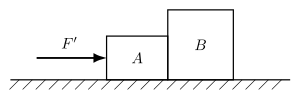
- TG EAPCET 2022Set eng-2022-07-19-AN1 markMCQQ.A constant horizontal force F of magnitude 10 N is applied to a block A and this produces an acceleration of magnitude 20 m/s2. If this block A is then kept against another block B of mass 1.5 kg as shown in figure and a force F′ of 20 N is applied, find the force on the block B. Neglect friction. (A) 15 N (B) 10 N (C) 20 N (D) 5 N
›Reveal solutionSolution
The key is to first find the mass of block A from the given force and acceleration, then treat both blocks as a system under the new force to find the common acceleration, and finally apply Newton’s second law to block B alone to get the force on it. The force on block B is 10 N.
Concept and intuition
We have two separate situations. In the first, a known force on block A alone gives us its acceleration — so we can find the mass of A. In the second, the same block A is pushed against block B, and a different force is applied to the combination. Since friction is neglected, the two blocks move together as one system. The force that block B experiences is simply the net force needed to accelerate block B at the system’s common acceleration. This is a classic “two-block pushed together” problem: find the system acceleration, then isolate one block.
- Find the mass of block A From the first scenario:
F=mAa⇒10=mA×20
So
mA=2010=0.5 kg
- Treat A and B as a single system under the new force The total mass is
mtotal=mA+mB=0.5+1.5=2.0 kg
The applied force is F′=20 N. The common acceleration of the system (no friction) is
a=mtotalF′=2.020=10 m/s2
- Find the force on block B Block B is accelerated only by the contact force from block A (call it FAB). Applying Newton’s second law to block B alone:
FAB=mB⋅a=1.5×10=15 N
This is the force that block A exerts on block B — which is the force “on block B” asked in the problem.
Watch outA common mistake is to think the force on B equals the applied force F′ (20 N) or to use the first acceleration (20 m/s²) in the second part. Both are wrong because the mass and the applied force have changed.
TipNotice that the force on B (15 N) is less than the applied force (20 N) because part of the applied force goes into accelerating block A itself. The ratio of forces on the blocks is exactly the ratio of their masses.
✓Final answerThe correct option is (A).
ANSWER: A
- TG EAPCET 2021Set ap-2021-08-09-AN1 markMCQQ.A machine gun fires five bullets per second into a target. The mass of each bullet is 5 gm. If the average force required to hold the gun in position is 12.5 N, then what is the speed (S in m/s) of each bullet & what is the power (P in kW) delivered to the each bullet? (A) S=2500,P=6.250 (B) S=2500,P=3.125 (C) S=500,P=3.125 (D) S=500,P=6.250
›Reveal solutionSolution
Force = rate of momentum transfer gives S=500 m/s; the power delivered to the bullets is KEbullet×firing rate=3.125 kW. Answer (C).
Given: firing rate n=5 s−1, bullet mass m=5 g=0.005 kg, holding force F=12.5 N.
Speed. The average force needed to hold the gun equals the momentum delivered to the bullets each second:
F=nmS⟹12.5=5×0.005×S=0.025S⟹S=0.02512.5=500 m/s.
Power. Kinetic energy of one bullet:
KE=21mS2=21(0.005)(500)2=625 J.
Energy is imparted to bullets at the firing rate, so the power delivered is
P=KE×n=625×5=3125 W=3.125 kW.
Thus S=500 m/s and P=3.125 kW.
✓Final answerS=500 m/s and P=3.125 kW -> option (C).
ANSWER: C
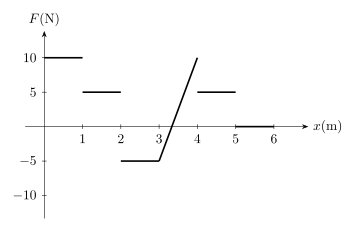
- TG EAPCET 2021Set ap-2021-08-09-AN1 markMCQQ.The relationship between the force F and position x of a particle is as shown in the following diagram. The work done in displacing the particle from x=0 m to 5 m will be? [FIGURE] (A) 30 J (B) 15 J (C) 25 J (D) 20 J
›Reveal solutionSolution
Work done by a variable force is the area under the force–displacement graph. Summing the triangle and rectangle gives 20 J, option (D).
The work done by a variable force equals the area under the F-vs-x curve: when the force is not constant you integrate Fdx, which geometrically is the area between the curve and the x-axis. The graph here is piecewise linear, so we split it into simple shapes.
- From x=0 to 2 m the force rises linearly from 0 to 5 N — a triangle:
W1=21×base×height=21×2×5=5 J.
- From x=2 to 5 m the force is constant at 5 N — a rectangle:
W2=base×height=3×5=15 J.
- Total work:
Wtotal=W1+W2=5+15=20 J.
TipAlways read the force value on the flat part of the graph carefully — the area (and hence the work) scales directly with it.
✓Final answerThe correct option is (D).
ANSWER: D
- TG EAPCET 2021Set ap-2021-08-09-FN1 markMCQQ.An object of mass 15kg moves at a constant speed of 15ms−1. A constant force, which acts for 5 seconds on the object, gives it a speed 5ms−1 in opposite direction. The force acting on the object is? (A) −50N (B) 60N (C) −40N (D) −60N
›Reveal solutionSolution
The key idea is to use the impulse–momentum theorem: the net impulse equals the change in momentum. The force is constant, so FΔt=m(vf−vi). With vi=+15 m/s, vf=−5 m/s, m=15 kg, and Δt=5 s, we get F=−60 N, which corresponds to option (D).
Concept and intuition:
When a constant force acts over a time interval, it changes the object’s momentum. The impulse–momentum theorem says:
Impulse=Force×time=change in momentum
Here the object reverses direction, so the change in velocity is large — and the force must be opposite to the original motion. We don’t need to know acceleration or distance; just the start and end velocities, the mass, and the time.
Step-by-step reasoning:
-
Choose a sign convention.
Let the initial direction of motion be positive.
So initial velocity: vi=+15 m/s.
The final velocity is 5 m/s in the opposite direction, so vf=−5 m/s.
-
Write the impulse–momentum equation.
For a constant force F acting for time Δt:
FΔt=mvf−mvi=m(vf−vi)
- Substitute the known values. m=15 kg, Δt=5 s, vi=+15, vf=−5:
F×5=15×[(−5)−(+15)]
- Simplify the velocity change.
vf−vi=−5−15=−20 m/s
So:
5F=15×(−20)=−300
- Solve for F.
F=5−300=−60 N
The negative sign means the force acts opposite to the initial direction.
Watch outA common mistake is to forget the sign of the final velocity. If you treat both speeds as positive, you get F=30 N, which isn’t even an option. Always set a direction as positive and stick to it.
TipNotice that the magnitude of the force is 60 N, but the direction matters. The problem asks for the force acting on the object, so the sign is part of the answer.
✓Final answerThe correct option is (D).
ANSWER: D
-
🎓Unlock everything free for 14 days
- ✓Full step-by-step solutions
- ✓Concept-first explanations
- ✓Methods, shortcuts & mistakes
- ✓PYQ mapping + timed mock tests
Full access for 14 days. No credit card required.