Q.Is viscosity a vector?
🔒You're viewing a preview — the full solution, concept, methods & PYQ mapping are locked.
🔒 Start your 14-day free trial to unlock the full solution →Concept understanding — Fluid Properties
Fluid Properties: From Intuition to Precision
Imagine you're holding a glass of water. Now imagine holding a glass of honey. You know instantly they behave differently — honey pours slowly, water splashes easily. That difference is what fluid properties capture. A fluid is anything that flows: liquids, gases, even some granular materials like sand (though we'll stick to liquids and gases here).
The key idea: fluids deform continuously under any shear stress, no matter how small. A solid resists deformation; a fluid gives way. But not all fluids give way the same way — that's where properties come in.
Density (ρ)
Intuition: A kilogram of feathers takes up much more space than a kilogram of lead. Density tells you how much mass is packed into a given volume.
Precise statement: Density is mass per unit volume.
ρ=Vm
Units: kg/m3 in SI. Water at 4∘C has ρ≈1000 kg/m3 — a useful benchmark. Air at sea level is about 1.2 kg/m3.
Density changes with temperature and pressure, especially for gases. For liquids, it's nearly constant — that's why we often call them "incompressible."
Specific Weight (γ)
Intuition: How heavy is that fluid? Not just mass — weight. A bucket of water feels heavier than the same bucket of air because gravity pulls harder on the denser fluid.
Precise statement: Specific weight is weight per unit volume.
γ=ρg
where g≈9.81 m/s2. Units: N/m3. For water, γ≈9810 N/m3.
Specific Gravity (SG)
Intuition: "How many times heavier than water is this fluid?" A number without units — pure comparison.
Precise statement: The ratio of a fluid's density to the density of water at a reference temperature (usually 4∘C).
SG=ρwaterρfluid
Mercury has SG ≈13.6 — it's 13.6 times denser than water. That's why a small column of mercury can balance a tall column of water in a barometer.
Viscosity (μ)
Intuition: Honey is "thick," water is "thin." Viscosity measures a fluid's resistance to flow — its internal friction. Imagine sliding a thin layer of fluid between two plates: the more viscous the fluid, the harder you must pull.
Precise statement: Viscosity (dynamic viscosity) is the proportionality constant between shear stress τ and the velocity gradient (rate of shear strain) in the fluid.
For a fluid between two parallel plates separated by distance dy, with top plate moving at speed dV:
τ=μdydV
This is Newton's law of viscosity. Units: Pa⋅s (or N⋅s/m2). Water at 20∘C has μ≈1.0×10⁻³ Pa⋅s; honey is about 2 Pa⋅s — two thousand times more viscous.
Viscosity is not density. Mercury is dense but flows easily (low viscosity). Honey is less dense but flows slowly (high viscosity). Don't confuse them.
Kinematic viscosity (ν) is dynamic viscosity divided by density:
ν=ρμ
Units: m2/s. It appears naturally in problems where both inertial and viscous forces matter.
Surface Tension (σ)
Intuition: A water strider walks on water. A needle floats even though steel is denser than water. The surface of a liquid acts like a stretched elastic membrane.
Precise statement: Surface tension is the force per unit length acting along the surface of a liquid, tending to minimize the surface area.
σ=LF
Units: N/m. For water-air at 20∘C, σ≈0.073 N/m. It arises because molecules at the surface experience a net inward pull (fewer neighbors above), creating tension.
Surface tension explains why small droplets are spherical — a sphere has the smallest surface area for a given volume.
Capillarity
Intuition: Water climbs up a narrow glass tube; mercury is pushed down. That's capillarity — the combined effect of surface tension and adhesion (attraction to the tube walls) versus cohesion (attraction within the liquid).
Precise statement: The rise (or fall) of a liquid in a narrow tube due to surface tension is given by:
h=ρgr2σcosθ
where θ is the contact angle (wetting angle), r is the tube radius. For water in clean glass, θ≈0∘ (rises); for mercury, θ≈130∘ (falls).
Bulk Modulus (K)
Intuition: How hard is it to squeeze a fluid? Gases compress easily; liquids barely compress at all. Bulk modulus measures resistance to uniform compression.
Precise statement: The ratio of pressure increase to the resulting volumetric strain (fractional change in volume):
K=−VdVdP
Units: Pa. For water, K≈2.2×10⁹ Pa — enormous. For air at atmospheric pressure, K≈1.4×10⁵ Pa — about 15,000 times smaller.
In most engineering problems, liquids are treated as incompressible (K→∞). Gases are compressible unless the pressure changes are very small.
Vapor Pressure (Pv) …
Viscosity is a fundamental property of a fluid that quantifies its resistance to flow or shear deformation.
A vector quantity possesses both magnitude and a specific direction in space. Viscosity, however, describes the internal friction within a fluid, opposing the relative motion between its layers, irrespective of any particular direction. It is a scalar constant of proportionality relat …
Viscosity is a measure of a fluid's resistance to flow. It is a scalar quantity for most common fluids (Newtonian and isotropic) and a tensor quantity for more complex fluids, but it is never a vector quantity.
To understand whether viscosity is a vector, we first need to clarify what a vector is and what viscosity represents.
Understanding Physical Quantities
Physical quantities are broadly classified based on whether they have direction in addition to magnitude:
- Scalar quantities possess only magnitude. Examples include mass, temperature, density, and energy.
- Vector quantities possess both magnitude and direction. Examples include force, velocity, acceleration, and momentum.
- Tensor quantities are more complex mathematical objects that generalize scalars and vectors. A scalar is a 0th-order tensor, and a vector is a 1st-order tensor. Higher-order tensors describe relationships between vectors or other tensors, often representing properties that vary with direction in a more intricate way than a simple vector. Stress and strain are examples of 2nd-order tensors.
What is Viscosity?
Viscosity is a fundamental property of fluids that quantifies their resistance to flow or deformation under shear stress. Imagine stirring honey versus water; honey is much more viscous, meaning it resists flow more strongly. This resistance arises from the internal friction between layers of the fluid moving at different velocities.
For a simple Newtonian fluid, the relationship between shear stress (τ) and the velocity gradient (shear rate, dydu) is given by:
τ=μdydu
Here, μ is the dynamic viscosity, τ is the shear stress (force per unit area acting tangentially), and dydu is the velocity gradient perpendicular to the flow direction.
Now, let's determine if viscosity fits the definition of a vector.
-
Viscosity as a Scalar (for Newtonian, Isotropic Fluids):
For the vast majority of fluids encountered in introductory physics and engineering (like water, air, oils under normal conditions), viscosity is considered a scalar quantity. This is because:
- The resistance to flow (viscosity) is an intrinsic property of the fluid itself.
- It does not inherently point in a specific direction. If you shear a fluid from left to right, its resistance to that shear is the same as if you shear it from top to bottom (assuming the fluid is isotropic, meaning its properties are uniform in all directions).
- In the formula τ=μdydu, μ acts as a proportionality constant. While shear stress (τ) and velocity gradient (dydu) are related to directional quantities (force, area, velocity, distance), the viscosity μ itself is a single value that describes the fluid's internal resistance, irrespective of the orientation of the applied shear.
-
Viscosity as a Tensor (for Complex Fluids): …
Newton's viscosity law: tau=mu*(du/dy), tau and du/dy are directional but mu itself is the scalar proportionality constant for isotropic Newtonian fluids -- same value regardless of shear directi …
- TG EAPCET 2026Set eng-2026-05-10-AN1 markMCQQ.In the strain-stress curve for a material, if the ultimate strength and fracture points are close, then the material is (A) Ductile (B) Elastomer (C) Brittle (D) Plastic
›Reveal solutionSolution
The key idea is that when the ultimate strength and fracture points are close on a stress-strain curve, the material undergoes little plastic deformation before breaking, which is the hallmark of brittleness. The correct answer is (C) Brittle.
Concept & Intuition
A stress-strain curve tells the story of how a material deforms under load. The ultimate strength is the maximum stress the material can withstand; the fracture point is where it actually breaks. If these two points are very close, the material snaps soon after reaching its peak strength, with almost no necking or stretching. That’s exactly what happens in brittle materials (like glass or cast iron) — they fail suddenly with little warning. In contrast, ductile materials (like copper or mild steel) stretch significantly between ultimate strength and fracture, giving a long “tail” on the curve.
Step-by-step reasoning
-
Recall the shape of stress-strain curves
- For a ductile material, after the ultimate strength, the material continues to deform plastically (necking) over a large strain range before finally fracturing. So the fracture point is far to the right of the ultimate strength point.
- For a brittle material, plastic deformation is minimal; the material fractures almost immediately after reaching ultimate strength. Hence the two points are very close on the strain axis.
-
Interpret the given condition
The problem states: “ultimate strength and fracture points are close.” This means the horizontal distance (strain) between them is small. That implies negligible plastic deformation after the peak stress.
-
Match to material types
- (A) Ductile → large separation → not correct.
- (B) Elastomer → these are rubber-like; they have a very different curve (large elastic strain, no clear yield/ultimate point in the same sense) — not characterized by closeness of ultimate and fracture.
- (C) Brittle → small separation → correct. …
-
- TG EAPCET 2025Set ap-2025-04-29-AN1 markMCQQ.The Reynolds number and nature of flow of water flowing with a velocity of 10 cms−1 through a pipe of diameter 1.8 cm is (Coefficient of viscosity of water =10−3 Pas) (A) 900 and laminar (B) 1800 and laminar (C) 1800 and unsteady (D) 1800 and turbulent
›Reveal solutionSolution
Re = ρvD/η = 1800; for 1000<Re<2000 the flow is unsteady.
With ρ=1000 kg m⁻³, v=0.10 m s⁻¹, D=0.018 m, η=10⁻³ Pa·s: Re = ρvD/η = (1000×0.10×0.018)/10⁻³ = 1800. Flow is laminar for Re≲1000, turbulent for Re≳2000, and unsteady/transitional in between. Re=1800 lies in that mi …
- TG EAPCET 2025Set ap-2025-04-29-AN1 markMCQQ.At room temperature, two bubbles of radii 8 cm and 15 cm are connected by a capillary tube. The final radii of the two bubbles respectively are (Neglect the volume of the air in the capillary tube) (A) 0 cm, 15.72 cm (B) 11.5 cm, 11.5 cm (C) 0 cm, 17 cm (D) 12.5 cm, 12.5 cm
›Reveal solutionSolution
Small bubble collapses (0 cm); the survivor grows to sqrt(8^2+15^2) = 17 cm.
Excess pressure inside a soap bubble is P = 4T/r, so the smaller bubble is at higher pressure. When two bubbles are connected by a tube, air flows from high to low pressure, i.e. from the small bubble to the large one. As the small bubble shrinks its pressure rises further, so it collapses completely (r -> 0).
For the combined air, using the standard idealisation (neglecting atmospheric pressure relative to the Laplace pressure, isothermal process): …
- TG EAPCET 2025Set ap-2025-04-30-FN1 markMCQQ.Petrol (density =750 kg m−3) and diesel (density =850 kg m−3) enter into two identical venturimeters each with a velocity 10 ms−1 as shown in the figure. If Δh1 is the difference in heights of petrol in the two vertical tubes of venturimeter A and if Δh2 is the difference in heights of diesel in the two vertical tubes of the venturimeter B, then Δh1:Δh2= [FIGURE] (A) 15:17 (B) 17:15 (C) 1:1 (D) 2:15
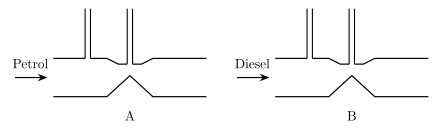
›Reveal solutionSolution
The key idea is that the pressure difference in a venturimeter depends only on the fluid’s velocity and density, but the height difference in the manometer tubes is inversely proportional to the fluid’s density. Since both fluids have the same velocity, the ratio of height differences is the inverse ratio of their densities, giving Δh1:Δh2=17:15.
Concept and Intuition
A venturimeter measures flow speed by converting kinetic energy into pressure change. For an incompressible fluid, Bernoulli’s equation tells us that an increase in speed (at the throat) causes a drop in pressure. That pressure drop is then read as a height difference in two vertical tubes (a manometer). Crucially, the height difference Δh is not the pressure difference itself — it’s the pressure difference divided by the fluid’s own weight density (ρg). So if two different fluids flow at the same speed through identical venturimeters, the one with lower density will show a larger height difference for the same pressure drop. That’s the heart of this problem.
Step-by-step solution
- Apply Bernoulli’s equation to each venturimeter For a horizontal venturimeter (no height change), Bernoulli’s equation between the wide section (area A1, velocity v1) and the throat (area A2, velocity v2) gives:
P1+21ρv12=P2+21ρv22
So the pressure drop is:
ΔP=P1−P2=21ρ(v22−v12)
- Relate the velocities By continuity (A1v1=A2v2), we have v2=A2A1v1. Since both venturimeters are identical, A1/A2 is the same constant k>1. Given v1=10 m/s for both, the pressure drop becomes:
ΔP=21ρ((k⋅10)2−102)=21ρ⋅100(k2−1)
So ΔP∝ρ — the pressure drop is directly proportional to the fluid’s density.
- Interpret the manometer reading Each vertical tube is open to the fluid at that point, so the height difference Δh in the two tubes is given by:
ΔP=ρgΔh
because the fluid in the tubes is the same as the flowing fluid. Therefore:
Δh=ρgΔP
- Substitute the pressure drop Using ΔP∝ρ from step 2:
Δh=ρg(constant⋅ρ)=gconstant
The density cancels! That would suggest Δh is the same for both — but wait, that’s only true if the manometer fluid is the same as the flowing fluid. Here it is: petrol in venturimeter A, diesel in B. So indeed, for identical venturimeters and same inlet velocity, the height difference is independent of density? Let’s check carefully.
Actually, the constant in step 2 is 21⋅100(k2−1), which does not depend on ρ. So:
- TG EAPCET 2024Set eng-2024-05-11-FN1 markMCQQ.If the excess pressures inside two soap bubbles are in the ratio 2:3, then the ratio of the volumes of the soap bubbles is (A) 3:2 (B) 9:4 (C) 27:8 (D) 81:16
›Reveal solutionSolution
The excess pressure inside a soap bubble is inversely proportional to its radius (ΔP∝1/r), so the radii ratio is 3:2, and since volume scales as r3, the volume ratio is 27:8. The correct option is (C).
Concept & Intuition
A soap bubble has two surfaces (inner and outer), so the excess pressure inside it is given by ΔP=r4T, where T is the surface tension and r is the radius. This is double the pressure for a liquid droplet (which has only one surface). The key insight: pressure and radius are inversely related — a smaller bubble has higher internal pressure. Once we know the radii ratio from the pressure ratio, the volume ratio follows directly because volume V=34πr3 scales with the cube of the radius.
Step-by-step solution
- Write the excess pressure formula for a soap bubble For a soap bubble of radius r, the excess pressure is ΔP=r4T. Given that the excess pressures are in the ratio 2:3, we have:
ΔP2ΔP1=32.
- Relate pressure ratio to radius ratio Since ΔP∝r1, we get:
ΔP2ΔP1=r1r2.
Therefore:
r1r2=32⇒r2r1=23.
So the radii are in the ratio 3:2.
- Find the volume ratio Volume of a sphere: V=34πr3. Hence:
- TG EAPCET 2023Set eng-2023-05-13-FN1 markMCQQ.The lengths of four wires A, B, C and D made of same material are 1 m, 2 m, 3 m and 4 m respectively. The radii of the wires A, B, C and D are 0.2 mm, 0.4 mm, 0.6 mm and 0.8 mm respectively. For the same applied tension, the elongation is more in the wire (A) A (B) B (C) C (D) D
›Reveal solutionSolution
For wires of the same material under equal tension, elongation is proportional to length and inversely proportional to cross‑sectional area (i.e., to the square of the radius). The wire with the largest ratio L/r2 elongates the most; here that is wire A.
The key idea is Hooke’s law for a wire under tension:
ΔL=AYFL
where F is the applied force (tension), L the original length, A the cross‑sectional area, and Y Young’s modulus (same for all wires since they are made of the same material).
Because F and Y are identical for all four wires, the elongation ΔL is simply proportional to AL. Since the wires are circular, A=πr2, so
ΔL∝r2L.
We only need to compare the ratio L/r2 for each wire — the largest ratio gives the greatest elongation.
- Wire A: L=1 m, r=0.2 mm=0.2×10⁻³ m.
r2L=(0.2×10⁻³)21=0.04×10−61=4×10−81=2.5×10⁷ m−1.
- Wire B: L=2 m, r=0.4 mm=0.4×10⁻³ m.
r2L=(0.4×10⁻³)22=0.16×10−62=1.6×10−72=1.25×10⁷ m−1.
- Wire C: L=3 m, r=0.6 mm=0.6×10⁻³ m.
r2L=(0.6×10⁻³)23=0.36×10−63=3.6×10−73≈0.833×10⁷ m−1.
- Wire D: L=4 m, r=0.8 mm=0.8×10⁻³ m. r2L=(0.8×10⁻³)24=0.64×10−64=6.4×10−74=0.625×10⁷ m−1. …
- TG EAPCET 2023Set eng-2023-05-12-FN1 markMCQQ.A straw of circular cross-section of radius R and negligible thickness is dipped vertically into a liquid of surface tension T. If the contact angle between the liquid and the straw material is 53∘. The force acting on the straw due to surface tension of the liquid is (cos53∘=0.6) (A) 512πRT (B) 56πRT (C) 54πRT (D) 53πRT
›Reveal solutionSolution
Because a straw is hollow, the liquid meniscus meets it along two circles (inner and outer), giving a contact length 4πR; with cos53∘=0.6 the force is 512πRT — option (A).
The concept first: force lives on the contact line, not on an area
Surface tension T is a force per unit length of the line along which the liquid surface meets the solid. So to get a force you must ask: how long is that line, and in which direction does it pull?
The pull acts along the liquid surface, i.e. at the contact angle θ to the wall. Resolving it along the straw (vertical) direction brings in the factor cosθ.
The subtlety that this question is built on: a straw is a tube of negligible thickness, not a solid rod. Liquid climbs on its inner wall and clings to its outer wall. Each contributes a circle of circumference 2πR (the thickness is negligible, so inner radius ≈ outer radius ≈R).
Step-by-step
Step 1 — Contact length.
L=inside2πR+outside2πR=4πR …
- TG EAPCET 2022Set ap-2022-07-31-FN1 markMCQQ.Water rises to a height H in a capillary tube of area of cross section A. To what height will water rise in a capillary tube of area of cross section 4A (A) 4H (B) 2H (C) 2H (D) 4H
›Reveal solutionSolution
Capillary rise height is inversely proportional to the tube radius, not the cross-sectional area. Since area quadruples, radius doubles, so height halves: the answer is H/2.
The key concept here is capillary rise — the phenomenon where a liquid climbs up a narrow tube due to adhesive forces between the liquid and the tube wall, balanced by gravity. The classic formula for the height h of the liquid column is:
h=ρgr2γcosθ
where:
- γ = surface tension of the liquid,
- θ = contact angle,
- ρ = density,
- g = gravity,
- r = radius of the tube.
Notice: height is inversely proportional to the radius, not to the cross-sectional area. This is the crucial insight. Many students mistakenly think height scales with area, but area is πr2, so a change in area changes the radius by the square root.
Let’s work through it step by step.
- Relate area to radius. The cross-sectional area of a circular capillary is A=πr2. If the area becomes 4A, then:
4A=πr′2⇒r′2=4r2⇒r′=2r
So the radius doubles.
- Apply the capillary rise formula. For the original tube:
H=ρgr2γcosθ
For the new tube (radius 2r):
H′=ρg(2r)2γcosθ=21⋅ρgr2γcosθ=2H
- Interpret the result. …
- TG EAPCET 2022Set eng-2022-07-20-FN1 markMCQQ.A soap bubble of initial radius R is to be blown up. The surface tension of the soap film is T. The surface energy needed to double the diameter of the bubble is (A) 12πR2T (B) 4πR2T (C) 16πR2T (D) 24πR2T
›Reveal solutionSolution
A soap bubble has two surfaces (inner and outer), so its total surface area is 2×4πr2=8πr2. Doubling the diameter means the radius goes from R to 2R, and the required surface energy is the change in surface energy: 8πT[(2R)2−R2]=24πR2T. The correct option is (D).
The key idea here is that a soap bubble is not a single surface — it’s a thin film of liquid with an inside surface and an outside surface. Each surface contributes to the total surface area, and surface energy is simply surface tension times total area.
Many students instinctively treat a bubble like a solid sphere, using 4πr2 for the area. That’s the trap. A bubble’s film has two sides, so the relevant area is 2×4πr2=8πr2. Surface energy is E=T×total surface area, and the work needed to blow the bubble is the change in this energy.
Let’s walk through it step by step.
- Surface area of a bubble For a sphere of radius r, the surface area of one side is 4πr2. Since a soap film has two surfaces (inner and outer), the total surface area of the bubble is
A=2×4πr2=8πr2.
- Surface energy Surface energy is given by E=T×A, where T is the surface tension. So for a bubble of radius r,
E(r)=T⋅8πr2.
-
Initial and final radii
The initial radius is R. Doubling the diameter means the new radius is 2R.
-
Change in surface energy …
- TG EAPCET 2022Set ap-2022-07-31-AN1 markMCQQ.Two wires A and B made of same material is subjected to same tension. The length and diameter of A, B are 10 cm, 1 mm and 70 cm, 2 mm respectively. Then identify the correct statement from the following: (A) Wire A would have larger extension than wire B (B) Wire A would have lesser extension than wire B (C) Wire A and Wire B would have same extension (D) No extension for Wire A and Wire B despite the application of tension
›Reveal solutionSolution
Since ΔL∝L/d2 (same material, same tension), wire A gives 10 units and wire B gives 17.5 units — A extends less than B.
Concept. For a wire under tension, Young's modulus gives
ΔL=AYFL=(πd2/4)YFL∝d2L
because F, Y (same material) and the constant π/4 are identical for both wires.
Calculation.
- Wire A: L=10cm,d=1mm⇒d2L=1210=10. …
- TG EAPCET 2021Set eng-2021-08-05-FN1 markMCQQ.A metal sheet 4 cm on a side and of negligible thickness is attached to a balance and inserted into container fluid. The balance to which metal sheet is attached read 0.50 N and the contact angle is found to be zero. A small amount of oil is then spread over the metal sheet. The contact angle now becomes 180° and the balance now reads 0.49 N. The surface tension of the fluid is (A) 6.25×10⁻² N/m (B) 1.25×10⁻¹ N/m (C) 4.25×10⁻² N/m (D) 0.1 N/m
›Reveal solutionSolution
Surface tension acts along the thin sheet's wetted perimeter L=2×4 cm=0.08 m. Flipping the contact angle from 0∘ to 180∘ reverses the pull, and the 0.01 N reading change gives T=6.25×10⁻² N/m, option (A).
Force from surface tension
For a thin square sheet of side 4 cm and negligible thickness, the contact line runs along both faces, so the effective perimeter is
L=2×0.04=0.08 m.
The vertical surface-tension force is F=TLcosθ, added to the sheet's weight W in the balance reading R=W+TLcosθ.
Two readings
- Contact angle θ=0∘ (fluid wets, pulls the sheet down): R1=W+TLcos0∘=W+TL=0.50 N. …
- TG EAPCET 2021Set eng-2021-08-05-FN1 markMCQQ.Match the columns I and II Column I A) Stoke’s law B) Turbulence C) Bernoulli’s Principle D) Pascal’s law Column II I) Pressure and energy II) Hydraulic lift III) Viscous drag IV) Reynold’s number The correct match is (A) A B C D III IV I II (B) A B C D I II III IV (C) A B C D II I IV III (D) A B C D III IV II I
›Reveal solutionSolution
This question asks us to match fundamental principles of fluid mechanics with their associated concepts or applications. Stoke's law describes viscous drag, turbulence is characterized by the Reynolds number, Bernoulli's principle relates pressure and energy, and Pascal's law is the basis for hydraulic lifts. The correct match is (A).
The core idea behind this problem is to correctly associate key principles in fluid mechanics with their defining characteristics or primary applications. Each principle in Column I describes a specific aspect of fluid behavior, and we need to find the most direct and accurate link in Column II.
Let's break down each concept:
-
Stoke's Law: This law quantifies the drag force experienced by a small spherical object moving through a viscous fluid at low Reynolds numbers (laminar flow). The force is directly proportional to the viscosity of the fluid, the radius of the sphere, and its velocity. This force is a type of viscous drag.
The viscous drag force Fd on a sphere of radius r moving with velocity v in a fluid of viscosity η is given by:
Fd=6πηrv
-
Turbulence: This describes a fluid flow regime characterized by chaotic, unpredictable changes in pressure and flow velocity. Unlike smooth, orderly laminar flow, turbulent flow involves eddies and vortices. The transition from laminar to turbulent flow is often predicted using a dimensionless quantity called the Reynolds number.
-
Bernoulli's Principle: This principle is a statement of the conservation of energy for an ideal fluid (incompressible, non-viscous, steady flow) along a streamline. It relates the pressure, fluid velocity, and height at different points in the flow. Essentially, it states that the sum of pressure energy, kinetic energy per unit volume, and potential energy per unit volume remains constant.
For an ideal fluid, Bernoulli's equation states:
P+21ρv2+ρgh=constant
where P is pressure, ρ is fluid density, v is fluid velocity, g is acceleration due to gravity, and h is height. This equation directly links pressure and energy forms. …
-
🎓Unlock everything free for 14 days
- ✓Full step-by-step solutions
- ✓Concept-first explanations
- ✓Methods, shortcuts & mistakes
- ✓PYQ mapping + timed mock tests
Full access for 14 days. No credit card required.