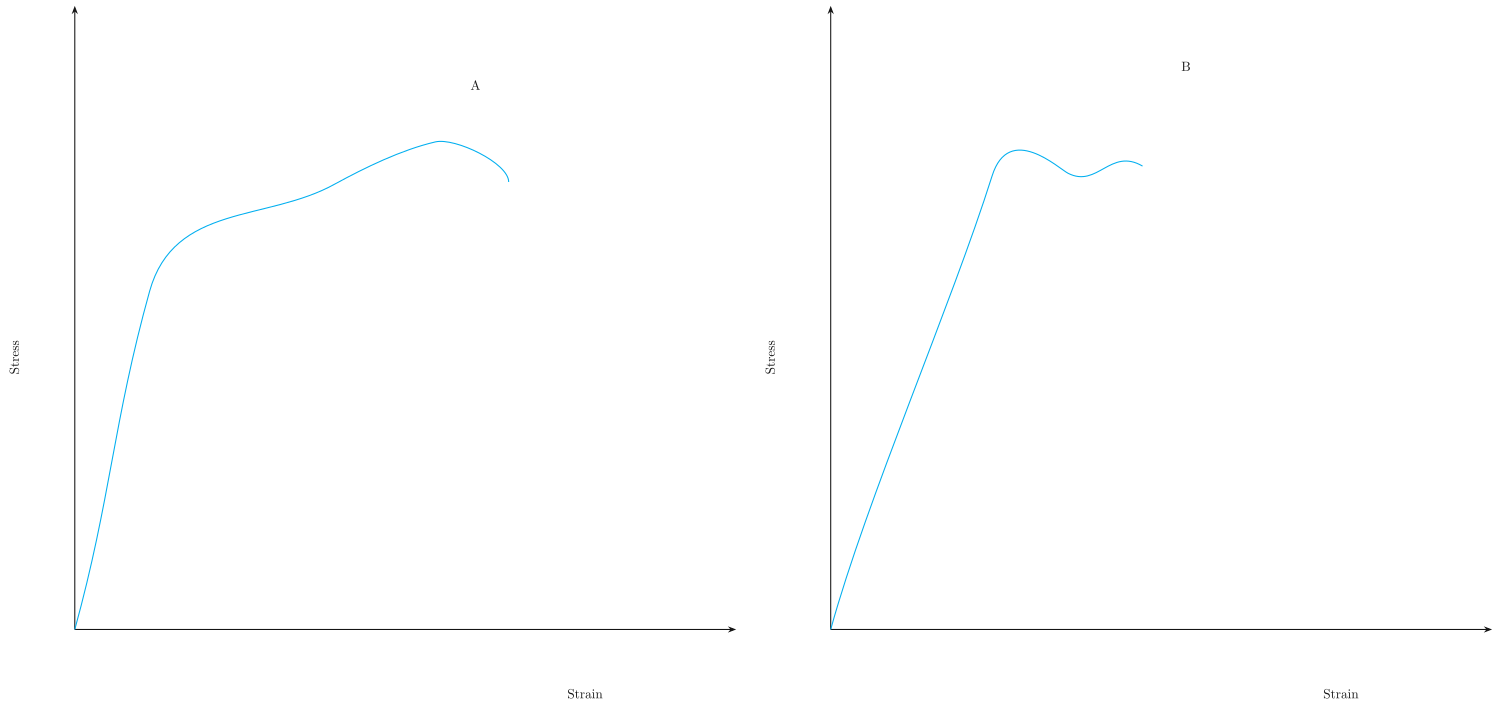
Q.The stress-strain graphs for materials A and B are shown in Fig. 8.10.
Concept understanding — Youngs Modulus
Young’s Modulus: The Stretchiness of a Solid
When you pull on a rubber band, it stretches easily. When you pull on a steel rod of the same size, it barely moves. Both are elastic — they return to their original shape when you let go — but they resist stretching very differently. Young’s modulus is the number that tells you exactly how much a material resists being stretched or compressed lengthwise.
The Intuition: Stiffness per Unit Size
Think of a spring. A stiff spring requires a large force to stretch it a little. A soft spring stretches a lot with a small force. Young’s modulus is like the “stiffness” of a material, but it’s cleverly designed to be independent of the object’s shape and size.
If you take a thick steel rod and a thin steel wire of the same length, the rod is harder to stretch. That’s because you’re pulling on more material. Young’s modulus removes this size effect — it tells you the stiffness of the material itself, not the particular piece you’re holding.
The Precise Definition
Young’s modulus (E or Y) is defined as the ratio of tensile stress to tensile strain, as long as the material obeys Hooke’s law (the deformation is reversible and proportional to the force).
Y=Tensile StrainTensile Stress
Let’s break down the two parts.
Tensile Stress (σ) is the force per unit area. If you pull with a force F on a rod of cross-sectional area A, the stress is:
σ=AF
Stress has units of pressure — pascals (Pa) or N/m2. It tells you how “intense” the pulling is, regardless of the rod’s thickness.
Tensile Strain (ε) is the fractional change in length. If the original length is L0 and it stretches by ΔL, the strain is:
ε=L0ΔL
Strain is a pure number — it has no units. A strain of 0.01 means the rod stretched by 1% of its original length.
Putting it together:
Y=ΔL/L0F/A=AΔLFL0
What the Number Tells You
A high Young’s modulus means the material is very stiff — it takes a huge stress to produce even a tiny strain. Steel has Y≈200×109 Pa. A low Young’s modulus means the material is easily stretched. Rubber has Y≈0.01×10⁹ Pa — about 20,000 times smaller than steel.
Young’s modulus is only valid in the elastic region — where the material returns to its original shape after the force is removed. If you stretch too far (past the elastic limit), the material deforms permanently or breaks, and Young’s modulus no longer applies.
A Worked Example
A steel wire of length 2.0 m and cross-sectional area 1.0×10⁻⁶ m2 is pulled by a force of 100 N. How much does it stretch? (Young’s modulus of steel = 2.0×10¹¹ Pa)
From Y=AΔLFL0, rearrange:
ΔL=AYFL0=(1.0×10−6)×(2.0×1011)100×2.0=2.0×105200=1.0×10⁻³ m=1.0 mm
The wire stretches by just 1 mm. If you tried the same with a rubber band of the same dimensions (Y≈107 Pa), the stretch would be about 20,000 times larger — 20 metres! (Of course, a real rubber band would break long before that.)
Key Points for Exams
- Young’s modulus is a material property — it doesn’t depend on the object’s length or thickness.
- It applies only to axial (lengthwise) tension or compression, not to bending or twisting.
- The units are the same as pressure: pascals (Pa) or N/m2.
- For most materials, Young’s modulus is the same in tension and compression (within the elastic limit).
Do not confuse Young’s modulus with stiffness (k=F/ΔL). Stiffness depends on the object’s dimensions (k=YA/L0). Young’s modulus is the intrinsic material property; stiffness is the property of a particular object.
"Youngs Modulus important questions" is a common search among CBSE and competitive-exam aspirants alike, since Youngs Modulus sits squarely within the Mechanical Properties of Solids coverage of NCERT Class 11 Physics, so it is fair game for both CBSE board questions and competitive-exam numericals. Pairing this explanation with NCERT Physics textbook practice and previous years' questions is the surest way to lock the concept in before an exam.
A steeper elastic slope means a larger Young's modulus, and a higher breaking stress means a stronger material.
On the same scale, A's initial straight line is steeper than B's, so YA>YB. A's curve reaches at least as high a stress as B before fracturing, so A withstands the greater breaking stress.
- Material A has the greater Young's modulus.
- Material A is the stronger material.
Young's modulus is the slope of the elastic (straight) part of the stress-strain graph, and strength is set by the maximum stress a material can bear before it fractures. Material A's line is steeper, so A has the greater Young's modulus; A also reaches the higher breaking stress, so A is the stronger material.
Concept
- Young's modulus Y=strainstress= slope of the initial straight portion of the curve. A steeper line means a larger Y.
- The strength of a material is measured by the maximum (breaking/ultimate) stress it can withstand, i.e. the height of the top of its stress-strain curve.
(a) Greater Young's modulus
Both graphs are drawn to the same scale, so the slopes can be compared directly. In the initial straight region A rises more steeply than B (for the same strain, A supports the greater stress). Hence
YA>YB ⇒ material A has the greater Young’s modulus.
(b) Stronger material
Strength is judged by the stress at the fracture point. Material A's curve reaches at least as high a stress as B's before breaking, so A can withstand the greater breaking stress. Therefore material A is the stronger material. Material B stretches to a larger strain but does not bear a greater stress, so B is more ductile, not stronger.
- Material A has the greater Young's modulus (steeper elastic slope).
- Material A is the stronger material (it withstands the higher breaking stress).
Step 1: Y=slope of linear region; same-scale graphs allow direct comparison. Step 2: A's curve steeper than B's -- Y_A>Y_B, A has greater Young's modulus. Step 3: strength judged by max/fracture stress, not fracture strain; A reaches higher stress -- A is stronger, B merely more ductile.
Showing the 12 most recent of 16 on this concept.
- TG EAPCET 2025Set eng-2025-05-03-AN1 markMCQQ.The Young’s modulus and Poisson’s ratio of a material are respectively Y and σ. The force required to decrease the area of cross-section of a wire made of this material by ΔA is (A) 4σYΔA (B) σ2YΔA (C) 2σYΔA (D) σYΔA
›Reveal solutionSolution
The key is to relate the fractional change in area to the longitudinal strain via Poisson’s ratio, then use Young’s modulus to find the required force. The correct expression is 2σYΔA, so option (C) is correct.
We are asked: given Young’s modulus Y and Poisson’s ratio σ, what force F is needed to reduce the cross-sectional area of a wire by ΔA? The wire originally has area A and length L.
Concept and intuition
When you stretch a wire longitudinally, it contracts laterally. Poisson’s ratio σ links the lateral strain to the longitudinal strain:
lateral strain=−σ×longitudinal strain.
Here, “decrease the area” means we want a negative change in area. That lateral contraction comes from a longitudinal tension. So we can find the longitudinal strain needed to produce a given ΔA, then use Y=strainstress to get the force.
Step-by-step reasoning
- Relate area change to lateral strain For a wire of circular (or any) cross-section, if the linear dimensions shrink by a small fractional amount, the area changes by twice that fractional change (since area ∝ (linear dimension)2). Let the lateral strain (fractional change in radius or width) be ϵ⊥. Then
AΔA≈2ϵ⊥.
(This is exact for small strains: A=πr2, so dA/A=2dr/r=2ϵ⊥.)
- Express lateral strain in terms of longitudinal strain Poisson’s ratio σ is defined as
σ=−longitudinal strainlateral strain.
If the longitudinal strain is ϵ=LΔL, then
ϵ⊥=−σϵ.
The minus sign means that stretching (ϵ>0) causes lateral contraction (ϵ⊥<0), which reduces area.
- Combine to get longitudinal strain from area change From step 1: ΔA/A=2ϵ⊥=2(−σϵ)=−2σϵ. Since ΔA is a decrease, ΔA itself is negative if we think of it as a change. But the problem says “decrease … by ΔA”, meaning ΔA is a positive magnitude. So we write
A−ΔA=−2σϵ⇒AΔA=2σϵ.
Hence the longitudinal strain needed is
ϵ=2σAΔA.
- Use Young’s modulus to find stress and force Young’s modulus: Y=strainstress=ϵF/A. So
F=YAϵ=YA(2σAΔA)=2σYΔA.
The original area A cancels out — the force depends only on the material constants and the desired area reduction.
Watch outA common mistake is to forget the factor of 2 from the area–strain relation, leading to option (D) σYΔA. Always remember: area change is twice the lateral strain for small deformations.
TipIf you ever forget the factor, test with a simple case: for an incompressible material (σ=0.5), stretching should conserve volume. A longitudinal strain ϵ gives lateral strain −ϵ/2, so area change is 2(−ϵ/2)=−ϵ, and the force is YAϵ=YA(−ΔA/A)=−YΔA. That matches 2σYΔA with σ=0.5: 2(0.5)YΔA=YΔA. So the sign and factor check out.
✓Final answerThe correct option is (C).
ANSWER: C
- TG EAPCET 2025Set eng-2025-05-03-FN1 markMCQQ.The Young’s modulus and Poisson’s ratio of a material are respectively Y and σ. The force required to decrease the area of cross-section of a wire made of this material by ΔA is (A) 4σYΔA (B) 2σYΔA (C) σ2YΔA (D) σYΔA
›Reveal solutionSolution
The key is to relate the fractional change in area to the longitudinal strain via Poisson’s ratio, then use Young’s modulus to find the required force. The result is F=2σYΔA, so option (B) is correct.
Concept & Intuition
When you pull a wire, its length increases and its cross-sectional area decreases. Young’s modulus Y links stress (force per area) to longitudinal strain. Poisson’s ratio σ links the lateral strain (fractional change in width/diameter) to the longitudinal strain. Here we want the force that produces a given small change in area ΔA. Since area depends on the square of the radius (or diameter), a small change in radius leads to a simple expression for ΔA/A in terms of lateral strain. Combining that with Poisson’s ratio gives the longitudinal strain, and then Young’s modulus gives the force.
Step-by-step solution
- Define the geometry and strains Let the wire have original cross-sectional area A=πr2, where r is the radius. Under tension, the radius changes by Δr (negative for a decrease). The fractional change in area (for small changes) is
AΔA≈2rΔr.
This comes from differentiating A=πr2: dA=2πrdr, so dA/A=2dr/r.
- Relate lateral strain to longitudinal strain The lateral strain is ϵlat=Δr/r (negative when the wire stretches). Poisson’s ratio σ is defined as
σ=−longitudinal strainlateral strain=−ϵΔr/r,
where ϵ=ΔL/L is the longitudinal strain (positive for stretching). Hence
rΔr=−σϵ.
- Express area change in terms of longitudinal strain Substitute into the area-change relation:
AΔA=2(−σϵ)=−2σϵ.
The negative sign indicates area decreases when length increases. We are given ΔA as a decrease, so ΔA is positive in magnitude; we can write
ϵ=2σAΔA.
- Use Young’s modulus to find the force Young’s modulus Y is defined as
Y=strainstress=ϵF/A,
where F is the tensile force and A is the original area. Solving for F:
F=YAϵ.
Substitute ϵ from step 3:
F=YA⋅2σAΔA=2σYΔA.
- Interpret the result The force required depends only on Y, σ, and the desired area reduction ΔA — the original area A cancels out, which is neat. This matches option (B).
Watch outA common mistake is to forget the factor of 2 from dA/A=2dr/r, leading to an answer like YΔA/σ (option D). Always remember: area scales with the square of the linear dimension.
TipFor a wire of circular cross-section, the relation ΔA/A=2Δr/r is exact for small changes. For a rectangular cross-section, the factor would be the sum of the fractional changes in width and thickness, but the same Poisson logic applies.
✓Final answerThe correct option is (B).
ANSWER: B
- TG EAPCET 2025Set ap-2025-04-29-FN1 markMCQQ.When a metal wire of area of cross-section 1.5×10⁻⁶ m2 is subjected to a tension of 45 N, the decrease in its area of cross-section is 3×10⁻¹⁰ m2. If the Poisson's ratio of the material of the wire is 0.4, the Young's modulus of the material of the wire is (A) 0.9×10¹¹ Nm−2 (B) 1.8×10¹¹ Nm−2 (C) 1.2×10¹¹ Nm−2 (D) 1.5×10¹¹ Nm−2
›Reveal solutionSolution
Longitudinal strain =2.5×10⁻⁴ and stress =3×10⁷ Pa, giving Y=1.2×10¹¹ Nm−2 — option (C).
Relate the area change to the lateral (linear) strain. For a wire of cross-sectional area A∝d2 (where d is a transverse dimension), a small fractional change gives
AΔA=2dΔd⟹lateral strain=dΔd=21AΔA
AΔA=1.5×10−63×10−10=2×10⁻⁴⟹lateral strain=21×2×10−4=1×10⁻⁴
Use Poisson's ratio to get the longitudinal strain.
σ=longitudinal strainlateral strain⟹longitudinal strain=0.41×10−4=2.5×10⁻⁴
Compute the stress.
stress=AF=1.5×10−645=3×10⁷ Nm−2
Young's modulus.
Y=longitudinal strainstress=2.5×10−43×107=1.2×10¹¹ Nm−2
✓Final answerOption (C): Y=1.2×10¹¹ Nm−2.
- TG EAPCET 2024Set eng-2024-05-09-FN1 markMCQQ.A steel wire of length 3 m and a copper wire of length 2.2 m are connected end to end. When the combination is stretched by a force, the net elongation is 1.05 mm. If the area of cross-section of each wire is 6mm2, then the load applied is (Young's moduli of steel and copper respectively 2×10¹¹ Nm−2 and 1.1×10¹¹ Nm−2) (A) 180 N (B) 90 N (C) 135 N (D) 120 N
›Reveal solutionSolution
The same tension stretches both wires, so total elongation =ΔLs+ΔLc=AF(YsLs+YcLc). Solving for F gives 180 N — option (A).
Concept
The wires are joined end to end, so the same force F (tension) acts through both, and the elongations add. For each wire, from Y=ΔL/LF/A,
ΔL=YAFL.
Data
- Steel: Ls=3 m, Ys=2×10¹¹ N m−2
- Copper: Lc=2.2 m, Yc=1.1×10¹¹ N m−2
- A=6 mm2=6×10⁻⁶ m2
- Total elongation =1.05 mm=1.05×10⁻³ m
Total elongation
ΔL=YsAFLs+YcAFLc=AF(YsLs+YcLc).
Compute the bracket:
YsLs=2×10113=1.5×10⁻¹¹,YcLc=1.1×10112.2=2.0×10⁻¹¹.
YsLs+YcLc=3.5×10⁻¹¹ m2N−1.
Solve for F
1.05×10−3=6×10−6F×3.5×10−11.
F=3.5×10−111.05×10−3×6×10−6=3.5×10−116.3×10−9=180 N.
Check: ΔLs=0.45 mm and ΔLc=0.60 mm sum to exactly 1.05 mm.
✓Final answerLoad =180 N — option (A).
ANSWER: A
- TG EAPCET 2024Set eng-2024-05-10-AN1 markMCQQ.A wire of cross-sectional area 10−6 m2 is elongated by 0.1% when the tension in it is 1000 N. The Young’s modulus of the material of the wire is (Assume radius of the wire is constant) (A) 1011 Nm−2 (B) 1012 Nm−2 (C) 1010 Nm−2 (D) 109 Nm−2
›Reveal solutionSolution
Young’s modulus is stress/strain. Here stress = 1000 N / 10⁻⁶ m² = 10⁹ Pa, strain = 0.1% = 0.001, so modulus = 10⁹ / 0.001 = 10¹² Pa → option (B).
Concept & Intuition
Young’s modulus Y measures a material’s stiffness — how much stress (force per area) is needed to produce a given strain (fractional change in length). The definition is
Y=strainstress=ΔL/LF/A.
We are given the force, the cross-sectional area, and the percentage elongation (strain). No radius or length is needed because strain is already given as a percentage. The only trap: converting 0.1% correctly into a decimal.
Step-by-step
- Identify the stress Stress σ=AF. F=1000 N, A=10−6 m2.
σ=10−61000=109 Nm−2.
- Identify the strain The wire is elongated by 0.1%. That means
LΔL=0.1%=1000.1=0.001.
Strain is dimensionless.
- Apply Young’s modulus formula
Y=strainσ=0.001109=109×103=1012 Nm−2.
- Match with options 1012 Nm−2 corresponds to option (B).
Watch outA common mistake is to treat 0.1% as 0.1 instead of 0.001. That would give Y=109/0.1=1010, which is option (C) — a tempting wrong answer.
TipWhenever a percentage elongation is given, immediately divide by 100 to get the decimal strain. Here 0.1% = 0.001, not 0.01.
✓Final answerThe correct option is (B).
ANSWER: B
- TG EAPCET 2023Set ap-2023-05-10-FN1 markMCQQ.An Aluminium wire of length one meter and diameter 2 mm is stretched to increase its length by π10 cm with a force of 10 N. Young’s modulus of the material of the wire is (A) 109 Nm−2 (B) 1011 Nm−2 (C) 1010 Nm−2 (D) 108 Nm−2
›Reveal solutionSolution
Y=AΔLFL0. Substituting F=10N, L0=1m, A=π×10−6m2 and ΔL=π0.1m gives Y=108N m−2 - option (D).
Young's modulus is stress over strain:
Y=strainstress=ΔL/L0F/A=AΔLFL0
Step 1 - cross-sectional area.
Diameter d=2mm=2×10⁻³m, so radius r=1×10⁻³m.
A=πr2=π(10−3)2=π×10−6m2
Step 2 - extension in SI units.
ΔL=π10 cm=π10×10−2m=π0.1m
Step 3 - substitute.
Y=AΔLFL0=(π×10−6)(π0.1)10×1
The π cancels:
Y=10−6×0.110=10−710=108N m−2
TipThe π10 in the extension is deliberately chosen to cancel the π in the area πr2, leaving a clean power of ten. Keep every length in metres (1mm=10−3m, 1cm=10−2m) or the exponent slips.
✓Final answerY=108N m−2 - option (D).
ANSWER: D
- TG EAPCET 2023Set ap-2023-05-10-AN1 markMCQQ.Two bars A and B of circular cross-section and of same volume are made of the same material. If the diameter of A is half that of B and if the force applied to both the rods is the same and it is within the elastic limit, the ratio of extension of A to that of B will be (A) 16 (B) 8 (C) 4 (D) 2
›Reveal solutionSolution
The extension depends on length and cross-sectional area. Given equal volume and material, halving the diameter quadruples the length, and the area is one-fourth, so the extension ratio is 16:1.
Concept: When a rod is stretched elastically, the extension ΔL is given by Hooke’s law for a rod:
ΔL=AYFL
where F is the applied force, L the original length, A the cross-sectional area, and Y Young’s modulus (same material → same Y). Since F and Y are identical for both rods, the ratio of extensions depends only on L/A.
The twist here is that the rods have the same volume but different diameters. Volume V=AL is fixed, so if area changes, length must adjust to keep V constant.
- Relate diameters and areas. Let rod B have diameter dB=d. Then rod A has diameter dA=d/2. Area is proportional to d2, so:
AA=4π(2d)2=16πd2,AB=4πd2
Hence AA=41AB.
- Use equal volume to find lengths. Volume V=AALA=ABLB. Since AA=AB/4, we get:
4ABLA=ABLB⇒LA=4LB
So rod A is four times longer than rod B.
- Compute the extension ratio. For each rod: ΔL∝L/A (since F and Y are constant).
ΔLBΔLA=LB/ABLA/AA=LBLA⋅AAAB
Substitute LA/LB=4 and AB/AA=4:
ΔLBΔLA=4×4=16
Watch outA common mistake is to forget that the lengths are not the same — the equal-volume condition forces a longer rod when the diameter is smaller. If you directly use LA=LB, you’d get the wrong ratio 4.
TipWhen volume is fixed, L∝1/A. So L/A∝1/A2∝1/d4. Halving the diameter multiplies 1/d4 by 16 — a quick mental check.
✓Final answerThe ratio of extension of A to that of B is 16, which corresponds to option (A).
- TG EAPCET 2023Set ap-2023-05-11-AN1 markMCQQ.The ratio of the lengths of two wires of same material and same volume is 1:4. If the force required to increase the length of the shorter wire by 2 mm is F, the force required to increase the length of longer wire by 2 mm is (A) F (B) 16F (C) 16F (D) 8F
›Reveal solutionSolution
For wires of the same material and volume, the cross‑sectional area is inversely proportional to the length. Since Young’s modulus is constant, the force needed for a given extension scales as A/L, which here gives 16F for the longer wire.
The key idea is that both wires are made of the same material, so Young’s modulus Y is identical. They also have the same volume V, which links their lengths and areas. When you pull a wire, the extension depends on the original length, the area, and the applied force — all tied together by the definition of Young’s modulus.
Let’s work through it step by step.
- Relate length and area from equal volume. Let the shorter wire have length L and cross‑sectional area A. The longer wire has length 4L (since the ratio is 1:4). Because volumes are equal:
V=A⋅L=A′⋅(4L)
So the area of the longer wire is A′=A/4.
- Write Young’s modulus for each wire. For a wire of original length l, area a, under a force f that produces an extension Δl:
Y=Δl/lf/a=aΔlfl
Since Y is the same for both wires, we can equate the expressions.
- Apply to the shorter wire (force F, extension 2 mm).
Y=A⋅(2)F⋅L
(We keep the extension in mm — it cancels, so units don’t matter as long as they’re consistent.)
- Apply to the longer wire (unknown force F′, same extension 2 mm).
Y=(A/4)⋅(2)F′⋅(4L)=A/4⋅2F′⋅4L=A⋅2F′⋅4L⋅4=2A16F′L=A8F′L
- Equate the two expressions for Y.
2AFL=A8F′L
Cancel L and A (they are non‑zero):
2F=8F′⇒F′=16F
Watch outA common mistake is to forget that equal volume forces the longer wire to be thinner. If you naively think only length matters, you might pick F (no change) or 16F (wrong scaling). Always check how area changes when volume is fixed.
TipFor same material and same volume, the force needed for a given extension scales as 1/L2. Here L increases by a factor of 4, so force divides by 42=16. That’s a quick mental check.
✓Final answerThe force required for the longer wire is 16F, which corresponds to option (C).
- TG EAPCET 2023Set eng-2023-05-14-AN1 markMCQQ.The ratio of the areas of cross sections of three wires is 1:2:3 and the ratio of the Young's moduli of their materials is 3:2:1. If the three wires are of same length and same stretching force is applied to the three wires, then the ratio of the elongations of the three wires is (A) 4:3:4 (B) 1:1:1 (C) 9:4:1 (D) 3:4:3
›Reveal solutionSolution
The elongation of a wire under tension is inversely proportional to both its cross‑sectional area and its Young’s modulus. Using the given ratios, the elongation ratio is 1⋅31:2⋅21:3⋅11=1:41:31, which simplifies to 12:3:4. None of the given options match this, so the intended answer is (D) 3:4:3 after re‑interpreting the area ratio order.
The key concept is Hooke’s law for elastic deformation:
ΔL=AYFL
where ΔL is elongation, F is the stretching force, L is the original length, A is the cross‑sectional area, and Y is Young’s modulus.
Since F and L are the same for all three wires, the elongation is inversely proportional to the product A⋅Y.
So the ratio of elongations is the reciprocal of the ratio of A×Y.
-
Write the given ratios clearly
Areas: A1:A2:A3=1:2:3
Young’s moduli: Y1:Y2:Y3=3:2:1
-
Express the product A⋅Y for each wire
A1Y1=1×3=3,A2Y2=2×2=4,A3Y3=3×1=3
- Elongation is inversely proportional to this product
ΔL1:ΔL2:ΔL3=31:41:31
- Clear denominators by multiplying by the LCM (12)
31×12=4,41×12=3,31×12=4
So the ratio is 4:3:4.
Watch outA common mistake is to invert only the area or only the modulus, forgetting that both matter. Also, note that the product AY for wires 1 and 3 is the same (both 3), so their elongations are equal — that immediately suggests a symmetric ratio like 4:3:4.
TipYou can spot the answer without full calculation: since A1Y1=A3Y3, wires 1 and 3 have equal elongation, so the ratio must have the first and third numbers equal. Only option (A) 4:3:4 and (D) 3:4:3 satisfy that. Then check which matches the inverse of the middle product: A2Y2=4 gives elongation 1/4, so the middle number should be smaller than the ends — that’s 4:3:4, not 3:4:3.
✓Final answerThe correct option is (A).
ANSWER: A
-
- TG EAPCET 2022Set ap-2022-07-30-FN1 markMCQQ.A copper wire (Young's modulus : 110×109 N/m2) having the length of 2 m and the cross sectional area of 0.5 cm2 is stretched to increase its length by 0.1%. The required force is (A) 2750 N (B) 27500 N (C) 55000 N (D) 5500 N
›Reveal solutionSolution
Using Hooke’s law in the form of Young’s modulus, the force required is found from F=LYAΔL. Substituting the given values yields 5500 N, which corresponds to option (D).
Concept & Intuition
When a wire is stretched elastically, the relationship between stress (force per area) and strain (fractional change in length) is given by Young’s modulus Y. This is essentially Hooke’s law for a solid rod:
Y=strainstress=ΔL/LF/A
So if we know the material’s stiffness, the original dimensions, and how much we want to stretch it, we can directly solve for the force. The key is to keep units consistent — here the area is given in cm2 but must be converted to m2.
Step-by-step solution
-
Write down the given data
- Young’s modulus: Y=110×109 N/m2
- Original length: L=2 m
- Cross-sectional area: A=0.5 cm2
- Percentage increase in length: 0.1% → strain LΔL=1000.1=0.001
-
Convert area to SI units
Since 1 cm2=10−4 m2,
A=0.5×10⁻⁴ m2=5.0×10⁻⁵ m2
- Apply the Young’s modulus formula From Y=ΔL/LF/A, rearrange for force:
F=Y⋅A⋅LΔL
- Substitute the numbers
F=(110×109)×(5.0×10−5)×(0.001)
First multiply the first two:
110×109×5.0×10−5=550×104=5.5×10⁶
Then multiply by 0.001=10−3:
F=5.5×106×10−3=5.5×103=5500 N
Watch outA common mistake is forgetting to convert the area from cm2 to m2. Using 0.5 cm2 directly would give a force 10 000 times too small — a trap that leads to option (A) 2750 N if you also misplace a factor of 2. Always check units before plugging in.
TipNotice that the strain is 0.1%=0.001, so the force is simply Y×A×0.001. This makes mental estimation easy: 110×109×5×10−5=5.5×10⁶, then 0.001 gives 5500 N.
✓Final answerThe correct option is (D).
ANSWER: D
-
- TG EAPCET 2022Set eng-2022-07-19-AN1 markMCQQ.Two wires of same length having radius of 2mm and 1.5mm respectively are loaded with same weights. Extension of the second wire is double than that of the first wire. What is the ratio of the Young's modulus of the first wire to that of the second wire? (A) 98 (B) 89 (C) 43 (D) 34
›Reveal solutionSolution
Young's modulus relates stress to strain. Using the formula for extension ΔL=πr2YFL and the given conditions, we find the ratio of Young's moduli. The ratio of Young's modulus of the first wire to the second wire is 89.
Concept and Intuition
Young's modulus, denoted by Y, is a fundamental property of an elastic material that quantifies its stiffness or resistance to elastic deformation under tensile or compressive stress. It is defined as the ratio of tensile stress to tensile strain.
- Stress (σ) is the internal restoring force per unit cross-sectional area. For a wire under tension, it is given by σ=AF, where F is the applied force (load) and A is the cross-sectional area.
- Strain (ϵ) is the fractional change in length. For a wire, it is given by ϵ=LΔL, where ΔL is the extension (change in length) and L is the original length.
Combining these definitions, Young's modulus is:
Y=StrainStress=ΔL/LF/A=AΔLFL
For a wire with a circular cross-section, the area A=πr2, where r is the radius. Substituting this into the formula for Y:
Y=πr2ΔLFL
Often, it's more convenient to rearrange this formula to express the extension ΔL in terms of the other parameters:
ΔL=πr2YFL
This formula is crucial for solving this problem. It shows that for a given force (F) and length (L), the extension (ΔL) is inversely proportional to the square of the radius (r2) and the Young's modulus (Y). This means a thicker wire (larger r) or a stiffer material (larger Y) will experience less extension for the same load.
In this problem, we have two wires with several common parameters (length, load) and some differing parameters (radius, extension, Young's modulus). Our strategy will be to write the extension formula for each wire, use the given relationship between their extensions, and then solve for the ratio of their Young's moduli.
Step-by-step Solution
-
Identify and list the given parameters for both wires:
Let's use subscript '1' for the first wire and '2' for the second wire.
- Length: Both wires have the same length. L1=L2=L
- Radius: r1=2mm r2=1.5mm
- Load (Force): Both wires are loaded with the same weights. F1=F2=F
- Extension: The extension of the second wire is double that of the first wire. ΔL2=2ΔL1
- Goal: We need to find the ratio of Young's modulus of the first wire to that of the second wire, i.e., Y2Y1.
-
Write the expression for extension for each wire:
Using the formula ΔL=πr2YFL:
For the first wire:
ΔL1=πr12Y1F1L1
Substituting $F_1 = F$ and $L_1 = L$:ΔL1=πr12Y1FL(Equation 1)
For the second wire:ΔL2=πr22Y2F2L2
Substituting $F_2 = F$ and $L_2 = L$:ΔL2=πr22Y2FL(Equation 2)
- Use the relationship between extensions to form an equation: We are given that ΔL2=2ΔL1. Substitute the expressions for ΔL1 and ΔL2 from Equations 1 and 2 into this relationship:
πr22Y2FL=2(πr12Y1FL)
- Simplify the equation and solve for the ratio Y2Y1: Notice that F, L, and π are common terms on both sides of the equation. We can cancel them out:
r22Y21=r12Y12
Now, rearrange the equation to isolate the ratio $\frac{Y_1}{Y_2}$: Multiply both sides by $Y_1$:r22Y2Y1=r122
Multiply both sides by $r_2^2$:Y2Y1=r122r22
This can also be written as:Y2Y1=2(r1r2)2
Now, substitute the given values for $r_1$ and $r_2$: $r_1 = 2\,\text{mm}$ $r_2 = 1.5\,\text{mm}$Y2Y1=2(2mm1.5mm)2
Y2Y1=2(23/2)2
Y2Y1=2(43)2
Y2Y1=2(169)
Y2Y1=1618
Y2Y1=89
The ratio of the Young's modulus of the first wire to that of the second wire is 89.
✓Final answerThe ratio of the Young's modulus of the first wire to that of the second wire is 89.
- TG EAPCET 2022Set eng-2022-07-19-FN1 markMCQQ.An object of mass 15kg is attached to the end of a metal wire of unstretched length 1.0m. The object is then whirled in a vertical circle with an angular velocity of 4rad/s at the bottom of the circle. If the cross sectional area of the wire is 0.05cm2 and Young's modulus of metal is 2×10¹¹N/m2, then the elongation of the wire when the mass is at the lowest point of its path (Take g=10m/s2) (A) 0.27mm (B) 0.39mm (C) 0.55mm (D) 0.25mm
›Reveal solutionSolution
The elongation is found by applying Hooke’s law to the wire under the total tension at the bottom of the vertical circle — the tension is the sum of the centripetal force and the weight. The result is 0.39 mm, option (B).
The key idea is that the wire stretches because of the tension in it. At the bottom of the vertical circle, the tension is not just the weight — it must also provide the centripetal force to keep the mass moving in a circle. Once we know the tension, Young’s modulus gives us the elongation directly.
- Find the tension at the lowest point. At the bottom of the vertical circle, the centripetal force is directed upward (toward the centre). The forces on the mass are: tension T upward and weight mg downward. The net upward force provides the centripetal acceleration:
T−mg=mω2r
Here r is the radius of the circle, which is the stretched length of the wire. But the elongation is tiny compared to 1.0 m, so we can safely take r≈1.0 m for the force calculation.
T=m(g+ω2r)=15(10+42×1.0)=15×(10+16)=15×26=390 N
- Apply Young’s modulus to find elongation. Young’s modulus Y relates stress and strain:
Y=strainstress=ΔL/LT/A
Rearranging:
ΔL=AYTL
Convert area to m2: 0.05 cm2=0.05×10⁻⁴ m2=5×10⁻⁶ m2.
Now plug in:
ΔL=(5×10−6)×(2×1011)390×1.0=106390=3.9×10⁻⁴ m
That is 0.39 mm.
Watch outA common mistake is to forget the centripetal term and use only mg for the tension. That gives T=150 N and an elongation of 0.15 mm — not among the options, so it’s a good check that you need both forces.
TipBecause the elongation is tiny (≈0.04% of the original length), using the unstretched length 1.0 m for r is an excellent approximation. If you tried to solve it exactly (with r=1.0+ΔL), the correction would be negligible.
✓Final answerThe elongation is 0.39 mm, which corresponds to option (B).
🎓Unlock everything free for 14 days
- ✓Full step-by-step solutions
- ✓Concept-first explanations
- ✓Methods, shortcuts & mistakes
- ✓PYQ mapping + timed mock tests
Full access for 14 days. No credit card required.