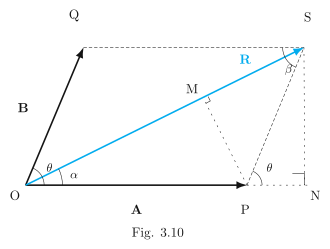
Q.Find the magnitude and direction of the resultant of two vectors A and B in terms of their magnitudes and angle θ between them.
🔒You're viewing a preview — the full solution, concept, methods & PYQ mapping are locked.
🔒 Start your 14-day free trial to unlock the full solution →Concept understanding — Relative Velocity
What is Relative Velocity?
Imagine you're sitting in a train that's moving smoothly. The person sitting opposite you appears to be perfectly still — yet both of you are hurtling past trees and buildings outside at 80 km/h. Which is the "real" velocity? The answer is: there is no single real velocity. Velocity always depends on who is measuring it.
That's the core idea of relative velocity: the velocity of an object as seen from a particular frame of reference. Change the frame, and the measured velocity changes.
The Intuition: Walking on a Moving Train
Let's build this step by step.
Step 1 — You on a stationary train.
You walk forward at 3 km/h inside the aisle. A friend on the platform sees you moving at exactly 3 km/h. Simple.
Step 2 — The train moves at 80 km/h, you stand still inside.
Your friend on the platform sees you moving at 80 km/h (the train's speed). You see the platform rushing backward at 80 km/h.
Step 3 — You walk forward at 3 km/h while the train moves at 80 km/h.
Your friend on the platform sees you moving at 80+3=83 km/h.
But the person sitting next to you sees you moving at just 3 km/h.
Same you, same walking speed — two different observers, two different velocities. That's relative velocity in action.
The "velocity" you feel is always relative to something. When you say "a car is moving at 60 km/h", you usually mean relative to the ground. But the ground itself is moving (Earth rotates, orbits the Sun, etc.). There is no absolute rest frame.
The Precise Definition
Relative velocity of object A with respect to object B is the velocity of A as measured by an observer who is at rest with respect to B.
Mathematically, if vA and vB are velocities of A and B measured in the same frame (say, the ground), then:
vAB=vA−vB
Where vAB means "velocity of A relative to B".
Read this carefully: you subtract the velocity of the reference object (B) from the velocity of the object you're tracking (A).
Why Subtraction? — The Logic
Think of the train example again. Let:
- vyou = your velocity relative to ground = 83 km/h forward
- vtrain = train's velocity relative to ground = 80 km/h forward
Your velocity relative to the train is:
vyou,train=vyou−vtrain=83−80=3 km/h forward
That matches: the person on the train sees you walking forward at 3 km/h.
Now what about the platform's velocity relative to you?
Platform is at rest relative to ground: vplatform=0
vplatform, you=0−83=−83 km/h
The negative sign means the platform appears to move backward relative to you — which is exactly what you see from the moving train.
A common mistake: thinking relative velocity is just adding speeds. It's vector subtraction. If two objects move in opposite directions, you subtract a negative — which becomes addition. Always use the vector formula.
One-Dimensional Cases (The Simplest)
When motion is along a straight line, we can use signs (+ for one direction, − for the opposite).
Case 1: Same direction
Car A at 60 km/h east, Car B at 40 km/h east.
Velocity of A relative to B: 60−40=20 km/h east.
A appears to move away from B at 20 km/h.
Case 2: Opposite directions
Car A at 60 km/h east, Car B at 40 km/h west.
Take east as positive. Then vB=−40 km/h. …
The key idea is the parallelogram law of vector addition, which gives both the magnitude and direction of the resultant.
Step 1 — Magnitude of the resultant
Place the vectors tail-to-tail with angle θ between them. Completing the parallelogram, the diagonal represents the resultant R. Using the law of cosines on the triangle formed by A, B, and R:
R2=A2+B2+2ABcosθ
Step 2 — Direction of the resultant …
The resultant of two vectors is found by placing them head-to-tail and applying the law of cosines for magnitude and the law of sines for direction. The magnitude is R=A2+B2+2ABcosθ, and the direction is given by tanα=A+BcosθBsinθ, where α is the angle the resultant makes with A.
Figure 3.10 shows the construction this derivation is built on: OP and OQ represent A and B at angle θ to each other, and the parallelogram's diagonal OS represents the resultant R=A+B. Dropping the perpendicular SN onto the extended line OP (meeting it at N, with PM perpendicular to OS) turns the geometry into the right triangles used below to derive R's magnitude and its direction α from A.
When you add two vectors, you're combining their effects. The key insight is that vectors don't add like plain numbers — direction matters. If you walk 5 km east and then 5 km north, you end up 7.07 km northeast, not 10 km. That's the whole story in a nutshell.
The most natural way to add vectors is the head-to-tail method: place the tail of B at the head of A, then draw the resultant R from the tail of A to the head of B. This creates a triangle, and the problem reduces to solving that triangle.
1. Set up the triangle
Let A and B have magnitudes A and B, with an angle θ between them. When you place them head-to-tail, the angle inside the triangle at the vertex where B starts is not θ — it's 180∘−θ. Why? Because θ is the angle between the vectors when they share a tail. Once you shift B to the head of A, the interior angle becomes supplementary to θ.
A very common mistake is to use θ directly in the law of cosines. The interior angle of the triangle is 180∘−θ, and cos(180∘−θ)=−cosθ. This sign flip is crucial.
2. Find the magnitude using the law of cosines
In any triangle with sides A, B, and R, where R is opposite the angle (180∘−θ), the law of cosines gives:
R2=A2+B2−2ABcos(180∘−θ)
Since cos(180∘−θ)=−cosθ, this becomes:
R2=A2+B2−2AB(−cosθ)=A2+B2+2ABcosθ
R=A2+B2+2ABcosθ
This is the magnitude of the resultant. Notice the plus sign — it comes from the fact that when θ is small (vectors nearly aligned), cosθ is large and positive, so R is close to A+B. When θ=90∘, cosθ=0, and you get the Pythagorean theorem: R=A2+B2. When θ=180∘ (opposite directions), cosθ=−1, and R=∣A−B∣, the minimum possible.
3. Find the direction …
Concept: Resultant of Two Vectors via Component Resolution
Method: Analytical (Resolve-and-Add) Method, Not the Law of Cosines
Rather than treating the head-to-tail figure as a triangle and invoking the law of cosines/sines, this method resolves B into a component along A and a component perpendicular to A, then adds the parallel pieces and the perpendicular pieces separately -- the standard "analytical method" of vector addition, distinct from the geometric triangle-law route.
Steps
-
Set up an axis along A. Let A point along a reference direction; the angle between A and B is θ.
-
Resolve B into components along and perpendicular to A:
B∥=Bcosθ(along A),B⊥=Bsinθ(perpendicular to A)
- Add the components along A. A itself contributes A (it is the axis), and B contributes Bcosθ along the same axis:
R∥=A+Bcosθ
- Add the components perpendicular to A. Only B has a perpendicular piece (by construction, A has none along its own perpendicular):
R⊥=Bsinθ
- Combine the two perpendicular pieces by Pythagoras to get the magnitude -- R∥ and R⊥ are, by construction, at right angles to each other, so the resultant's magnitude is:
R=R∥2+R⊥2=(A+Bcosθ)2+(Bsinθ)2
=A2+2ABcosθ+B2cos2θ+B2sin2θ=A2+B2+2ABcosθ
(using cos2θ+sin2θ=1). …
- TG EAPCET 2026Set eng-2026-05-09-AN1 markMCQQ.If the minimum velocity of a projectile is 15 ms−1 and the maximum height reached by it is 20 m, then the velocity of projection of the projectile is (Acceleration due to gravity =10 ms−2) (A) 35 ms−1 (B) 30 ms−1 (C) 20 ms−1 (D) 25 ms−1
›Reveal solutionSolution
The minimum velocity of a projectile occurs at the top of its trajectory, where only the horizontal component remains. Using the given minimum speed and maximum height, we find the vertical component from vy2=2gh, then combine with the horizontal component to get the projection speed. The answer is 25 m/s.
The key insight: In projectile motion, the minimum speed is at the highest point, because there the vertical velocity is zero and only the horizontal component ux remains. So the given 15 m/s is actually ux. The maximum height H tells us the vertical component uy via uy2=2gH. Then the projection speed is u=ux2+uy2.
-
Identify the minimum velocity.
At the peak, vy=0, so the speed is just ∣vx∣=ux. Hence ux=15 m/s.
-
Find the vertical component from maximum height.
Using vy2=uy2−2gH with vy=0 at the top:
0=uy2−2⋅10⋅20
uy2=400⇒uy=20 m/s
- Combine components to get projection speed. …
-
- TG EAPCET 2026Set eng-2026-05-11-AN1 markMCQQ.A boy can swim with a speed of 18 kmph in still water. If the speed of the water in a river is 10.8 kmph, then the average speed of the boy in travelling downstream for a distance of 120 m and upstream for a distance of 90 m in the river is (A) 3 ms−1 (B) 3.5 ms−1 (C) 4 ms−1 (D) 4.5 ms−1
›Reveal solutionSolution
Downstream 8 m/s (15s), upstream 2 m/s (45s); average =60 s210 m=3.5 m/s.
Convert speeds using 1 kmph=185 m/s:
- Downstream speed =(18+10.8)=28.8 kmph=28.8×185=8 m/s.
- Upstream speed =(18−10.8)=7.2 kmph=7.2×185=2 m/s.
Times for each leg:
tdown=8120=15 s,tup=290=45 s. …
- TG EAPCET 2024Set eng-2024-05-09-AN1 markMCQQ.A cannon placed on a cliff at a height of 375m fires a cannon ball with a velocity of 100ms−1 at an angle of 30∘ above the horizontal. The horizontal distance between the cannon and the target is (Acceleration due to gravity =10ms−2) (A) 7503 m (B) 5003 m (C) 2503 m (D) 750 m
›Reveal solutionSolution
This is a projectile‑motion problem where the launch point is above the landing point. The key is to solve the vertical motion quadratic for time of flight, then use that time to find the horizontal range. The correct horizontal distance is 5003 m, which corresponds to option (B).
We start by recognising that the cannonball is launched from a height of 375 m above the ground. The initial speed is 100 m/s at 30∘ above the horizontal. The acceleration due to gravity is 10 m/s2 downward.
The standard approach for projectile motion is to treat horizontal and vertical motions independently. The horizontal motion has constant velocity; the vertical motion has constant acceleration. Because the ball lands below the launch height, the time of flight is found by solving the vertical displacement equation for when the vertical position equals −375 m (taking upward as positive).
-
Resolve the initial velocity into components
Horizontal: ux=100cos30∘=100⋅23=503 m/s
Vertical: uy=100sin30∘=100⋅21=50 m/s
-
Write the vertical displacement equation
Taking upward as positive, the vertical displacement y at time t is
y=uyt−21gt2
The ball starts at y=0 (cliff top) and lands at y=−375 m (ground level below). So we set
−375=50t−21⋅10⋅t2
Simplify:
−375=50t−5t2
Rearranging:
5t2−50t−375=0
Divide through by 5:
t2−10t−75=0
- Solve the quadratic for time of flight
t=210±100+300=210±400=210±20
The positive root is t=210+20=15 s. (The negative root is discarded.)
- Compute the horizontal distance …
-
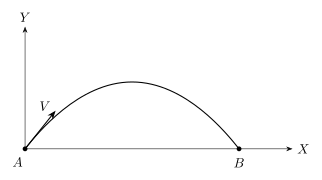
- TG EAPCET 2023Set ap-2023-05-10-FN1 markMCQQ.The velocity of a projectile at the initial point A is (4i+5j) ms−1, as shown in the given figure. Its velocity at the point B (in ms−1) [FIGURE] (A) 4i+5j (B) 4i−5j (C) −4i−5j (D) −4i+5j
›Reveal solutionSolution
In projectile motion, the horizontal component of velocity remains constant, while the vertical component reverses direction at the same height. At point B (same height as A), the velocity is 4i−5j m/s.
The key idea is that projectile motion is a combination of constant horizontal velocity (no horizontal acceleration) and uniformly accelerated vertical motion (due to gravity). At the same vertical height, the vertical speed is the same magnitude but opposite direction compared to the launch point.
-
Identify the components at point A
The initial velocity is vA=4i+5j m/s.
- Horizontal component: vx=4 m/s (constant throughout the flight).
- Vertical component: vy=5 m/s upward.
-
Understand what happens at point B
Point B is at the same height as point A (the figure shows a symmetric trajectory). In projectile motion, when the projectile returns to the same vertical level, the vertical velocity has the same magnitude but opposite direction (because gravity has acted symmetrically on the way up and down).
-
Apply the symmetry
- Horizontal velocity unchanged: vx=4 m/s (still positive i direction).
- Vertical velocity at B: vy=−5 m/s (downward, so −j). …
-
- TG EAPCET 2023Set eng-2023-05-14-AN1 markMCQQ.The displacement-time graphs of two moving particles make angles of 30∘ and 45∘ with the time axis. The ratio of their velocities is (A) 3:2 (B) 1:1 (C) 1:2 (D) 1:3
›Reveal solutionSolution
The slope of a displacement–time graph gives velocity; the ratio of the slopes (tan of the angles) yields the velocity ratio, which is 1:3.
The key idea is that on a displacement–time graph, the slope (gradient) at any point represents the instantaneous velocity. For straight-line graphs, the slope is constant, so the velocity is simply the tangent of the angle the line makes with the time axis. Therefore, comparing velocities reduces to comparing the tangents of those angles.
-
Identify the slopes.
The displacement–time graph of a particle moving with constant velocity is a straight line. The slope of that line is tanθ, where θ is the angle the line makes with the time axis (the positive t-axis).
- For the first particle, θ1=30∘, so its velocity v1=tan30∘.
- For the second particle, θ2=45∘, so its velocity v2=tan45∘.
-
Compute the tangents.
- tan30∘=31
- tan45∘=1
-
Form the ratio.
The ratio of their velocities is
-
- TG EAPCET 2022Set eng-2022-07-19-AN1 markMCQQ.Two cars, at a certain instant, are 50 km apart on a line running from south to north. The one farther north is moving west at 25 km/hr. The other is moving towards north at 25 km/hr. How long do they take to reach their distance of closest approach? (A) 30 min (B) 60 min (C) 85 min (D) 90 min
›Reveal solutionSolution
The problem reduces to finding when the relative velocity vector is perpendicular to the relative position vector. The time to closest approach is 1 hour (60 min), option (B).
Concept and Intuition
When two objects move with constant velocities, the distance between them changes in a way that depends on their relative motion. The distance of closest approach occurs at the instant when the relative velocity is perpendicular to the relative position vector. Why? Because if you imagine standing on one car and watching the other, the line joining you shrinks fastest when the other car moves directly toward you; once it starts moving "sideways" relative to that line, the distance begins to increase again. The turning point — the minimum separation — happens exactly when the relative velocity has no component along the line joining them.
So instead of solving messy coordinate equations, we work in the frame of one car and use the condition vrel⋅rrel=0.
Step-by-step solution
1. Set up coordinates and initial positions
Let the south–north direction be the y-axis (north positive) and the west–east direction be the x-axis (west positive, since both cars move west or north). Place the southern car at the origin at t=0:
-
Southern car (Car A): at (0,0), moving north at 25 km/hr.
vA=(0,25) km/hr.
-
Northern car (Car B): initially 50 km north of Car A, so at (0,50). It moves west at 25 km/hr.
vB=(25,0) km/hr (west is positive x).
2. Find relative position and relative velocity
Relative position of Car B with respect to Car A:
rBA(0)=(0−0,50−0)=(0,50) km.
Relative velocity of Car B with respect to Car A:
vBA=vB−vA=(25−0,0−25)=(25,−25) km/hr.
So Car B is moving, in Car A's frame, with a velocity that has equal components eastward (wait — careful: +x is west, so 25 km/hr west relative to Car A) and southward (since −25 in y means south). The magnitude of vBA is 252 km/hr, directed southeast.
3. Condition for closest approach
At time t, the relative position vector is:
rBA(t)=rBA(0)+vBAt=(0+25t,50−25t).
The distance d(t)=∣rBA(t)∣ is minimum when vBA⋅rBA(t)=0 (the relative velocity is perpendicular to the line joining them). …
-
- TG EAPCET 2021Set eng-2021-08-06-AN1 markMCQQ.A projectile object is thrown in the upward direction making an angle of 60∘ with the horizontal with velocity of 140 m/s. Then the time after which its velocity makes an angle 30∘ with the horizontal is (use g=10 m/s2) (A) 314 s (B) 73 s (C) 145 s (D) 37 s
›Reveal solutionSolution
The horizontal component of velocity remains constant in projectile motion, while the vertical component changes due to gravity. By relating the initial and final angles of the velocity vector to its components, we find the time when the velocity makes an angle of 30∘ with the horizontal is 314 s.
When an object is launched into the air, undergoing projectile motion, its trajectory is influenced only by gravity (neglecting air resistance). This means the acceleration acts purely in the vertical direction. A key insight here is that the horizontal component of the velocity remains constant throughout the flight, while the vertical component changes uniformly due to gravity. The angle the velocity vector makes with the horizontal depends on the ratio of its vertical and horizontal components.
Here's how we can determine the time:
- Resolve the initial velocity into components: The initial velocity u=140 m/s is given at an angle of θ0=60∘ with the horizontal. We break this down into its horizontal (ux) and vertical (uy) components:
ux=ucosθ0=140cos60∘=140×21=70 m/s
uy=usinθ0=140sin60∘=140×23=703 m/s
- Determine velocity components at time t: As discussed, the horizontal velocity component remains constant because there is no horizontal acceleration.
vx=ux=70 m/s
The vertical velocity component changes due to gravity. Since the object is thrown upwards, gravity acts downwards, reducing the upward velocity.vy=uy−gt
Substituting the values:vy=703−10t
- Relate the velocity components to the final angle: At some time t, the velocity vector v makes an angle θf=30∘ with the horizontal. The tangent of this angle is the ratio of the vertical velocity component to the horizontal velocity component: tanθf=vxvy …
🎓Unlock everything free for 14 days
- ✓Full step-by-step solutions
- ✓Concept-first explanations
- ✓Methods, shortcuts & mistakes
- ✓PYQ mapping + timed mock tests
Full access for 14 days. No credit card required.