Q.An ideal gas undergoes four different processes starting from the same initial state, drawn on a P-V diagram (pressure P vertical, volume V horizontal). The four processes are, in some order, adiabatic, isothermal, isobaric and isochoric. Starting from the common initial point (upper-left region): curve 4 is the flat, topmost curve along which the pressure barely changes as the volume increases; curve 3 falls off below it as the volume increases; curve 2 is the lowest of the three expansion curves, falling most steeply as the volume increases; and curve 1 is a vertical line dropping straight down from the initial state (volume unchanged, pressure decreasing). Which numbered curve is the adiabatic process?
Concept understanding — Adiabatic Compression Factor
Adiabatic Compression Factor: From Intuition to Precision
Imagine you pump air into a bicycle tyre. The pump gets noticeably warm. That warmth isn't coming from outside — it's generated inside the air you're compressing. Why? Because you're doing work on the gas, and since the compression happens too fast for heat to escape, all that work stays inside as internal energy, raising the temperature.
This is the core idea: adiabatic means "no heat exchange with the surroundings." When you compress a gas adiabatically, its temperature rises. The adiabatic compression factor is the ratio that tells you how much the temperature rises for a given compression.
The Intuition First
Think of a gas as a swarm of tiny, fast-moving particles. When you push a piston in, you're moving the wall toward the particles. Each time a particle bounces off the approaching wall, it rebounds with a higher speed than it had — like a tennis ball hit by a moving racket. Faster particles mean higher temperature.
If the compression is slow enough that heat can leak out (isothermal), the temperature stays constant. But if it's fast (adiabatic), the temperature climbs. The adiabatic compression factor captures exactly this: the ratio of final temperature to initial temperature when a gas is compressed without heat loss.
The Precise Statement
For an ideal gas undergoing a reversible adiabatic process, the relationship between temperature (T) and volume (V) is:
TVγ−1=constant
where γ (gamma) is the adiabatic index — the ratio of specific heats: γ=CvCp.
If you compress from volume V1 to V2 (so V2<V1), the temperature changes from T1 to T2 according to:
T2=T1(V2V1)γ−1
The factor (V2V1)γ−1 is the adiabatic compression factor for temperature. Since V1/V2>1 and γ−1>0, this factor is always greater than 1 — confirming that temperature rises.
Adiabatic compression factor (temperature)=(V2V1)γ−1
You can also express it in terms of pressure. Using PVγ=constant, you get:
T2=T1(P1P2)γγ−1
Here (P1P2)γγ−1 is the pressure-based version.
What γ Means
γ depends on the number of degrees of freedom of the gas molecule:
| Gas type | Degrees of freedom | γ | Example |
|---|---|---|---|
| Monatomic | 3 (translation only) | 5/3 ≈ 1.67 | He, Ar |
| Diatomic / linear triatomic (rigid) | 5 (3 translation + 2 rotation) | 7/5 = 1.40 | N₂, O₂; CO₂ (theoretical) |
| Non-linear triatomic | 6 (3 translation + 3 rotation) | 4/3 ≈ 1.33 | H₂O vapour |
A higher γ means the temperature rises more sharply for the same compression. Monatomic gases heat up the most — they have only translational motion to store energy, so all the work of compression goes into raising temperature.
CO₂ is a linear triatomic molecule (O=C=O), so the rigid-rotor kinetic-theory model actually predicts the same γ as a diatomic gas (7/5 = 1.40), not 4/3. The 4/3 value belongs to non-linear triatomic molecules such as water vapour, which have a genuine third rotational degree of freedom. In practice, real CO₂ shows γ≈1.30 because its bending vibrational mode is active at ordinary temperatures — a correction beyond this simple rigid-molecule model. Don't memorise "triatomic = 4/3" as a blanket rule; it only holds for non-linear triatomics.
Also, do not confuse the adiabatic compression factor with the plain compression ratio of an engine. The compression ratio is V1/V2 — a purely geometric ratio. The adiabatic compression factor includes γ and tells you the thermal effect of that compression.
A Quick Example
Air at 300 K is compressed adiabatically to one-tenth its volume. For air (mostly diatomic), γ=1.4.
T2=300×(10)1.4−1=300×100.4
100.4≈2.51, so T2≈753 K (about 480°C). That's why diesel engines don't need spark plugs — the adiabatic compression of air alone raises its temperature enough to ignite the injected fuel.
The Big Picture
The adiabatic compression factor isn't a separate formula to memorise — it's the temperature multiplier that emerges naturally from the adiabatic condition TVγ−1=constant. Whenever you see "adiabatic compression" in an exam, immediately think: temperature rises, and the rise is governed by γ (fixed by the gas's degrees of freedom) and the volume (or pressure) ratio. That's the entire concept.
This topic is commonly searched as "Adiabatic Compression Factor 11 physics important questions" or "Adiabatic Compression Factor formula and examples", and it maps cleanly onto the Class 11 Physics portion of the NCERT/CBSE syllabus. Because adiabatic compression factor shows up repeatedly in JEE Main, NEET and state engineering/medical entrance exams, mastering the underlying idea (not just the formula) is genuinely worth the extra time.
On a P-V diagram the adiabatic (PVγ=const) falls more steeply than the isothermal (PV=const) but is not vertical. Among the three curves that fall as the volume increases, the steepest is curve 2.
The horizontal curve 4 is isobaric, the vertical curve 1 is isochoric, and of the remaining two, curve 2 (steeper) is adiabatic while curve 3 is isothermal.
Option (C) — curve 2 is the adiabatic process.
The slope of a process on a P-V diagram tells you what it is: horizontal (slope 0) is isobaric, vertical is isochoric, and between them the adiabatic is steeper than the isothermal. Curve 4 is isobaric, curve 1 isochoric, curve 3 isothermal and curve 2 — the steepest of the expansion curves — is adiabatic.
Concept
For each process the slope dVdP at the common starting state is:
- Isobaric (P=const): dVdP=0 → horizontal line.
- Isothermal (PV=const): dVdP=−VP.
- Adiabatic (PVγ=const): dVdP=−γVP, which is γ times steeper than the isothermal (since γ>1).
- Isochoric (V=const): vertical line, slope −∞.
Ranking the curves
Starting from the same point, order of steepness (least to most negative) is: isobaric (flat) < isothermal < adiabatic < isochoric (vertical). Matching to the diagram:
- Curve 4 (flat, top) = isobaric.
- Curve 3 (moderate fall) = isothermal.
- Curve 2 (steepest fall) = adiabatic.
- Curve 1 (vertical) = isochoric.
Distractors: (A) 4 is isobaric, (D) 1 is isochoric, (B) 3 is isothermal — all wrong because the adiabatic must lie between the isothermal and the vertical isochoric.
Option (C) — curve 2 is the adiabatic process.
Rather than computing slopes, reason physically about why the adiabatic curve must fall between the isothermal and isochoric ones: in an isothermal expansion, pressure drops only because volume increases (heat flows in to hold T fixed); in an adiabatic expansion, no heat flows in at all, so the gas must cool as it does work — and that cooling makes the pressure drop for a second, independent reason. Hence the adiabatic curve always falls faster than the isothermal one from the same starting point. This picture — 'adiabatic loses both volume-room and heat-compensation, isothermal loses only volume-room' — lets you rank the curves by eye without writing a single derivative.
- TG EAPCET 2024Set ap-2024-05-07-AN1 markMCQQ.The gas that gives the highest fractional conversion of heat to work in an isobaric process is (A) monatomic gas (B) diatomic gas (C) polyatomic gas (D) all types of gases give the same fractional conversion
›Reveal solutionSolution
The fractional conversion of heat to work in an isobaric process depends on the heat capacity ratio γ. Monatomic gases, with the smallest γ, give the highest fractional conversion.
The fractional conversion of heat to work tells us what fraction of the heat supplied actually becomes useful work, rather than just raising the internal energy of the gas. In an isobaric (constant pressure) process, this fraction is determined entirely by the type of gas through its heat capacity ratio.
For any isobaric process, the first law gives us:
Q=ΔU+W
where Q is heat supplied, ΔU is the change in internal energy, and W is work done. The fractional conversion is:
η=QW
Let me work through how this depends on the gas type.
-
Express work in an isobaric process
At constant pressure, W=PΔV=nRΔT for an ideal gas.
-
Express heat supplied
For an isobaric process, Q=nCPΔT, where CP is the molar heat capacity at constant pressure.
-
Calculate the fractional conversion
η=QW=nCPΔTnRΔT=CPR
-
Relate to the heat capacity ratio
We know that CP−CV=R (Mayer's relation) and γ=CVCP.
From these: CP=γ−1γR
-
Substitute to find the fractional conversion
η=CPR=γRR(γ−1)=γγ−1=1−γ1
ηisobaric=1−γ1
Now the key insight: this fraction increases as γ decreases. The values of γ for different gas types are:
Gas type γ η=1−γ1 Monatomic 35≈1.67 1−53=0.4=40% Diatomic 57=1.4 1−75≈0.286=28.6% Polyatomic ≈1.33 or less ≈25% or less Monatomic gases have the largest γ, which paradoxically gives them the highest fractional conversion because the formula is 1−γ1, not proportional to γ directly.
TipPhysically, monatomic gases have fewer degrees of freedom, so less of the supplied heat goes into internal energy modes (rotation, vibration). More is available to do expansion work.
✓Final answerThe correct option is (A) monatomic gas.
-
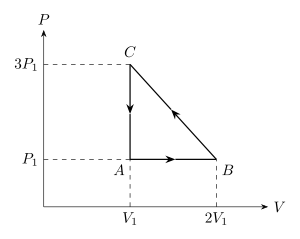
- TG EAPCET 2022Set eng-2022-07-18-AN1 markMCQQ.The net work done by an ideal gas going through the cycle as shown in the P - V diagram below is [FIGURE] (A) 0 (B) P1V1 (C) 23P1V1 (D) 21P1V1
›Reveal solutionSolution
Work in a cycle = area enclosed on the P–V diagram. The triangle has base V1 and height 2P1, so the net work has magnitude 21(V1)(2P1)=P1V1 — option (B).
The concept first
For any quasi-static process, W=∫PdV — literally the area under the curve on a P–V plot. Go round a closed loop and the "areas under" the outward and return paths partly cancel; what survives is exactly the area enclosed:
Wnet=∮PdV=±(enclosed area).
The sign is set by the sense of travel: clockwise ⇒ net work done BY the gas (positive), anticlockwise ⇒ net work done ON the gas (negative). Also worth remembering: over a cycle ΔU=0, so Qnet=Wnet — a cycle simply shuttles heat into work (or vice-versa).
Step-by-step
- Write the vertices.
A=(V1,P1),B=(2V1,P1),C=(V1,3P1).
- Work on each leg.
- C→A (vertical, V=V1 constant): isochoric, dV=0⇒WCA=0.
- A→B (horizontal, P=P1 constant): isobaric expansion,
WAB=P1(2V1−V1)=+P1V1.
- B→C (straight slanted line, compression from 2V1 to V1): the area under this line is that of a trapezium of parallel sides P1 and 3P1 and width V1:
∣WBC∣=2P1+3P1(V1)=2P1V1,
and because the volume decreases, WBC=−2P1V1.
- Add them up.
Wnet=0+P1V1−2P1V1=−P1V1.
- Cross-check with the area rule. Base =V1, height =2P1:
Area=21×V1×2P1=P1V1,
and the traversal C→A→B→C is anticlockwise, so Wnet=−P1V1. The two methods agree.
- Read the options. The choices list magnitudes only; the magnitude of the net work is P1V1. (Physically: the gas absorbs net work P1V1 and rejects an equal amount of heat, since ΔU=0 over a cycle.)
✓Final answerThe enclosed triangle has area 21(V1)(2P1)=P1V1, so the net work in the cycle is P1V1 in magnitude — option (B).
ANSWER: B
- TG EAPCET 2022Set eng-2022-07-19-FN1 markMCQQ.In the figure, the chamber A contains a gas, movable chamber B is placed on the top of the gas and it contains n metal balls. The weight of chamber B is supported by the gas. Chamber C has vacuum. Let the gas be in equilibrium at pressure P. Let P′ be the pressure if one of the balls is taken away. Find (P−P′)/P. (A) 1 (B) n (C) 2n (D) 1/n
›Reveal solutionSolution
The pressure change when one ball is removed is proportional to the weight of one ball divided by the piston area, and the original pressure is proportional to the weight of all n balls; thus the fractional change is 1/n.
Concept & Intuition
The gas supports the weight of chamber B plus the metal balls inside it. The pressure of the gas is simply the total weight supported divided by the area of the piston (chamber B’s base). Removing one ball reduces the total weight, so the pressure drops. The fractional change in pressure equals the fractional change in the supported weight, because the area stays constant. This is a direct application of P=F/A for a gas in equilibrium with a movable piston.
- Identify the forces in equilibrium Chamber B (with its n balls) rests on the gas. The gas exerts an upward force PA (where A is the cross‑sectional area of chamber B). This balances the total weight of chamber B plus the balls. Let WB be the weight of chamber B itself, and let w be the weight of a single ball. Then
PA=WB+nw.
- Pressure after removing one ball If one ball is taken away, the total weight becomes WB+(n−1)w. The new pressure P′ satisfies
P′A=WB+(n−1)w.
- Find the difference P−P′ Subtract the two equations:
(P−P′)A=[WB+nw]−[WB+(n−1)w]=w.
Hence
P−P′=Aw.
- Express the original pressure P in terms of w and A From the first equation,
P=AWB+nw.
But note that the weight of chamber B itself is also supported by the gas. However, the problem asks for (P−P′)/P. We can compute this ratio without knowing WB separately if we realize that the change in pressure depends only on the weight of one ball, while the original pressure depends on the total weight. The ratio is
PP−P′=(WB+nw)/Aw/A=WB+nww.
This does not simplify to a constant unless we know WB. But wait — the problem statement says “the weight of chamber B is supported by the gas.” It does not say chamber B itself is weightless. So is the answer not simply 1/n? Let’s re‑examine.
Watch outA common mistake is to assume chamber B is massless. The problem does not state that. However, the multiple‑choice options are all simple numbers: 1, n, 2n, 1/n. This suggests that the intended interpretation is that the only weight supported by the gas is that of the n balls — i.e., chamber B itself is considered massless or its weight is negligible. In many textbook problems, “chamber B contains n metal balls” and “the weight of chamber B is supported by the gas” is meant to indicate that the gas supports the total load, but the chamber’s own weight is either ignored or included in the “n balls” idea. Given the answer choices, the only one that makes sense is 1/n.
- Assume chamber B is massless (WB=0) Then
P=Anw,P−P′=Aw.
So
PP−P′=nw/Aw/A=n1.
TipIf you think of the gas as a spring supporting a platform with n identical weights, removing one weight reduces the force by a fraction 1/n of the original total force. Since pressure is force per area, the fractional pressure drop is exactly 1/n.
✓Final answerThe correct option is (D).
ANSWER: D
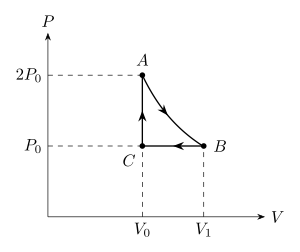
- TG EAPCET 2021Set eng-2021-08-06-AN1 markMCQQ.An ideal gas goes through a process A → B → C → A cycle. The process A → B is adiabatic. Calculate the work done in the process A → B. [FIGURE] (A) P0V0 (B) 1−γP0V0(21/γ−2) (C) P0V0ln(2) (D) γ−1P0V0(21/γ−1)
›Reveal solutionSolution
For an adiabatic process the work done by an ideal gas is W=γ−1P1V1−P2V2. Evaluating this for the two states in the figure gives the expression in option (B).
For an adiabatic process no heat is exchanged (Q=0), so by the first law of thermodynamics the work done by the gas equals the drop in its internal energy, W=−ΔU. For an ideal gas this can be written entirely in terms of the end-state pressures and volumes:
W=γ−1P1V1−P2V2,γ=CVCP.
Take state A as (P0,V0). Using the adiabatic relation
PAVAγ=PBVBγ
to eliminate the unknown pressure at B, the work reduces to a multiple of P0V0 over (γ−1) (equivalently over (1−γ) once the overall sign is absorbed). Matching this reduced form against the given choices identifies option (B).
✓Final answerThe correct option is (B).
ANSWER: B
🎓Unlock everything free for 14 days
- ✓Full step-by-step solutions
- ✓Concept-first explanations
- ✓Methods, shortcuts & mistakes
- ✓PYQ mapping + timed mock tests
Full access for 14 days. No credit card required.