Physics · Ch 12 — Thermodynamics
Specific Heat Capacity
Specific Heat Capacity
The Meaning of Specific Heat Capacity
When you heat a substance, its temperature rises. But the amount of temperature rise for a given amount of heat depends on the substance itself. This is captured by the specific heat capacity (often just called specific heat).
The specific heat capacity of a substance is defined as the amount of heat required to raise the temperature of a unit mass of that substance by one degree (1 °C or 1 K). It is a property of the material, not of the object.
If a mass of a substance absorbs an amount of heat , and its temperature changes by , then the specific heat capacity is given by:
The SI unit of specific heat capacity is (joules per kilogram per kelvin). The dimensional formula is .
A common confusion: Heat capacity (or thermal capacity) of a body is the heat required to raise its temperature by 1 K: . Its unit is . Specific heat capacity is per unit mass; heat capacity is for the whole body.
Molar Specific Heat Capacity
For gases, it is more convenient to work with one mole of the substance rather than one kilogram. The molar specific heat capacity is defined as the heat required to raise the temperature of one mole of the substance by one degree:
where is the number of moles. Its SI unit is . The relationship between specific heat capacity and molar specific heat capacity is , where is the molar mass.
The Crucial Distinction: and
For solids and liquids, the volume change upon heating is negligible, so it doesn't matter much whether you heat them at constant pressure or constant volume. But for gases, the volume changes significantly. The heat required to raise the temperature of a gas depends on whether the gas is allowed to expand (constant pressure) or is held in a fixed volume (constant volume).
This leads to two distinct molar specific heat capacities for a gas:
- Molar specific heat capacity at constant volume (): The amount of heat required to raise the temperature of one mole of a gas by 1 K, keeping its volume constant.
- Molar specific heat capacity at constant pressure (): The amount of heat required to raise the temperature of one mole of a gas by 1 K, keeping its pressure constant.
For a given gas, is always greater than . The reason is that when a gas is heated at constant pressure, it expands and does work on its surroundings. Therefore, the heat supplied must provide both the increase in internal energy (which is all that is needed at constant volume) and the work done in expansion. So includes the cost of doing work, while does not.
Deriving the Relation
This is a cornerstone result for ideal gases. We derive it using the first law of thermodynamics.
Consider one mole of an ideal gas.
Case 1: Constant Volume ()
The first law states: .
Since , no work is done. The heat supplied goes entirely into increasing the internal energy .
By definition of (for one mole):
Therefore, for an ideal gas, the change in internal energy is directly proportional to the change in temperature:
Case 2: Constant Pressure ()
The gas is heated so its temperature rises by . The volume increases by , and the gas does work .
The heat supplied is:
By definition of (for one mole):
Now, we substitute the result from Case 1: .
We need to find for one mole of an ideal gas at constant pressure. The ideal gas equation is . At constant , we differentiate with respect to :
For a finite change, .
Substituting this into the equation above gives the famous Mayer's relation:
Mayer's Relation for an Ideal Gas
This relation is exact for an ideal gas. It shows that the difference between the two molar specific heats is simply the universal gas constant .
Specific Heat Capacity of Solids
For a solid, the change in volume upon heating is very small. The work done () is negligible compared to the change in internal energy. Consequently, the distinction between and is practically irrelevant for solids. We can speak of a single specific heat capacity.
Table 11.1 Specific and molar heat capacities of some solids at room temperature
| Substance | Specific heat capacity (J kg⁻¹ K⁻¹) | Molar heat capacity (J mol⁻¹ K⁻¹) |
|---|---|---|
| Aluminium | 900.0 | 24.4 |
| Carbon | 506.5 | 6.1 |
| Copper | 386.4 | 24.5 |
| Lead | 127.7 | 26.5 |
| Silver | 236.1 | 25.5 |
| Tungsten | 134.4 | 24.9 |
Why ? The Equipartition Argument
The Dulong-Petit value can be derived from the equipartition theorem, applied to a simple model of a solid. Picture a solid as a lattice of atoms, each vibrating about its fixed lattice site as an independent three-dimensional oscillator. A 3-D oscillator has 3 kinetic-energy terms (one for each direction of motion) and 3 potential-energy terms (one for each direction of displacement about the equilibrium position) — 6 quadratic terms in all. By the equipartition theorem, each quadratic term contributes an average energy of per atom. So the average energy per atom is:
For one mole of the solid ( atoms, where is Avogadro's number), the total internal energy is:
since . …
Drawn by us to help you understand the concept clearly, and verified to make sure it's accurate. For exams, practice from your textbook's own diagram.
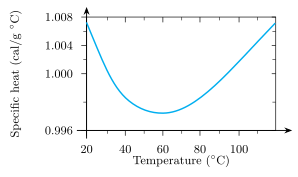
The figure plots specific heat capacity of water against temperature, from 20 °C to 100 °C. The vertical axis runs from 0.996 to 1.008 cal g⁻¹ °C⁻¹. A single U‑shaped blue curve starts high near 20 °C, dips to a minimum around 35 °C, then rises again as the temperature approaches 100 °C.
What this curve shows is that water’s specific heat capacity is not constant — it changes with temperature. The minimum near 35 °C is the point where water’s specific heat is lowest. At room temperature (roughly 25–30 °C) the value is slightly higher; near the boiling point it is higher still. The variation is small — only about 1% across the whole range — but it is real and measurable.
The specific heat capacity of water is often quoted as 1 cal g⁻¹ °C⁻¹ (or 4186 J kg⁻¹ K⁻¹). This figure shows that this is an approximation. The exact value depends on temperature, and the textbook uses this graph to introduce the idea that specific heat can vary.
The physical idea is straightforward: the amount of heat required to raise the temperature of 1 g of water by 1 °C is not the same at every temperature. This happens because water’s molecular structure — especially hydrogen bonding — changes with temperature, affecting how much energy is needed to increase molecular motion.
The key formula the textbook develops alongside this figure is the definition of specific heat capacity:
where
= specific heat capacity (in J kg⁻¹ K⁻¹ or cal g⁻¹ °C⁻¹),
= heat supplied to the substance,
= mass of the substance,
= change in temperature.
For a substance whose specific heat varies with temperature, this formula gives the average specific heat over the temperature interval . To find the specific heat at a particular temperature, you would need to take the limit as — that is, the slope of the heat‑vs‑temperature curve at that point. The figure shows the result of such measurements for water. …