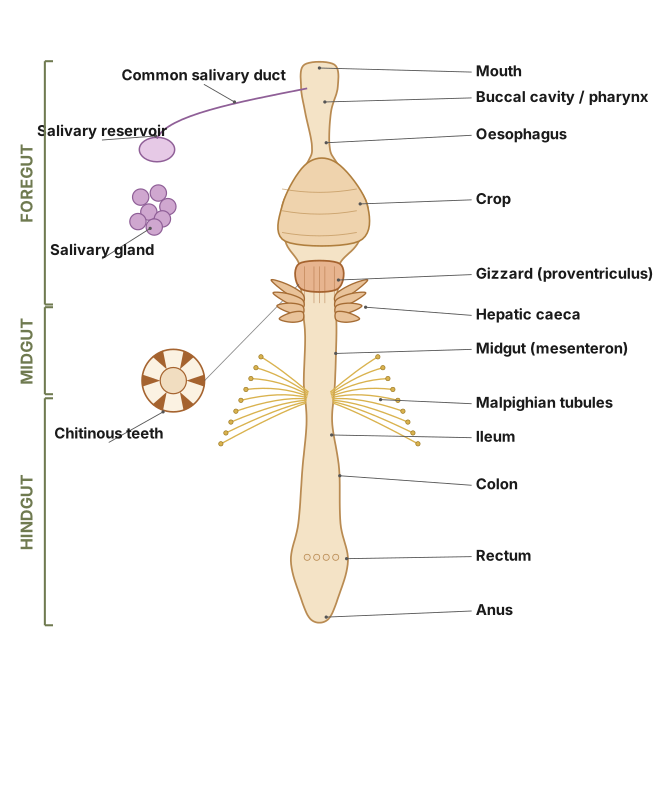
Q.Describe the digestive system of the cockroach with the help of a labelled diagram.
Overview and salivary apparatus
The cockroach's digestive system centres on the alimentary canal, a single coiled tube from mouth to anus divided into three regions of different embryonic origin. Digestion begins even before swallowing: a pair of lobed salivary glands, lying over the crop in the third-fourth abdominal segments, secretes saliva rich in amylase (starting starch digestion) and mucus (lubrication); this saliva is held in paired salivary reservoirs between meals and delivered through a single median salivary duct, opening near the hypopharynx, onto food as it is chewed.
Foregut — intake, storage and grinding
The foregut (ectodermal, cuticle-lined) comprises the buccal cavity, a short muscular pharynx, the narrow oesophagus, the large thin-walled crop (which stores gorged food), and the muscular gizzard (proventriculus). The gizzard's inner cuticular lining is folded into six ridges bearing hard cuticular teeth, which the gizzard's powerful muscles work against one another to grind the stored food into a fine pulp before releasing it, through a valve, into the midgut. No enzymatic digestion occurs in the cuticle-lined foregut beyond this mechanical grinding.
Midgut — enzymatic digestion and absorption
The midgut (endodermal, with no cuticular lining) is the true site of chemical digestion. At its junction with the foregut, 6-8 finger-like gastric caecae project forward, secreting digestive enzymes (amylase, protease, lipase) and assisting absorption. Because the unlined midgut epithelium would otherwise be abraded by the coarsely ground food, midgut cells secrete a thin, permeable peritrophic membrane around the food mass — protecting the epithelium while still allowing enzymes to act on the enclosed food and digested nutrients to pass back through it for absorption into the haemolymph.
Hindgut — waste passage and water reabsorption
The hindgut (again cuticle-lined) is divided into a narrow ileum, a wider colon, and a terminal rectum opening at the anus. Numerous thread-like Malpighian tubules (excretory organs) empty nitrogenous waste (chiefly uric acid) into the gut at the midgut-hindgut junction, so excretory and undigested material travel together through the hindgut. The rectal wall bears specialised rectal papillae that actively reabsorb water (and salts) from this material, so the residue is finally voided as a dry faecal pellet — an important water-conservation adaptation for a scavenging insect.
[!ANSWER] The cockroach's digestive system comprises the salivary apparatus (glands, reservoirs, duct) supplying amylase-and-mucus saliva, and the three-part alimentary canal: the cuticle-lined foregut (oesophagus, crop, gizzard) for storage and mechanical grinding, the unlined midgut (with gastric caecae and a protective peritrophic membrane) for enzymatic digestion and absorption, and the cuticle-lined hindgut (ileum, colon, rectum) for passage of waste and, critically, water reabsorption in the rectum.
Unlock everything free for 14 days
- Full step-by-step solutions
- Concept-first explanations
- Methods, shortcuts & mistakes
- PYQ mapping + timed mock tests
Full access for 14 days. No credit card required.