Commerce · Ch 1 — Financial Markets
Dematerialisation and Depositories
Dematerialisation and Depositories
Since all trading is now done through computer terminals, the buying and selling of securities is settled through an electronic book-entry form. This is done mainly to eliminate problems such as theft, fake or forged transfers, transfer delays and the paperwork associated with share certificates held in physical form.
Dematerialisation is the process by which securities held by an investor in physical form are cancelled, and the investor is given an electronic entry or number so that the holding can be kept as an electronic balance in an account. For this, the investor opens a demat account with an organisation called a depository. Almost all Initial Public Offers are now issued in demat form, and the great majority of turnover is settled by delivery in demat form. Holding shares in demat form is convenient — it is just like a bank account; physical shares can be converted into electronic form and electronic holdings reconverted into physical certificates (rematerialisation). Demat securities can even be pledged or hypothecated to obtain loans, and there is no danger of loss, theft or forgery.
Working of the demat system
- A depository participant (DP) — a bank, broker or financial services company — is identified.
- An account-opening form and documentation (PAN card details, photograph, power of attorney) are completed.
- The physical certificate is given to the DP along with a dematerialisation request form.
- If shares are applied for in a public offer, the DP and demat account details are given, and the shares on allotment are automatically credited to the demat account.
- If shares are to be sold through a broker, the DP is instructed to debit the account with the number of shares.
- The broker instructs its DP to deliver the shares to the stock exchange.
- The broker receives payment and pays the seller for the shares sold.
- All these transactions are completed within two days, i.e., delivery of shares and receipt of payment are on a T+2 settlement basis.
Depository
Just as a bank keeps money in safe custody for its customers, a depository keeps securities in electronic form on behalf of the investor. In a depository a securities account can be opened, shares deposited, and withdrawn or sold at any time, with instructions to deliver or receive shares given on the investor's behalf. It is a technology-driven electronic storage system with no paperwork.
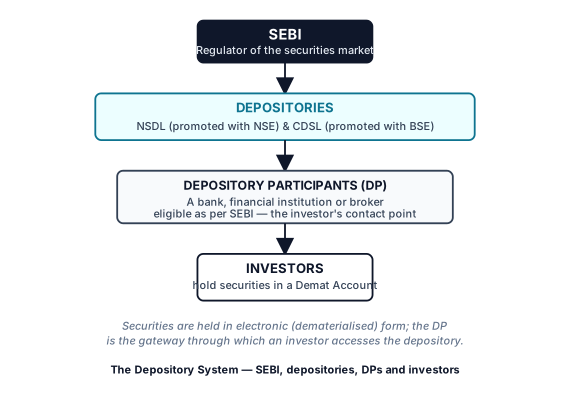
Drawn by us to help you understand the concept clearly, and verified to make sure it's accurate. For exams, practice from your textbook's own diagram.
Our own schematic of how the depository system is organised. SEBI regulates the two depositories — NSDL (promoted along with the NSE) and CDSL (promoted along with the BSE). Investors do not deal with a depository directly; they reach it through a Depository Participant (DP) — a bank, financial institution or broker eligible as per SEBI — who maintains the investor …
…