Commerce · Ch 6 — Nature and Significance of Management
Characteristics of Coordination
Characteristics of Coordination
Concept First
Coordination is the essence of management — it is not a separate function but the thread that binds all management functions together. Without coordination, individual efforts become scattered, departments work at cross-purposes, and the organisation fails to achieve its goals efficiently. Think of coordination as the glue that holds the entire management process together.
Features of Coordination
The textbook identifies six key characteristics of coordination:
1. Coordination Integrates Group Efforts
- Coordination unifies unrelated or diverse interests into purposeful work activity.
- It gives a common focus to group effort so that performance happens as planned and scheduled.
- Without coordination, individual efforts remain isolated and may not contribute to organisational goals.
2. Coordination Ensures Unity of Action
- The purpose of coordination is to secure unity of action in realising a common purpose.
- It acts as the binding force between departments, ensuring all action is aimed at achieving organisational goals.
- Example: At Namchi Designer Candles, the production and sales departments must coordinate so that production happens according to market demand.
3. Coordination is a Continuous Process
- Coordination is not a one-time function but a continuous process.
- It begins at the planning stage and continues through to controlling.
- Example: Smita plans her Diwali collection in June itself. She must then ensure adequate workforce and continuously monitor production. Her marketing department must also be briefed in time to prepare promotional campaigns.
4. Coordination is an All-Pervasive Function
- Coordination is required at all levels of management because activities of various departments are interdependent.
- It integrates efforts of different departments and different levels.
- Example: The purchase, production, and sales departments must be coordinated. The purchase department procures fabric, which becomes the basis for production, and then sales can take place. If fabric is of inferior quality or not according to production specifications, sales will decline.
- Without coordination, there is overlapping and chaos instead of harmony and integration.
5. Coordination is the Responsibility of All Managers
- Coordination is the function of every manager in the organisation.
- Top-level managers coordinate with subordinates to ensure overall policies are carried out.
- Middle-level management coordinates with both top-level and first-line managers.
- Operational-level management coordinates activities of workers to ensure work proceeds according to plans.
6. Coordination is a Deliberate Function
- A manager must coordinate efforts of different people in a conscious and deliberate manner.
- Even when members willingly cooperate, coordination gives direction to that willing spirit.
- Cooperation without coordination may lead to wasted effort.
- Coordination without cooperation may lead to dissatisfaction among employees.
- Coordination is not a separate function of management, but its very essence — like a thread in a garland, it is part of all management functions.
Importance of Coordination
Coordination is important because it integrates the efforts of individuals, departments, and specialists. The primary reason for coordination is that departments and individuals in the organisation are interdependent — they depend on each other for information and resources to perform their activities. Managers need to reconcile differences in approach, timing, effort, or interest, and harmonise individual goals with organisational goals.
The textbook highlights three main reasons why coordination is important:
1. Growth in Size
- As organisations grow, the number of employees increases.
- It becomes difficult to integrate their efforts and activities.
- All individuals differ in habits of work, background, approaches to situations, and relationships with others.
- Employees may have their own individual goals that differ from organisational goals.
- Therefore, for organisational efficiency, it is important to harmonise individual goals and organisational goals through coordination.
2. Functional Differentiation
- Functions of an organisation are divided into departments, divisions, and sections (e.g., finance, production, marketing, human resources).
- Each department may have its own objectives, policies, and style of working.
- Example of conflict: The marketing department may want to increase sales by 10 per cent by offering discounts, but the finance department may not approve because it means loss of revenue.
- Such conflicts arise because each unit performs activities in isolation from others, and barriers between departments become more rigid.
- However, all departments are interdependent and need information from each other.
- Coordination links the activities of various departments to focus on common organisational goals.
3. Specialisation
- Modern organisations are characterised by a high degree of specialisation.
- Specialisation arises from the complexities of modern technology and the diversity of tasks to be performed. …
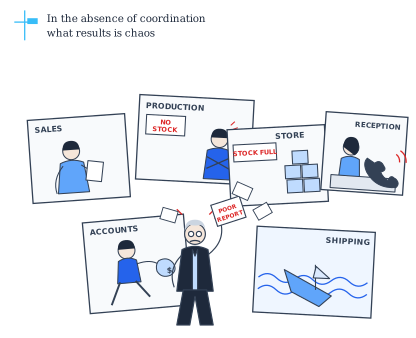
Drawn by us to help you understand the concept clearly, and verified to make sure it's accurate. For exams, practice from your textbook's own diagram.
What the Figure Shows
The NCERT figure is a multi-panel illustration of an office and factory floor, deliberately drawn to show disorganisation. It is not a single scene but a collage of separate, unconnected areas:
- Sales – a desk with papers, likely a salesperson looking busy but isolated.
- Production – a prominent "No Stock" sign, indicating a shortage that halts work.
- Store – a "Stock Full" sign, showing excess inventory that cannot be used.
- Accounts – a desk with ledgers, working in its own silo.
- Reception – a front desk with a phone ringing unanswered.
- Shipping – a shipment sinking (literally a ship or crate going down), symbolising failed delivery.
In the centre or top, a manager is angrily throwing a "Poor Report" — papers fly through the air. Every department is busy, but no one is talking to each other. The arrows or implied relationships show overlapping, clashing efforts: production has no stock, store has too much, sales cannot sell, shipping fails, and the manager’s report is useless because the chaos is already complete.
What It Teaches About Coordination
The figure directly illustrates the textbook’s key point: "In the absence of coordination what results is chaos." It shows the opposite of coordination — each department works for itself, not for the common goal. The result is:
- Overlapping efforts (e.g., store full while production empty)
- Clashing activities (e.g., sales pushing products that cannot be made)
- Wasted resources (e.g., stock piling up, shipment sinking)
- No unity of action — everyone pulls in different directions
This chaos is exactly what coordination prevents. Coordination integrates group efforts (unifies departments), ensures unity of action (all work toward the same goal), and is continuous (not a one-time fix). Without it, even hard work leads to failure — as the figure’s sinking shipment and angry manager show.