Commerce · Ch 9 — Planning
Concept
Concept
The Concept of Planning
Planning means deciding in advance what to do and how to do it. It is one of the basic managerial functions. Before a manager begins any task, they must first formulate an idea of how to work on it. This makes planning closely connected with creativity and innovation — it is not just routine paperwork, but a thinking process that shapes the future course of action.
A manager must first set objectives. Only then will they know where the organisation needs to go. Planning seeks to bridge the gap between where the organisation currently is and where it wants to reach. It is an activity performed by managers at all levels — from top management to first-line supervisors.
Because planning involves making a choice from alternative courses of action, it requires decision-making. In essence, planning involves two things: setting objectives, and developing appropriate courses of action to achieve those objectives.
Why Objectives Matter
Objectives provide direction for all managerial decisions and actions. They give a rational approach for achieving predetermined goals. When objectives are clearly set, every member of the organisation knows what they are working towards. These goals become the targets against which actual performance is later measured.
Planning is concerned with both ends and means — that is, what is to be done and how it is to be done.
The Role of Time
Every plan must have a given time frame. Time is a limited resource and needs to be used judiciously. If the time factor is ignored, conditions in the environment may change, and all business plans could become useless. A plan that is not acted upon or implemented is a futile exercise.
A Comprehensive Definition
Putting all these ideas together, planning can be defined as: …
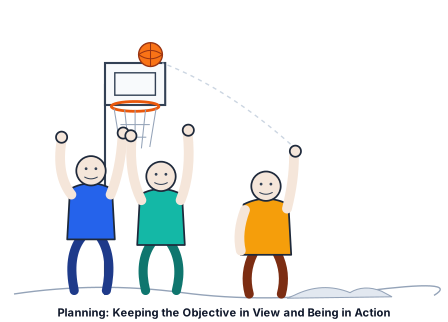
Drawn by us to help you understand the concept clearly, and verified to make sure it's accurate. For exams, practice from your textbook's own diagram.
What the Figure Shows
Three boys are caught mid-play under a basketball hoop. The ball is already in the air, just above the rim, about to drop through the net. Two of the boys are jumping together right beneath the hoop, arms stretched upward toward the ball; a third boy stands a little to the side, also reaching up, having just released the shot moments earlier.
What It Teaches
The chapter opens by defining planning as deciding in advance what to do and how to do it — bridging the gap between where an organisation is and where it wants to go. This figure captures that idea in miniature. Every player on the court keeps the same objective fixed firmly in view — the ball going through the hoop — while being in action at the same time: jumping, reaching, moving toward that goal rather than merely intending to reach it. That is exactly the twin thread running through the concept of planning: it is concerned with both ends and means — what …