Commerce · Ch 9 — Planning
Features of Planning
Features of Planning
Planning is not a random or haphazard activity. Every organisation, whether a small shop or a large company like Polaris, follows a set pattern when it plans. The features of planning explain what planning really is — its nature and its scope. These features are the fundamental truths about planning that you will see reflected in real business situations.
(i) Planning focuses on achieving objectives
Every organisation is created with a general purpose. Planning translates that purpose into specific, concrete goals. A plan lays out exactly what goals must be achieved and what activities will be undertaken to reach them. Without a clear objective, planning has no meaning. It is a purposeful activity — its entire value lies in contributing to the achievement of predetermined organisational goals. In the Polaris example, the company's objective was to increase capacity by 1500–2000 professionals within six months. The plan was built entirely around that target.
(ii) Planning is a primary function of management
This is often called the primacy of planning. Planning provides the foundation for every other managerial function — organising, staffing, directing, and controlling. All other functions are performed within the framework set by the plans. For instance, you cannot decide how many people to hire (staffing) or what tasks to assign (organising) unless you first know what the plan is. Planning, therefore, comes first. However, this does not mean planning is more important than other functions — all functions are interrelated and equally important. But planning is the starting point, the base on which everything else is built.
(iii) Planning is pervasive
Planning is required at every level of management and in every department of the organisation. It is not a job reserved only for top management or for a particular department like marketing or finance. The scope of planning, however, differs at different levels:
- Top management undertakes planning for the entire organisation — strategic, long-term plans.
- Middle management does departmental planning — for example, the production department head plans for the production targets.
- Lower-level management (supervisors) do day-to-day operational planning — scheduling work for a shift or a week.
So, while planning is everywhere, the nature and time horizon of the plan changes as you move down the hierarchy.
(iv) Planning is continuous
Plans are made for a specific period — a month, a quarter, or a year. Once that period ends, the plan is no longer valid. A new plan must be drawn up based on the new requirements and the changed future conditions. This creates a planning cycle: a plan is framed, it is implemented, and then it is followed by another plan, and so on. Planning never stops; it is an ongoing, repetitive process.
(v) Planning is futuristic
Planning is essentially about looking ahead. Its purpose is to prepare the organisation for future events so that it can meet them effectively and to its best advantage. This involves peeping into the future, analysing what might happen, and predicting it. Planning is therefore a forward-looking function that relies on forecasting. For example, a business firm uses sales forecasting — predicting how much it will sell next year — as the basis for preparing its annual production and sales plan. Without forecasting, planning would be blind.
(vi) Planning involves decision making …
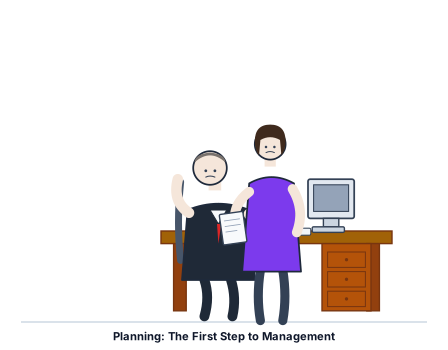
Drawn by us to help you understand the concept clearly, and verified to make sure it's accurate. For exams, practice from your textbook's own diagram.
What the Figure Shows
A man sits at an office desk, one hand raised thoughtfully to his temple, looking down at a plan spread open in front of him. Beside him, a woman stands holding a sheet of paper, also looking at the same plan. A desktop computer sits on the desk nearby.
What It Teaches
This figure sits directly under the last of the seven Features of Planning — (vii) Planning is a mental exercise. Planning requires the application of the mind: foresight, intelligent imagination and sound judgement. It is basically an intellectual activity of thinking rather than doing, because planning determines the action to be taken later; the thinking itself must be orderly and logical, based on analysis of facts and forecasts rather than guesswork or wishful thinking. The manager's reflective pose over the spread-out plan — not yet acting, still weighing it over — is exactly that: planning as the …