Commerce · Ch 11 — Staffing
Staffing Process
Staffing Process
The Staffing Process: An Overview
The staffing function is not a single action but a sequence of linked steps. Its core purpose is to ensure that the right number of people, with the right skills, are in the right jobs at the right time. This need arises when a new business starts, an existing one expands, or when employees leave, retire, are promoted, transferred, or fired.
Finding the right person for a job is difficult. Even when hundreds apply for a single vacancy, the challenge is to select the most suitable candidate. Once selected, a new employee needs orientation to understand how the organisation works, and often training in specific skills. For instance, a person hired by a BPO for being fluent in English and extroverted will still need training in the specific business processes, telephone etiquette, and diction before they can start work. The employee's first experiences during orientation and placement create a lasting first impression. Even after joining, employees need ongoing training to upgrade their knowledge and prepare for higher responsibilities.
The staffing process, therefore, is a cycle that includes the following stages.
(i) Estimating Manpower Requirements
This is the foundation of the entire process. It is not just about counting how many people are needed, but also what type of people are needed. When designing an organisational structure, various job positions are created. Each job requires a person with a specific set of educational qualifications, skills, and experience.
Manpower planning must also consider encouraging diversity in the workforce — including women, persons from backward communities, and persons with special abilities (physically challenged, visually or hearing impaired). This requires redefining manpower requirements to be inclusive.
We are encouraged to include women, persons from backward communities, and persons with special abilities (physically challenged, visually or hearing impaired) in responsible positions. Can you think why we should encourage such a diversity in the workforce?
Operationally, this stage involves two analyses:
- Workload Analysis: This assesses the number and types of human resources needed to perform various jobs and achieve organisational objectives.
- Workforce Analysis: This reveals the number and types of human resources already available within the organisation.
Comparing the two analyses shows whether the organisation is understaffed, overstaffed, or optimally staffed. Neither overstaffing nor understaffing is desirable. Overstaffing may require employee removal or transfer; understaffing triggers the recruitment process.
Neither over-staffing nor under-staffing is a desirable situation for an organisation. Can you think why?
Before recruitment can begin, the manpower requirements must be translated into two key documents:
- Job Description: A clear statement of the tasks, duties, and responsibilities of a specific job.
- Job Specification (or Candidate Profile): The desired qualifications, experience, personality characteristics, and skills required of the person who will fill the job.
This information becomes the basis for finding potential employees.
(ii) Recruitment
Recruitment is the process of searching for prospective employees and stimulating them to apply for jobs in the organisation.
The information from the job description and candidate profile is used to create a 'situations vacant' advertisement. This can be displayed on the factory gate, published in print media, or flashed on electronic media. The essential objective of recruitment is to create a large pool of prospective job candidates.
Both internal sources (existing employees) and external sources (outside the organisation) are explored. Internal sources are used to a limited extent, while external sources are used for fresh talent and a wider choice.
(iii) Selection
Selection is the process of choosing from among the pool of prospective candidates developed during recruitment.
Even for highly specialised jobs with a narrow choice, a rigorous selection process serves two important purposes:
- It ensures the organisation gets the best among the available candidates.
- It enhances the self-esteem and prestige of those selected, conveying the seriousness with which the organisation operates.
The rigour of selection involves a series of tests and interviews. Those who successfully pass these stages are offered an employment contract — a written document containing the offer of employment, terms and conditions, and the date of joining.
(iv) Placement and Orientation
Joining a job marks the beginning of an employee's socialisation at the workplace.
- Orientation is the process of introducing the selected employee to other employees and familiarising them with the rules, policies, and culture of the organisation. The employee is given a brief presentation about the company, introduced to superiors, subordinates, and colleagues, and taken around the workplace. This is a crucial step that can have a lasting impact on the employee's decision to stay and on their job performance.
- Placement refers to the employee actually occupying the position or post for which they have been selected.
(v) Training and Development
People seek a career, not just a job. To provide opportunities for growth, organisations facilitate employee learning. This can be done through in-house training centres or through alliances with external training and educational institutes.
Training and development benefits both the employee and the organisation. When employee motivation is high and their competencies are strengthened, they perform better, contributing to organisational effectiveness and efficiency. By offering career advancement opportunities, organisations can attract and retain talented people.
(vi) Performance Appraisal
After a period of training and on-the-job experience, employee performance needs to be evaluated.
Performance appraisal means evaluating an employee's current and/or past performance against certain predetermined standards. The employee must know what these standards are, and the superior must provide feedback on the employee's performance. The process includes defining the job, appraising performance, and providing feedback.
(vii) Promotion and Career Planning
Organisations must address career-related issues and promotional avenues for their employees. Managers need to design activities that serve employees' long-term interests and encourage them to grow and realise their full potential.
Promotions refer to being placed in positions of increased responsibility. They usually mean more pay, greater responsibility, and higher job satisfaction.
(viii) Compensation
All organisations need to establish wage and salary plans for their employees. …
Drawn by us to help you understand the concept clearly, and verified to make sure it's accurate. For exams, practice from your textbook's own diagram.
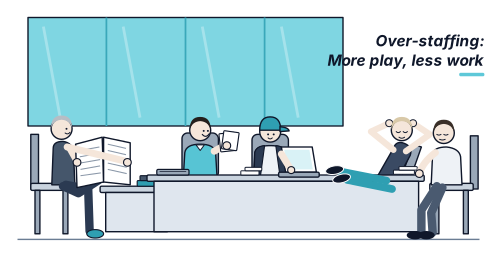
The textbook illustrates estimating manpower requirements with a small cartoon captioned "Over-staffing: More play, less work" — an office where several employees sit around idle — one reclining with his hands behind his head, one reading a newspaper, others chatting — with little real work to do.
The point ties directly to the workload-analysis/workforce-analysis comparison discussed just above: when an organisation has more people on its rolls than the actual workload needs, individual employees end up with too little real work. The visible symptoms are exactly what the cartoon shows — idle time, casual conversation, low urgency — and the organisational cost is real: higher wage and salary outlay for no matching output, and eventually a drop in productivity per employee. This is why the textbook treats overstaffing as just as undesirable as un …