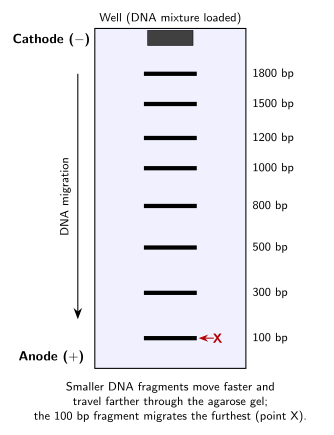
Q.Observe the given picture carefully. A mixture of DNA with fragments ranging from 100 base pairs to 1800 base pairs were separated by electrophoresis on agarose gel with the following arrangement :
You're viewing a preview — the full solution, concept, methods & PYQ mapping are locked.
Start your 14-day free trial to unlock the full solution →Ethidium bromide stains all DNA fragments, making them visible under UV light as distinct bands. In gel electrophoresis, 100 base pair fragments appear at 'X' (the furthest point) because they are the smallest and migrate fastest; this result is achieved by running the gel for sufficient time and using an appropriate gel concentration.
Gel electrophoresis is a fundamental technique used to separate DNA fragments based on their size. DNA, being negatively charged due to its phosphate backbone, migrates towards the positive electrode (anode) when an electric field is applied across an agarose gel. The gel acts as a molecular sieve, impeding the movement of larger fragments more than smaller ones.
(a) Result of Staining with Ethidium Bromide
When the agarose gel, after electrophoresis, is stained with ethidium bromide, all the DNA fragments present in the gel will become visible as distinct bands under ultraviolet (UV) light.
- Ethidium Bromide's Action: Ethidium bromide is a fluorescent dye that has the ability to intercalate, or wedge itself, between the stacked base pairs of the DNA double helix. This binding is non-specific, meaning it binds to all DNA fragments regardless of their sequence or size.
- Fluorescence under UV Light: Once bound to DNA, ethidium bromide absorbs UV radiation and re-emits it as visible orange-red light. This property makes the DNA-ethidium bromide complex fluorescent.
- Visibility of Bands: Therefore, when the stained gel is placed on a UV transilluminator, all the separated DNA fragments, ranging from 100 base pairs to 1800 base pairs, will fluoresce and appear as bright orange-red bands. The intensity of a band is generally proportional to the amount of DNA present in that band.
Ethidium bromide is a potent mutagen and should be handled with extreme care, always using appropriate protective equipment.
(b) Changes Made and Reason for Band at 'X'
The setup was modified to obtain a band with 100 base pairs at 'X'. This implies that 'X' represents the furthest point of migration on the gel, closest to the positive electrode.
Why the band appeared at 'X':
The fundamental principle of agarose gel electrophoresis dictates that DNA fragments migrate through the gel matrix at different rates based on their size.
- Negative Charge of DNA: All DNA fragments carry a net negative charge, causing them to move towards the positive electrode.
- Size-Dependent Migration: Smaller DNA fragments encounter less resistance from the pores of the agarose gel matrix compared to larger fragments. Consequently, smaller fragments travel faster and migrate further down the gel towards the positive electrode.
- Smallest Fragment: In the given mixture, the 100 base pair fragments are the smallest. Therefore, they will exhibit the highest mobility and migrate the furthest distance on the gel, appearing at the position marked 'X'.
Changes made to the previous design to get a band at 'X': …
Unlock everything free for 14 days
- Full step-by-step solutions
- Concept-first explanations
- Methods, shortcuts & mistakes
- PYQ mapping + timed mock tests
Full access for 14 days. No credit card required.