Botany · Ch 6 — Principles of Inheritance and Variation
Incomplete Dominance
Incomplete Dominance
Incomplete dominance is a pattern of inheritance where the heterozygous condition produces a phenotype that is a blend — intermediate between the two homozygous parents. It was first noticed when Mendel's laws were tested on other plants beyond the pea.
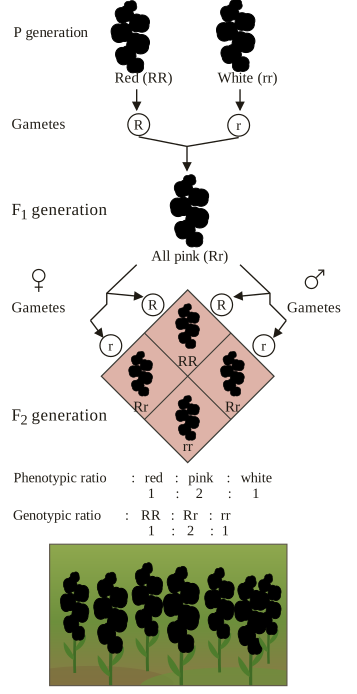
The classic example is flower colour in the snapdragon (Antirrhinum sp., also called dog flower). When a true-breeding red-flowered plant (RR) is crossed with a true-breeding white-flowered plant (rr), the F₁ generation is not red or white — it is pink (Rr). This pink colour is intermediate, not like either parent.
When the F₁ pink plants are self-pollinated, the F₂ generation shows the following result:
| Genotype | Phenotype | Ratio |
|---|---|---|
| RR | Red | 1 |
| Rr | Pink | 2 |
| rr | White | 1 |
The genotypic ratio is exactly 1:2:1, just as in any Mendelian monohybrid cross. But the phenotypic ratio has changed from the usual 3:1 (dominant : recessive) to 1:2:1. This happens because the allele R is not completely dominant over r. The heterozygote Rr can be distinguished from both homozygotes — it is pink, not red or white.
In incomplete dominance, the phenotype of the heterozygote is intermediate between the two homozygotes. The phenotypic ratio in F₂ becomes 1:2:1 instead of 3:1.
What exactly is dominance? To understand this, we need to look at what a gene does. Every gene carries information to produce a particular trait. In a diploid organism, there are two copies of each gene — a pair of alleles. These two alleles need not be identical; one may be different due to changes (mutations) that modify the information it carries.
Consider a gene that contains the information for producing an enzyme. The normal allele produces the normal enzyme needed to convert a substrate S into a product. The modified allele could be responsible for one of three things:
- (i) producing the normal enzyme or a less efficient enzyme,
- (ii) producing a non-functional enzyme,
- (iii) producing no enzyme at all.
In case (i), the modified allele is functionally equivalent to the unmodified allele — it still results in the transformation of substrate S, so the phenotype remains the same. Such equivalent allele pairs are very common. …
Drawn by us to help you understand the concept clearly, and verified to make sure it's accurate. For exams, practice from your textbook's own diagram.
Figure 4.6 shows the complete monohybrid cross for flower colour in snapdragon (Antirrhinum), laid out in the standard three-generation pedigree format. At the top, the two true-breeding parents are shown: a red-flowered plant labelled RR and a white-flowered plant labelled rr. A horizontal line connects them to indicate a cross. Below them, the F₁ generation is represented by a single plant with pink flowers, labelled Rr. An arrow from the F₁ plant loops back to itself, indicating self-pollination. Below that, the F₂ generation is shown as three plants in a row: a red-flowered plant labelled RR, a pink-flowered plant labelled Rr, and a white-flowered plant labelled rr. The relative sizes or positions of these three F₂ plants are often drawn to reflect the 1:2:1 ratio — one red, two pink, one white — but the key point is that all three phenotypes appear, and each corresponds exactly to its genotype.
The figure teaches the central lesson of incomplete dominance: the heterozygote (Rr) is not identical to either homozygote. Instead, it produces an intermediate phenotype — pink — because the red allele (R) does not completely mask the white allele (r). This is why the phenotypic ratio in the F₂ generation is 1 red : 2 pink : 1 white, matching the genotypic ratio 1 RR : 2 Rr : 1 rr. In a standard Mendelian monohybrid cross with complete dominance, the heterozygote would look like the dominant homozygote, giving a 3:1 phenotypic ratio. Here, because the heterozygote is visibly distinct, the ratio changes. …