Botany · Ch 6 — Principles of Inheritance and Variation
Linkage and Recombination
Linkage and Recombination
Morgan’s work on Drosophila (the fruit fly) revealed a major exception to Mendel’s law of independent assortment. He carried out dihybrid crosses involving sex-linked genes — for instance, crossing yellow-bodied, white-eyed females with brown-bodied, red-eyed males, and then intercrossing the F₁ progeny. The results were striking: the two genes did not segregate independently, and the F₂ ratio deviated sharply from the expected 9:3:3:1.
Morgan and his team already knew that these genes were located on the X chromosome. They quickly realised that when two genes in a dihybrid cross lie on the same chromosome, the parental combinations of traits appear far more often in the offspring than the non-parental (recombinant) combinations. Morgan attributed this to the physical association of genes on a chromosome — he coined the term linkage for this physical association, and recombination for the generation of non-parental gene combinations.
Linkage is the physical association of genes on the same chromosome. Recombination is the production of new gene combinations (non-parental types) due to crossing over.
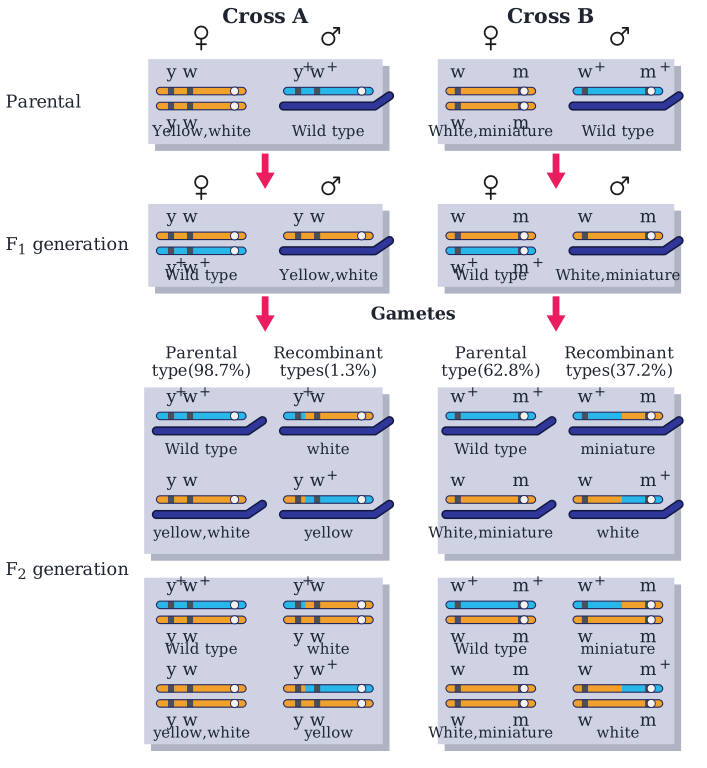
Morgan and his group also discovered that not all linked genes behave the same way. Some genes are very tightly linked — they show very low recombination. Others are loosely linked — they show higher recombination. For example, the genes for white eyes and yellow body in Drosophila are very tightly linked, with only 1.3 per cent recombination. In contrast, the genes for white eyes and miniature wings show 37.2 per cent recombination.
The strength of linkage between yellow (y) and white (w) is much higher than between white (w) and miniature wing (m). Tight linkage means low recombination; loose linkage means higher recombination.
Morgan’s student Alfred Sturtevant took this further. He used the frequency of recombination between gene pairs on the same chromosome as a measure of the distance between those genes. By doing this, he was able to ‘map’ the positions of genes on a chromosome — creating the first genetic maps.
Today, genetic maps are extensively used as a starting point in sequencing whole genomes. The Human Genome Sequencing Project, for instance, relied on such maps.
| Cross | Genes involved | Recombination frequency | Nature of linkage |
|---|---|---|---|
| Cross A | y (yellow) and w (white) | 1.3% | Very tight linkage |
Drawn by us to help you understand the concept clearly, and verified to make sure it's accurate. For exams, practice from your textbook's own diagram.
Figure 4.11 presents two separate dihybrid crosses in Drosophila, drawn side by side as Cross A and Cross B. Each cross shows a pair of homologous X chromosomes from the female parent (the male in Drosophila is XY and does not undergo crossing over in meiosis, so recombination is studied in females). The chromosomes are drawn as two parallel horizontal lines, with the positions of the two genes marked as small vertical tick marks along each chromosome. The wild-type allele is indicated with a superscript + (e.g., y+, w+, m+), while the mutant allele is written without the superscript (e.g., y, w, m).
In Cross A, the two genes are yellow (body colour, symbol y) and white (eye colour, symbol w). The female parent is heterozygous: one X chromosome carries y+ and w (wild-type body, white eyes), the other X carries y and w+ (yellow body, wild-type red eyes). The two genes are shown very close together on the chromosome — they are tightly linked. Below the chromosome pair, the figure shows the four possible gamete types produced by the female after meiosis: two parental types (y+ w and y w+) in large proportion, and two recombinant types (y+ w+ and y w) in very small proportion. The arrow or bracket between the genes indicates that crossing over between them is rare, so recombination frequency is low (1.3% in Morgan’s actual data).
In Cross B, the genes are white (eye colour, w) and miniature (wing size, m). Again the female is heterozygous: one X carries w+ and m (red eyes, miniature wings), the other X carries w and m+ (white eyes, normal wings). Here the two genes are drawn farther apart on the chromosome — they are loosely linked. The four gamete types are again shown: two parental types (w+ m and w m+) and two recombinant types (w+ m+ and w m). But now the recombinant types appear in a much larger proportion, because crossing over occurs more frequently between genes that are farther apart. Morgan observed 37.2% recombination for this pair. …