Q.A, B, D are three independently assorting genes with their recessive alleles a, b, d, respectively. A cross was made between individuals of Aa bb DD genotype with aa bb dd. Find out the type of genotypes of the offspring produced.
🔒You're viewing a preview — the full solution, concept, methods & PYQ mapping are locked.
🔒 Start your 14-day free trial to unlock the full solution →Concept understanding — Mendelian Genetics Basics
Mendelian Genetics Basics
Imagine you have a box of coloured beads — red and white. If you pick one bead from the box, you get either red or white. Now imagine that the colour of your eyes, or the shape of your earlobe, is decided by something like that: a tiny "packet" inside your cells that comes in two versions, and you inherit one from each parent. That is the core idea of Mendelian genetics.
The everyday intuition
You have probably noticed that children often look like their parents — same hair colour, same dimples, same height. But they are never exact copies. Why? Because each parent contributes half of the "instructions" for building a child. Those instructions come in pairs, one from mother and one from father. Sometimes one instruction overrides the other; sometimes they blend. Gregor Mendel, a 19th-century monk, figured out the rules by watching pea plants — tall vs short, yellow vs green seeds — and counting what appeared in the next generation.
The precise meaning
Mendelian genetics is the study of how traits are passed from parents to offspring through genes. A gene is a unit of heredity — a stretch of DNA that codes for a specific characteristic, like flower colour. Each gene comes in different versions called alleles. For every gene, you inherit two alleles: one from your mother, one from your father.
If the two alleles are identical, you are homozygous for that trait. If they are different, you are heterozygous. In a heterozygous pair, one allele may be dominant — it shows up in the appearance — and the other recessive — it stays hidden unless both alleles are recessive.
Mendel's key insight was that traits are not blended like paint. Instead, alleles remain separate and are passed on intact. A recessive allele can skip a generation and reappear later, unchanged.
Why it matters
Mendelian genetics is the foundation of modern biology. It explains:
- Why some diseases run in families (like cystic fibrosis or sickle-cell anaemia)
- How plant and animal breeders create new varieties
- Why you might have your grandmother's eyes but not your mother's
The NCERT textbook states that Mendel's work established the laws of inheritance — the Law of Dominance, the Law of Segregation, and the Law of Independent Assortment. These laws describe how alleles separate during the formation of eggs and sperm, and how different genes are inherited independently of one another.
Key terms at a glance
- Gene: a unit of heredity on a chromosome
- Allele: a variant form of a gene
- Dominant: the allele that expresses itself even when paired with a different allele
- Recessive: the allele that expresses itself only when paired with an identical recessive allele
- Homozygous: having two identical alleles for a gene
- Heterozygous: having two different alleles for a gene …
When two parents are crossed, each passes one allele per gene to the offspring. Here the first parent is Aa bb DD and the second is aa bb dd.
For gene A: The first parent can give either A or a (heterozygous), while the second parent can only give a (homozygous recessive). The offspring will therefore be either Aa or aa in a 1:1 ratio.
For gene B: Both parents are bb (homozygous recessive), so every offspring must receive b from each parent. All offspring will be bb.
For gene D: The first parent is DD (homozygous dominant) and can only give D, while the second parent is dd and can only give d. Every offspring will be Dd. …
Crossing Aa bb DD x aa bb dd yields only two genotypes — Aa bb Dd and aa bb Dd — in a 1:1 ratio. The B locus stays bb and the D locus is uniformly Dd; only the A locus segregates.
Gametes each parent can form
- Parent 1 (Aa bb DD): heterozygous at A (gives A or a), homozygous at B (only b) and D (only D) -> gametes A b D and a b D.
- Parent 2 (aa bb dd): homozygous recessive at every locus -> a single gamete a b d.
Combining the gametes, locus by locus
Because the genes assort independently, each locus can be analysed on its own:
- A locus: Aa x aa -> Aa or aa (1 : 1)
- B locus: bb x bb -> bb in every offspring
- D locus: DD x dd -> Dd in every offspring …
Use the forked-line (branch) method instead of a combined table: draw the A locus outcome first (Aa or aa, each 1/2), then branch each of those into the B-locus outcome (always bb), then branch each again into the D-locus outcome (always Dd). Multiplying probabilities along each completed branch reproduc …
Showing the 12 most recent of 16 on this concept.
- TG EAPCET 2026Set ap-2026-05-04-AN1 markMCQQ.Match the following List-1 List-2 A. linkage I. Common in cancer cells B. Recombination II. Parental gene combination C. Point mutation III. Non parental combination D. Chromosomal aberration IV. Sickle cell anemia V. Multiple phenotypes The correct answer is (A) A-II, B-V, C-IV, D-I (B) A-II, B-III, C-IV, D-I (C) A-I, B-IV, C-III, D-V (D) A-II, B-III, C-IV, D-V
›Reveal solutionSolution
This question tests your understanding of key genetic terms and their real-world examples. The correct mapping is A-II, B-III, C-IV, D-I, which corresponds to option (B).
Let’s build the intuition first. Each term in List-1 describes a specific genetic phenomenon, and List-2 gives either a cause, a consequence, or a classic example. The trick is to match each term with its most direct and well-known association — not just any possible connection, but the one that is textbook-standard for Indian exams.
-
A. Linkage → II. Parental gene combination
Linkage means genes located close together on the same chromosome tend to be inherited as a block. They do not assort independently, so the offspring often get the same combination of alleles that the parents had — hence “parental gene combination.” This is the classic definition: linkage preserves parental combinations unless crossing over breaks them.
-
B. Recombination → III. Non-parental combination
Recombination is the process that shuffles alleles between homologous chromosomes during meiosis (crossing over). The result is new combinations of genes that were not present together in either parent — these are called “non-parental” or “recombinant” combinations. So B matches III directly.
-
C. Point mutation → IV. Sickle cell anemia
A point mutation is a change in a single nucleotide base pair. Sickle cell anemia is the classic example: a single base substitution in the beta-globin gene (GAG → GTG) changes glutamic acid to valine, causing the disease. This is the go-to example in every syllabus.
-
D. Chromosomal aberration → I. Common in cancer cells …
-
- TG EAPCET 2026Set ap-2026-05-04-AN1 markMCQQ.Study the following and choose the correct statements I. If a single gene influences more than one phenotypic trait, it is called pleiotropy II. Due to absence of antibodies anti A and anti B, the persons with AB blood group are described as universal recipients III. Inheritance of sex linked dominant traits follow cris cross inheritance IV. If sex index ratio is 0.33, then sexual phenotype of Drosophila is intersex (A) I, III (B) II, IV (C) III, IV (D) I, II
›Reveal solutionSolution
Statements I and II are correct; III and IV are wrong, so the correct set is I, II — option (D).
I – Correct. When a single gene affects several phenotypic traits, the effect is called pleiotropy (e.g. the sickle-cell gene affects RBC shape, anaemia and malaria resistance). This is the standard definition.
II – Correct. Blood group AB carries both A and B antigens but no anti-A or anti-B antibodies in the plasma, so such persons can receive blood of any ABO type without agglutination — they are universal recipients.
III – Incorrect. Criss-cross inheritance (father → daughter → grandson) is the pattern of X-linked recessive traits. X-linked dominant traits do not show criss-cross inheritance — an affected father passes the trait to all his daughters but to none of his sons. …
- TG EAPCET 2025Set ap-2025-04-29-AN1 markMCQQ.The disease sickle cell anemia is caused by substitution of ‘A’ by ‘B’ of ‘C’ globin chain of hemoglobin molecule. Identify A, B and C respectively (A) A – Alanine, B – Glutamic acid, C – Beta (B) A – Glutamic acid, B – Valine, C – Beta (C) A – Valine, B – Glutamic acid, C – Alpha (D) A – Valine, B – Serine, C – Beta
›Reveal solutionSolution
Sickle cell anemia results from a point mutation where glutamic acid is replaced by valine at the sixth position of the beta-globin chain of hemoglobin. The correct option is (B).
Sickle cell anemia is a classic example of a genetic disorder caused by a single point mutation, leading to a change in a single amino acid in a protein. This seemingly small change has profound effects on the structure and function of hemoglobin, ultimately altering the shape of red blood cells and causing the disease's characteristic symptoms. Understanding this specific molecular change is key to grasping the pathology of sickle cell anemia.
Here's a breakdown of the molecular basis of sickle cell anemia:
-
Hemoglobin Structure: Hemoglobin is the oxygen-carrying protein in red blood cells. In adults, it is primarily composed of four polypeptide chains: two alpha (α) globin chains and two beta (β) globin chains. Each chain contains a heme group that binds oxygen.
-
The Genetic Defect: Sickle cell anemia arises from a mutation in the gene that codes for the beta-globin chain. This is a point mutation, meaning a change in a single nucleotide base pair in the DNA sequence.
-
Identifying the Globin Chain (C): The specific mutation responsible for sickle cell anemia occurs in the beta (β) globin chain. This is why the disease is often referred to as a "beta-thalassemia" in some contexts, though sickle cell anemia has its own distinct pathology.
-
Identifying the Amino Acid Substitution (A and B):
- At the sixth position of the beta-globin chain, the normal amino acid is glutamic acid (A). Glutamic acid is a hydrophilic (water-loving) amino acid.
- Due to the point mutation (a change from GAG to GTG in the mRNA codon), valine (B) is substituted in place of glutamic acid at this sixth position. Valine is a hydrophobic (water-fearing) amino acid. …
-
- TG EAPCET 2025Set ap-2025-04-29-AN1 markMCQQ.Study the following and identify the correct combinations(A) I & III (B) II & III (C) II & IV (D) I & II
Phenomenon Phenotypic ratio Genotypic ratio I Co-dominance 1:2:1 1:2:1 II Incomplete dominance 3:1 1:2:1 III Monohybrid test cross 1:1 1:1 IV Dihybrid test cross 9:3:3:1 1:1:1:1 ›Reveal solutionSolution
Only I (co-dominance: 1:2:1 and 1:2:1) and III (monohybrid test cross: 1:1 and 1:1) are stated correctly. Incomplete dominance gives a 1:2:1 phenotypic ratio (not 3:1), and a dihybrid test cross gives 1:1:1:1 phenotypes (not 9:3:3:1). Hence the correct combination is I & III — option (A).
The concept first
Two different things are being asked in every row:
- The genotypic ratio comes only from which gametes combine — it is pure Punnett-square bookkeeping and is the same whatever the dominance relationship is.
- The phenotypic ratio depends on how the alleles interact:
- Complete dominance — the heterozygote looks like the dominant homozygote, so two genotype classes fuse and 1:2:1 collapses to 3:1.
- Incomplete dominance — the heterozygote is intermediate (e.g. pink Mirabilis), so nothing fuses and the phenotypic ratio equals the genotypic ratio, 1:2:1.
- Co-dominance — the heterozygote shows both phenotypes together (e.g. blood group AB), so again nothing fuses and the phenotypic ratio equals the genotypic ratio, 1:2:1.
So the memorable rule is: in both incomplete dominance and co-dominance, phenotypic ratio = genotypic ratio =1:2:1.
Step-by-step
Step 1 — Row I: Co-dominance.
Cross IAIB×IAIB (or any co-dominant heterozygote × itself). Gametes from each parent: 21IA, 21IB.
Offspring=41IAIA:21IAIB:41IBIB=1:2:1 (genotypic)
Because the heterozygote expresses both alleles, it is its own distinct phenotype, so the phenotypic ratio is also 1:2:1. The row says 1:2:1 and 1:2:1 — correct.
Step 2 — Row II: Incomplete dominance.
Rr×Rr gives genotypes RR:Rr:rr=1:2:1 — the row's genotypic ratio is right. But the heterozygote Rr is pink, distinct from red RR and white rr, so the phenotypes are 1 red :2 pink :1 white =1:2:1. The row prints 3:1, which is the complete-dominance result. Row II is incorrect.
Step 3 — Row III: Monohybrid test cross.
A test cross is heterozygote × recessive homozygote: Aa×aa. Gametes: 21A,21a from one side; only a from the other.
Offspring=21Aa:21aa=1:1 …
- TG EAPCET 2025Set ap-2025-04-29-FN1 markMCQQ.Study the following and identify the correct statements: I. The alleles IA and IB regarding blood groups are dominant over IO, and IA and IB are co-dominant II. In some fishes, reptiles and birds, females are heterogametic (ZW) and males are homogametic (ZZ). III. Genic balance theory states that Y-chromosome is essential for determination of sex in male Drosophila IV. Person with O blood group are called universal donors because their RBC contain both antigens A and B. (A) I, II (B) III, IV (C) I, III (D) II, IV
›Reveal solutionSolution
The question tests four statements on genetics — blood group inheritance, sex determination in ZW systems, the genic balance theory in Drosophila, and the basis of universal donation. Statements I and II are correct; III and IV are false. The correct option is (A).
Let’s examine each statement carefully, one by one.
-
Statement I: The alleles IA and IB regarding blood groups are dominant over IO, and IA and IB are co-dominant.
This is textbook ABO blood group genetics. The IA and IB alleles each produce a specific antigen (A and B respectively), while IO produces no functional antigen. Both IA and IB are dominant over IO, so a person with genotype IAIO has blood group A, and IBIO gives group B. When both IA and IB are present together, both antigens are expressed equally — that is co-dominance, giving blood group AB.
Statement I is correct.
-
Statement II: In some fishes, reptiles and birds, females are heterogametic (ZW) and males are homogametic (ZZ).
In the ZW sex-determination system, the female has two different sex chromosomes (ZW) and the male has two identical ones (ZZ). This is indeed found in birds, many reptiles, and some fishes. The opposite (XX/XY) system is typical in mammals and Drosophila.
Statement II is correct.
-
Statement III: Genic balance theory states that Y-chromosome is essential for determination of sex in male Drosophila.
This is a classic trap. In Drosophila melanogaster, sex is determined not by the presence of a Y chromosome, but by the ratio of X chromosomes to autosomes (the X:A ratio). The Y chromosome in Drosophila is required only for male fertility, not for male determination. The genic balance theory, proposed by Calvin Bridges, explicitly states that the Y chromosome is not essential for maleness — a fly with XXY is female, and a fly with XO (no Y) is male but sterile.
Statement III is false. …
-
- TG EAPCET 2025Set ap-2025-04-30-FN1 markMCQQ.Consider the following statements Assertion (A): Skin colour in human beings is a polygenetic trait. Reason (R): Human skin colour is controlled by cumulative effect of genes. The correct answer is (A) Both (A) and (R) are true, (R) is the correct explanation of (A) (B) Both (A) and (R) are true, (R) is not the correct explanation of (A) (C) (A) is true, but (R) is false (D) (A) is false, but (R) is true
›Reveal solutionSolution
Skin colour is polygenic because multiple genes act cumulatively/additively; R explains A.
Assertion: Skin colour in human beings is a polygenic trait - a phenotype governed by more than one gene, showing a continuous gradation of expression rather than discrete classes. …
- TG EAPCET 2024Set ap-2024-05-07-AN1 markMCQQ.Observe the phenotypic ratios given below A. 9:3:3:1 B. 1:2:1 C. 1:1 Arrange the ratios in the order of monohybrid test cross; incomplete dominance; and dihybrid cross (A) B-C-A (B) C-B-A (C) B-A-C (D) A-B-C
›Reveal solutionSolution
A monohybrid test cross gives 1:1 (ratio C), incomplete dominance gives 1:2:1 (ratio B) and a dihybrid cross gives 9:3:3:1 (ratio A). In the order asked, that is C – B – A, i.e. option (B).
The concept first
Ratios in genetics are not things to be memorised as trivia — each one is generated by a specific set of gametes, and if you can build the Punnett square you never have to remember anything.
Two questions decide every ratio:
- How many gene pairs are segregating? One → monohybrid arithmetic. Two → multiply the two monohybrid outcomes (Law of Independent Assortment).
- Is the heterozygote phenotypically identical to the dominant homozygote, or does it look different? If identical → complete dominance, and genotypes collapse into fewer phenotypes. If different → incomplete dominance, and no collapsing happens.
Step-by-step
- Monohybrid test cross → ratio C (1:1). A test cross means crossing an individual of unknown genotype with the homozygous recessive. For a heterozygote:
Tt×tt
Gametes: T and t from the first parent; only t from the second.
Offspring: 21Tt (tall) and 21tt (dwarf).
∴phenotypic ratio=1:1⇒C
This is exactly why a test cross works — a heterozygote betrays itself by producing recessive offspring.
- Incomplete dominance → ratio B (1:2:1). In Mirabilis jalapa (four o'clock plant), RR = red, rr = white, and Rr is pink — its own distinct phenotype. Selfing the F1:
Rr×Rr→1RR:2Rr:1rr=1 red:2 pink:1 white
Because the heterozygote is visibly different, the 2Rr class does not merge with the 1RR class. So the phenotypic ratio equals the genotypic ratio:
1:2:1⇒B …
- TG EAPCET 2024Set ap-2024-05-07-AN1 markMCQQ.If karyotype of a Drosophila is AA-XXXY, its sexual phenotype is (A) Matafemale (B) Metamale (C) Intersex (D) Female with Y chrosome
›Reveal solutionSolution
In Drosophila, sex is determined by the ratio of X chromosomes to sets of autosomes (the sex index). For a karyotype of AA-XXXY, the sex index is 1.5, which results in a Metafemale phenotype.
The sexual phenotype of Drosophila is determined by a mechanism known as the genic balance theory, proposed by C.B. Bridges. Unlike humans where the presence of a Y chromosome primarily determines maleness, in Drosophila, the balance between the number of X chromosomes and the number of sets of autosomes dictates the sex. The Y chromosome in Drosophila is primarily involved in male fertility, not sex determination itself.
This balance is quantified by the "sex index," which is calculated as the ratio of the number of X chromosomes (X) to the number of sets of autosomes (A).
Sex Index (I)=Number of sets of autosomesNumber of X chromosomes
Different values of this index correspond to different sexual phenotypes:
- I=1.0: Normal Female
- I>1.0: Metafemale (also called Superfemale)
- I=0.5: Normal Male
- I<0.5: Metamale (also called Supermale)
- 0.5<I<1.0: Intersex
Let's apply this concept to the given karyotype.
-
Identify the number of X chromosomes: The given karyotype is AA-XXXY. Here, 'XXXY' indicates there are three X chromosomes. So, X=3.
-
Identify the number of sets of autosomes: The 'AA' in the karyotype represents two sets of autosomes. So, A=2. …
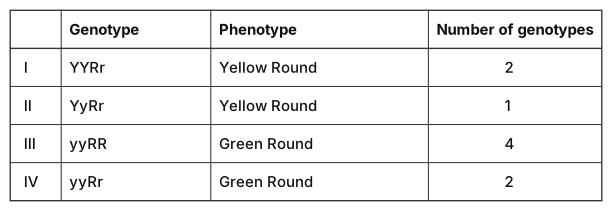
- TG EAPCET 2024Set ap-2024-05-07-FN1 markMCQQ.The table given below is related to checker board of dihybrid F2 progeny of Mendel’s experiment. Identify correct combinations Genotype | Phenotype | Number of genotypes I YYRr Yellow Round 2 II YyRr Yellow Round 1 III yyRR Green Round 4 IV yyRr Green Round 2 Options : (A) I and II (B) II and IV (C) III and IV (D) I and IV
›Reveal solutionSolution
In the 16-square dihybrid Punnett square, YYRr appears 2 times and yyRr appears 2 times (both correct), while YyRr appears 4 (not 1) and yyRR appears 1 (not 4). The correct combinations are I and IV — option (D).
The concept first
The dihybrid F2 is nothing more than two independent monohybrid crosses multiplied together — that is Mendel's Law of Independent Assortment in action. YyRr makes four gamete types, YR, Yr, yR, yr, in equal 1:1:1:1 proportion, so the checker board has 4×4=16 boxes.
Because the loci are independent, the number of boxes for any genotype is just the product of its two single-locus frequencies out of 4:
homozygote at a locus→1/4,heterozygote at a locus→2/4
So:
- homozygous at both loci → 1×1=1 box,
- heterozygous at one locus → 2×1=2 boxes,
- heterozygous at both loci → 2×2=4 boxes. That single rule answers the whole question without drawing anything.
Step-by-step
- Write the full F2 genotypic ratio (the 9 genotypes in 16 boxes):
1YYRR:2YYRr:2YyRR:4YyRr:1YYrr:2Yyrr:1yyRR:2yyRr:1yyrr
(These 16 collapse into the familiar phenotypic 9:3:3:1.) …
- TG EAPCET 2023Set ap-2023-05-10-FN1 markMCQQ.Study the following tables and match the correct combination for the dihybrid F2 progeny Genotype Phenotype Genotypes Number I YYRr Yellow round 2 II YyRr Yellow round 1 III yyRR Green round 4 IV yyRr Green round 2 (A) III and IV (B) II and IV (C) I and II (D) I and IV
›Reveal solutionSolution
In a dihybrid cross (YyRr × YyRr), the F2 progeny follow a 9:3:3:1 phenotypic ratio. The table lists genotypes and their counts; we must match each row to the correct number of individuals. The correct combination is I and IV.
The question tests your understanding of Mendelian dihybrid inheritance — specifically, the genotypic and phenotypic ratios that arise from a cross between two double heterozygotes (YyRr×YyRr). The key is to recall that each trait (seed colour and seed shape) segregates independently, giving a 9:3:3:1 phenotypic ratio in the F2 generation. But here, the table gives specific genotypes and asks you to verify the number of individuals with that genotype.
Let’s break it down step by step.
-
Set up the cross.
Both parents are YyRr (yellow, round). The gametes produced are YR, Yr, yR, yr in equal proportions (1:1:1:1). The Punnett square for a dihybrid cross has 16 equally likely combinations.
-
Determine the expected genotypic frequencies.
For any one gene pair, the monohybrid ratio is 1:2:1 (e.g., YY:Yy:yy). Since the two genes assort independently, the combined genotypic ratio is the product of the two monohybrid ratios.
- For colour: YY (1), Yy (2), yy (1).
- For shape: RR (1), Rr (2), rr (1). Multiply these to get the 16-cell Punnett square frequencies. For example, YYRR appears 1×1=1 time, YyRr appears 2×2=4 times, etc.
-
Match each row in the table to the expected count.
- Row I: YYRr — genotype YY (1) × Rr (2) = 2 individuals. The table says 2. Correct.
- Row II: YyRr — Yy (2) × Rr (2) = 4 individuals. The table says 1. Incorrect. …
-
- TG EAPCET 2023Set ap-2023-05-10-AN1 markMCQQ.Study the following and pick up the correct combinations S.No. Hormone Gland Effect of Hyper / Hyposecretion I Vasopressin Pituitary gland Diabetes insipidus II Calcitonin Parathyroid gland Cretinism III Cortisol Adrenal gland Addison's disease IV Insulin Pancreas Diabetes insipidus (A) I, II (B) III, IV (C) I, III (D) II, IV
›Reveal solutionSolution
The question tests your knowledge of hormones, their source glands, and the diseases caused by their abnormal secretion. Only combinations I (Vasopressin → Pituitary → Diabetes insipidus) and III (Cortisol → Adrenal → Addison's disease) are correct, so the answer is option (C).
The key here is to match each hormone with its correct gland and then with the specific disorder caused by either hypo- or hypersecretion. Many students mix up glands (like parathyroid vs. thyroid) or confuse diseases (like diabetes insipidus vs. mellitus). Let’s check each row carefully.
-
Row I: Vasopressin – Pituitary gland – Diabetes insipidus
Vasopressin (also called antidiuretic hormone, ADH) is secreted by the posterior pituitary. Its main job is to increase water reabsorption in the kidneys. When secretion is too low (hyposecretion), the kidneys cannot concentrate urine, leading to diabetes insipidus — excessive dilute urine and thirst. This match is correct.
-
Row II: Calcitonin – Parathyroid gland – Cretinism
Calcitonin is actually secreted by the thyroid gland (parafollicular cells), not the parathyroid. The parathyroid glands secrete parathyroid hormone (PTH). And cretinism is caused by hyposecretion of thyroid hormone (thyroxine) during childhood, not by calcitonin issues. So both the gland and the disease are wrong. This row is incorrect.
-
Row III: Cortisol – Adrenal gland – Addison's disease …
-
- TG EAPCET 2023Set ap-2023-05-11-FN1 markMCQQ.Inhalation of iron particles causes (A) Pneumoconiosis (B) Pneumonia (C) Emphysema (D) Black lung disease.
›Reveal solutionSolution
Chronic inhalation of iron dust particles leads to deposition in the lungs, causing pneumoconiosis — specifically a form called siderosis. The answer is (A).
Pneumoconiosis is the umbrella term for any lung disease caused by the inhalation and accumulation of mineral or metallic dust particles. The name itself tells the story: pneumo- (lung) + coni- (dust) + -osis (condition). Different dusts produce different variants of the disease, each with its own name and characteristics.
When iron particles are inhaled occupationally — in welding shops, iron ore mines, steel mills — they settle deep in the alveoli and interstitial tissue. The body cannot effectively clear these inert particles, so they accumulate over years. Macrophages engulf the iron dust, and the lung tissue responds with fibrosis in severe cases. This iron-induced pneumoconiosis is specifically called siderosis (from the Greek sideros, iron).
Let's see why the other options don't fit:
- Pneumonia (B) is an acute infection of the lung parenchyma caused by bacteria, viruses, or fungi. It presents with fever, productive cough, and consolidation on imaging. Iron dust is not infectious and does not cause the inflammatory exudate characteristic of pneumonia. …
🎓Unlock everything free for 14 days
- ✓Full step-by-step solutions
- ✓Concept-first explanations
- ✓Methods, shortcuts & mistakes
- ✓PYQ mapping + timed mock tests
Full access for 14 days. No credit card required.