Q.Name the electrophile produced in the reaction of benzene with benzoyl chloride in the presence of anhydrous AlCl3. Name the reaction also.
🔒You're viewing a preview — the full solution, concept, methods & PYQ mapping are locked.
🔒 Start your 14-day free trial to unlock the full solution →Concept understanding — Clemmensen Reduction Cannizzaro Reaction
Clemmensen Reduction & Cannizzaro Reaction: Two Completely Different Reactions
These two reactions are often grouped together in textbooks because they both involve carbonyl compounds (C=O), but they do entirely different things. Let's take them one at a time.
Clemmensen Reduction
Intuition first. Imagine you have a ketone or aldehyde — a molecule with a C=O group. You want to remove that oxygen entirely and replace the C=O with two hydrogen atoms, turning it into a simple hydrocarbon chain. That's a reduction (adding hydrogen, removing oxygen). The Clemmensen reduction is a brute-force way to do this using a strongly acidic, reducing environment.
The precise reaction:
A ketone or aldehyde is heated with zinc amalgam (Zn-Hg) and concentrated hydrochloric acid (HCl). The C=O group is reduced to a CH₂ group.
R−C(=O)−RX′+4[H]Zn(Hg),HCl,heatR−CHX2−RX′+HX2O
Aldehyde or KetoneZn(Hg), conc. HCl, ΔHydrocarbon
Key points for exams:
- Works only for ketones and aldehydes that are stable in strong acid.
- Does not work for compounds that get destroyed by conc. HCl (e.g., acid-sensitive groups like esters, nitriles).
- The mechanism is complex and not usually tested in detail — just know it's a reductive removal of C=O.
- The product is always a saturated hydrocarbon (alkane).
Clemmensen reduction cannot reduce carboxylic acids, esters, or amides. Only aldehydes and ketones.
Example:
Acetophenone (CX6HX5−CO−CHX3) → Ethylbenzene (CX6HX5−CHX2−CHX3)
Cannizzaro Reaction
Intuition first. This is a disproportionation reaction — one molecule of aldehyde gets oxidised (to a carboxylic acid) while another gets reduced (to an alcohol). It happens only with aldehydes that have no alpha-hydrogen atoms (i.e., the carbon next to the C=O has no H). Why? Because if there were alpha-hydrogens, the aldehyde would undergo aldol condensation instead.
The precise reaction:
An aldehyde without α-hydrogen is treated with concentrated aqueous or alcoholic base (NaOH/KOH). Two molecules of aldehyde react: one becomes a carboxylate salt, the other becomes a primary alcohol.
2R−CHO+OHX−R−COOX−+R−CHX2OH
After acidification, the carboxylate salt gives the carboxylic acid.
2HCHOconc. NaOHHCOONa+CH3OH
(Formaldehyde → sodium formate + methanol)
Key points for exams:
- Only works for aldehydes with no α-hydrogen: formaldehyde, benzaldehyde, trimethylacetaldehyde, etc.
- The base must be concentrated (dilute base won't work).
- Formaldehyde is the most common example — it gives formic acid (as formate) and methanol.
- Crossed Cannizzaro: When formaldehyde is mixed with another aldehyde (like benzaldehyde), formaldehyde is always the one that gets oxidised (to formate), and the other aldehyde gets reduced (to alcohol). This is because formaldehyde is the strongest reducing agent among aldehydes.
In a crossed Cannizzaro, formaldehyde always becomes the carboxylate. The other aldehyde becomes the alcohol. This is a common exam question.
Example: …
Why this formula?
Okay, let's break down these two very different reactions. They are often studied together because they both involve carbonyl compounds (C=O), but their mechanisms and purposes are completely opposite.
The Core Idea: Two Paths from a Carbonyl
Think of a carbonyl group (C=O) as a reactive hub. The carbon is electrophilic (electron-loving) because the oxygen pulls electron density away. The reactions it undergoes depend entirely on the conditions (acidic, basic, reducing) and the structure of the molecule (does it have an α-hydrogen?).
- Clemmensen Reduction is about removing the oxygen entirely.
- Cannizzaro Reaction is about disproportionating the molecule (one gets reduced, one gets oxidized).
1. Clemmensen Reduction: Why it Removes Oxygen
What it does: Converts a carbonyl group (C=O) in an aldehyde or ketone into a methylene group (CHX2).
RX2C=OZn(Hg)/HCl,heatRX2CHX2
Why this formula holds (The Mechanism):
The key is the reducing power of zinc amalgam in a strongly acidic environment.
- Protonation: The carbonyl oxygen is basic. In the strong HCl, it gets protonated first.
RX2C=O+HX+RX2C=OHX+
This makes the carbon *even more* electrophilic.
2. Electron Transfer from Zinc: Zinc metal (Zn) is a good reducing agent. It donates electrons to the electron-deficient carbon. This is a single electron transfer (SET) process, not a simple hydride transfer.
- The zinc inserts itself, forming an organozinc intermediate (a carbenoid species).
- This intermediate is highly reactive.
- Protonation and Elimination: The acidic medium provides plenty of HX+ ions. The intermediate gets protonated, and the oxygen (now as HX2O) is eliminated. The zinc is oxidized to ZnX2+.
The "Why" in a nutshell: The strong acid activates the carbonyl, and the zinc metal provides the electrons needed to break the C=O bond and replace it with two C−H bonds. The reaction does not work under basic conditions because you need the acid to protonate the oxygen first.
2. Cannizzaro Reaction: Why it Disproportionates
What it does: An aldehyde without an α-hydrogen (like formaldehyde HCHO or benzaldehyde CX6HX5CHO) reacts with a strong base to give a carboxylic acid and an alcohol.
2HCHOconc⋅NaOHHCOONa+CHX3OH
Why this formula holds (The Mechanism):
The key is the absence of α-hydrogens. If there were an α-hydrogen, the base would deprotonate that instead, leading to an aldol reaction. Here, the base has no choice but to attack the carbonyl itself.
- Nucleophilic Attack: The strong base (OHX−) attacks the electrophilic carbonyl carbon.
RCHO+OHX−R−CH(OH)OX−
This forms a **tetrahedral intermediate** (an alkoxide).
2. The Crucial Hydride Transfer: This is the unique step. The tetrahedral intermediate is unstable. It can't lose OHX− (that would just give back the aldehyde). Instead, it acts as a hydride donor (HX−).
- The carbon bearing the negative charge (from the OHX− attack) is very electron-rich. It kicks out a hydride ion (HX−) to a second molecule of aldehyde.
- This is a hydride shift.
R−CH(OH)OX−+RCHORCOOH+RCHX2OX− …
The key idea here is Friedel-Crafts acylation of benzene. Benzoyl chloride (C6H5COCl) reacts with benzene in the presence of anhydrous AlCl3 (a Lewis acid catalyst) to form benzophenone.
Reasoning steps:
- Anhydrous AlCl3 coordinates to the chlorine atom of benzoyl chloride, polarising the C−Cl bond and generating a highly reactive acylium ion.
- The acylium ion formed is C6H5−C+=O (the benzoyl cation), which acts as the electrophile. …
The reaction is Friedel–Crafts acylation; the electrophile is the acylium ion CX6HX5COX+ (benzoylium ion), generated from benzoyl chloride and AlClX3.
The question asks for two things: the name of the reaction and the identity of the electrophile. Let’s build the understanding from the ground up.
1. What kind of reaction is this?
Benzene is an aromatic ring — it’s electron-rich but not reactive enough to attack most electrophiles on its own. To substitute a hydrogen on benzene with an acyl group (−COR), we need a strong electrophile. The classic method is Friedel–Crafts acylation, where an acyl chloride (here benzoyl chloride, CX6HX5COCl) reacts with benzene in the presence of a Lewis acid catalyst like anhydrous AlClX3.
Friedel–Crafts acylation is preferred over alkylation because it gives a single product — the acyl group deactivates the ring, preventing further substitution.
2. How is the electrophile generated?
The catalyst AlClX3 is a Lewis acid — it accepts a lone pair from the chlorine atom of benzoyl chloride. This weakens the C−Cl bond, and the chloride ion leaves as AlClX4X−. What remains is a positively charged species:
CX6HX5COCl+AlClX3CX6HX5COX++AlClX4X−
The cation CX6HX5COX+ is called the acylium ion (specifically, the benzoylium ion here). It is resonance-stabilised:
CX6HX5−CX+=OCX6HX5−CX+=OX−
This delocalisation makes it a stable, effective electrophile.
A common mistake is to think the electrophile is AlClX3 itself or the acyl chloride directly. No — AlClX3 only generates the electrophile; it does not attack benzene.
3. What happens next? …
Concept: Friedel–Crafts Acylation of Benzene
This is an electrophilic aromatic substitution reaction where an acyl group is introduced onto the benzene ring.
Method: Friedel–Crafts Acylation
Step 1 — Formation of the electrophile
Anhydrous AlCl3 (a Lewis acid) reacts with benzoyl chloride (C6H5COCl). The AlCl3 abstracts a chloride ion, generating the acylium ion (also called benzoylium ion).
C6H5COCl+AlCl3→C6H5CO++AlCl4−
Step 2 — Electrophilic attack
The acylium ion acts as the electrophile and attacks the benzene ring, forming a resonance-stabilized carbocation intermediate (sigma complex).
Step 3 — Restoration of aromaticity …
Here are the common mistakes students make on this question, along with how to avoid each one.
1. Mistake: Naming the wrong electrophile (e.g., Cl+ or AlCl3)
- Why it happens: Students often confuse the Friedel-Crafts acylation mechanism with alkylation. In alkylation, the electrophile is often a carbocation (or a polarized complex). Here, they might think AlCl3 just "makes" Cl+ or that AlCl3 itself attacks the ring.
- How to avoid: Remember the role of AlCl3 — it is a Lewis acid catalyst. It does not become the electrophile. Its job is to help generate the acylium ion from the acyl chloride.
- The actual electrophile is the benzoylium ion (or benzoyl cation): CX6HX5COX+.
- Key check: The electrophile must have a positive charge on the carbon attached to the benzene ring (the carbonyl carbon). Draw the mechanism: AlCl3 pulls off the Cl from CX6HX5COCl, leaving CX6HX5COX+.
2. Mistake: Naming the reaction incorrectly (e.g., "Friedel-Crafts alkylation")
- Why it happens: Both reactions use AlCl3 and a benzene ring, so students mix them up. The presence of a carbonyl group (C=O) in the reagent is the giveaway.
- How to avoid: Look at the reagent name: benzoyl chloride contains a carbonyl group. If the reagent is an acyl chloride (RCOCl), the reaction is Friedel-Crafts acylation.
- Mnemonic: "Acyl" = carbonyl = acylation. "Alkyl" = no carbonyl = alkylation.
- Correct answer: Friedel-Crafts acylation.
3. Mistake: Writing the electrophile as CX6HX5COCl (unchanged) or CX6HX5COX+AlClX3X−
- Why it happens: Students think the complex formed between AlCl3 and benzoyl chloride is the attacking species. While the complex exists, the actual attacking species is the free acylium ion.
- How to avoid: Understand that the complex CX6HX5COCl−AlClX3 is highly polarized and dissociates to give the acylium ion (CX6HX5COX+). This ion is the true electrophile because it has a complete positive charge and is highly reactive.
- Correct answer: Benzoylium ion (CX6HX5COX+) or benzoyl cation.
4. Mistake: Forgetting to specify the "benzoyl" part (e.g., just writing "acylium ion")
- Why it happens: Students learn the general mechanism but fail to apply it to the specific reagent. …
Showing the 12 most recent of 25 on this concept.
- TG EAPCET 2026Set eng-2026-05-09-AN1 markMCQQ.Consider the following rection sequence Styrene (i) HBr/(C6H5CO2)O2 X $\xrightarrow{\text{(ii) KCN(iii) Y}}ZIdentifythecorrectset(s)withrespecttoX,YandZrespectively(dryether=పాడిఈథర్)I.KCN;H_3O^+;C_6H_5CH_2CH_2CO_2HII.Zn∣H^+;KMnO_4∣OH^-,H_3O^+;C_6H_5CH_2CH_2CO_2HIII.Mg∣dryether;CO_2,H_3O^+;C_6H_5CH_2CH_2CO_2HIV.KCN;H_3O^+;C_6H_5CH_2CH_2CH_2CO_2$H The correct answer is (only = మాత్రమే) (A) I, II, III (B) IV only (C) II, III only (D) I, III only
›Reveal solutionSolution
The reaction proceeds via anti-Markovnikov addition of HBr to styrene (peroxide effect), followed by nucleophilic substitution with KCN and hydrolysis to give 3-phenylpropanoic acid. The correct sets are I, II, and III, all yielding CX6HX5CHX2CHX2COX2H.
The key here is the peroxide effect (Kharasch effect) in the first step. When HBr adds to an alkene in the presence of peroxides like dibenzoyl peroxide, the addition follows an anti-Markovnikov pathway — the bromine ends up on the less substituted carbon. This happens because the reaction proceeds via a free-radical mechanism, where the more stable benzylic radical forms first.
So styrene (CX6HX5CH=CHX2) with HBr/peroxide gives X = 1-bromo-2-phenylethane (CX6HX5CHX2CHX2Br), not the Markovnikov product. From here, each set describes a different route to convert the alkyl bromide into a carboxylic acid. Let’s check each one.
-
Set I: KCN then HX3OX+
CX6HX5CHX2CHX2Br undergoes SN2 substitution with KCN to give CX6HX5CHX2CHX2CN (3-phenylpropanenitrile). Acidic hydrolysis (HX3OX+) converts the nitrile to the carboxylic acid: CX6HX5CHX2CHX2COX2H (3-phenylpropanoic acid). This is correct.
-
Set II: Zn/HX+ then KMnOX4/OHX−, HX3OX+
Zn/HX+ reduces the alkyl bromide to ethylbenzene (CX6HX5CHX2CHX3). Then alkaline KMnOX4 oxidises the alkyl side-chain completely to a carboxyl group, giving benzoic acid (CX6HX5COX2H) — not the product claimed. Wait — that’s a problem. Let’s re-read: the product listed is CX6HX5CHX2CHX2COX2H, but oxidation of ethylbenzene gives benzoic acid, not 3-phenylpropanoic acid. So Set II is incorrect as written. …
-
- TG EAPCET 2026Set eng-2026-05-10-AN1 markMCQQ.CX2HX2HX2O333KHgX2+/HX+ACHX3MgBrHX3OX+BCu573KC A and C cannot be distinguished by using (A) HX+∣KX2CrX2OX7 (B) Fehling’s reagent (C) Tollens’ reagent (D) Iodoform test
›Reveal solutionSolution
The sequence gives A = acetaldehyde, B = propan-2-ol, C = acetone (propanone). A is an aldehyde and C is a methyl ketone; both respond positively to the iodoform test, so it cannot tell them apart. Option (D).
Identifying A, B, C
-
C2H2H2O, Hg2+/H+333K A: acid-catalysed hydration of ethyne (via the enol) gives acetaldehyde, CH3CHO.
-
CH3CHOCH3MgBrH3O+ B: the Grignard adds a methyl group to the carbonyl, giving the secondary alcohol propan-2-ol, CH3CH(OH)CH3.
-
CH3CH(OH)CH3Cu573K C: a secondary alcohol undergoes catalytic dehydrogenation to a ketone, giving acetone, CH3COCH3.
So A = acetaldehyde, C = acetone.
Which test fails to distinguish A and C?
- H+/K2Cr2O7: oxidises the aldehyde A (orange → green); the ketone C is not oxidised — distinguishes. …
-
- TG EAPCET 2026Set eng-2026-05-11-FN1 markMCQQ.Given below are two statements Statement-I: CO reduces Al2O3 to Al Statement-II: CO is the neutral ligand with one σ and 2π bonds between carbon and oxygen (A) Both statements I and II are correct (B) Statement I is correct, but statement II is not correct (C) Statement I is not correct, but statement II is correct (D) Both statements I and II are not correct
›Reveal solutionSolution
The key idea is that CO cannot reduce Al2O3 to Al because aluminum is more reactive than carbon, but the description of CO's bonding as having one sigma and two pi bonds is correct. Thus, Statement I is false, Statement II is true, so the correct option is (C).
Concept and Intuition
This question tests two separate ideas: (1) the relative reducing power of carbon monoxide in metallurgy, and (2) the molecular orbital description of the carbon monoxide ligand.
- For reduction of a metal oxide, the reducing agent must be more reactive (higher in the reactivity series) than the metal. Aluminum is a very reactive metal; it is extracted by electrolysis, not by chemical reduction with CO.
- For CO bonding, the molecule has a triple bond: one sigma bond (from overlap of sp hybrids) and two pi bonds (from side-on overlap of p orbitals). In coordination chemistry, CO donates its lone pair (sigma) and accepts electron density via its pi* orbitals (back-bonding), but the intramolecular bond is indeed one sigma and two pi.
Step-by-step reasoning
-
Evaluate Statement I: "CO reduces Al2O3 to Al"
- In the reactivity series, aluminum is above carbon. This means aluminum has a stronger affinity for oxygen than carbon does.
- Therefore, carbon (or CO) cannot displace aluminum from its oxide; the reaction Al2O3+3CO→2Al+3CO2 is not thermodynamically favorable under standard conditions.
- Aluminum is extracted by electrolysis of molten Al2O3 (Hall–Héroult process), not by chemical reduction.
- Conclusion: Statement I is incorrect.
-
Evaluate Statement II: "CO is the neutral ligand with one σ and 2π bonds between carbon and oxygen"
- The Lewis structure of CO shows a triple bond: C≡O with a lone pair on carbon and a lone pair on oxygen.
- In molecular orbital terms: …
- TG EAPCET 2026Set ap-2026-05-04-FN1 markMCQQ.What are A and B in the following reactions? C3H4AH2OXB(CH3)2CHOH (A) H+,273 K ; Cu∣573 K (B) H+,273 K ; CrO3 (C) Hg2+/H+,333 K ; PCl3 (D) Hg2+/H+,333 K ; Cu∣573 K
›Reveal solutionSolution
Propyne undergoes mercuric ion-catalyzed hydration to form propan-2-one (X). Propan-2-one is then reduced to propan-2-ol using copper at high temperature. The correct option is (D).
The problem describes a two-step reaction sequence starting from propyne (C3H4) and ending with propan-2-ol ((CH3)2CHOH). We need to identify the reagents A and B.
Concept and Intuition
- Hydration of Alkynes: Alkynes react with water in the presence of a mercuric salt catalyst (Hg2+) and acid (H+) to form enols, which rapidly tautomerize to more stable carbonyl compounds (ketones or aldehydes). For terminal alkynes like propyne, the addition follows Markovnikov's rule, leading to a methyl ketone.
- Reduction of Ketones: Ketones can be reduced to secondary alcohols. Common laboratory reducing agents include sodium borohydride (NaBH4) or lithium aluminium hydride (LiAlH4). Catalytic hydrogenation, typically using hydrogen gas (H2) over a metal catalyst like nickel (Ni), platinum (Pt), palladium (Pd), or copper (Cu), can also achieve this reduction.
Step-by-step Derivation
-
Identify the starting material and final product:
- The starting material is C3H4, which is propyne (CH3−C≡CH).
- The final product is (CH3)2CHOH, which is propan-2-ol (CH3−CH(OH)−CH3).
-
Analyze the first reaction: C3H4AH2OX
- This is the hydration of propyne. Propyne is a terminal alkyne.
- The standard conditions for alkyne hydration involve a mercuric salt catalyst (Hg2+, often from HgSO4) in an acidic aqueous medium (H+, often from H2SO4) at an elevated temperature.
- The reaction proceeds via Markovnikov's addition of water, forming an enol intermediate:
CH3−C≡CH+H2OHg2+/H+CH3−C(OH)=CH2
* This enol is unstable and rapidly tautomerizes to the more stable keto form:CH3−C(OH)=CH2⇌CH3−CO−CH3
*   Therefore, $\mathrm{X}$ is propan-2-one (acetone).
*   Now, let's check the options for reagent A:
    *   Options (A) and (B) suggest $\mathrm{H^+, 273\ K}$. Simple acid catalysis without $\mathrm{Hg^{2+}}$ is not effective for alkyne hydration under these conditions.
    *   Options (C) and (D) suggest $\mathrm{Hg^{2+}/H^+, 333\ K}$. These are the correct reagents and a typical temperature for alkyne hydration.
*   Thus, reagent A must be $\mathrm{Hg^{2+}/H^+, 333\ K}$. This narrows down the possible answers to options (C) and (D).
3. Analyze the second reaction: XB(CH3)2CHOH
* We identified X as propan-2-one (CH3−CO−CH3).
* The product is propan-2-ol (CH3−CH(OH)−CH3).
* This transformation is the reduction of a ketone to a secondary alcohol. …
- TG EAPCET 2026Set ap-2026-05-04-FN1 markMCQQ.Match the following List-1 (Reaction) A Rosenmund B Stephen C Etard D Gatterman-Koch List-2 (Reagent) I CrOX2ClX2,HX3OX+ II HX2 / Pd−BaSOX4 III CO+HCl / dry AlClX3 IV SnClX2+HCl;HX3OX+ (A) A – III, B – I, C – II, D – IV (B) A – III, B – II, C – I, D – IV (C) A – II, B – IV, C – I, D – III (D) A – III, B – IV, C – II, D – I
›Reveal solutionSolution
This is a matching problem on four classic organic reactions that convert an acyl chloride or an aromatic ring into an aldehyde. The correct pairing is A–II, B–IV, C–I, D–III, which corresponds to option (C).
The key is to recall the specific reagent each reaction uses and the functional group transformation it achieves. All four reactions produce aldehydes, but from different starting materials and under different conditions. Let’s go through each one.
-
Rosenmund reduction (A) reduces an acyl chloride (RCOCl) to an aldehyde (RCHO) using hydrogen gas over a poisoned palladium catalyst. The catalyst is Pd/BaSOX4 (often with a poison like sulfur to prevent over-reduction to the alcohol). So A matches with II.
-
Stephen reduction (B) also converts a nitrile (RCN) to an aldehyde. The reagent is stannous chloride in dry HCl (SnClX2+HCl), which forms an imine intermediate that is then hydrolysed with water (HX3OX+) to give the aldehyde. So B matches with IV.
-
Etard reaction (C) oxidises a methyl group attached to an aromatic ring (ArCHX3) directly to an aldehyde (ArCHO) using chromyl chloride (CrOX2ClX2) in carbon disulfide, followed by aqueous work-up (HX3OX+). So C matches with I. …
-
- TG EAPCET 2025Set eng-2025-05-02-FN1 markMCQQ.Oxidation state of hydrogen in compound X is −1 and in compound Y is +1. X and Y are respectively (A) LiAlH4, H2O (B) NH3, NaH (C) CH4, H2O (D) H2S, NaBH4
›Reveal solutionSolution
The oxidation state of hydrogen depends on the electronegativity of the bonded element: it is −1 when bonded to a less electronegative metal (like in hydrides) and +1 when bonded to a more electronegative non-metal (like in water). The pair that fits is LiAlH4 (H = −1) and H2O (H = +1), so the answer is (A).
Concept & Intuition
Oxidation states are assigned by assuming bonds are ionic — the more electronegative atom “takes” the bonding electrons. Hydrogen is special: it can be either less electronegative (when bonded to metals) or more electronegative (when bonded to non-metals).
- If H is bonded to a metal (e.g., Na, Li, Al), the metal is less electronegative, so H gains the electron pair → oxidation state −1 (hydride).
- If H is bonded to a non-metal (e.g., O, N, S), the non-metal is more electronegative, so H loses its electron → oxidation state +1.
We need one compound where H is −1 (X) and another where H is +1 (Y).
Step-by-step reasoning
-
Check option (A): LiAlH4 and H2O
- In LiAlH4, Li is a metal (EN ≈ 0.98), Al is a metal (EN ≈ 1.61), H is 2.20. Both Li and Al are less electronegative than H, so H takes electrons → oxidation state −1.
- In H2O, O (EN ≈ 3.44) is more electronegative than H, so H gives up electrons → oxidation state +1. This pair matches: X = LiAlH4 (H = −1), Y = H2O (H = +1).
-
Check option (B): NH3 and NaH
- In NH3, N (EN ≈ 3.04) is more electronegative than H → H is +1 here, not −1. So X would be +1, but we need X to be −1.
- In NaH, Na (EN ≈ 0.93) is less electronegative than H → H is −1. So Y would be −1, but we need Y to be +1. This is reversed — wrong.
-
Check option (C): CH4 and H2O
- In CH4, C (EN ≈ 2.55) is slightly more electronegative than H (2.20) → H is +1 (not −1). So X fails. …
- TG EAPCET 2025Set eng-2025-05-02-AN1 markMCQQ.Zinc on reaction with concentrated nitric acid gives an oxide of nitrogen (A). Zinc with dilute nitric acid gives another oxide of nitrogen (B). Oxidation numbers of nitrogen in (A) & (B) are respectively (A) +4,+1 (B) +4,+2 (C) +2,+4 (D) +1,+4
›Reveal solutionSolution
Concentrated nitric acid oxidises zinc to produce nitrogen dioxide (NO₂, N oxidation state +4), while dilute nitric acid yields nitrous oxide (N₂O, N oxidation state +1). The correct pair is +4 and +1.
The key idea is that the concentration of nitric acid determines which reduction product of nitrogen is favoured. Concentrated HNO₃ is a stronger oxidising agent and is itself reduced to a higher oxidation state of nitrogen (NO₂, +4). Dilute HNO₃ is less oxidising and is reduced further, to a lower oxidation state (N₂O, +1). Zinc, being a reactive metal, always gets oxidised to Zn²⁺, so the difference lies entirely in the fate of the nitrate ion.
- Identify the reaction with concentrated nitric acid. When zinc reacts with concentrated HNO₃, the typical product is nitrogen dioxide (NO₂), a brown gas. The unbalanced reaction is:
Zn+HNO3(conc.)→Zn(NO3)2+NO2+H2O
In NO₂, oxygen has oxidation number –2 (each), so let the oxidation number of N be x:
x+2(−2)=0⇒x=+4
So oxide (A) is NO₂, with nitrogen at +4.
- Identify the reaction with dilute nitric acid. With dilute HNO₃, zinc produces nitrous oxide (N₂O), a colourless gas with a sweetish odour. The unbalanced reaction is:
Zn+HNO3(dil.)→Zn(NO3)2+N2O+H2O
In N₂O, the two nitrogen atoms are not equivalent, but the average oxidation state is found by:
- TG EAPCET 2025Set eng-2025-05-03-FN1 markMCQQ.Identify the pair of drugs which act as antihistamines. (A) Veronal, Valium (B) Iproniazid, Nardil (C) Dimetapp, Seldane (D) Heroin, Codeine
›Reveal solutionSolution
Antihistamines block histamine receptors to treat allergies; among the listed pairs, only Dimetapp and Seldane are antihistamines, so the correct option is (C).
Concept & Intuition
Antihistamines are drugs that counteract the effects of histamine, a chemical released during allergic reactions. They work by blocking histamine receptors (mainly H₁ receptors) in the body, reducing symptoms like sneezing, itching, and runny nose. Common over-the-counter antihistamines include diphenhydramine (Benadryl), loratadine (Claritin), and cetirizine (Zyrtec). In the given options, we need to identify which pair consists solely of antihistamines, not sedatives, antidepressants, or opioids.
Step-by-step reasoning
-
Examine option (A): Veronal and Valium
- Veronal (barbital) is a barbiturate sedative-hypnotic.
- Valium (diazepam) is a benzodiazepine used for anxiety and muscle relaxation.
- Neither is an antihistamine. → Eliminate (A).
-
Examine option (B): Iproniazid and Nardil
- Iproniazid and Nardil (phenelzine) are both monoamine oxidase inhibitors (MAOIs), a class of antidepressants.
- They have no significant antihistamine activity. → Eliminate (B).
-
Examine option (C): Dimetapp and Seldane
- Dimetapp is a brand containing brompheniramine (an antihistamine) and a decongestant.
- Seldane (terfenadine) is a classic non-sedating antihistamine (now largely replaced due to cardiac side effects, but still an antihistamine).
- Both drugs act primarily as H₁ receptor antagonists. → This pair fits. …
-
- TG EAPCET 2025Set ap-2025-04-29-AN1 markMCQQ.What are X and Y respectively in the following set of reactions? (A) CH3CHOHCH3 , \chemfig{*6(-=-=-(-COCH_3)-=)} (B) CH3CHOHCH3 , \chemfig{*6(-=-=-(-COOH)-=)} (C) CH3COCH3 , \chemfig{*6(-=-=-(-COOH)-=)} (D) CH3COCH3 , \chemfig{*6(-=-=-(-COCH_3)-=)}
›Reveal solutionSolution
The two products required are a ketone (X) and an aromatic carboxylic acid (Y): X is acetone (CH3COCH3) and Y is benzoic acid (C6H5COOH) — option (C).
The item presents a set of reactions whose arrows/reagents are given only in the printed scheme (not reproduced in the text captured here). The four options differ on exactly two decisions, and each can be settled from the type of product each option assigns:
-
Choice for X — the options offer either CH3CHOHCH3 (propan-2-ol, a secondary alcohol) or CH3COCH3 (acetone, a ketone). The step producing X terminates at the carbonyl stage, so X is the ketone CH3COCH3, not the alcohol. This eliminates (A) and (B).
-
Choice for Y — the options offer the aromatic ring bearing either −COCH3 (an aryl methyl ketone, acetophenone) or −COOH (benzoic acid). The final step is a complete side-chain oxidation (methyl ketone → carboxylic acid, i.e. the −COCH3 group is degraded to −COOH), so Y is benzoic acid. This eliminates (D). …
-
- TG EAPCET 2025Set ap-2025-04-29-FN1 markMCQQ.Isopentyl alcohol on reaction with the reagent X gave corresponding carboxylic acid which on decarboxylation gave Y. Reaction of Y with reagent Z gave t-butyl alcohol. What are X and Z? (A) PCC ; KMnO4 (B) KMnO4/H+ ; KMnO4 (C) PCC ; (CH3COO)2Mn, Δ (D) KMnO4 ; O2, Cu/Δ
›Reveal solutionSolution
X = KMnO4/H+ (primary alcohol -> acid); Y = isobutane; Z = KMnO4 (tertiary C-H -> tert-butanol).
Isopentyl alcohol = 3-methylbutan-1-ol, (CH3)2CH-CH2-CH2-OH (a primary alcohol).
Step 1 (reagent X): To convert a primary alcohol all the way to a carboxylic acid, a strong oxidising agent is required - KMnO4/H+. (PCC would stop at the aldehyde, so X cannot be PCC.) Product = 3-methylbutanoic acid, (CH3)2CH-CH2-COOH.
Step 2 (decarboxylation): Removal of CO2 replaces -COOH by -H, giving (CH3)2CH-CH3 = 2-methylpropane (isobutane) = Y. …
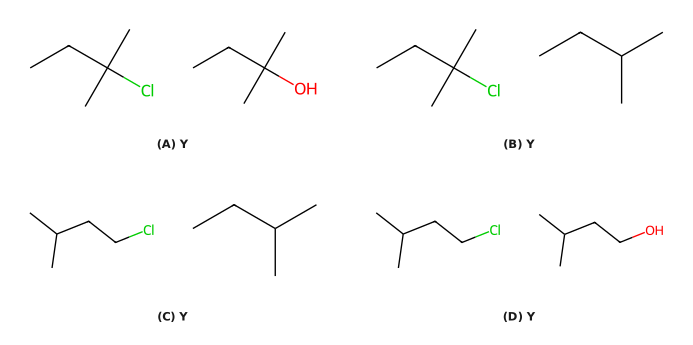
- TG EAPCET 2025Set ap-2025-04-30-FN1 markMCQQ.An alcohol X (C5H12O) is converted to corresponding chloride Y by shaking it with conc. HCl at room temperature. Reaction of Y with Mg in dry ether and then with water gave Z. What are Y and Z? (A) Y=CH3CH2C(CH3)2Cl (2-chloro-2-methylbutane) ; Z=CH3CH2C(CH3)2OH (2-methylbutan-2-ol) (B) Y=CH3CH2C(CH3)2Cl (2-chloro-2-methylbutane) ; Z=(CH3)2CHCH2CH3 (2-methylbutane) (C) Y=(CH3)2CHCH2CH2Cl (1-chloro-3-methylbutane) ; Z=(CH3)2CHCH2CH3 (2-methylbutane) (D) Y=(CH3)2CHCH2CH2Cl (1-chloro-3-methylbutane) ; Z=(CH3)2CHCH2CH2OH (3-methylbutan-1-ol)
›Reveal solutionSolution
X reacts with conc. HCl merely on shaking at room temperature, so X is the tertiary alcohol 2-methylbutan-2-ol. It gives Y= 2-chloro-2-methylbutane; the Grignard from Y, on hydrolysis with water, gives the hydrocarbon Z= 2-methylbutane — option (B).
Identify X. An alcohol that reacts with concentrated HCl by simple shaking at room temperature (the Lucas test giving an immediate turbidity) is a tertiary alcohol, because it ionises readily to a stable 3∘ carbocation (SN1). For the formula C5H12O the only tertiary alcohol is 2-methylbutan-2-ol, CH3CH2C(CH3)2OH.
Form Y. The −OH is replaced by −Cl:
CH3CH2C(CH3)2OHconc. HClCH3CH2C(CH3)2Cl
So Y= 2-chloro-2-methylbutane. This already rules out (C) and (D), which need a primary alcohol (unreactive to cold conc. HCl).
Form Z. Y reacts with Mg in dry ether to give the Grignard reagent, which is then treated with water: …
- TG EAPCET 2025Set ap-2025-04-30-FN1 markMCQQ.An alcohol X(C5H12O) undergoes dehydration when passed over copper at 573 K. X can be prepared from which of the following reactants? (A) CH3COCH3, C2H5MgBr (B) HCHO, CH3CH2CH(CH3)MgBr (C) (CH3)2CHCH2CHO, NaBH4 (D) (CH3)2CHCH=CH2, H2O/H+
›Reveal solutionSolution
The alcohol X is a tertiary alcohol (2‑methylbutan‑2‑ol) because only tertiary alcohols dehydrate easily over hot copper. It can be prepared from acetone and ethylmagnesium bromide, so the correct option is (A).
The key to this problem is the dehydration condition: passing an alcohol over copper at 573 K is a standard method to dehydrate alcohols to alkenes. But not all alcohols dehydrate equally easily. The ease of dehydration follows the order: tertiary > secondary > primary. At 573 K, only tertiary alcohols undergo dehydration readily; primary and secondary alcohols require stronger conditions (like concentrated H₂SO₄ at higher temperatures). So X must be a tertiary alcohol.
X has the formula C₅H₁₂O. A saturated alcohol with five carbons can be primary, secondary, or tertiary. The tertiary alcohol with five carbons is 2‑methylbutan‑2‑ol: (CH₃)₂C(OH)CH₂CH₃. That’s the only tertiary C₅ alcohol. So X is that.
Now we check which reaction gives that alcohol.
-
Option (A): Acetone (CH₃COCH₃) reacts with ethylmagnesium bromide (C₂H₅MgBr). The Grignard reagent adds to the carbonyl carbon, forming a tertiary alcohol after hydrolysis. Acetone has two methyl groups; adding ethyl gives (CH₃)₂C(OH)CH₂CH₃ — exactly 2‑methylbutan‑2‑ol. This works.
-
Option (B): Formaldehyde (HCHO) reacts with a Grignard reagent derived from a branched alkyl halide. Formaldehyde gives a primary alcohol (since it has no alkyl groups on the carbonyl carbon). So the product would be a primary alcohol, not tertiary. Not correct.
-
Option (C): Reducing an aldehyde with NaBH₄ gives a primary alcohol. (CH₃)₂CHCH₂CHO is an aldehyde; reduction yields (CH₃)₂CHCH₂CH₂OH, a primary alcohol. Not tertiary. …
-
🎓Unlock everything free for 14 days
- ✓Full step-by-step solutions
- ✓Concept-first explanations
- ✓Methods, shortcuts & mistakes
- ✓PYQ mapping + timed mock tests
Full access for 14 days. No credit card required.