Q.An organic compound with the molecular formula C9H10O forms 2,4-DNP derivative, reduces Tollens' reagent and undergoes Cannizzaro reaction. On vigorous oxidation, it gives 1,2-benzenedicarboxylic acid. Identify the compound.
🔒You're viewing a preview — the full solution, concept, methods & PYQ mapping are locked.
🔒 Start your 14-day free trial to unlock the full solution →Concept understanding — Cannizzaro Reaction
Clemmensen Reduction & Cannizzaro Reaction: Two Completely Different Reactions
These two reactions are often grouped together in textbooks because they both involve carbonyl compounds (C=O), but they do entirely different things. Let's take them one at a time.
Clemmensen Reduction
Intuition first. Imagine you have a ketone or aldehyde — a molecule with a C=O group. You want to remove that oxygen entirely and replace the C=O with two hydrogen atoms, turning it into a simple hydrocarbon chain. That's a reduction (adding hydrogen, removing oxygen). The Clemmensen reduction is a brute-force way to do this using a strongly acidic, reducing environment.
The precise reaction:
A ketone or aldehyde is heated with zinc amalgam (Zn-Hg) and concentrated hydrochloric acid (HCl). The C=O group is reduced to a CH₂ group.
R−C(=O)−RX′+4[H]Zn(Hg),HCl,heatR−CHX2−RX′+HX2O
Aldehyde or KetoneZn(Hg), conc. HCl, ΔHydrocarbon
Key points for exams:
- Works only for ketones and aldehydes that are stable in strong acid.
- Does not work for compounds that get destroyed by conc. HCl (e.g., acid-sensitive groups like esters, nitriles).
- The mechanism is complex and not usually tested in detail — just know it's a reductive removal of C=O.
- The product is always a saturated hydrocarbon (alkane).
Clemmensen reduction cannot reduce carboxylic acids, esters, or amides. Only aldehydes and ketones.
Example:
Acetophenone (CX6HX5−CO−CHX3) → Ethylbenzene (CX6HX5−CHX2−CHX3)
Cannizzaro Reaction
Intuition first. This is a disproportionation reaction — one molecule of aldehyde gets oxidised (to a carboxylic acid) while another gets reduced (to an alcohol). It happens only with aldehydes that have no alpha-hydrogen atoms (i.e., the carbon next to the C=O has no H). Why? Because if there were alpha-hydrogens, the aldehyde would undergo aldol condensation instead.
The precise reaction:
An aldehyde without α-hydrogen is treated with concentrated aqueous or alcoholic base (NaOH/KOH). Two molecules of aldehyde react: one becomes a carboxylate salt, the other becomes a primary alcohol.
2R−CHO+OHX−R−COOX−+R−CHX2OH
After acidification, the carboxylate salt gives the carboxylic acid.
2HCHOconc. NaOHHCOONa+CH3OH
(Formaldehyde → sodium formate + methanol)
Key points for exams:
- Only works for aldehydes with no α-hydrogen: formaldehyde, benzaldehyde, trimethylacetaldehyde, etc.
- The base must be concentrated (dilute base won't work).
- Formaldehyde is the most common example — it gives formic acid (as formate) and methanol.
- Crossed Cannizzaro: When formaldehyde is mixed with another aldehyde (like benzaldehyde), formaldehyde is always the one that gets oxidised (to formate), and the other aldehyde gets reduced (to alcohol). This is because formaldehyde is the strongest reducing agent among aldehydes.
In a crossed Cannizzaro, formaldehyde always becomes the carboxylate. The other aldehyde becomes the alcohol. This is a common exam question.
Example: …
Why this formula?
Cannizzaro Reaction: Why the Key Formulas Hold
The Cannizzaro reaction is a disproportionation reaction of aldehydes (without α-hydrogens) in the presence of a strong base. Let's build the understanding from the ground up.
1. What Happens in the Reaction?
An aldehyde (like formaldehyde or benzaldehyde) reacts with concentrated base to give:
- One molecule is oxidized to a carboxylic acid (or its salt)
- Another molecule is reduced to a primary alcohol
General equation (for two identical aldehydes):
2RCHO+OH−→RCOO−+RCH2OH
2. Why Does Disproportionation Occur?
The Key Insight: No α-Hydrogen
- Aldehydes with α-hydrogens undergo aldol condensation instead.
- Without α-hydrogens, the only available reaction path is hydride transfer.
The Mechanism (Step-by-Step Reasoning)
-
Nucleophilic attack: OH− attacks the carbonyl carbon of one aldehyde molecule.
- Forms a tetrahedral intermediate (a gem-diolate).
-
Hydride shift: The intermediate acts as a hydride donor (H−) to a second aldehyde molecule.
- This is the rate-determining step.
- The hydride comes from the C–H bond of the intermediate (not from the OH).
-
Products:
- The donor aldehyde becomes a carboxylate ion (oxidized).
- The acceptor aldehyde becomes an alkoxide ion (reduced).
-
Protonation: In workup, the carboxylate gives the acid, and the alkoxide gives the alcohol.
3. The Key Formula(e) and Their Derivation
Formula 1: Stoichiometry
2RCHO+OH−→RCOO−+RCH2OH
Why this holds:
- One aldehyde loses a hydride (H−) → gains an oxygen → oxidation state increases by 2.
- The other aldehyde gains a hydride → oxidation state decreases by 2.
- The base (OH−) is consumed stoichiometrically (one per two aldehydes).
Formula 2: Oxidation State Change
For an aldehyde carbon (carbonyl carbon):
- In RCHO: oxidation state = +1
- In RCOO−: oxidation state = +3 (gain of +2)
- In RCH2OH: oxidation state = -1 (loss of -2)
Net change: +2 (oxidation) + (−2) (reduction) = 0 — consistent with disproportionation.
Formula 3: Rate Law (for the hydride transfer step)
Rate=k[aldehyde]2[OH−]
Why:
- First aldehyde reacts with OH− to form the hydride donor (first order in each).
- Second aldehyde accepts the hydride (first order in aldehyde).
- Overall: second order in aldehyde, first order in base.
4. Why Only Certain Aldehydes Work?
Condition: Aldehyde must have no α-hydrogen atoms.
- Examples: HCHO (formaldehyde), C6H5CHO (benzaldehyde), (CH3)3CCHO (pivalaldehyde). …
The key idea is that a compound reducing Tollens' reagent must be an aldehyde, and undergoing Cannizzaro reaction means it has no α-hydrogen — which for an aldehyde almost always means the −CHO is attached directly to an aromatic ring or another carbon with no H. Vigorous oxidation yielding 1,2-benzenedicarboxylic acid (phthalic acid) shows the aldehyde group is directly attached to a benzene ring that also carries a second, oxidisable side-chain at the ortho position.
Reasoning steps:
-
Functional group clues: Reduces Tollens' reagent → aldehyde (−CHO). Undergoes Cannizzaro reaction → no α-hydrogen, so the −CHO must be attached directly to the aromatic ring (an aryl aldehyde).
-
Oxidation product: Vigorous oxidation gives 1,2-benzenedicarboxylic acid (phthalic acid), i.e. a benzene ring with two −COOH groups at ortho positions. One −COOH comes from the −CHO itself (oxidised in place); the other must come from a second ring substituent that is also fully oxidisable to −COOH — any alkyl side-chain on a benzene ring is oxidised this way under vigorous conditions, regardless of chain length. …
The compound is an aldehyde (reduces Tollens') with no α-hydrogen (undergoes Cannizzaro), and its oxidation yields phthalic acid — so it must be 2-ethylbenzaldehyde, CX6HX4(CHO)(CHX2CHX3) with the aldehyde and ethyl group ortho to each other.
The problem gives you four clues about a compound CX9HX10O. Let’s unpack each one and see how they fit together.
Why the Cannizzaro reaction is the key
The Cannizzaro reaction is a disproportionation of an aldehyde that has no α-hydrogen atoms — that is, no hydrogen on the carbon next to the −CHO group. In strong base, one molecule gets oxidised to a carboxylic acid and another gets reduced to an alcohol. So if your compound undergoes Cannizzaro, it must be an aldehyde with the −CHO group attached either to an aromatic ring or to a tertiary carbon (like (CHX3)3CCHO). That immediately narrows the field.
Now let’s walk through the clues step by step.
-
Forms a 2,4-DNP derivative
This tells you the compound has a carbonyl group (C=O) — either an aldehyde or a ketone. 2,4-dinitrophenylhydrazine reacts with any carbonyl to give an orange/red precipitate.
-
Reduces Tollens’ reagent
Tollens’ reagent ([Ag(NHX3)X2]X+) is reduced only by aldehydes (and some α-hydroxy ketones, but that’s rare). Ketones do not react. So the compound is an aldehyde.
-
Undergoes Cannizzaro reaction
As we said, this means the aldehyde has no α-hydrogen. For an aromatic aldehyde, that’s automatic — the α-carbon is part of the benzene ring. So the compound is an aromatic aldehyde.
-
On vigorous oxidation, gives 1,2-benzenedicarboxylic acid
That’s phthalic acid — a benzene ring with two carboxylic acid groups in the ortho positions. Vigorous oxidation (like hot KMnOX4 or HNOX3) will oxidise any alkyl side chain on a benzene ring to −COOH, and it will also oxidise −CHO to −COOH. So the original compound must have had two substituents on the benzene ring that could be oxidised to −COOH groups, and they must be ortho to each other.
One of those substituents is the aldehyde group (−CHO). The other must be a carbon chain that, after oxidation, becomes the second −COOH. Since the molecular formula is CX9HX10O, and we already have CX6HX4 (benzene ring) + CHO (1 carbon), that accounts for CX7HX5O. The remaining CX2HX5 must be the other side chain — an ethyl group (−CHX2CHX3).
So the compound is an ethylbenzaldehyde with the two groups ortho to each other. …
Method: Retrospective Analysis (Reverse Engineering) from Chemical Tests
This method works backwards from the given reactions and final oxidation product to deduce the structure.
Step 1: Analyse the molecular formula
C9H10O
Degree of unsaturation (DoU) = 22C+2−H=22(9)+2−10=210=5
Four unsaturations likely come from a benzene ring, leaving one more — possibly a carbonyl (C=O) or an alkene.
Step 2: Interpret the chemical tests
- Forms 2,4-DNP derivative → Contains a carbonyl group (C=O), either aldehyde or ketone.
- Reduces Tollens' reagent → Must be an aldehyde (ketones do not reduce Tollens').
- Undergoes Cannizzaro reaction → Aldehyde with no α-hydrogen (i.e., α-carbon has no H attached). This is the key restriction.
So the compound is an aromatic aldehyde with no α-hydrogen.
Step 3: Use the oxidation product
Vigorous oxidation gives 1,2-benzenedicarboxylic acid (phthalic acid):
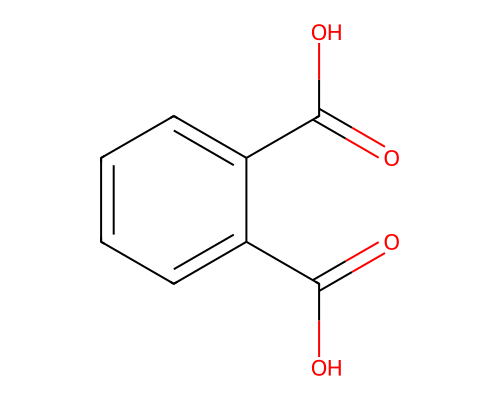
This means the original compound has a benzene ring with two substituents in ortho (1,2) positions, both of which can be oxidised to −COOH groups.
One substituent is already −CHO (the aldehyde). The other must be a side chain that oxidises to −COOH — likely an alkyl group.
Step 4: Assemble the structure
- Benzene ring with two ortho substituents.
- One is −CHO (aldehyde, no α-H).
- The other must be a group that gives total C9H10O.
Count carbons: …
Common Mistakes & How to Avoid Them (Cannizzaro Reaction Problem)
Mistake 1: Forgetting that Cannizzaro requires no α-hydrogen
- The error: Students often pick an aldehyde that has α-hydrogens (e.g., propanal, butanal) and still apply Cannizzaro.
- Why it's wrong: Cannizzaro reaction is specific to aldehydes without α-hydrogen (like HCHO, Ar–CHO, or R3C–CHO). If α-hydrogens exist, the compound undergoes aldol condensation instead.
- How to avoid: Before writing Cannizzaro, check the α-carbon. If it has even one H, Cannizzaro is impossible.
Mistake 2: Ignoring the 2,4-DNP test implication
- The error: Students conclude the compound is an aldehyde from Tollens' test, but forget that 2,4-DNP also confirms a carbonyl group (aldehyde or ketone).
- Why it's wrong: 2,4-DNP alone doesn't distinguish aldehyde vs ketone — but combined with Tollens' (positive) and Cannizzaro (positive), it narrows to an aldehyde without α-H.
- How to avoid: Always list what each test tells you:
- 2,4-DNP positive → C=O present
- Tollens' positive → aldehyde (not ketone)
- Cannizzaro positive → aldehyde with no α-H
Mistake 3: Misinterpreting "vigorous oxidation gives 1,2-benzenedicarboxylic acid"
- The error: Students think the compound itself contains two –COOH groups, or that it's already phthalic acid.
- Why it's wrong: Vigorous oxidation (e.g., hot KMnO₄) converts alkyl side chains on benzene to –COOH. Getting phthalic acid means the original compound had two substituents in ortho positions on the benzene ring.
- How to avoid: Draw the product (phthalic acid) and work backwards:
- Two –COOH groups at ortho positions → original had two alkyl/aldehyde groups at ortho positions.
- One of them must be –CHO (from Tollens' and Cannizzaro).
Mistake 4: Forgetting the molecular formula constraint (C9H10O)
- The error: Students propose a structure that doesn't match the formula (e.g., adding too many carbons or oxygens).
- Why it's wrong: The formula is a hard constraint. C9H10O has degree of unsaturation = 22(9)+2−10=5. A benzene ring accounts for 4, so there's one more double bond or ring — which is the C=O of the aldehyde.
- How to avoid: Always calculate unsaturation first. Then check: benzene (4) + one C=O (1) = 5. Perfect fit. …
Showing the 12 most recent of 14 on this concept.
- TG EAPCET 2026Set eng-2026-05-09-FN1 markMCQQ.The incorrect statement regarding 'C' formed in the given sequence of reactions is
[!FORMULA] CHX2O(i) CH3MgBr(ii) H2OAPCCBdil.NaOHC
(A) It is β-Hydroxybutyraldehyde (B) It has no asymmetric carbons (C) The IUPAC name of it is 3-Hydroxybutanal (D) This on heating gives α,β-unsaturated aldehyde›Reveal solutionSolution
The sequence converts formaldehyde into 3-hydroxybutanal (aldol product), which has one chiral carbon, so the statement claiming it has no asymmetric carbons is false; the incorrect statement is (B).
Concept & Intuition
This problem tests your ability to trace a multi-step organic reaction sequence and spot a structural claim that contradicts the actual product. The key is to recognize each transformation:
- Grignard addition to formaldehyde gives a primary alcohol.
- PCC oxidation turns that alcohol into an aldehyde.
- Dilute NaOH then triggers an aldol condensation between two identical aldehyde molecules, yielding a β-hydroxy aldehyde. Once you draw the final product, you can evaluate each statement about its structure, chirality, and reactivity.
Step-by-step reasoning
- First step: Grignard reaction with formaldehyde Formaldehyde (HX2C=O) reacts with methylmagnesium bromide (CHX3MgBr). The Grignard reagent attacks the carbonyl carbon, and after aqueous workup, you get a primary alcohol:
CHX2O+CHX3MgBrHX2OCHX3CHX2OH
So A is ethanol (CHX3CHX2OH).
- Second step: PCC oxidation Pyridinium chlorochromate (PCC) oxidizes primary alcohols to aldehydes without overoxidation to carboxylic acids.
CHX3CHX2OHPCCCHX3CHO
Thus B is acetaldehyde (CHX3CHO).
- Third step: Aldol condensation with dilute NaOH Dilute NaOH catalyzes an aldol reaction between two molecules of acetaldehyde. One molecule forms an enolate, which attacks the carbonyl of another, giving a β-hydroxy aldehyde:
2CHX3CHOdil⋅NaOHCHX3CH(OH)CHX2CHO
This product is 3-hydroxybutanal (common name: β-hydroxybutyraldehyde). So C is CHX3CH(OH)CHX2CHO.
- Evaluate each statement about C
- (A) It is β-Hydroxybutyraldehyde — True. The hydroxyl is on the β-carbon relative to the aldehyde group.
- (B) It has no asymmetric carbons — False. The carbon bearing the –OH group (C3) is attached to four different groups: H, OH, CH3, and CH2CHO. This is a chiral (asymmetric) carbon. …
- TG EAPCET 2026Set eng-2026-05-10-FN1 markMCQQ.Which of the following does not undergo disproportionation reaction in the presence of Conc. NaOH? (A) HCHO (B) C_6H_5CHO (C) (CH_3)_3CCHO (D) CH_3CH_2CHO
›Reveal solutionSolution
Disproportionation (Cannizzaro reaction) requires an aldehyde with no α-hydrogen. Among the given options, only (CH3)3CCHO has no α-hydrogen, so it does undergo the reaction — meaning the one that does not undergo disproportionation is the one that has α-hydrogens. That is CH3CH2CHO.
The question is about the Cannizzaro reaction — a disproportionation of aldehydes in concentrated base. In this reaction, one molecule of aldehyde is reduced to an alcohol and another is oxidized to a carboxylic acid (which appears as its salt in strong base). The key condition: the aldehyde must have no α-hydrogen atoms (i.e., no hydrogen on the carbon next to the −CHO group). Why? Because if α-hydrogens are present, the base will instead deprotonate that α-carbon, leading to an enolate, and the reaction takes a different path (aldol condensation). So the Cannizzaro reaction is the only disproportionation path available to aldehydes that cannot form enolates.
Let’s examine each option.
-
HCHO (formaldehyde) — The carbon attached to the −CHO group is simply a hydrogen atom. There is no α-carbon at all, so certainly no α-hydrogen. Formaldehyde readily undergoes the Cannizzaro reaction with conc. NaOH to give methanol and sodium formate. So it does undergo disproportionation.
-
C6H5CHO (benzaldehyde) — The α-carbon is the one directly attached to the −CHO group; here that carbon is part of the aromatic ring. Aromatic ring carbons do not have α-hydrogens (the hydrogen is on the ring, not on the α-carbon). So benzaldehyde has no α-hydrogen and undergoes the Cannizzaro reaction to give benzyl alcohol and sodium benzoate. It does undergo disproportionation.
-
(CH3)3CCHO (pivalaldehyde, trimethylacetaldehyde) — The α-carbon is the quaternary carbon bearing three methyl groups. That carbon has no hydrogen atoms at all — it is fully substituted. So there are no α-hydrogens. Pivalaldehyde undergoes the Cannizzaro reaction to give neopentyl alcohol and the salt of pivalic acid. It does undergo disproportionation. …
-
- TG EAPCET 2025Set eng-2025-05-04-AN1 markMCQQ.What are X and Y in the following reaction sequence? $\mathrm{C_5H_{12}O} \xrightarrow{\text{Cu, 573 K}} \mathrm{C_5H_{10}} \xrightarrow{\text{(i) O}_3 \text{(ii) Zn + H}_2\mathrm{O}} X + Y$ (A) O∣CH3CH2CH2CCH3+CH3CHO (B) CH3CH2CH2CHO+HCHO (C) CH3CH2CO∣H+CH3CHO (D) O∣CH3CH2CH2CCH3+HCO2H
›Reveal solutionSolution
The starting alcohol is 3‑methylbutan‑2‑ol; dehydration gives 3‑methylbut‑1‑ene, which upon ozonolysis yields acetone and acetaldehyde — matching option (A).
Concept & Intuition
We are given a three‑step sequence: an alcohol C₅H₁₂O → alkene C₅H₁₀ → ozonolysis products X + Y.
- The first step (Cu, 573 K) is dehydrogenation of a secondary alcohol to a ketone, but here the product is an alkene (C₅H₁₀), not a ketone. That means the alcohol must be tertiary (cannot be dehydrogenated) or the conditions cause dehydration instead. In fact, hot copper can catalyse dehydration of alcohols to alkenes, especially for tertiary alcohols.
- The second step is ozonolysis (O₃ then Zn/H₂O), which cleaves the alkene double bond to give carbonyl compounds (aldehydes and/or ketones).
- We need to deduce the structure of the original alcohol so that the alkene formed gives the observed fragments.
Step‑by‑step reasoning
-
Identify the alcohol’s skeleton from the alkene formula
The alkene is C₅H₁₀. The alcohol C₅H₁₂O must have the same carbon skeleton. Possible skeletons for C₅ alkenes:
- pent‑1‑ene
- pent‑2‑ene
- 2‑methylbut‑1‑ene
- 2‑methylbut‑2‑ene
- 3‑methylbut‑1‑ene The alcohol that dehydrates to a given alkene must have the –OH on a carbon adjacent to the double bond.
-
Work backwards from the ozonolysis products
Ozonolysis of an alkene R₁R₂C=CR₃R₄ gives two carbonyl compounds:
R1R2C=OandR3R4C=O
Look at the options:
- (A) gives acetone (CH₃COCH₃) + acetaldehyde (CH₃CHO)
- (B) gives butanal (CH₃CH₂CH₂CHO) + formaldehyde (HCHO)
- (C) gives propanal (CH₃CH₂CHO) + acetaldehyde
- (D) gives acetone + formic acid (HCO₂H)
Only (A) and (D) contain a ketone (acetone). Since ozonolysis with reductive work‑up (Zn/H₂O) gives aldehydes and ketones, not carboxylic acids, (D) is ruled out (formic acid would require oxidative work‑up). So the alkene must yield acetone + acetaldehyde.
- Deduce the alkene structure
Acetone = (CH₃)₂C=O, acetaldehyde = CH₃CHO.
The alkene double bond must be between the carbons that become the carbonyl groups.
- The carbon that becomes the carbonyl of acetone is a disubstituted carbon (two methyls).
- The carbon that becomes the aldehyde is a monosubstituted carbon (one H, one CH₃). Hence the alkene is:
(CH3)2C=CHCH3
That is 2‑methylbut‑2‑ene.
- Find the alcohol that dehydrates to 2‑methylbut‑2‑ene Dehydration of an alcohol removes –OH and an adjacent H to form the double bond. …
- TG EAPCET 2025Set ap-2025-04-30-FN1 markMCQQ.Alkene (C3H6) reacts with X to give C3H8O, which reacts with Y to give Z. Z forms 2,4-dinitrophenylhydrazone and gives yellow ppt with NaOH|I2. What are X and Y? (A) BH3,H2O2/OH−;CrO3 (B) BH3,H2O2/OH−;PCC (C) H2O/H+;CrO3 (D) H2O/H+;KMnO4∣OH−,Δ
›Reveal solutionSolution
The alkene propene undergoes hydration to give an alcohol, which is then oxidised to a methyl ketone — the key is that the final product gives a positive iodoform test. The correct reagents are H2O/H+ followed by CrO3, which is option (C).
The problem gives you a sequence: an alkene C3H6 (propene) reacts with X to give C3H8O (an alcohol), which then reacts with Y to give Z. Z forms a 2,4-dinitrophenylhydrazone (so it's a carbonyl compound — aldehyde or ketone) and gives a yellow precipitate with NaOH/I2 (the iodoform test). The iodoform test is positive only for methyl ketones (R−CO−CH3) or ethanol/ secondary alcohols that can be oxidised to such ketones. Since Z is already a carbonyl, it must be a methyl ketone.
The alkene is propene, CH3−CH=CH2. The first step (X) must add the elements of water across the double bond to give an alcohol C3H8O. There are two possible alcohols: propan-1-ol (CH3CH2CH2OH) and propan-2-ol (CH3CH(OH)CH3). Only propan-2-ol can be oxidised to a methyl ketone (propanone, CH3COCH3), which gives the iodoform test. So X must be a reagent that gives Markovnikov addition of water — that is, H2O/H+ (acid-catalysed hydration). The alternative, hydroboration-oxidation (BH3,H2O2/OH−), gives anti-Markovnikov addition, producing propan-1-ol, which would oxidise to an aldehyde (propanal) — and propanal does NOT give the iodoform test. …
- TG EAPCET 2024Set ap-2024-05-08-FN1 markMCQQ.A hydrocarbon has 85.7% of carbon by weight. 56 g (2 moles) of hydrocarbon was completely burnt in oxygen and obtained CO2 and H2O. What is the weight (in g) of CO2 formed? (C = 12 u, H = 1 u, O = 16 u) (A) 176 (B) 88 (C) 132 (D) 352
›Reveal solutionSolution
The hydrocarbon has molar mass 28 g/mol with 2 carbons per molecule (C2H4); 2 mol gives 4 mol CO2 =176 g.
Molar mass of the hydrocarbon =2 mol56 g=28 g/mol.
Mass of carbon per mole =85.7%×28=24 g, so number of C atoms =1224=2.
Hydrogen per mole =28−24=4 g⇒4 H atoms. The hydrocarbon is C2H4. …
- TG EAPCET 2024Set eng-2024-05-09-FN1 markMCQQ.An alkene X (C4H8) exhibits geometrical isomerism. Oxidation of A with KMnO4 ∣ H+ gave Y. On heating sodium salt of Y with a mixture of NaOH and CaO gave Z. What is Z? (A) CH3CH3 (B) CH3CH2CH3 (C) CH3CH2CH2CH3 (D) CH4
›Reveal solutionSolution
The alkene X is but-2-ene (the only C₄H�8 alkene that shows geometrical isomerism). Its oxidative cleavage gives two molecules of acetic acid (Y). The sodium salt of Y undergoes decarboxylation to yield methane (Z). So the correct option is (D).
Concept & Intuition
The problem tests two key reactions:
- Oxidative cleavage of alkenes with hot acidic KMnO₄ – this breaks the double bond and turns each carbon of the double bond into a carboxylic acid (or ketone if the carbon is disubstituted).
- Decarboxylation of sodium carboxylates (the soda-lime reaction) – heating the sodium salt of a carboxylic acid with NaOH/CaO removes CO₂ and leaves an alkane with one fewer carbon.
We need to identify which C₄H₈ alkene shows geometrical isomerism, then follow the reaction sequence.
Step-by-step reasoning
-
Identify the alkene X
The molecular formula C₄H₈ corresponds to several alkenes: but-1-ene, but-2-ene, and 2-methylpropene.
Geometrical isomerism (cis/trans) requires that each carbon of the double bond has two different substituents.
- But-1-ene (CH₂=CH–CH₂–CH₃): one carbon has two H’s → no geometrical isomers.
- 2-Methylpropene (CH₂=C(CH₃)₂): one carbon has two H’s, the other has two CH₃’s → no geometrical isomers.
- But-2-ene (CH₃–CH=CH–CH₃): each double-bond carbon has one H and one CH₃ → can exist as cis and trans. Hence X must be but-2-ene.
-
Oxidation of X with KMnO₄ / H⁺
Hot acidic KMnO₄ cleaves the double bond completely. For but-2-ene:
CH3–CH=CH–CH3KMnO4,H+,Δ2CH3COOH
Each half becomes a carboxylic acid. So Y is acetic acid (CH₃COOH).
-
Formation of the sodium salt
The sodium salt of Y is sodium acetate: CH₃COONa.
-
Decarboxylation with soda lime …
- TG EAPCET 2024Set ap-2024-05-07-AN1 markMCQQ.A hydrocarbon containing C and H has 92.3% of C. When 52 g of hydrocarbon is completely burnt in oxygen, x moles of water and y moles of CO2 were formed. The liberated water is sufficient to liberate one mole of H2 when reacted with sodium metal. What is the weight (in g) of O2 consumed? (C = 12u; H = 1u; O = 16u) (A) 80 (B) 160 (C) 240 (D) 320
›Reveal solutionSolution
The key is to first find the empirical formula from the carbon percentage, then use the water-liberation clue to determine the molecular formula and the moles of hydrocarbon burned. From the combustion reaction, we calculate the moles of O₂ consumed and convert to grams, yielding 160 g.
Concept and Intuition
We have a hydrocarbon (only C and H) with a known mass percentage of carbon. That lets us find the simplest whole-number ratio of C to H — the empirical formula. But we need the actual molecular formula to know how much oxygen is consumed per mole of hydrocarbon. The extra clue: the water produced from burning 52 g of the hydrocarbon is enough to liberate exactly 1 mole of H₂ when reacted with sodium. Sodium reacts with water:
2Na+2H2O→2NaOH+H2
So 2 moles of water give 1 mole of H₂. Therefore, the water produced must be 2 moles. That tells us exactly how many moles of hydrocarbon were burned, and from there we can deduce the molecular formula and the oxygen consumed.
Step-by-step solution
-
Find the empirical formula from the percentage composition
- 92.3% C means 92.3 g C per 100 g hydrocarbon, and the rest is H: 7.7 g H.
- Moles of C = 1292.3≈7.692
- Moles of H = 17.7=7.7
- Ratio C : H = 7.692:7.7≈1:1 (very close, tiny rounding).
- So the empirical formula is CH.
-
Use the water clue to find the molecular formula
- From the reaction with sodium: 2 H₂O → 1 H₂.
- Liberating 1 mole of H₂ requires 2 moles of H₂O.
- Therefore, burning 52 g of hydrocarbon produces 2 moles of water.
- In a combustion reaction:
CnHm+(n+4m)O2→nCO2+2mH2O
So moles of H₂O = $ \frac{m}{2} \times $ (moles of hydrocarbon).- Let the molecular formula be (CH)ₖ, so m = k.
- Then moles of H₂O = 2k× (moles of hydrocarbon) = 2.
- Also, the mass of hydrocarbon burned is 52 g. Molar mass of (CH)ₖ = (12+1)k = 13k g/mol.
- Moles of hydrocarbon = 13k52=k4.
- Plug into water equation:
2k×k4=2
This simplifies to $ 2 = 2 $, which is always true — so any k works? That can’t be right. Wait — we need to check: the water produced is exactly 2 moles, but that doesn’t fix k uniquely unless we also know the CO₂ produced. Let’s use the CO₂ clue.3. Use the CO₂ produced to find k
- From combustion, moles of CO₂ = n× (moles of hydrocarbon) = k×k4=4 moles.
- So y = 4 moles of CO₂.
- Now we have: from 52 g of hydrocarbon, we get 4 moles CO₂ and 2 moles H₂O. …
-
- TG EAPCET 2023Set eng-2023-05-13-FN1 markMCQQ.1-Propanol can be distinguished from 2-propanol by which test? (A) 2,4-DNP test (B) Tollens' test (C) Lucas test (D) Fehling's test
›Reveal solutionSolution
The Lucas test distinguishes 1‑propanol from 2‑propanol because 2‑propanol (a secondary alcohol) reacts quickly with Lucas reagent to form a cloudy alkyl chloride, while 1‑propanol (a primary alcohol) does not react at room temperature. The correct option is (C).
The key concept here is the relative reactivity of alcohols toward nucleophilic substitution — specifically, the ease with which an alcohol can be converted to an alkyl halide. The Lucas test (ZnCl₂ in concentrated HCl) exploits the fact that tertiary alcohols react instantly, secondary alcohols react within minutes (forming a cloudy emulsion), and primary alcohols do not react appreciably at room temperature. Since 1‑propanol is primary and 2‑propanol is secondary, only 2‑propanol gives a positive Lucas test under standard conditions.
Let’s walk through the reasoning step by step:
-
Understand what each test detects
- 2,4‑DNP test (2,4‑dinitrophenylhydrazine) reacts with carbonyl groups (aldehydes and ketones) to form a yellow/orange precipitate. Neither 1‑propanol nor 2‑propanol has a carbonyl group, so both would give a negative result.
- Tollens’ test (ammoniacal silver nitrate) oxidizes aldehydes to carboxylic acids, depositing a silver mirror. Alcohols are not aldehydes, so neither propanol reacts.
- Fehling’s test (copper(II) complex in alkaline solution) also detects aldehydes (and some α‑hydroxy ketones). Again, no reaction with simple alcohols.
- Lucas test specifically distinguishes primary, secondary, and tertiary alcohols based on the rate of formation of an alkyl chloride.
-
Focus on the Lucas test mechanism
The Lucas reagent (ZnCl₂ in concentrated HCl) protonates the alcohol’s –OH group, turning it into a better leaving group (water). A carbocation intermediate then forms. The stability of this carbocation determines the reaction rate:
- Tertiary carbocations are very stable → immediate reaction.
- Secondary carbocations are moderately stable → reaction in 5–10 minutes (cloudiness appears).
- Primary carbocations are highly unstable → no reaction at room temperature.
-
Apply to the two propanols
- 1‑Propanol (CH₃CH₂CH₂OH): If it lost water, it would form a primary carbocation (CH₃CH₂CH₂⁺), which is too unstable to form under these mild conditions. Hence, no visible change. …
-
- TG EAPCET 2023Set eng-2023-05-12-FN1 markMCQQ.Identify A and B from the following reactions I) CH3−CH=CH−CH3(i) O3(ii) Zn-H2O2X II) 2X1. NaOH(dil)2. AZ(i) O3(ii) Zn-H2OA+B (A) CH3−CHO+HCHO (B) CH3CHO+CHOCHO (C) CH3−CH2−CHO+CH2O (D) CH3−∣OC−CH3+CHOCHO
›Reveal solutionSolution
Ozonolysis of but-2-ene gives 2 molecules of acetaldehyde (X). Aldol condensation of X then dehydration gives but-2-enal (crotonaldehyde), Z. Ozonolysis of Z cleaves its double bond to give acetaldehyde and glyoxal, so A+B=CH3CHO+OHC-CHO.
Reaction I — identifying X. But-2-ene, CH3-CH=CH-CH3, on reductive ozonolysis (O3; Zn/H2O) cleaves the C=C bond to give two identical carbonyls:
CH3-CH=CH-CH3⟶2CH3CHO.
So X=acetaldehyde (CH3CHO).
Reaction II — building Z. Two molecules of acetaldehyde undergo base-catalysed aldol addition with dilute NaOH to give 3-hydroxybutanal, which on warming eliminates water (aldol condensation) to give the α,β-unsaturated aldehyde but-2-enal (crotonaldehyde): …
- TG EAPCET 2022Set eng-2022-07-20-AN1 markMCQQ.A solid has a structure in which ‘W’ atoms are located at the corners of a cubic lattice, oxygen atoms at the edge centre and Na atom at the body centre. The formula of the compound is (A) NaWO2 (B) Na2WO3 (C) NaWO3 (D) NaWO4
›Reveal solutionSolution
To find the formula of a compound from its crystal structure, we determine the effective number of each type of atom within a single unit cell by considering their positions and fractional contributions. For this compound, the effective number of Na, W, and O atoms are 1, 1, and 3 respectively, leading to the formula NaWO3.
When atoms arrange themselves in a crystal lattice, they form a repeating unit called a unit cell. The chemical formula of the compound is determined by the net number of each type of atom present within one such unit cell. Atoms located at different positions within the unit cell (like corners, edges, faces, or the body center) are shared by a different number of adjacent unit cells, and thus contribute only a fraction of themselves to any single unit cell.
Here's how we account for these contributions in a cubic lattice:
- An atom at a corner is shared by 8 unit cells, so its contribution to one unit cell is 1/8.
- An atom at an edge center is shared by 4 unit cells, so its contribution to one unit cell is 1/4.
- An atom at a face center is shared by 2 unit cells, so its contribution to one unit cell is 1/2.
- An atom at the body center is entirely within one unit cell, so its contribution is 1.
Let's apply this to find the effective number of each atom in the given compound:
-
Calculate the effective number of 'W' atoms:
'W' atoms are located at the corners of the cubic lattice. A cubic unit cell has 8 corners.
Each corner atom contributes 1/8 to the unit cell.
Effective number of W atoms = (Number of corners) × (Contribution per corner atom)
Effective number of W atoms = 8×81=1
-
Calculate the effective number of 'O' atoms:
Oxygen atoms are located at the edge centers. A cubic unit cell has 12 edges. …
- TG EAPCET 2021Set ap-2021-08-10-AN1 markMCQQ.An iodo-organic compound, when fused with sodium metal, followed by acidification with nitric acid and then treated with silver nitrate gives (A) A white precipitate is formed, which is soluble in NH4OH solution (B) A yellow precipitate is formed, which is insoluble in NH4OH solution (C) A red precipitate is formed, which is insoluble in NH4OH solution (D) A yellow precipitate is formed, which is soluble in NH4OH solution
›Reveal solutionSolution
The Lassaigne test for iodine produces a yellow precipitate of AgI that is insoluble in NH₄OH, so the correct choice is (B).
The question tests the Lassaigne test (sodium fusion test) for halogens in organic compounds. When an organic compound containing iodine is fused with sodium, the iodine is converted to sodium iodide (NaI). After acidification with nitric acid (to destroy any cyanide or sulfide ions that might interfere), adding silver nitrate (AgNO₃) gives a silver halide precipitate. The key is identifying the color and solubility of silver iodide (AgI) in ammonium hydroxide.
- Fusion with sodium – The iodo-organic compound is heated with sodium metal. This breaks the C–I bond, forming NaI:
R–I+2Na→NaI+R–Na
-
Acidification with nitric acid – After dissolving the fused mass in water, dilute HNO₃ is added. This serves two purposes: it neutralizes any excess NaOH and decomposes any NaCN or Na₂S (from nitrogen or sulfur in the compound) so they don’t form false precipitates later.
-
Addition of silver nitrate – AgNO₃ reacts with iodide ions:
Ag++I−→AgI↓
Silver iodide is pale yellow (often described simply as “yellow” in textbooks). …
- TG EAPCET 2021Set ap-2021-08-10-FN1 markMCQQ.An iodo-organic compound, when fused with sodium metal, followed by acidification with nitric acid and then treated with silver nitrate gives (A) A white precipitate is formed, which is soluble in NH4OH solution (B) A yellow precipitate is formed, which is insoluble in NH4OH solution (C) A red precipitate is formed, which is insoluble in NH4OH solution (D) A yellow precipitate is formed, which is soluble in NH4OH solution
›Reveal solutionSolution
The test detects iodine in an organic compound via sodium fusion, forming NaI; acidification with HNO₃ and addition of AgNO₃ yields AgI, a yellow precipitate insoluble in NH₄OH. The correct option is (B).
Concept & Intuition
When an organic compound containing iodine is fused with sodium metal, the iodine is converted into sodium iodide (NaI). This is the Lassaigne’s test for halogens. After acidification with nitric acid (to destroy any cyanide or sulfide ions that might interfere), silver nitrate is added. Silver iodide (AgI) is a pale yellow solid that is insoluble in aqueous ammonia (NH₄OH), unlike silver chloride (white, soluble) and silver bromide (pale yellow, sparingly soluble). This difference in solubility in ammonia is the key to identifying the halogen.
Step-by-step reasoning
- Sodium fusion The iodo-organic compound is heated with sodium metal. The reaction converts covalently bonded iodine into ionic iodide:
R–I+2Na→NaI+R–Na
The sodium iodide dissolves in water when the fused mass is extracted.
-
Acidification with nitric acid
Nitric acid is added to the aqueous extract. This serves two purposes:
- It neutralizes any leftover sodium hydroxide.
- It decomposes sodium cyanide (if nitrogen was present) and sodium sulfide (if sulfur was present) as HCN and H₂S gases, preventing them from forming precipitates with silver nitrate later. The iodide ion remains unaffected.
-
Addition of silver nitrate
Silver nitrate reacts with iodide ions to form silver iodide:
AgNO3+NaI→AgI↓+NaNO3
Silver iodide is a pale yellow precipitate.
- Solubility in ammonium hydroxide …
🎓Unlock everything free for 14 days
- ✓Full step-by-step solutions
- ✓Concept-first explanations
- ✓Methods, shortcuts & mistakes
- ✓PYQ mapping + timed mock tests
Full access for 14 days. No credit card required.