Q.Which of the following compounds would undergo aldol condensation, which the Cannizzaro reaction and which neither? Write the structures of the expected products of aldol condensation and Cannizzaro reaction.
🔒You're viewing a preview — the full solution, concept, methods & PYQ mapping are locked.
🔒 Start your 14-day free trial to unlock the full solution →Concept understanding — Oxidation Reactions
Alcohol Oxidation: The Intuition First
Imagine you have a molecule of ethanol — the alcohol in your hand sanitizer or a drink. It has a carbon atom bonded to an –OH group. Now picture that –OH group as a "handle" that can be transformed. Oxidation, in organic chemistry, doesn't always mean adding oxygen — it often means removing hydrogen from a carbon that already has a bond to oxygen. For alcohols, oxidation is like "stripping away" hydrogen atoms from the carbon that holds the –OH, turning the alcohol into a more oxidized functional group.
Think of it this way: a primary alcohol (R–CH₂–OH) has two hydrogens on the carbon with the –OH. If you remove one hydrogen and the hydrogen from the –OH, you get an aldehyde (R–CHO). Remove both hydrogens (and the –OH hydrogen), and you get a carboxylic acid (R–COOH). A secondary alcohol (R–CHOH–R') has only one hydrogen on that carbon — remove it, and you get a ketone (R–CO–R'). A tertiary alcohol has no hydrogen on that carbon — so it cannot be oxidized without breaking the carbon skeleton.
That's the core intuition: oxidation of an alcohol is about removing hydrogens from the carbon bearing the –OH group. The more hydrogens you can remove, the more oxidized the product.
The Precise Statement
Alcohol oxidation is the process in which an alcohol loses hydrogen atoms (dehydrogenation) from the carbon bonded to the –OH group, increasing the number of C–O bonds (or decreasing C–H bonds). The outcome depends on the class of the alcohol:
| Alcohol Class | Structure | Product after oxidation | Reagent example |
|---|---|---|---|
| Primary (1°) | R–CH₂–OH | Aldehyde (R–CHO) then Carboxylic acid (R–COOH) | PCC (stops at aldehyde); K₂Cr₂O₇/H⁺ (goes to acid) |
| Secondary (2°) | R–CHOH–R' | Ketone (R–CO–R') | K₂Cr₂O₇/H⁺, CrO₃, etc. |
| Tertiary (3°) | R₃C–OH | No reaction (under normal conditions) | — |
A common mistake: students think "oxidation" always adds oxygen. For alcohols, it's removal of hydrogen from the carbon with the –OH. The oxygen from the –OH stays — it's the hydrogens that leave.
Why Does Tertiary Alcohol Not Oxidize?
Look at the carbon with the –OH in a tertiary alcohol: it has three carbon groups attached and no hydrogen. To form a C=O bond, you'd need to remove a hydrogen from that carbon — but there is none. The only way to oxidize a tertiary alcohol is to break a C–C bond (strong and difficult), which is not typical oxidation. So in standard organic chemistry, tertiary alcohols are inert to mild oxidizing agents.
A Real-World Analogy
Think of the alcohol carbon as a "parking spot" with a certain number of hydrogen "cars." Primary alcohol has two cars parked. Oxidation is like towing away one car (→ aldehyde) or both cars (→ carboxylic acid). Secondary alcohol has one car — tow it away, and you get a ketone. Tertiary alcohol has zero cars — nothing to tow, so no reaction.
Key Reagents to Remember (for exams)
- PCC (pyridinium chlorochromate): oxidizes 1° alcohols to aldehydes only — stops there.
- K₂Cr₂O₇ / H₂SO₄ (Jones reagent): oxidizes 1° alcohols all the way to carboxylic acids; 2° alcohols to ketones.
- KMnO₄: similar to dichromate, but stronger — can over-oxidize. …
Why this formula?
Oxidation Reactions: Why the Key Principles Hold
Oxidation reactions are fundamental to chemistry, and understanding why they work the way they do is essential for mastering Indian board exams (Class 11, 12, JEE, NEET). Let's break down the core ideas from first principles.
1. The Core Definition: What Does "Oxidation" Really Mean?
Historically, oxidation meant "adding oxygen." But that's too narrow. The modern, exam-correct definition is:
Oxidation is the loss of electrons by a species.
This is the electronic concept (given by the ionic theory). The why behind this definition comes from the behavior of atoms during chemical reactions.
Why do atoms lose electrons?
Atoms seek stability. They achieve this by having a full outer electron shell (octet, duplet, or pseudo-inert gas configuration).
- Metals (like Na, Mg, Fe) have few valence electrons (1, 2, or 3). It's energetically easier for them to lose these electrons than to gain 5, 6, or 7.
- Non-metals (like O, Cl, F) have many valence electrons (5, 6, or 7). It's energetically easier for them to gain electrons.
So, when a metal reacts with a non-metal, the metal loses electrons (gets oxidized), and the non-metal gains electrons (gets reduced).
Example:
2Na+Cl2→2NaCl
- Na loses 1 electron: Na→Na++e− (Oxidation)
- Cl gains 1 electron: Cl2+2e−→2Cl− (Reduction)
Key takeaway: Oxidation and reduction always happen together (Redox reactions). You cannot have one without the other.
2. The Key Formula(e): Oxidation Number Rules
The oxidation number (O.N.) is a bookkeeping tool. It's not a real charge (except in ionic compounds), but it helps track electron flow.
Why do we assign oxidation numbers?
Because in covalent compounds (like CH4 or H2O), electrons are shared, not transferred. We need a way to pretend they are transferred to see which atom "owns" the electrons more.
The Rules (and why they exist)
| Rule | Statement | Why this rule? |
|---|---|---|
| 1 | O.N. of an element in its free state = 0 | No electron transfer has occurred. |
| 2 | O.N. of a monatomic ion = its charge | The atom has actually lost/gained that many electrons. |
| 3 | O.N. of H = +1 (except in metal hydrides where it's -1) | H is less electronegative than O, F, Cl, but more electronegative than metals. |
| 4 | O.N. of O = -2 (except in peroxides where it's -1, superoxides -1/2, and with F where it's +2) | O is highly electronegative (3.44 on Pauling scale). It "pulls" electrons toward itself. |
| 5 | Sum of O.N. in a neutral compound = 0 | The compound has no net charge. |
| 6 | Sum of O.N. in a polyatomic ion = charge of the ion | The ion's overall charge must be accounted for. |
The Derivation of a Key Formula: Finding O.N. of an Unknown Element
Suppose you need to find the O.N. of S in H2SO4.
Step 1: Write known O.N.s:
- H: +1 (rule 3)
- O: -2 (rule 4)
- S: let it be x (unknown)
Step 2: Apply rule 5 (neutral compound sum = 0):
2(+1)+x+4(−2)=0
Step 3: Solve:
2+x−8=0
x−6=0
x=+6
Why this works: The oxidation number is a mathematical consequence of the electronegativity hierarchy. Oxygen is more electronegative than sulfur, so it "takes" the electrons. Hydrogen is less electronegative than sulfur, so it "gives" electrons to sulfur. The net result is that sulfur appears to have lost 6 electrons.
3. The Key Formula(e): Balancing Redox Equations
Two methods are exam-critical: Oxidation Number Method and Ion-Electron Method (Half-Reaction Method).
Why do we need these methods?
Because in a redox reaction, the total number of electrons lost (oxidation) must equal the total number of electrons gained (reduction). This is the Law of Conservation of Charge.
The Ion-Electron Method (for acidic medium) — Step-by-step why
Example: Balance MnO4−+Fe2+→Mn2++Fe3+ (acidic)
Step 1: Write half-reactions.
-
Oxidation: Fe2+→Fe3++e−
Why? Fe loses 1 electron (O.N. goes from +2 to +3).
-
Reduction: MnO4−→Mn2+
Why? Mn gains electrons (O.N. goes from +7 to +2).
Step 2: Balance atoms other than H and O.
- Mn is already balanced (1 on each side).
Step 3: Balance O by adding H2O.
- Left: 4 O atoms. Right: 0 O atoms.
- Add 4 H2O to the right:
MnO4−→Mn2++4H2O
Step 4: Balance H by adding H+ (because acidic medium).
- Right: 8 H atoms (from 4 H2O). Left: 0 H atoms.
- Add 8 H+ to the left:
8H++MnO4−→Mn2++4H2O
Step 5: Balance charge by adding electrons.
- Left: 8(+1)+(−1)=+7 charge.
- Right: +2 charge.
- To make left = right, add 5 electrons to the left:
8H++MnO4−+5e−→Mn2++4H2O
Step 6: Multiply half-reactions to equalize electrons.
- Oxidation: Fe2+→Fe3++e− (×5)
- Reduction: 8H++MnO4−+5e−→Mn2++4H2O (×1)
Step 7: Add them:
5Fe2++8H++MnO4−→5Fe3++Mn2++4H2O
Why this works: Every step is driven by conservation laws:
- Mass balance: Same number of each atom on both sides.
- Charge balance: Net charge on left = net charge on right.
- Electron balance: Electrons lost = electrons gained.
4. The Key Formula(e): Electrochemical Series and Cell Potential
For a galvanic cell (voltaic cell), the cell potential Ecell∘ is:
Ecell∘=Ecathode∘−Eanode∘
Why this formula? …
Concept: Aldol Condensation vs. Cannizzaro Reaction
Key idea: Aldol condensation requires at least one α-hydrogen on the carbonyl compound. Cannizzaro reaction requires an aldehyde with no α-hydrogen. Neither applies to ketones without α-H or to alcohols.
Step 1 – Identify α-hydrogens
- Methanal (HCHO): no α-H → Cannizzaro
- 2-Methylpentanal: has α-H → Aldol
- Benzaldehyde: no α-H → Cannizzaro
- Benzophenone: ketone, no α-H → Neither
- Cyclohexanone: ketone with α-H → Aldol
- 1-Phenylpropanone: ketone with α-H → Aldol
- Phenylacetaldehyde: aldehyde with α-H → Aldol
- Butan-1-ol: alcohol → Neither
- 2,2-Dimethylbutanal: aldehyde, no α-H → Cannizzaro
Step 2 – Products (every aldol product below is a β-hydroxy carbonyl compound before dehydration; dehydration removes that water to give the conjugated enal/enone)
- Aldol products (self-condensation):
- 2-Methylpentanal → 2-(1-hydroxy-2-methylpentyl)-2-methylpentanal (then dehydration to the α,β-unsaturated aldehyde) …
The key is whether the aldehyde/ketone has at least one α-hydrogen (for aldol) or no α-hydrogens (for Cannizzaro). Methanal, benzaldehyde, and 2,2-dimethylbutanal undergo Cannizzaro; 2-methylpentanal, cyclohexanone, 1-phenylpropanone, and phenylacetaldehyde undergo aldol; benzophenone and butan-1-ol do neither.
Let's first understand the two reactions at a conceptual level.
Aldol condensation requires a carbonyl compound (aldehyde or ketone) that has at least one hydrogen atom on the carbon next to the carbonyl group — that's the α-carbon. In base, that α-hydrogen is acidic enough to be removed, forming an enolate ion. The enolate then attacks another carbonyl molecule, building a new C–C bond. The product is a β-hydroxy carbonyl compound, which often dehydrates to an α,β-unsaturated carbonyl.
Cannizzaro reaction is a disproportionation of an aldehyde that has no α-hydrogens. In strong base, one molecule of aldehyde is reduced to an alcohol while another is oxidized to a carboxylic acid (or its salt). Only aldehydes like HCHO or ArCHO (with no α-H) can do this — ketones never undergo Cannizzaro.
Now, examine each compound.
1. Methanal (HCHO) — No α-carbon at all. → Cannizzaro. Products: methanol + formic acid (as formate salt in base).
2. 2-Methylpentanal — CH3CH2CH2CH(CH3)CHO. The α-carbon (C2, next to −CHO) bears one H (and a methyl branch). → Aldol possible.
Self-aldol: the enolate carbon of one molecule (C2, bearing a methyl branch and losing its remaining H to form the new bond) attacks the carbonyl carbon of a second molecule. The unreacted molecule's own −CHO and its C2 methyl branch stay in place; the new C–OH-bearing carbon (from the attacked molecule) becomes a substituent hanging off that same C2. The result, before dehydration, is 2-(1-hydroxy-2-methylpentyl)-2-methylpentanal — a β-hydroxy aldehyde. Dehydration gives the corresponding α,β-unsaturated aldehyde.
3. Benzaldehyde (C6H5CHO) — The carbon next to the carbonyl is an aromatic ring carbon, with no α-H. → Cannizzaro. Products: benzyl alcohol + benzoic acid (as salt).
4. Benzophenone (C6H5−CO−C6H5) — A ketone with no α-H (both neighbouring carbons are aromatic ring carbons) and ketones never do Cannizzaro. → Neither.
5. Cyclohexanone — The ring carbons flanking the carbonyl (C2 and C6) each carry 2 H's. → Aldol possible. Self-aldol gives 2-(1-hydroxycyclohexyl)cyclohexan-1-one (one ring keeps its ketone; the other ring's former carbonyl carbon becomes a C–OH, now a substituent on the first ring's α-carbon). Dehydration gives 2-cyclohexylidenecyclohexan-1-one.
6. 1-Phenylpropanone (C6H5−CO−CH2−CH3) — The α-carbon (the CH2) has 2 H's. → Aldol possible. Self-aldol: one molecule's enolate carbon (bearing a methyl group left over from its own ethyl side-chain, plus one remaining H) attacks the carbonyl carbon of a second molecule — which keeps ITS phenyl group and gains an -OH. Both phenyl groups therefore survive into the product: 3-hydroxy-2-methyl-1,3-diphenylpentan-1-one. Dehydration gives the conjugated enone.
It is easy to drop one of the two phenyl rings when naming this product — one phenyl comes from the molecule that keeps its ketone (C1), and the SECOND phenyl comes from the molecule that is attacked (now sitting on C3, next to the new -OH). Both must appear in the name.
7. Phenylacetaldehyde (C6H5−CH2−CHO) — The α-carbon (the CH2, benzylic) has 2 H's. → Aldol possible. Because the nucleophile's own −CHO survives unchanged, the product is still an ALDEHYDE, not a ketone: one molecule's enolate carbon (bearing a phenyl substituent and one remaining H) attacks the carbonyl carbon of a second molecule (which keeps its own phenyl group and gains an -OH). The result is a 4-carbon aldehyde chain: 3-hydroxy-2,4-diphenylbutanal. Dehydration gives a substituted cinnamaldehyde-type product. …
Method: Reactivity Classification Based on α-Hydrogen Availability
This method uses the presence or absence of α-hydrogen atoms (hydrogens on the carbon adjacent to the carbonyl group) to decide between aldol condensation and Cannizzaro reaction.
Step 1: Check for α-hydrogens
- Aldol condensation requires at least one α-hydrogen on the carbonyl compound.
- Cannizzaro reaction requires no α-hydrogens and an aldehyde (not a ketone).
- Neither applies to alcohols or ketones without α-hydrogens.
Step 2: Apply to each compound
| Compound | α-Hydrogens? | Aldehyde/Ketone? | Reaction Type |
|---|---|---|---|
| (i) Methanal (HCHO) | No (H–C=O, no α-C) | Aldehyde | Cannizzaro |
| (ii) 2-Methylpentanal | Yes (α-C has H) | Aldehyde | Aldol condensation |
| (iii) Benzaldehyde (C₆H₅CHO) | No (α-C is part of ring) | Aldehyde | Cannizzaro |
| (iv) Benzophenone (C₆H₅COC₆H₅) | No | Ketone | Neither |
| (v) Cyclohexanone | Yes (α-CH₂ groups) | Ketone | Aldol condensation |
| (vi) 1-Phenylpropanone (C₆H₅COCH₂CH₃) | Yes (α-CH₂) | Ketone | Aldol condensation |
| (vii) Phenylacetaldehyde (C₆H₅CH₂CHO) | Yes (α-CH₂) | Aldehyde | Aldol condensation |
| (viii) Butan-1-ol (CH₃CH₂CH₂CH₂OH) | N/A (alcohol) | Neither | Neither |
| (ix) 2,2-Dimethylbutanal | No (α-C is quaternary) | Aldehyde | Cannizzaro |
Step 3: Write expected products
Aldol condensation products (β-hydroxy carbonyl compounds, then dehydration)
- (ii) 2-Methylpentanal Two molecules react:
2 CH3CH2CH2CH(CH3)CHOOH−CH3CH2CH2CH(CH3)CH(OH)CH(CH3)CH2CH2CH3
Then dehydration gives an α,β-unsaturated aldehyde.
- (v) Cyclohexanone
2C6H10OOH−C6H10(OH)C6H9O−H2OC6H9–C6H7O
-
(vi) 1-Phenylpropanone
Self-condensation at the α-carbon next to the carbonyl.
-
(vii) Phenylacetaldehyde
2C6H5CH2CHOOH−C6H5CH2CH(OH)CH(C6H5)CHO
Cannizzaro reaction products (alcohol + carboxylic acid salt)
- (i) Methanal …
Here is a breakdown of the common mistakes students make when classifying and solving problems on Aldol Condensation and Cannizzaro Reactions, specifically for the compounds listed.
Mistake 1: Confusing the "No α-Hydrogen" Rule for Aldol vs. Cannizzaro
The Mistake:
Students often think that any aldehyde without α-hydrogen undergoes Cannizzaro. They forget that formaldehyde (methanal) is the classic case, but other aldehydes like benzaldehyde also lack α-hydrogens. However, they fail to check if the compound is an aldehyde at all.
How to Avoid:
- Step 1: Check for the carbonyl group (C=O). Only aldehydes (and not ketones like benzophenone) can undergo Cannizzaro.
- Step 2: Check for α-hydrogen. If an aldehyde has no α-H, it undergoes Cannizzaro.
- Step 3: If an aldehyde has α-H, it undergoes Aldol condensation.
Application to the list:
- Methanal (i): Aldehyde, no α-H → Cannizzaro.
- Benzaldehyde (iii): Aldehyde, no α-H (the α-carbon is part of the aromatic ring) → Cannizzaro.
- 2,2-Dimethylbutanal (ix): Aldehyde, no α-H (the α-carbon has three methyl groups, no H) → Cannizzaro.
Mistake 2: Forgetting that Ketones Can Undergo Aldol (Crossed Aldol) but Not Cannizzaro
The Mistake:
Students often say "ketones do not undergo aldol condensation" because they think of simple ketones like acetone. They forget that ketones with α-hydrogen can undergo aldol, though the equilibrium often favors the reactant (unless conditions are forcing). More importantly, they incorrectly apply Cannizzaro to ketones.
How to Avoid:
- Rule: Cannizzaro is only for aldehydes (no α-H). Ketones never undergo Cannizzaro.
- Rule: Aldol condensation requires at least one α-H on the carbonyl compound. Ketones with α-H can undergo aldol (e.g., cyclohexanone).
Application to the list:
- Benzophenone (iv): Ketone, no α-H (both α-carbons are part of aromatic rings) → Neither.
- Cyclohexanone (v): Ketone, has α-H → Aldol condensation.
- 1-Phenylpropanone (vi): Ketone, has α-H (on the methyl group next to carbonyl) → Aldol condensation.
Mistake 3: Misidentifying α-Hydrogens in Branched or Aromatic Compounds
The Mistake:
Students look at the carbon directly attached to the carbonyl and count hydrogens. They often miss that in 2-methylpentanal, the α-carbon has a hydrogen (it is a secondary carbon), so it does have α-H. Similarly, they think phenylacetaldehyde has no α-H because the phenyl group is attached, but the α-carbon is −CHX2−.
How to Avoid:
- Draw the structure. The α-carbon is the carbon directly attached to the carbonyl carbon.
- Count the number of hydrogens on that α-carbon. If it is CHX3, CHX2, or CH (i.e., at least one H), it has α-H.
Application to the list:
- 2-Methylpentanal (ii): α-carbon is CH(CHX3)X− → has one α-H → Aldol.
- Phenylacetaldehyde (vii): α-carbon is CHX2X− (attached to phenyl) → has two α-H → Aldol.
- 2,2-Dimethylbutanal (ix): α-carbon is C(CHX3)X2X− → no α-H → Cannizzaro.
Mistake 4: Forgetting that Alcohols (like Butan-1-ol) Do Not Undergo These Reactions Directly
The Mistake:
Students see "Butan-1-ol" and think it might undergo oxidation to butanal, then aldol. But the question asks: "Which of the following compounds would undergo..." — the compound itself must have a carbonyl group.
How to Avoid:
- Aldol condensation requires a carbonyl compound (aldehyde or ketone) with α-H.
- Cannizzaro reaction requires an aldehyde without α-H.
- Alcohols do not undergo either reaction directly. They must first be oxidized to a carbonyl.
Application:
- Butan-1-ol (viii): It is an alcohol, not a carbonyl compound → Neither.
Mistake 5: Writing Incorrect Products (Especially for Crossed Aldol)
The Mistake:
When writing the product of aldol condensation, students often forget to:
- Show the aldol addition product (the β-hydroxy carbonyl) before dehydration.
- Dehydrate correctly (losing water from α and β positions).
- For unsymmetrical ketones (like 1-phenylpropanone), they forget that two different enolates can form, leading to two possible products.
How to Avoid:
- Step 1: Identify the α-carbon and the enolate formed. …
Showing the 12 most recent of 15 on this concept.
- TG EAPCET 2026Set eng-2026-05-09-AN1 markMCQQ.Benzene gets converted to ‘X’ in a reaction (A) and to ‘Y’ in another reaction (B). X gets oxidized by ammoniacal silver nitrate solution but not Y. Reactions A and B respectively are (A) Stephen; Fittig (B) Fittig; Stephen (C) Gatterman-Koch; Friedel-Crafts (D) Friedel-Crafts; Gatterman-Koch
›Reveal solutionSolution
The key is that X must be an aldehyde (oxidizable by Tollens’ reagent) and Y must be a ketone (not oxidizable). Benzene to aldehyde is Gatterman–Koch; benzene to ketone is Friedel–Crafts acylation. So reaction A = Gatterman–Koch, reaction B = Friedel–Crafts. The correct option is (C).
The problem tests your knowledge of two classic benzene reactions and the chemical distinction between aldehydes and ketones. The clue is that X reacts with ammoniacal silver nitrate (Tollens’ reagent) — that means X is an aldehyde (or another easily oxidized group like a formyl group). Y does not react, so Y is a ketone. Now we just need to match which reaction on benzene gives an aldehyde and which gives a ketone.
-
Identify the functional group of X and Y
- Tollens’ reagent oxidizes aldehydes to carboxylic acids, producing a silver mirror. Ketones are not oxidized under these mild conditions.
- Therefore, X must be an aldehyde (e.g., benzaldehyde) and Y must be a ketone (e.g., acetophenone).
-
Recall the reactions that introduce a –CHO group onto benzene
- Gatterman–Koch reaction: Benzene + CO + HCl in the presence of AlCl₃ and CuCl gives benzaldehyde.
C6H6+CO+HClAlCl3/CuClC6H5CHO
- This is a direct formylation, producing an aldehyde.
- Recall the reaction that introduces a –COR group onto benzene
- Friedel–Crafts acylation: Benzene + acyl chloride (or anhydride) in the presence of AlCl₃ gives a ketone.
C6H6+RCOClAlCl3C6H5COR+HCl
- The product is a ketone, which does not react with Tollens’ reagent.
- Match the reactions to A and B
- Reaction A produces X (aldehyde) → must be Gatterman–Koch. …
-
- TG EAPCET 2026Set eng-2026-05-10-AN1 markMCQQ.Identify the functional group Y in the end product of the reaction sequence? Heptane Mo2O3773K10−20atm A (i) (CH3CO)2O+CrO3273−283K (ii) H3O+,Δ ⟶ \chemfig{*6(-=-=-=)}-Y (A) −OH (B) ∥−C−CH3O (C) ∥−C−OHO (D) ∥−C−HO
›Reveal solutionSolution
The reaction sequence involves the aromatization of heptane to toluene, followed by the Etard reaction which oxidizes the methyl group of toluene to an aldehyde group. The functional group Y is therefore an aldehyde. The final answer is (D).
The problem asks us to identify the functional group Y in the final product of a two-step reaction sequence starting from heptane. This requires understanding two key organic reactions: aromatization of alkanes and the Etard reaction.
The first step converts a straight-chain alkane into an aromatic compound. This process, known as aromatization or catalytic reforming, involves cyclization, dehydrogenation, and isomerization. For a 7-carbon alkane like heptane, it typically forms toluene (methylbenzene).
The second step involves the selective oxidation of the methyl group attached to the aromatic ring. The reagents (CH3CO)2O+CrO3 at low temperature are characteristic of the Etard reaction, which specifically converts a benzylic methyl group into an aldehyde group.
Let's break down the reaction sequence step-by-step.
- First Reaction: Aromatization of Heptane
- Starting Material: Heptane (CH3(CH2)5CH3), a straight-chain alkane with 7 carbon atoms.
- Reagents/Conditions: Mo2O3 (molybdenum oxide catalyst), 773K (high temperature), 10−20atm (high pressure).
- Concept: These conditions are characteristic of aromatization (catalytic reforming). Alkanes with six or more carbon atoms, when heated to high temperatures and pressures in the presence of catalysts like Cr2O3, V2O5, or Mo2O3 supported on alumina, undergo cyclization and dehydrogenation to form aromatic compounds.
- Product A: For heptane (7 carbons), the product is toluene (methylbenzene).
CH3(CH2)5CH3Mo2O3773K10−20atm\chemfig∗6(−=−=−=)-CH3+4H2
So, **A is Toluene**.2. Second Reaction: Etard Reaction of Toluene
* Starting Material: Toluene (A).
* Reagents/Conditions:
* (i) (CH3CO)2O+CrO3 (acetic anhydride and chromium trioxide) at 273−283K (low temperature).
* (ii) H3O+,Δ (acidic hydrolysis with heating).
* Concept: This is the Etard reaction. It is a selective oxidation reaction that converts a methyl group directly attached to an aromatic ring (a benzylic methyl group) into an aldehyde group. The reaction proceeds via the formation of an intermediate chromium complex (Etard complex), which is then hydrolyzed under acidic conditions to yield the aldehyde.
* Product: The methyl group of toluene is oxidized to an aldehyde group.
\chemfig∗6(−=−=−=)-CH3(i) (CH3CO)2O+CrO3273−283KEtard Complex(ii) H3O+,Δ\chemfig∗6(−=−=−=)-CHO
The final product is **Benzaldehyde**. … - First Reaction: Aromatization of Heptane
- TG EAPCET 2024Set ap-2024-05-08-FN1 markMCQQ.Which of the following sequence of reagents convert benzoic acid to benzaldehyde? (A) $\mathrm{C_2H_5OH, H^+;(i) DIBAL-H\ (ii)\ H_2O}(B)\mathrm{SOCl_2; H_2|Ni}(C)\mathrm{C_2H_5OH, H^+; LiAlH_4, H_2O}(D)\mathrm{LiAlH_4, H_2O; KMnO_4|H^+}$
›Reveal solutionSolution
Benzoic acid is first converted to an ester, ethyl benzoate, which is then selectively reduced to benzaldehyde using DIBAL-H at low temperatures. The correct sequence of reagents is (A).
The challenge in converting a carboxylic acid to an aldehyde lies in the fact that aldehydes are generally more reactive towards reduction than carboxylic acids themselves. If you try to reduce a carboxylic acid directly, it's very difficult to stop the reaction at the aldehyde stage; the aldehyde will almost always be further reduced to a primary alcohol.
To overcome this, a common strategy is to first convert the carboxylic acid into a less reactive derivative, such as an ester or an acid chloride. This derivative can then be reduced using a mild, selective reducing agent that stops precisely at the aldehyde stage.
Let's evaluate each option based on this principle:
- Analyze Option (A): C2H5OH,H+;(i)DIBAL−H (ii) H2O
- Step 1: C2H5OH,H+ Benzoic acid undergoes Fischer esterification with ethanol in the presence of an acid catalyst (H+) to form ethyl benzoate.
C6H5COOH+C2H5OHH+C6H5COOC2H5+H2O
This converts the carboxylic acid into an ester, which is a suitable derivative for controlled reduction. * **Step 2: $\mathrm{(i) DIBAL-H\ (ii)\ H_2O}$** Diisobutylaluminium hydride (DIBAL-H) is a bulky, mild reducing agent. When used in stoichiometric amounts at low temperatures (typically $-78^\circ\mathrm{C}$), it selectively reduces esters to aldehydes. The reaction proceeds via an intermediate hemiacetal, which is stable at low temperatures and then hydrolyzes to the aldehyde upon aqueous workup.C6H5COOC2H5(i)DIBAL−H,−78∘C(ii)H2OC6H5CHO+C2H5OH
This sequence successfully converts benzoic acid to benzaldehyde.2. Analyze Option (B): SOCl2;H2∣Ni
* Step 1: SOCl2
Benzoic acid reacts with thionyl chloride (SOCl2) to form benzoyl chloride. This is a standard method to convert carboxylic acids to acid chlorides.
C6H5COOH+SOCl2→C6H5COCl+SO2+HCl
*   **Step 2: $\mathrm{H_2|Ni}$**
    Hydrogenation with a nickel catalyst ($\mathrm{H_2|Ni}$) is a strong reducing condition. While acid chlorides can be reduced to aldehydes using hydrogen with a poisoned palladium catalyst (Rosenmund reduction, e.g., $\mathrm{Pd/BaSO_4}$), $\mathrm{H_2|Ni}$ is not selective for stopping at the aldehyde stage. It would likely reduce the acid chloride further, potentially to a primary alcohol ($\mathrm{C_6H_5CH_2OH}$), or it might not be the appropriate catalyst for this specific transformation. Therefore, this option is unlikely to yield benzaldehyde selectively.
3. Analyze Option (C): C2H5OH,H+;LiAlH4,H2O
* Step 1: C2H5OH,H+
As in option (A), this step forms ethyl benzoate.
C6H5COOH+C2H5OHH+C6H5COOC2H5+H2O
* **Step 2: $\mathrm{LiAlH_4, H_2O}$** … - Analyze Option (A): C2H5OH,H+;(i)DIBAL−H (ii) H2O
- TG EAPCET 2024Set ap-2024-05-07-AN1 markMCQQ.A carbonyl compound X(C3H6O) on oxidation gave carboxylic acid Y(C3H6O2). Oxime of X is (A) CH3CH2CH=NNH2 (B) CH3CH2CH=NOH (C) (CH3)2C=N−NH2 (D) (CH3)2C=N−OH
›Reveal solutionSolution
The carbonyl compound X (C₃H₆O) is propanal, which forms an oxime with hydroxylamine; the oxime is CH₃CH₂CH=NOH, corresponding to option (B).
Concept & Intuition
We are told that a carbonyl compound X with formula C₃H₆O (an aldehyde or ketone) is oxidized to a carboxylic acid Y with formula C₃H₆O₂. The key clue: oxidation of an aldehyde gives a carboxylic acid with the same number of carbon atoms, while oxidation of a ketone breaks the carbon chain (giving smaller acids). Since Y has exactly 3 carbons, X must be an aldehyde — specifically propanal (CH₃CH₂CHO). The oxime of an aldehyde or ketone is formed by reaction with hydroxylamine (NH₂OH), giving a C=NOH group. So the oxime of propanal is CH₃CH₂CH=NOH.
Step-by-step reasoning
-
Identify the functional group of X
The molecular formula C₃H₆O corresponds to either an aldehyde (propanal) or a ketone (acetone). Both are carbonyl compounds.
-
Use the oxidation result
Oxidation of an aldehyde yields a carboxylic acid with the same number of carbons. Oxidation of a ketone cleaves the carbon chain, typically giving a mixture of smaller acids. Here Y is C₃H₆O₂, a three-carbon carboxylic acid (propanoic acid). This is only possible if X is an aldehyde — propanal (CH₃CH₂CHO).
-
Confirm the identity of X
Propanal: CH₃CH₂CHO. Oxidation gives propanoic acid: CH₃CH₂COOH (C₃H₆O₂). Perfect match.
-
Form the oxime of X
An oxime is formed when a carbonyl compound reacts with hydroxylamine (NH₂OH), replacing the C=O with C=NOH.
For propanal:
CH3CH2CHO+NH2OH→CH3CH2CH=NOH+H2O…
-
- TG EAPCET 2023Set eng-2023-05-12-AN1 markMCQQ.Which of the following compound has no reaction with sodium metal? (A) Phenol (B) Ethanol (C) Benzoic acid (D) Anisole
›Reveal solutionSolution
The key idea is that sodium metal reacts with compounds containing a labile (acidic) hydrogen atom, typically from –OH or –COOH groups. Anisole (methoxybenzene) has no such hydrogen, so it does not react. The correct option is (D).
Concept and Intuition
Sodium metal is a strong reducing agent, but its classic reaction with organic compounds is a single displacement where it replaces a hydrogen atom that is bonded to a highly electronegative atom (like oxygen). This happens when the hydrogen is acidic enough to be displaced as H⁺, forming sodium alkoxides, phenoxides, or carboxylates, plus hydrogen gas.
- Phenol has an –OH group attached to an aromatic ring; the hydrogen is acidic (pKa ≈ 10).
- Ethanol has an –OH group; the hydrogen is weakly acidic (pKa ≈ 16) but still reacts with sodium.
- Benzoic acid has a –COOH group; the hydrogen is strongly acidic (pKa ≈ 4.2).
- Anisole (C₆H₅–O–CH₃) is an ether; it has no O–H bond — only C–O–C. No labile hydrogen exists, so sodium cannot displace anything.
Step-by-step reasoning
- Identify the reactive functional group Sodium metal reacts with compounds that have a hydrogen atom attached to oxygen (or sometimes nitrogen or sulfur) that can be removed as H⁺. The general reaction is:
2R–OH+2Na→2R–ONa+H2↑
This requires an O–H bond.
- Examine each option
- (A) Phenol: Structure is C₆H₅–OH. Contains an O–H bond. Reacts:
2C6H5OH+2Na→2C6H5ONa+H2
- (B) Ethanol: Structure is CH₃CH₂–OH. Contains an O–H bond. Reacts:
2CH3CH2OH+2Na→2CH3CH2ONa+H2
- (C) Benzoic acid: Structure is C₆H₅–COOH. Contains an O–H bond in the carboxyl group. Reacts:
- TG EAPCET 2023Set eng-2023-05-12-AN1 markMCQQ.Which of the following represents Gatterman-Koch reaction? (A) [FIGURE] Benzoyl chloride (C6H5COCl) H2Pd-BaSO4 benzaldehyde (C6H5CHO) (B) [FIGURE] Toluene (i) CrO2Cl2/CS2(ii) H3O+ benzaldehyde (C6H5CHO) (C) [FIGURE] Benzene CO, HClAnh. AlCl3/CuCl benzaldehyde (C6H5CHO) (D) [FIGURE] Benzene C2H5COClAnh. AlCl3 propiophenone (C6H5CO−C2H5)
›Reveal solutionSolution
Gatterman–Koch formylates benzene with CO and HCl over anhydrous AlCl3/CuCl to give benzaldehyde. That is option (C); the other three are Rosenmund, Étard and Friedel–Crafts acylation. Option (C).
The concept: why we need a special reaction at all
To attach a −CHO group to benzene by a Friedel–Crafts acylation you would need formyl chloride, HCOCl — but that compound is unstable and decomposes instantly to CO+HCl.
Gatterman–Koch simply runs that decomposition backwards in situ: pass CO and HCl gases into benzene in the presence of anhydrous AlCl3 with CuCl as a co-catalyst; the electrophilic formylating species is generated on the spot:
C6H6+CO+HClanhyd. AlCl3CuClC6H5CHO
The CuCl helps absorb the CO and keep the reactive species available.
Step 1 — Identify each option
- (A) C6H5COClH2, Pd-BaSO4C6H5CHO — this is the Rosenmund reduction: a poisoned palladium catalyst reduces an acyl chloride only as far as the aldehyde. Not our reaction. ✗ …
- TG EAPCET 2023Set eng-2023-05-12-AN1 markMCQQ.The major products of Reimer-Tiemann reaction and Kolbe reaction are respectively (A) [FIGURE] Phenol (C6H5OH), and benzaldehyde (C6H5CHO) (B) [FIGURE] Salicylaldehyde (benzene ring with −OH and, ortho to it, −CHO), and salicylic acid (benzene ring with −OH and, ortho to it, −CO2H) (C) [FIGURE] o-Cresol (benzene ring with −OH and, ortho to it, −CH3), and salicylic acid (benzene ring with −OH and, ortho to it, −CO2H) (D) [FIGURE] 4-Nitrophenol (benzene ring with −OH and, para to it, −NO2), and 1,4-benzoquinone
›Reveal solutionSolution
Reimer–Tiemann ⇒ salicylaldehyde; Kolbe ⇒ salicylic acid. Both are ortho products from the phenoxide ion. Option (B).
The concept: the phenoxide ion is the real nucleophile
Phenol on its own is a modest nucleophile. But with NaOH it becomes the phenoxide ion, whose negative charge is delocalised onto the ortho and para ring carbons. That extra electron density lets the ring attack even weak electrophiles. The two reactions differ only in which weak electrophile is offered.
Reaction 1 — Reimer–Tiemann (the electrophile is dichlorocarbene)
CHCl3+OH−⟶:CCl2+Cl−+H2O
The phenoxide attacks :CCl2 at the ortho carbon; rearomatisation gives an ArCHCl2 group, which the alkaline medium hydrolyses:
Ar−CHCl2OH−, then H3O+Ar−CHO
Product: salicylaldehyde (2-hydroxybenzaldehyde)
Reaction 2 — Kolbe (the electrophile is CO2)
C6H5OHNaOHC6H5O−Na+CO2pressuresodium salicylateH3O+salicylic acid
The phenoxide attacks the electrophilic carbon of CO2, again at the ortho position (the sodium ion chelates the phenoxide oxygen and the incoming CO2, holding it next door). …
- TG EAPCET 2023Set ap-2023-05-11-FN1 markMCQQ.phenol CHX3CO,H X AlClX3 Y (Major) The incorrect statement about Y is (A) It undergoes reduction with HX2N−NHX2 / KOH, glycol, Δ (B) It gives iodoform test (C) It liberates hydrogen with Na metal (D) Conversion of X to Y is Friedel-Crafts reaction
›Reveal solutionSolution
Phenol reacts with acetic anhydride to form phenyl acetate (X), which undergoes Fries rearrangement with AlCl₃ to give ortho- and para-hydroxyacetophenone (Y, major = para). The incorrect statement is (D) — the conversion is a Fries rearrangement, not a Friedel-Crafts reaction.
The reaction sequence begins with phenol and acetic anhydride. Acetic anhydride acetylates the phenolic –OH group to form an ester, phenyl acetate (X). When this ester is treated with a Lewis acid like AlCl₃, the acetyl group migrates from the oxygen to the aromatic ring in what is known as the Fries rearrangement. The major product (Y) is para-hydroxyacetophenone, though some ortho-isomer also forms.
The structure of Y is:
HO−CX6HX4−CO−CHX3
(the –OH and –COCH₃ groups are para to each other).
Now let's examine each statement about Y:
- Statement (A): Reduction with hydrazine/KOH (Wolff-Kishner) or glycol/Δ (Clemmensen-like conditions) Y contains a ketone group (–CO–CH₃). The Wolff-Kishner reduction converts a carbonyl to a methylene group:
−CO−CHX3−CHX2−CHX3
This is a standard reaction for ketones, so Y will indeed undergo this reduction. Statement (A) is correct.
-
Statement (B): Iodoform test
The iodoform test is positive for compounds containing the structural unit CHX3−COX− (a methyl ketone) or CHX3−CH(OH)X− (secondary alcohol with a methyl group). Y is para-hydroxyacetophenone, which has the −CO−CHX3 group directly attached to the benzene ring. When treated with iodine and base, the methyl ketone oxidizes and cleaves to give iodoform (CHI₃, a yellow precipitate). Statement (B) is correct.
-
Statement (C): Liberation of hydrogen with Na metal
Y has a phenolic –OH group. Phenols are weakly acidic and react with sodium metal to liberate hydrogen gas:
Ar−OH+NaAr−OX− NaX++21HX2↑
Statement (C) is correct.
- Statement (D): Conversion of X to Y is a Friedel-Crafts reaction …
- TG EAPCET 2023Set eng-2023-05-12-FN1 markMCQQ.I. (CH3)2C=CH2KMnO4/H+X+CO2+H2O II. CH3−CH=CH−CH3KMnO4/H+Y The functional groups in X and Y are respectively Options : (A) O∣C−CH3,O∣C−H (B) O∣C−CH3,O∣C−OH (C) O∣C−H,O∣C−O (D) O∣C−O,O∣C−H
›Reveal solutionSolution
The key idea is that hot acidic KMnO₄ cleaves alkenes at the double bond, oxidising each vinylic carbon to a carbonyl group (ketone, aldehyde, or CO₂ depending on substitution). For (CH₃)₂C=CH₂, the more substituted side gives acetone (a ketone) and the terminal =CH₂ gives CO₂; for CH₃–CH=CH–CH₃, both sides give acetic acid (a carboxylic acid). So X has a ketone group and Y has a carboxylic acid group, which matches option (B).
Concept & Intuition
Hot acidic KMnO₄ is a strong oxidising agent that breaks carbon‑carbon double bonds completely. Each carbon that was part of the double bond ends up as part of a carbonyl group (C=O). The exact product depends on how many hydrogens that carbon originally had:
- A carbon with two alkyl groups (disubstituted) becomes a ketone.
- A carbon with one alkyl group and one hydrogen (monosubstituted) becomes a carboxylic acid.
- A carbon with two hydrogens (terminal =CH₂) becomes CO₂ (plus water).
This is a classic “oxidative cleavage” reaction — think of it as cutting the alkene in half and oxidising the cut ends.
Step‑by‑step reasoning
-
Identify the alkene in reaction I
The alkene is (CH₃)₂C=CH₂.
- Left side of the double bond: the carbon is attached to two methyl groups (and the other carbon) → it is a disubstituted vinylic carbon.
- Right side: the carbon is attached to two hydrogens (and the other carbon) → it is a terminal (=CH₂) carbon.
-
Predict the products for reaction I
- The disubstituted carbon (with two alkyl groups) oxidises to a ketone: acetone, (CH₃)₂C=O.
- The terminal carbon (with two H’s) oxidises all the way to CO₂ (and H₂O). So X is acetone, which contains the ketone functional group (–C(=O)–).
-
Identify the alkene in reaction II
The alkene is CH₃–CH=CH–CH₃ (but‑2‑ene).
- Both vinylic carbons are identical: each is attached to one methyl group and one hydrogen → they are monosubstituted (one alkyl, one H).
-
Predict the products for reaction II
Each monosubstituted carbon oxidises to a carboxylic acid.
- CH₃–CH= becomes CH₃–COOH (acetic acid). …
- TG EAPCET 2022Set ap-2022-07-30-FN1 markMCQQ.The major product of the following reaction sequence is [FIGURE: 1-[2-(hydroxymethyl)phenyl]propan-1-one — a benzene ring carrying a −C(=O)CH2CH3 group and, at the ortho position, a −CH2OH group] i) PCC; ii) NaOH, Δ (A) 2-methylindane-1,3-dione — bicyclic indane with two C=O groups and a CH3 on the carbon between them (B) 2-methyl-1H-inden-1-one — indenone with the CH3 on the carbon adjacent to the C=O (C) 3-methyl-1H-inden-1-one — indenone with the CH3 on the carbon away from the C=O (position 3) (D) Isobenzofuran-1(3H)-one (phthalide) — bicyclic five-membered lactone with a ring oxygen and one C=O
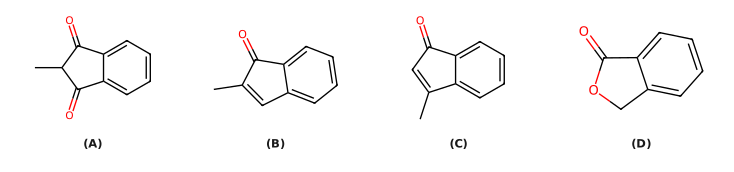
›Reveal solutionSolution
PCC oxidises the −CH2OH to −CHO; NaOH/Δ then drives an intramolecular aldol condensation between the ketone's α-carbon and that aldehyde, closing a five-membered ring. The product is 2-methyl-1H-inden-1-one — option (B).
The concept first
Two classical reactions, run back to back.
PCC (pyridinium chlorochromate) is the mild chromium oxidant. In an anhydrous medium (CH2Cl2) it converts:
1∘ alcohol⟶aldehyde(it stops here — no carboxylic acid)
2∘ alcohol⟶ketone
Aldol condensation requires a carbonyl with an α-hydrogen (to make the nucleophilic enolate) and a carbonyl that is electrophilic (to be attacked). Warm base then dehydrates the β-hydroxy carbonyl to a conjugated enone. When both carbonyls sit in the same molecule and geometry permits, the aldol becomes intramolecular and forges a ring — and rings of size five or six form fastest.
Step-by-step
- Read the substrate. A benzene ring carries:
- a propanoyl group, −C(=O)CH2CH3, and
- ortho to it, a primary alcohol, −CH2OH.
- Step (i) — PCC. The primary alcohol is oxidised, and PCC stops cleanly at the aldehyde:
Ar−CH2OH PCC Ar−CHO
We now have a 1,2-disubstituted benzene bearing an aldehyde and an ethyl ketone side by side.
3. Step (ii) — identify the enolate. Which carbonyl has an α-hydrogen?
- The aryl aldehyde (ArCHO) has no α-H — the carbon next to it is an aromatic carbon. It can only be the electrophile.
- The ketone has an α-CH2 (from the ethyl group). Hydroxide removes one of those protons to give the enolate. It is the nucleophile. This asymmetry is what makes the reaction clean — no self-condensation confusion.
- Close the ring. The enolate carbon attacks the aldehyde carbon. Trace the atoms of the new ring: 1Car−2C=O−3αC(CH3)−4CH(OH)−5Car …
- Read the substrate. A benzene ring carries:
- TG EAPCET 2022Set ap-2022-07-31-AN1 markMCQQ.The total number of aromatic (benzenoid compounds) isomers for the molecular formula of C7H8O is (A) 2 (B) 4 (C) 5 (D) 6
›Reveal solutionSolution
We systematically place a −CHX3 and −OH group on a benzene ring, then consider all possible positions. The total number of benzenoid aromatic isomers is 5.
The molecular formula CX7HX8O with a benzene ring (CX6HX4) leaves us with CHX4O to distribute as substituents. For aromatic compounds, we need to attach groups that maintain the benzene core while accounting for all atoms.
The degree of unsaturation is 22(7)+2−8=4, which matches a benzene ring (4 degrees). So we're looking at a disubstituted benzene with one carbon and one oxygen in the substituents.
The possible substitution patterns are:
- A methyl group (−CHX3) and a hydroxyl group (−OH): methylphenols (cresols)
- A methoxy group (−OCHX3): anisole
Let me work through each case.
Methylphenols (Cresols): −CHX3 and −OH on benzene
When two different groups occupy a benzene ring, we have three positional isomers:
-
ortho (1,2-positions): The −OH and −CHX3 are adjacent → o-cresol
-
meta (1,3-positions): The groups are separated by one carbon → m-cresol
-
para (1,4-positions): The groups are opposite each other → p-cresol
All three cresols are aromatic and satisfy CX7HX8O.
Methoxybenzene (Anisole): −OCHX3 on benzene …
- TG EAPCET 2021Set ap-2021-08-10-AN1 markMCQQ.The molecule that undergo self oxidation and reduction (disproportionation) reaction intramolecularly upon heating with concentrated alkali is (A) 3-Bromobenzaldehyde (B) 4-Methoxybenzaldehyde (C) Phthalic acid (D) Phthalaldehyde
›Reveal solutionSolution
The key is that only an aldehyde lacking an alpha‑hydrogen can undergo the Cannizzaro reaction (intramolecular disproportionation) in concentrated alkali. Phthalaldehyde, with two aldehyde groups on the same benzene ring, can undergo an intramolecular Cannizzaro reaction upon heating with concentrated alkali. The correct option is (D).
The concept here is the Cannizzaro reaction — a disproportionation of an aldehyde without an α‑hydrogen, where one molecule is oxidized to a carboxylic acid and another is reduced to an alcohol, under concentrated alkali. When two aldehyde groups are present on the same molecule (like in phthalaldehyde), the reaction can occur intramolecularly: one –CHO gets oxidized, the other gets reduced, forming a hydroxy acid. This is a classic test for aromatic aldehydes without α‑hydrogens.
Let’s examine each option:
-
3‑Bromobenzaldehyde – This is a simple aromatic aldehyde with no α‑hydrogen. It can undergo the Cannizzaro reaction, but only intermolecularly (between two separate molecules). The question specifies “intramolecularly” — so this does not fit.
-
4‑Methoxybenzaldehyde – Same as above: it has no α‑hydrogen, so it undergoes intermolecular Cannizzaro, not intramolecular. Not the answer.
-
Phthalic acid – This is a dicarboxylic acid, not an aldehyde. It cannot undergo a Cannizzaro reaction at all (no aldehyde group). Incorrect. …
-
🎓Unlock everything free for 14 days
- ✓Full step-by-step solutions
- ✓Concept-first explanations
- ✓Methods, shortcuts & mistakes
- ✓PYQ mapping + timed mock tests
Full access for 14 days. No credit card required.