Chemistry · Ch 9 — Amines
Classification
Classification
The basis of classification
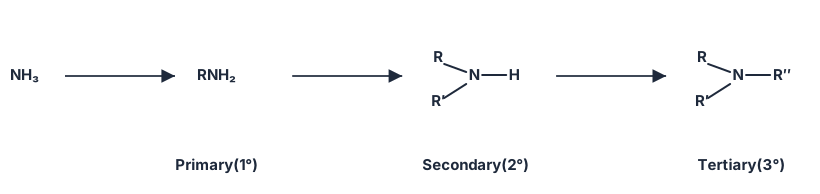
Every amine can be pictured as ammonia, , with one or more of its hydrogen atoms swapped out for an alkyl or aryl group. The number of hydrogen atoms that have been replaced is what sorts an amine into primary, secondary, or tertiary.
- Replace one hydrogen atom of with an alkyl or aryl group a primary amine (1°), written or .
- Replace two hydrogen atoms a secondary amine (2°), written . Equivalently, this is what you get if you take a primary amine, , and replace its one remaining N–H hydrogen with a second alkyl/aryl group, .
- Replace a third hydrogen atom (the last one on nitrogen) a tertiary amine (3°), written , with no hydrogen left on the nitrogen at all.
So the progression runs:
Drawn by us to help you understand the concept clearly, and verified to make sure it's accurate. For exams, practice from your textbook's own diagram.
Redrawn from the NCERT page with the structures, printed labels (NH3, RNH2, R′, R″) and reagent placement exactly as the textbook prints them. Every element of this display was checked against the printed page during the sweep's blind-judge verification pass, so wha …
Not the same test as for alcohols and halides
This is a frequent point of confusion, so it is worth stating plainly: the 1°/2°/3° labels for amines do not measure the same thing as the 1°/2°/3° labels for alcohols or alkyl halides.
For an alcohol or a halide, primary/secondary/tertiary describes the carbon atom carrying the functional group — specifically, how many other carbon atoms that carbon is attached to.
For an amine, primary/secondary/tertiary describes the nitrogen atom — specifically, how many hydrogen atoms of ammonia it has had replaced by carbon-containing groups (alkyl or aryl), regardless of how those attached carbons are themselves substituted.
A tertiary amine can perfectly well be built from three simple, unbranched alkyl groups, and a primary amine can carry a heavily branched alkyl or an aryl group — the classification only counts substitutions at nitrogen, never the branching at carbon.