Chemistry · Ch 9 — Amines
Nomenclature
Nomenclature
Amines can be named either by the older common-name system or by the systematic IUPAC system, and the two use quite different logic.
Common (functional class) names
In the common-name approach, an aliphatic amine is named by simply writing the name of the alkyl group directly in front of the word "amine," with the two fused into a single word — for instance, becomes methylamine. This works cleanly for a primary amine, where only one alkyl group is attached to nitrogen.
For secondary and tertiary amines, the same idea is extended by listing the attached groups before "amine." When two or all three of the groups on nitrogen are identical, this is compressed using the multiplying prefixes "di" or "tri" placed just before the alkyl name — so an amine carrying three identical methyl groups on nitrogen is named trimethylamine rather than spelling "methyl" out three separate times. When the groups on nitrogen differ from each other, they are simply cited one after another (in alphabetical order) ahead of "amine," giving names such as ethylmethylamine for a secondary amine bearing one ethyl and one methyl group on the same nitrogen.
IUPAC names
The systematic IUPAC system treats a primary amine as a substituted alkane and calls it an alkanamine. The name is built by taking the corresponding alkane name and swapping its final "-e" for "-amine" — so , built off methane, is named methanamine.
When a molecule carries more than one group attached to different carbons of the parent chain, each position is pinpointed with a locant number placed on the carbon bearing the amino group, and a multiplying prefix (di, tri, and so on) is inserted before "amine" to show how many such groups are present, while the final "-e" of the parent hydrocarbon name is kept rather than dropped. For example, is named ethane-1,2-diamine.
For secondary and tertiary amines, IUPAC naming treats the parent chain as the longest carbon chain attached to nitrogen and names the other group(s) on nitrogen as substituents, using the italic locant "N" to make clear that a substituent sits directly on the nitrogen atom rather than on a numbered carbon of the chain. So a molecule such as is named N-methylethanamine (ethanamine is the parent chain, methyl is the substituent on N), and , where two of the three ethyl groups are treated as N-substituents on the third, is named N,N-diethylethanamine. When both nitrogen substituents are identical, the locant "N" is doubled as N,N- to show that both extra groups sit on the same nitrogen. Several further worked names built on this pattern are collected in the accompanying nomenclature table.
Naming arylamines
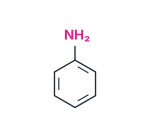
An arylamine is one in which the group is bonded straight onto a benzene ring rather than onto a chain carbon. The simplest such compound, , is universally known by its common name aniline, and this common name is unusual in also being accepted as a valid IUPAC name in its own right — it does not need to be replaced by a systematic alternative. …
| Structure | Common name | IUPAC name |
|---|---|---|
| Ethylamine | Ethanamine | |
| n-Propylamine | Propan-1-amine | |
| Isopropylamine | Propan-2-amine | |
| Ethylmethylamine | N-Methylethanamine | |
| Trimethylamine | N,N-Dimethylmethanamine | |
| N,N-Diethylbutylamine | N,N-Diethylbutan-1-amine | |
| Allylamine | Prop-2-en-1-amine | |
| Hexamethylenediamine | Hexane-1,6-diamine | |
| Aniline | Aniline or Benzenamine | |
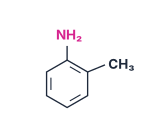
| o- | o-Toluidine | 2-Methylaniline |
| p- | p-Bromoaniline | 4-Bromobenzenamine or 4-Bromoaniline |
| N,N-Dimethylaniline | N,N-Dimethylbenzenamine |
The real Table 9.1 draws the four arylamines in the table as ring structures — here they are, drawn out, so the condensed formulas above have a visual anchor: