Q.Which of the following reactions of glucose can be explained only by its cyclic structure?
🔒You're viewing a preview — the full solution, concept, methods & PYQ mapping are locked.
🔒 Start your 14-day free trial to unlock the full solution →Concept understanding — Glucose Cyclization
Glucose Cyclization: From a Straight Chain to a Ring
Imagine you have a long, flexible chain with a hook at one end and an eyelet at the other. If you swing that chain around, the hook can snap into the eyelet, forming a loop. That's the core idea behind glucose cyclization.
Glucose in its simplest written form is a straight chain of six carbon atoms with an aldehyde group (−CHO) at one end. But in water (like in your blood), this chain doesn't stay straight. The aldehyde group reacts with the alcohol group on the fifth carbon, forming a stable six-membered ring.
Why does this happen?
The aldehyde carbon is electrophilic (electron-poor), and the oxygen on carbon-5 has lone pairs (nucleophilic). They attack each other, forming a new bond. This creates a hemiacetal — a carbon bonded to both an −OH and an −OR group. The ring is more stable than the open chain in solution.
The open-chain form of glucose exists in equilibrium with the cyclic form, but at any given time, over 99% of glucose molecules are in the cyclic form.
The precise statement
Glucose cyclization is an intramolecular nucleophilic addition where the aldehyde group at C1 reacts with the hydroxyl group at C5, forming a six-membered pyranose ring (named after pyran, a six-membered oxygen heterocycle). This reaction creates a new chiral center at C1, giving two possible stereoisomers called anomers: α and β.
The two anomers
When the ring forms, the oxygen from C5 becomes part of the ring. The carbon that was the aldehyde (now C1) becomes a new chiral center. The −OH group at this new center can point:
- Down (relative to the ring plane) → α-D-glucose
- Up → β-D-glucose
The α and β anomers are diastereomers, not enantiomers. They differ only at the anomeric carbon (C1). In solution, they interconvert through the open-chain form — a process called mutarotation.
How to draw it (Haworth projection)
- Draw a hexagon with an oxygen atom at the top-right corner.
- Number the carbons clockwise from the oxygen: C1 is the carbon to the right of oxygen, C2 next, and so on.
- For α-D-glucose, the −OH at C1 points down (opposite to the CH2OH group at C5).
- For β-D-glucose, the −OH at C1 points up (same side as the CH2OH group). …
Why this formula?
Glucose Cyclization: Why the Ring Forms
Glucose cyclization is a classic example of an intramolecular reaction — a molecule reacting with itself. Let's build the understanding step by step.
1. The Starting Point: Open-Chain Glucose
Glucose (C6H12O6) in its open-chain form has:
- An aldehyde group (−CHO) at carbon 1 (C1)
- A hydroxyl group (−OH) at carbon 5 (C5)
The aldehyde is electrophilic (electron-deficient at the carbonyl carbon), and the hydroxyl is nucleophilic (electron-rich oxygen with lone pairs).
2. Why Cyclization Happens: Thermodynamic & Kinetic Favorability
The Key Insight
The molecule is flexible — it can bend so that the C5 hydroxyl oxygen approaches the C1 aldehyde carbon. This brings two reactive groups into close proximity.
- Entropy is favorable: One molecule becomes one ring — no loss of translational entropy (unlike two separate molecules reacting).
- Ring strain is manageable: A 5- or 6-membered ring (furanose or pyranose) has minimal angle strain (close to tetrahedral angles).
Result: The reaction is reversible but strongly favors the cyclic form — in aqueous solution, >99% of glucose exists as the ring.
3. The Reaction: Hemiacetal Formation
The nucleophilic oxygen of the C5 hydroxyl attacks the electrophilic carbonyl carbon of C1:
R-CHO+R’-OH⇌R-CH(OH)(OR’)
This is a hemiacetal — a carbon bonded to both an −OH and an −OR group.
Mechanism (simplified)
- Protonation of the carbonyl oxygen (acid-catalyzed) makes C1 more electrophilic.
- Nucleophilic attack by the C5 oxygen.
- Deprotonation yields the cyclic hemiacetal.
4. The Key Formula(e): Ring Size & Anomeric Carbon
Ring Size Determination
The ring size depends on which hydroxyl attacks:
- C5 hydroxyl → pyranose (6-membered ring: 5 carbons + 1 oxygen)
- C4 hydroxyl → furanose (5-membered ring: 4 carbons + 1 oxygen)
For D-glucose, the C5 attack is overwhelmingly favored, giving the pyranose form.
The Anomeric Carbon
The new chiral center formed at C1 is called the anomeric carbon. Two stereoisomers arise:
- α-anomer: −OH at C1 is trans to the −CH2OH group (axial in the chair conformation)
- β-anomer: −OH at C1 is cis to the −CH2OH group (equatorial in the chair conformation)
Why two forms? The attack can occur from either face of the planar carbonyl group — leading to two possible configurations at the new stereocenter.
5. The Equilibrium Constant & Mutarotation
The interconversion between α and β anomers is called mutarotation:
α-D-glucopyranose⇌open chain⇌β-D-glucopyranose
At equilibrium (in water at 20°C):
- β-D-glucopyranose: ~64%
- α-D-glucopyranose: ~36%
- Open chain: <0.1% …
The key idea is that the cyclic hemiacetal form of glucose hides the aldehyde group, preventing certain reactions that require a free carbonyl.
- Glucose exists predominantly as a six-membered pyranose ring (cyclic hemiacetal). The aldehyde group is tied up in the ring.
- A free aldehyde reacts with hydroxylamine to form an oxime. Glucose itself does form an oxime slowly because a tiny amount of the open-chain form is present. …
The key is that a free aldehyde group reacts with hydroxylamine to form an oxime, but if the aldehyde is locked in a cyclic hemiacetal (as in glucose's cyclic form), it cannot do so. The pentaacetate of glucose has all five —OH groups acetylated, and since the cyclic form has no free aldehyde, it does not react with hydroxylamine. Hence, option (iii) is the correct answer.
Glucose exists predominantly in a cyclic (pyranose or furanose) form in solution, not as a free open-chain aldehyde. This cyclic structure is a hemiacetal — the aldehyde group has reacted with the C5 hydroxyl to form an internal ring. In this ring form, the aldehyde carbon (C1) is now an acetal carbon, and it no longer behaves like a free aldehyde.
The question asks which reaction cannot be explained if we think of glucose as a simple open-chain aldehyde, but can be explained once we know it's cyclic. Let's examine each option.
-
Option (i): Glucose forms pentaacetate.
Glucose has five —OH groups. Whether in open-chain or cyclic form, all five hydroxyls can be acetylated. Acetylation does not require a free aldehyde — it just needs —OH groups. So this reaction is explained by either structure. Not the answer.
-
Option (ii): Glucose reacts with hydroxylamine to form an oxime.
Hydroxylamine (NH2OH) reacts with a free aldehyde or ketone to give an oxime (C=NOH). In solution, a tiny fraction of glucose exists as the open-chain aldehyde, so a slow oxime formation does occur. This reaction can be explained by the open-chain form, but the question asks which reaction is explained only by the cyclic structure. Since the oxime formation is actually explained by the open-chain form (not the cyclic one), this option is not correct.
Watch outA common mistake is to think that because glucose mostly exists in cyclic form, it cannot form an oxime. But the equilibrium between cyclic and open-chain forms means a small amount of free aldehyde is always present, so oxime formation does happen — just slowly.
-
Option (iii): Pentaacetate of glucose does not react with hydroxylamine.
This is the clincher. When glucose is acetylated to form pentaacetate, all five —OH groups are converted to acetate esters. In the cyclic form, the anomeric carbon (C1) is part of the ring and has no free aldehyde — it's an acetal. Acetylation does not open the ring; the cyclic structure is locked. So the pentaacetate has no free aldehyde group at all. Hydroxylamine cannot form an oxime because there is no carbonyl to attack. …
Method: Cyclic Structure Evidence via Differential Reactivity
This question is solved using the method of functional group masking in cyclic vs. open-chain forms.
Step 1: Recall the key structural feature
Glucose exists predominantly in a cyclic hemiacetal form (pyranose ring). In this form, the −CHO group at C1 is masked — it is no longer a free aldehyde but part of a hemiacetal linkage.
Step 2: Analyse each option for aldehyde-specific reactions
-
(A) Glucose forms pentaacetate
All five −OH groups (including the anomeric −OH at C1) get acetylated. This happens in both cyclic and open forms — not exclusive to cyclic structure.
-
(B) Glucose reacts with hydroxylamine to form an oxime
Oxime formation requires a free carbonyl group (>C=O). The cyclic form has no free aldehyde, so this reaction occurs only via the open-chain form — not explained by cyclic structure.
-
(C) Pentaacetate of glucose does not react with hydroxylamine …
Here are the common mistakes students make on this question about glucose cyclization, along with how to avoid each.
Mistake 1: Confusing open-chain vs. cyclic reactivity
The error: Students think that reactions involving the aldehyde group (like oxime formation or oxidation) can only happen if glucose is in the cyclic form.
- In reality, the open-chain form also has a free aldehyde group and can do these reactions.
How to avoid:
- Remember: Glucose exists mostly as a cyclic hemiacetal, but a tiny amount of the open-chain aldehyde form is always present in equilibrium.
- Any reaction that uses the aldehyde group (e.g., with NHX2OH or HNOX3) can happen via the open-chain form — cyclic structure is not required to explain it.
Mistake 2: Thinking pentaacetate formation proves cyclic structure
The error: Students assume that because glucose forms a pentaacetate, it must have 5 –OH groups, which is true — but this is also true for the open-chain form.
How to avoid:
- Both open-chain and cyclic glucose have 5 hydroxyl groups.
- Acetylation happens at all –OH groups regardless of ring form.
- So, pentaacetate formation does not distinguish between cyclic and open-chain structures.
Mistake 3: Missing the key clue — “pentaacetate does not react with hydroxylamine”
The error: Students overlook that the pentaacetate of glucose has no free aldehyde group (because the anomeric –OH is also acetylated).
- If glucose were open-chain, the aldehyde group would still be free and could form an oxime.
- Since the pentaacetate does not react with NHX2OH, it proves the aldehyde group is blocked — which only happens in the cyclic hemiacetal form.
How to avoid:
- Focus on which –OH is involved in ring formation. In the cyclic form, the anomeric carbon’s –OH is part of the ring and gets acetylated, removing the aldehyde.
- In the open-chain form, the aldehyde remains free even after acetylation of the other –OH groups.
Mistake 4: Confusing gluconic acid with saccharic acid
The error: Students think oxidation by HNOX3 gives gluconic acid (which only oxidizes the aldehyde). …
- TG EAPCET 2026Set eng-2026-05-10-AN1 markMCQQ.Which of the following represents the correct pyranose structure of β-D-(+)-glucose? (A) Haworth pyranose ring (CH2OH up at C-5): C-1 has H above and OH below; C-2 has OH above and H below; C-3 has OH above and H below; C-4 has H above and OH below (B) Haworth pyranose ring (CH2OH up at C-5): C-1 has H above and OH below; C-2 has H above and OH below; C-3 has OH above and H below; C-4 has H above and OH below (C) Haworth pyranose ring (CH2OH up at C-5): C-1 has OH above and H below; C-2 has H above and OH below; C-3 has OH above and H below; C-4 has H above and OH below (D) Haworth pyranose ring (CH2OH up at C-5): C-1 has OH above and H below; C-2 has H above and OH below; C-3 has OH above and H below; C-4 has OH above and H below
›Reveal solutionSolution
For β-D-glucopyranose the Haworth ring must read OH up at C-1, down at C-2, up at C-3, down at C-4, with CH2OH up at C-5. Only option (C) shows that pattern.
The concept first
There are just three rules for turning the open-chain Fischer projection into a Haworth pyranose ring.
Rule 1 — the "right–down" rule. Any −OH written on the right in the Fischer projection is drawn below the ring in Haworth; anything on the left is drawn above.
Rule 2 — the D-configuration. In a D-sugar the terminal CH2OH (C-6, attached at C-5) points up.
Rule 3 — α versus β. The new stereocentre created on ring closure is C-1, the anomeric carbon.
- β: the C-1 OH is on the same side as the CH2OH — i.e. up.
- α: the C-1 OH is down (opposite to CH2OH).
Step-by-step
Step 1 — recall the Fischer projection of D-(+)-glucose. Reading down from C-1 (the CHO):
C-2: OH right,C-3: OH left,C-4: OH right,C-5: OH right (D)
The memory aid many students use is "right–left–right–right", the lone left-hand OH being at C-3.
Step 2 — apply the right–down rule to C-2, C-3, C-4.
- C-2: OH on the right ⇒ OH below the ring, H above.
- C-3: OH on the left ⇒ OH above the ring, H below.
- C-4: OH on the right ⇒ OH below the ring, H above.
Step 3 — place the CH2OH. D-sugar ⇒ CH2OH at C-5 points up. (Both the question's diagrams and every standard Haworth drawing agree on this.)
Step 4 — set the anomeric carbon. We want the β anomer, so the C-1 OH must be cis to the CH2OH — i.e. OH above, H below.
Step 5 — assemble the required pattern.
C-1: OH up,C-2: OH down,C-3: OH up,C-4: OH down,C-5: CH2OH up …
- TG EAPCET 2026Set eng-2026-05-11-FN1 markMCQQ.Match the following List-1 List-2 A. Antioxidant I. Antiseptic B. Food preservative II. Artificial sweetener C. Sucralose III. Butylated hydroxy toluene D. Bithionol IV. Sodium benzoate The correct answer is (A) A – III, B – I, C – IV, D – II (B) A – IV, B – III, C – II, D – I (C) A – III, B – IV, C – I, D – II (D) A – III, B – IV, C – II, D – I
›Reveal solutionSolution
Match each compound with its function: antioxidants prevent oxidative rancidity, preservatives inhibit microbial growth in food, artificial sweeteners provide sweetness without calories, and antiseptics kill microbes on living tissue. The correct pairing is A–III, B–IV, C–II, D–I.
This question tests your knowledge of the classification and applications of important organic compounds in everyday life, particularly in the pharmaceutical and food industries. Each substance has a specific role determined by its chemical structure and properties.
Let's identify each compound and its function:
A. Antioxidant → III. Butylated hydroxy toluene (BHT)
Antioxidants prevent oxidative degradation of fats and oils in food by inhibiting free-radical chain reactions. BHT is a phenolic compound widely used in the food industry to prevent rancidity. The hydroxyl group on the aromatic ring donates hydrogen atoms to free radicals, breaking the oxidation chain and preserving freshness.
B. Food preservative → IV. Sodium benzoate
Food preservatives extend shelf life by inhibiting microbial growth (bacteria, fungi, yeasts). Sodium benzoate (CX6HX5COONa) is one of the most common preservatives, especially effective in acidic foods like pickles, jams, and carbonated beverages. In acidic conditions it converts to benzoic acid, which penetrates microbial cell walls and disrupts their metabolism.
C. Sucralose → II. Artificial sweetener …
- TG EAPCET 2026Set ap-2026-05-05-FN1 markMCQQ.Essential amino acids which are basic in nature are (A) Arg, Lys (B) His, Ser (C) Arg, Thr (D) Pro, Trp
›Reveal solutionSolution
Basic amino acids have side chains that can accept protons (positive charge at neutral pH). Among the essential amino acids, arginine (Arg) and lysine (Lys) are basic, making option (A) correct.
The key to this question is understanding two classifications at once: which amino acids are essential (must come from diet) and which are basic (have a net positive charge at physiological pH). You need the overlap.
Amino acids are basic when their side chain contains an extra amino group or a guanidino group — something that can grab a proton. The three standard basic amino acids are arginine (Arg), lysine (Lys), and histidine (His). But not all of these are essential for adults.
-
Identify the basic amino acids.
At pH ~7.4, the side chains of Arg (guanidino group, pKa ~12.5), Lys (ε-amino group, pKa ~10.5), and His (imidazole group, pKa ~6.0) can carry a positive charge. So the set of basic amino acids is {Arg, Lys, His}.
-
Identify the essential amino acids.
The nine essential amino acids for humans are: histidine, isoleucine, leucine, lysine, methionine, phenylalanine, threonine, tryptophan, and valine. (Histidine is essential for infants and often considered conditionally essential for adults, but standard lists include it.)
-
Find the intersection.
From the basic set {Arg, Lys, His}, which are essential?
- Lysine is essential.
- Histidine is essential.
- Arginine is not essential for adults (the body can synthesize it), though it is essential for children. In most exam contexts, arginine is classified as non-essential for adults.
So the essential basic amino acids are histidine and lysine. But look at the options — none say "His, Lys". Option (A) says "Arg, Lys". Why would that be correct?
Watch outMany standard Indian exam lists (including NCERT) treat arginine as essential for children and sometimes include it in the essential set for general purposes. Also, histidine is sometimes omitted from the essential list in older or simplified versions. This mismatch is a known source of confusion.
- Check each option against the standard NCERT/NEET classification. …
-
- TG EAPCET 2024Set eng-2024-05-09-FN1 markMCQQ.The functional groups involved in the conversion of glucose to gluconic acid and gluconic acid to saccharic acid respectively are (A) −CHO, −CHOH (B) −CHO, −CH2OH (C) −CH2OH, −CHO (D) −CH2OH, −CHOH
›Reveal solutionSolution
Glucose is an aldohexose; mild oxidation (e.g., with bromine water) converts its aldehyde group (−CHO) to a carboxylic acid, giving gluconic acid. Stronger oxidation (e.g., with nitric acid) also oxidises the primary alcohol at the other end (−CH2OH) to a carboxylic acid, yielding saccharic acid. Thus the functional groups involved are −CHO then −CH2OH — option (B).
Concept & Intuition
Glucose is a six-carbon sugar with an aldehyde group at C1 and a primary alcohol group at C6 (the terminal −CH2OH). The other four carbons carry secondary alcohol groups (−CHOH).
- Mild oxidation (like bromine water) selectively attacks the most easily oxidised group — the aldehyde — turning it into a carboxylic acid. This gives gluconic acid.
- Stronger oxidation (like hot nitric acid) is powerful enough to also oxidise the primary alcohol at C6 to a carboxylic acid. The result is a dicarboxylic acid called saccharic acid. The secondary alcohol groups (−CHOH) are not oxidised under these conditions (they would require even harsher reagents). So the two steps target different functional groups: first the aldehyde, then the primary alcohol.
Step-by-step reasoning
-
Identify the functional groups in glucose
Glucose has the formula CHO(CHOH)4CH2OH. The key groups are:
- An aldehyde: −CHO at C1.
- A primary alcohol: −CH2OH at C6.
- Four secondary alcohols: −CHOH at C2–C5.
-
First conversion: glucose → gluconic acid
Reagent: mild oxidising agent (e.g., Br2/H2O).
Reaction: The aldehyde group is oxidised to a carboxylic acid:
−CHO[O]−COOH
The product is gluconic acid: HOOC(CHOH)4CH2OH.
Functional group involved: −CHO.
- Second conversion: gluconic acid → saccharic acid Reagent: strong oxidising agent (e.g., hot HNO3). Reaction: The primary alcohol at C6 is now oxidised to a carboxylic acid: …
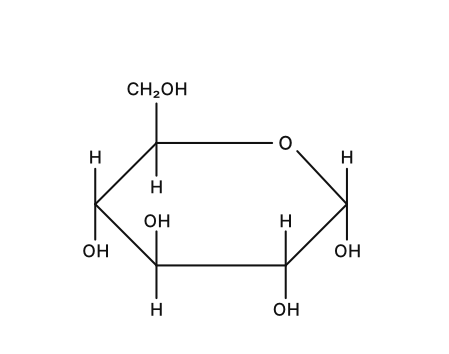
- TG EAPCET 2023Set eng-2023-05-13-FN1 markMCQQ.The Haworth projection shown below represents [FIGURE] (A) β-D-(-)-Fructofuranose (B) β-D-(+)-Glucopyranose (C) α-D-(-)-Fructofuranose (D) α-D-(+)-Glucopyranose
›Reveal solutionSolution
A six-membered ring rules out fructose; CHX2OH up marks the D-series; the anomeric OH pointing down marks the α anomer. The sugar is α-D-(+)-glucopyranose — option (D).
The concept first: how to read a Haworth projection
A Haworth projection is the cyclic hemiacetal drawn as a flat ring seen edge-on. Three questions unlock it, in this order:
- How many atoms in the ring? Six (5 C + O) = pyranose; five (4 C + O) = furanose. Glucose, an aldohexose, cyclises through C-1 and C-5 giving a six-membered pyranose. Fructose, a ketohexose, cyclises through C-2 and C-5 giving a five-membered furanose. So ring size alone separates glucose from fructose.
- Which way does CHX2OH (on C-5) point? Up ⇒ D-sugar; down ⇒ L-sugar.
- Which way does the OH on the anomeric carbon (C-1 for glucose) point?
- Down (i.e. trans / on the opposite side from CHX2OH) ⇒ α.
- Up (cis to CHX2OH) ⇒ β.
Step-by-step
Step 1 — Count the ring. The drawing is a hexagon with the oxygen at the top-right vertex: five carbons + one oxygen ⇒ pyranose. Immediately, both fructofuranose options fall away — fructose does not give a six-membered ring in these options.
Step 2 — Fix the D/L label. C-5 (top-left carbon, next to the ring O) carries CHX2OH upward. ⇒ D-sugar. …
- TG EAPCET 2023Set ap-2023-05-11-AN1 markMCQQ.Among the following, sulphur containing amino acids are (A) A & B only. (B) B & C only. (C) B & D only. (D) A & C only.
›Reveal solutionSolution
The two standard amino acids that contain sulphur are Cysteine and Methionine. To answer the question, we need to identify which of the labels A, B, C, D correspond to these amino acids. Assuming B and D represent Cysteine and Methionine respectively, the correct option is (C).
Concept and Intuition
Amino acids are the fundamental building blocks of proteins. Each amino acid has a central carbon atom (the alpha-carbon) bonded to four different groups:
- An amino group (−NH2)
- A carboxyl group (−COOH)
- A hydrogen atom (−H)
- A unique side chain, also known as the R-group
The R-group is what distinguishes one amino acid from another and determines its chemical properties. To identify sulphur-containing amino acids, we need to look for the presence of a sulphur atom within this R-group.
There are 20 standard amino acids commonly found in proteins. Among these, only two contain sulphur atoms in their side chains: Cysteine and Methionine.
Step-by-step Analysis
-
Identify Sulphur-Containing Amino Acids:
Out of the 20 standard amino acids, Cysteine and Methionine are the only two that contain sulphur in their R-groups.
-
Cysteine:
Cysteine has a thiol group (−SH) in its side chain. This thiol group is highly reactive and can form disulfide bonds (−S−S−) with another cysteine residue, which is crucial for stabilizing protein structures.
The structure of Cysteine is:
H2N−R-group∣CH−COOHCH2SH
Here, the sulphur atom is part of the $-\text{CH}_2\text{SH}$ (thiomethyl) group.3. Methionine:
Methionine contains a thioether group (−S−CH3) in its side chain. Unlike cysteine, the sulphur in methionine is not directly bonded to a hydrogen atom, making it less reactive and unable to form disulfide bonds. Methionine is also unique as it is typically the first amino acid incorporated into a polypeptide chain during protein synthesis.
The structure of Methionine is:
H2N−R-group∣CH−COOHCH2CH2SCH3
Here, the sulphur atom is part of the $-\text{CH}_2\text{CH}_2\text{SCH}_3$ (ethyl methyl thioether) group.

> [!IMPORTANT]
> Cysteine contains a thiol ($-\text{SH}$) group, while Methionine contains a thioether ($-\text{S}-\text{CH}_3$) group. Both contain sulphur.
4. Addressing the Options (A, B, C, D): …
- TG EAPCET 2023Set ap-2023-05-11-AN1 markMCQQ.Match the following List - I (Example) A. Cimetidine B. Alitame C. Morphine D. Iodoform List-II (Type of chemical substance) I. Artificial sweetener II. Analgesic III. Antacid IV. Antifertility drug V. Antiseptic (A) A - I, B - III, C - IV, D - II (B) A - III, B - I, C - IV, D - II (C) A - V, B - II, C - I, D - III (D) A - III, B - I, C - II, D - V
›Reveal solutionSolution
This question asks us to match common chemical substances with their respective categories based on their primary use or function. Cimetidine is an antacid, Alitame is an artificial sweetener, Morphine is an analgesic, and Iodoform is an antiseptic, leading to option (D).
The field of chemistry, particularly medicinal chemistry and food chemistry, involves a vast array of substances designed for specific purposes. Understanding the function of these chemicals is crucial. This problem tests your knowledge of common examples of drugs and food additives and their classifications. Each substance has a distinct chemical structure that dictates its biological activity or physical property, allowing it to serve a particular role.
Here's how we can match each substance to its correct category:
-
Analyze Cimetidine:
Cimetidine is a drug primarily used to treat heartburn and stomach ulcers. It works by blocking histamine H2 receptors in the stomach, which reduces the production of stomach acid. Substances that neutralize or reduce stomach acid are classified as antacids.
- Therefore, Cimetidine matches with III. Antacid.
-
Analyze Alitame:
Alitame is a high-potency artificial sweetener. It is a dipeptide derivative, significantly sweeter than sucrose (table sugar), and is used as a sugar substitute in various food products.
- Therefore, Alitame matches with I. Artificial sweetener.
-
Analyze Morphine:
Morphine is a powerful opioid drug used to relieve severe pain. It acts on the central nervous system to produce its pain-relieving effects. Drugs that alleviate pain are known as analgesics.
- Therefore, Morphine matches with II. Analgesic.
-
Analyze Iodoform: …
-
- TG EAPCET 2022Set ap-2022-07-30-FN1 markMCQQ.Given sub-structure belongs to which amino acid (A) Proline (B) Arginine (C) Tyrosine (D) Histidine
›Reveal solutionSolution
The sub-structure shown is the imidazole ring, which is the distinctive side chain of histidine; therefore the correct answer is histidine.
The question asks you to match a given sub-structure to its parent amino acid. The key is to recognize the unique chemical group that defines each amino acid’s side chain. Among the options, proline has a pyrrolidine ring, arginine has a guanidinium group, tyrosine has a phenol ring, and histidine has an imidazole ring. The sub-structure in question is a five-membered ring containing two nitrogen atoms — that is the imidazole ring, exclusive to histidine.
Let’s walk through the reasoning step by step:
-
Identify the sub-structure’s features.
The given sub-structure is a five-membered ring with two nitrogen atoms (one at position 1 and one at position 3) and three carbon atoms. This is the imidazole ring. It is aromatic and can exist in two tautomeric forms (with the hydrogen on either nitrogen).
-
Recall the side chains of the listed amino acids.
- (A) Proline: Its side chain is a pyrrolidine ring — a five-membered ring with one nitrogen (a secondary amine). Not a match.
- (B) Arginine: Its side chain is a straight chain ending in a guanidinium group (three nitrogens, no ring). Not a match.
- (C) Tyrosine: Its side chain contains a phenol ring (a six-membered aromatic ring with one oxygen). Not a match.
- (D) Histidine: Its side chain is exactly the imidazole ring. This is the only amino acid among the 20 standard ones that contains an imidazole group.
-
Confirm by elimination. …
-
- TG EAPCET 2022Set eng-2022-07-20-FN1 markMCQQ.The organic compound 5-allylcyclohex-3-ene-1-ol is reacted with cold, dilute, aqueous solution of KMnO4. The total number of hydroxyl group(s) (–OH) present in the product is (A) 1 (B) 2 (C) 3 (D) 5
›Reveal solutionSolution
Cold dilute KMnO4 adds two –OH groups across each double bond (syn dihydroxylation). The starting compound has two double bonds (one in the ring, one in the allyl side chain), so the product gains four new –OH groups, plus the existing one, for a total of 5 hydroxyl groups.
The key is to recognise what cold, dilute, aqueous KMnO4 does. This is Baeyer’s reagent — it performs syn dihydroxylation of alkenes, converting each C=C into a vicinal diol (two adjacent –OH groups). It does not cleave the double bond (that requires hot, concentrated KMnO4 or ozonolysis). So every double bond in the molecule gets two –OH groups added across it.
Let’s look at the structure of 5-allylcyclohex-3-ene-1-ol.
-
Draw the molecule. The parent is cyclohex-3-ene-1-ol: a six-membered ring with a double bond between C3 and C4, and an –OH group at C1. At C5, there is an allyl substituent: –CH2–CH=CH2. So the molecule contains two separate double bonds — one in the ring (C3=C4) and one in the allyl side chain (the terminal CH2=CH–).
-
Apply cold KMnO4 to each double bond.
- The ring double bond (C3=C4) gets two –OH groups added, one on C3 and one on C4.
- The allyl double bond (CH2=CH–) gets two –OH groups added, one on the terminal carbon and one on the middle carbon of the side chain.
-
Count the –OH groups in the product.
- The original molecule already has one –OH at C1.
- The ring dihydroxylation adds two new –OH groups.
- The side-chain dihydroxylation adds two more –OH groups. …
-
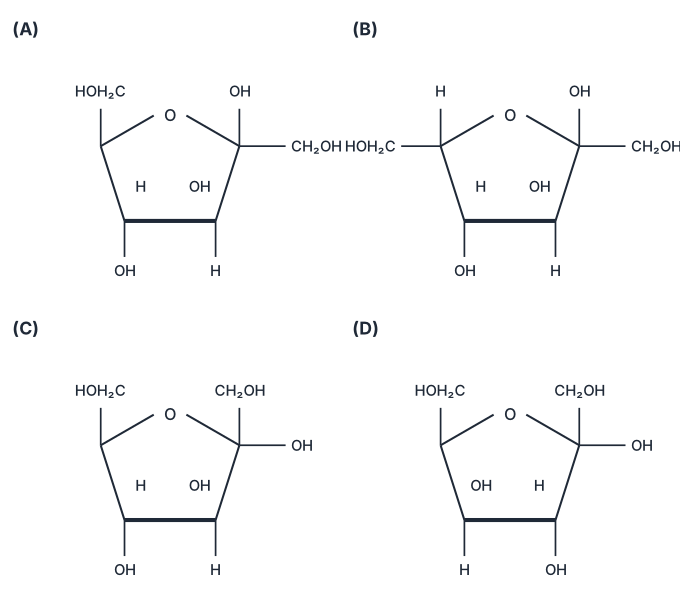
- TG EAPCET 2021Set eng-2021-08-04-FN1 markMCQQ.The structure of α-D-Fructofuranose is (A) [FIGURE] Haworth furanose ring: HOH2C at the upper left of the ring oxygen and OH at the upper right (anomeric carbon); H and OH inside the ring face; H on the left ring carbon with OH below it; CH2OH on the right ring carbon with H below it (B) [FIGURE] Haworth furanose ring: H at the upper left of the ring oxygen and OH at the upper right; HOH2C written on the left ring carbon; H OH inside; OH and H at the bottom; CH2OH on the right ring carbon (C) [FIGURE] Haworth furanose ring: HOH2C at the upper left of the ring oxygen and CH2OH at the upper right (anomeric carbon); H and OH inside; H on the left ring carbon with OH below; OH on the right ring carbon with H below (D) [FIGURE] Haworth furanose ring: HOH2C at the upper left and CH2OH at the upper right; OH and H inside (reversed relative to option C); H on the left; OH on the right; H and OH at the bottom
›Reveal solutionSolution
α-D-Fructofuranose forms when C-2 (the ketone carbon) cyclizes with the C-5 hydroxyl, placing the anomeric OH below the ring plane in the α-anomer; the final structure has CH2OH groups at both C-1 and C-6 positions flanking the ring oxygen.
Why fructose cyclizes differently from glucose
Fructose is a ketohexose — the carbonyl sits at C-2, not C-1. When it cyclizes into a five-membered furanose ring, the C-5 hydroxyl attacks the C-2 ketone, making C-2 the new anomeric center. This is fundamentally different from aldoses like glucose, where C-1 becomes anomeric.
The furanose ring of D-fructose therefore contains carbons 2, 3, 4, 5, and the ring oxygen. Carbon-1 and carbon-6 both end up as CH2OH groups outside the ring — C-1 attached to C-2 (the anomeric carbon) and C-6 attached to C-5.
Building the Haworth projection step by step
-
Identify the ring atoms and numbering.
The furanose ring runs C-2 (anomeric) → C-3 → C-4 → C-5 → O → back to C-2. In a standard Haworth projection, we draw the ring with oxygen at the back (top), C-2 to the right of oxygen, C-3 at the bottom right, C-4 at the bottom left, and C-5 to the left of oxygen.
-
Place the exocyclic CH2OH groups.
- C-1 is bonded to C-2 (the anomeric carbon, upper right position). So CH2OH from C-1 projects from the anomeric carbon.
- C-6 is bonded to C-5 (upper left position). So HOH2C (or CH2OH) projects from C-5.
This immediately tells us the upper-left and upper-right substituents are both CH2OH groups.
-
Determine the anomeric configuration at C-2.
In D-sugars, the α-anomer has the anomeric OH on the opposite side of the ring from the C-6 CH2OH group (which defines the D-configuration). Since C-6 projects upward from C-5 in D-fructose, the α-OH at C-2 must point downward (below the ring plane).
The anomeric carbon (C-2) therefore carries the C-1 CH2OH substituent and an OH group; in α-D-fructofuranose, that OH is down.
-
Assign the remaining hydroxyls using Fischer → Haworth rules.
In the D-fructose Fischer projection:
- C-3: OH on the right → projects down in Haworth (below the ring). …
-
- TG EAPCET 2021Set eng-2021-08-05-AN1 markMCQQ.Glucose on prolonged heating with HI, gives product P. The product P is (A) CH2I∣(CHOH)4∣CH2OH (B) CHO∣(CH−I)4∣CH2I (C) CH3∣(CH2)4∣CH3 (D) CH2−I∣(CHI)4∣CH2I
›Reveal solutionSolution
Prolonged heating of glucose with HI causes exhaustive reduction — all hydroxyl (–OH) groups are replaced by hydrogen, and the aldehyde group is also reduced to a methyl group. The final product is n-hexane, which matches option (C).
The key here is understanding what HI does to a sugar like glucose. HI is a powerful reducing agent, especially under prolonged heating. It doesn’t just replace one or two –OH groups — it goes all the way. Every hydroxyl group in glucose gets replaced by hydrogen, and the aldehyde group at C1 gets reduced to a methyl group as well. So the entire carbon skeleton becomes a straight-chain alkane.
Let’s walk through it step by step.
- Glucose’s structure Glucose is an aldohexose: a six-carbon straight chain with an aldehyde group at C1 and a hydroxyl group on every other carbon. Its open-chain form is:
CHO−(CHOH)4−CH2OH
-
What HI does
HI replaces each –OH group with –I in the first step, but under prolonged heating, the C–I bonds are further reduced to C–H bonds. The aldehyde group (–CHO) is also reduced: first to –CH₂OH, then to –CH₃. So every oxygen atom is removed and replaced by hydrogen.
-
The result on each carbon
- C1 (originally –CHO) becomes –CH₃.
- C2 through C5 (originally –CHOH–) each become –CH₂–.
- C6 (originally –CH₂OH) becomes –CH₃.
So the product is a straight chain of six carbons with no functional groups:
CH3−(CH2)4−CH3
- That’s n-hexane …
🎓Unlock everything free for 14 days
- ✓Full step-by-step solutions
- ✓Concept-first explanations
- ✓Methods, shortcuts & mistakes
- ✓PYQ mapping + timed mock tests
Full access for 14 days. No credit card required.