Q.Explain on the basis of valence bond theory that [Ni(CN)4]2− ion with square planar structure is diamagnetic and the [NiCl4]2− ion with tetrahedral geometry is paramagnetic.
Concept understanding — Geometrical Isomerism Conditions
Geometrical Isomerism: The Intuition
Imagine you have two friends standing on opposite sides of a door. If the door is open, they can walk around and swap places easily — there's no real difference between who is on the left and who is on the right. But if the door is locked shut, they are stuck. One is permanently on the left side, the other on the right. That locked door creates two distinct arrangements: Friend A on the left, Friend B on the right versus Friend A on the right, Friend B on the left.
That locked door is the key idea behind geometrical isomerism.
In chemistry, molecules are three-dimensional. Atoms connected by a single bond can rotate freely — like an open door. But a double bond (or a ring structure) locks the atoms in place. If you have two different groups attached to each carbon of a double bond, you get two distinct spatial arrangements that cannot interconvert without breaking the bond. These are geometrical isomers (also called cis-trans or E-Z isomers).
The Precise Conditions
For a molecule to show geometrical isomerism, it must satisfy two conditions simultaneously:
Condition 1: There must be a restricted rotation around a bond — typically a carbon-carbon double bond (C=C) or a ring structure.
Condition 2: Each of the two atoms (or groups) involved in that restricted rotation must have two different substituents attached to it.
Let's unpack each.
Condition 1: Restricted Rotation
A single bond (C−C) allows free rotation — the atoms spin around the bond axis like a wheel. So no geometrical isomers exist there. A double bond (C=C) has a pi (π) bond that locks the molecule flat. Rotation would break the π bond, which requires a lot of energy (about 250–270 kJ/mol). At room temperature, this rotation simply does not happen.
Rings (like cyclopropane, cyclobutane, etc.) also restrict rotation because the ring is a closed loop — atoms cannot rotate past each other without breaking the ring.
Condition 2: Two Different Substituents on Each End
This is the "different groups" rule. Look at each carbon of the double bond (or each ring carbon involved). If both carbons have two different groups attached, geometrical isomers exist. If even one carbon has two identical groups, there is only one possible arrangement.
A common mistake: students check only one carbon. Both carbons must have two different substituents. If one carbon has two identical groups (like two hydrogens), the molecule is identical in both arrangements — no isomerism.
How to Check: A Step-by-Step Method
Take any molecule with a double bond. Follow these steps:
- Identify the double bond (or ring). Mark the two carbon atoms involved.
- List the two groups attached to the first carbon. Are they different from each other? If yes, proceed. If no → no geometrical isomerism.
- List the two groups attached to the second carbon. Are they different from each other? If yes → geometrical isomerism exists. If no → no geometrical isomerism.
If the two groups on a carbon are identical, the molecule is symmetric about that carbon. Flipping the other side gives the same molecule — no isomers.
Examples to Cement the Idea
Example 1: But-2-ene (CH3CH=CHCH3)
- Carbon 1 of the double bond: attached to CH3 and H → different ✓
- Carbon 2 of the double bond: attached to CH3 and H → different ✓
Result: Two geometrical isomers exist — cis (both methyl groups on the same side) and trans (methyl groups on opposite sides).
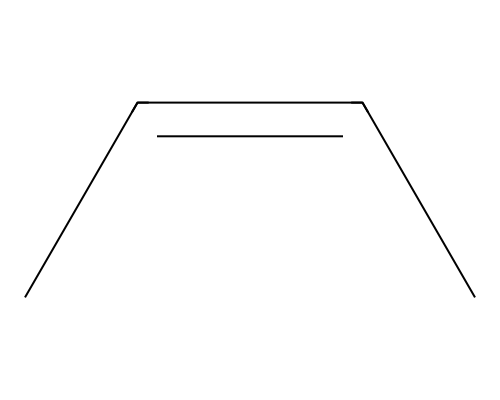
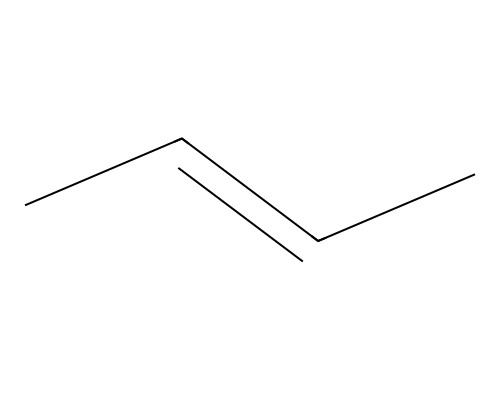
Example 2: 1,2-Dichloroethene (ClCH=CHCl)
- Carbon 1: attached to Cl and H → different ✓
- Carbon 2: attached to Cl and H → different ✓
Result: cis and trans isomers exist.
Example 3: 1,1-Dichloroethene (Cl2C=CH2)
- Carbon 1: attached to Cl and Cl → identical ✗
Result: No geometrical isomerism. Both doubly-bonded carbons carry two identical substituents (H and H on one, Cl and Cl on the other in 1,1-dichloroethene) — geometrical isomerism requires each double-bond carbon to carry two DIFFERENT groups, and neither one here does. The molecule is the same no matter how you look at it.
Example 4: Cyclopropane-1,2-dicarboxylic acid (a ring)
- The ring restricts rotation.
- Carbon 1: attached to COOH and H → different ✓
- Carbon 2: attached to COOH and H → different ✓
Result: cis and trans isomers exist (both carboxylic acid groups on same side vs opposite sides of the ring).
The Naming: cis-trans vs E-Z
For simple cases where the two identical groups are on the same side (like both methyl groups), we use cis (same side) and trans (opposite sides). But when all four substituents are different, cis-trans fails — you need the E-Z system (based on priority rules from Cahn-Ingold-Prelog). That's a separate topic, but the condition for geometrical isomerism remains the same.
Geometrical isomerism requires:
- Restricted rotation (double bond or ring)
- Two different substituents on each of the two atoms involved
If both conditions hold, the molecule exists as two distinct spatial isomers that differ in physical properties (melting point, boiling point, polarity) and often in biological activity.
The conditions required for geometrical isomerism are covered in both the NCERT/CBSE Class 11 Organic Chemistry and Class 12 Coordination Compounds chapters, and ‘conditions for geometrical isomerism’ is a commonly searched important-question topic for board exams, JEE Main and NEET. Applying these two conditions correctly to both alkenes and coordination complexes is a skill tested across multiple competitive-exam chemistry sections.
Why this formula?
Geometrical Isomerism: Why the Conditions Hold
Geometrical isomerism (also called cis-trans or E-Z isomerism) arises when atoms or groups are arranged differently in space around a rigid part of a molecule — typically a double bond or a ring. The key is that rotation is restricted, so the spatial positions become fixed and distinct.
Let’s break down why the conditions are what they are.
1. The Core Requirement: Restricted Rotation
For two molecules to be geometrical isomers, they must have the same connectivity but different spatial arrangement due to a barrier to rotation.
- Double bonds (C=C): The π-bond locks the two carbons in place — rotation requires breaking the π-bond (energy ~250 kJ/mol), so it doesn’t happen at room temperature.
- Rings (e.g., cycloalkanes): The ring structure physically prevents free rotation about C–C single bonds within the ring.
Why this matters: Without restricted rotation, the molecule would freely interconvert between arrangements — no distinct isomers exist.
2. Condition 1: Two Different Groups on Each Carbon (for C=C)
Consider a general alkene:
C=C
Each carbon must have two different substituents (not counting the other carbon of the double bond).
Why?
- If one carbon has two identical groups (e.g., both H), then swapping the groups on that carbon produces the same molecule — no isomerism.
Example:
- 1,2-dichloroethene (ClHC=CHCl): Each carbon has H and Cl (different) → geometrical isomers exist.
- 1,1-dichloroethene (Cl2C=CH2): One carbon has two Cl (identical) → no geometrical isomers.
Formal condition:
For a C=C bond, geometrical isomerism is possible iff each doubly bonded carbon bears two different substituents.
3. Condition 2: For Rings — Similar Logic
In a ring (e.g., cyclopropane, cyclohexane), the ring itself restricts rotation. Here, geometrical isomerism occurs when two substituents on different ring carbons can be on the same side (cis) or opposite sides (trans).
Why?
- The ring is a closed loop — you cannot rotate one carbon relative to another without breaking bonds.
- If the two substituents are on different carbons, their relative orientation (same side / opposite sides) is fixed.
Condition:
- The ring must have at least two substituents (could be same or different) on different carbons.
- If both substituents are on the same carbon, swapping them doesn’t change the molecule (no isomerism).
Example:
- 1,2-dimethylcyclopropane: Two methyl groups on adjacent carbons → cis and trans isomers exist.
- 1,1-dimethylcyclopropane: Both methyls on same carbon → no geometrical isomerism.
4. The E-Z Notation (Why It’s Needed)
When the four substituents on a C=C are all different, cis-trans naming fails. The Cahn-Ingold-Prelog priority rules assign E (opposite sides) or Z (same side).
Why this works:
- Priority is based on atomic number (higher = higher priority).
- Compare the two groups on each carbon — if the higher priority groups are on the same side → Z (German zusammen = together); if opposite → E (entgegen = opposite).
Key insight: The condition remains the same — each carbon must have two different groups — but the naming becomes unambiguous.
5. Summary of Conditions (Exam-Ready)
| Structure | Condition | Why? |
|---|---|---|
| C=C double bond | Each carbon must have two different substituents | Otherwise, swapping groups gives same molecule |
| Ring (e.g., cycloalkane) | At least two substituents on different carbons | Ring prevents rotation; same-side/opposite-side are distinct |
| General | Restricted rotation (double bond or ring) | Without it, free rotation makes isomers identical |
6. Common Exam Pitfall
Don’t confuse:
- Geometrical isomerism ≠ optical isomerism (chirality).
- A molecule can have geometrical isomers even if it has no chiral centre.
- For rings: cis and trans are geometrical isomers only if the substituents are on different carbons.
Final takeaway: The conditions exist because restricted rotation creates a fixed spatial arrangement, and different substituents ensure that swapping positions actually changes the molecule. Without either, you get the same compound — not an isomer.
The key idea is that the magnetic property of a complex depends on the number of unpaired electrons, which is determined by the hybridisation and geometry of the central metal ion under Valence Bond Theory.
Step 1: Electronic configuration of Ni²⁺
Ni (Z = 28): [Ar]3d84s2
Ni²⁺: [Ar]3d8 — three 3d orbitals are doubly occupied and two are singly occupied (two unpaired electrons).
Step 2: [Ni(CN)4]2− — square planar, diamagnetic
CN⁻ is a strong field ligand. It forces pairing of the two unpaired 3d electrons, leaving one 3d orbital empty. The hybridisation is dsp2 (one 3d, one 4s, two 4p orbitals). All eight electrons are paired → no unpaired electrons → diamagnetic.
Step 3: [NiCl4]2− — tetrahedral, paramagnetic
Cl⁻ is a weak field ligand. It does not cause pairing. The hybridisation is sp3 (one 4s, three 4p orbitals), using the original 3d⁸ configuration with two unpaired electrons. Hence, the complex is paramagnetic.
[Ni(CN)4]2− is diamagnetic (all electrons paired, dsp2 hybridisation) while [NiCl4]2− is paramagnetic (two unpaired electrons, sp3 hybridisation).
On valence bond theory: Ni2+ is 3d8 — three electron pairs plus two unpaired electrons. In [Ni(CN)4]2−, the strong field CN− ligand forces the two unpaired 3d electrons to pair up, emptying one 3d orbital — that orbital joins one 4s and two 4p orbitals in dsp2 hybridisation, giving a square planar geometry with no unpaired electrons (diamagnetic). In [NiCl4]2−, the weak field Cl− causes no pairing, so no 3d orbital is freed and bonding uses sp3 hybridisation — a tetrahedral geometry that retains two unpaired electrons (paramagnetic).
Why This Happens: The Concept
Valence Bond Theory (VBT) explains bonding in terms of hybridization of atomic orbitals. But to understand magnetism and geometry, we need to see how the ligand field affects the d-orbital energies.
For a Ni2+ ion, the electronic configuration is [Ar]3d8. In a free ion, all five d-orbitals are degenerate (same energy). When ligands approach, they split these orbitals into different energy levels depending on the geometry.
The nature of the ligand (strong field vs weak field) decides whether electrons pair up or remain unpaired. This pairing directly determines:
- The hybridization scheme (and thus geometry)
- The magnetic property (diamagnetic = all paired, paramagnetic = unpaired electrons)
Step-by-Step Analysis
1. Identify the central metal ion and its d-electron count
Nickel in both complexes is in the +2 oxidation state.
Ni atomic number = 28.
Ni2+: loses two 4s electrons → configuration: 3d8.
So we have 8 electrons in the 3d orbitals.
2. Consider the ligand strength
- CN− is a strong field ligand (high up in the spectrochemical series). It causes a large crystal field splitting (Δ).
- Cl− is a weak field ligand (low in the spectrochemical series). It causes a small crystal field splitting (Δ).
This difference is the entire reason for the different outcomes.
3. Case 1: [Ni(CN)4]2− — Strong field, square planar
Because CN− is a strong field ligand, the splitting between the d-orbitals is large. In a square planar geometry, the d-orbital splitting pattern (from highest to lowest energy) is approximately:
dx2−y2≫dxy>dz2>dxz=dyz
The energy gap is so large that it is energetically favourable for electrons to pair up in the lower orbitals rather than occupy the high-energy dx2−y2 orbital.
So the 8 d-electrons fill as:
- dxz,dyz: 2 electrons each (paired)
- dz2: 2 electrons (paired)
- dxy: 2 electrons (paired)
- dx2−y2: empty
This leaves zero unpaired electrons — the complex is diamagnetic.
Now, for bonding: the empty dx2−y2 orbital, along with one 4s and two 4p orbitals, undergoes dsp2 hybridization (one d, one s, two p). This gives a square planar geometry.
4. Case 2: [NiCl4]2− — Weak field, tetrahedral
Cl− is a weak field ligand. The splitting Δ is small. In a tetrahedral geometry, the d-orbital splitting is inverted compared to octahedral:
- Lower energy set: e (dx2−y2,dz2)
- Higher energy set: t2 (dxy,dyz,dzx)
The splitting Δt is much smaller than in octahedral complexes (roughly 94 of Δo). So the energy cost of pairing electrons is greater than the energy gained by occupying the lower e set.
Thus, the 8 d-electrons fill from the bottom up:
- e set (lower): 4 electrons — both orbitals doubly occupied
- t2 set (higher): 4 electrons — the first three occupy the three orbitals singly (Hund's rule), and the fourth pairs up in one of them
A common mistake is to think that d8 in a weak field always gives two unpaired electrons — but this is only true for tetrahedral geometry. In an octahedral weak field, d8 would have two unpaired electrons in the eg set, but the geometry would be different.
This gives two unpaired electrons — the complex is paramagnetic.
For bonding: since the d-orbitals are all occupied (or partially occupied), the metal uses sp3 hybridization (one s, three p orbitals) — no d-orbital is empty for dsp2. This yields a tetrahedral geometry.
Summary Table
| Property | [Ni(CN)4]2− | [NiCl4]2− |
|---|---|---|
| Ligand type | Strong field (CN−) | Weak field (Cl−) |
| Geometry | Square planar | Tetrahedral |
| Hybridization | dsp2 | sp3 |
| Unpaired electrons | 0 | 2 |
| Magnetic nature | Diamagnetic | Paramagnetic |
A quick way to remember: Strong field + d8 → square planar + diamagnetic. Weak field + d8 → tetrahedral + paramagnetic. The ligand decides the pairing, and the pairing decides the geometry.
[Ni(CN)4]2− is diamagnetic (no unpaired electrons) due to strong field CN− causing pairing in a square planar dsp2 geometry, while [NiCl4]2− is paramagnetic (two unpaired electrons) due to weak field Cl− leaving electrons unpaired in a tetrahedral sp3 geometry.
Method: Valence Bond Theory (VBT) Analysis of Geometry and Magnetism
Concept: Valence bond theory links ligand field strength → electron pairing → hybridisation → geometry and magnetic behaviour.
Step 1: Determine the oxidation state and electron configuration of Ni
-
For [Ni(CN)4]2−:
Let Ni oxidation state be x.
x+4(−1)=−2⇒x=+2
Ni in +2 state: Atomic number 28, configuration [Ar]3d84s2
Remove 2 electrons → 3d8
-
For [NiCl4]2−:
Same calculation → Ni is also in +2 state → 3d8
Step 2: Identify ligand field strength and decide hybridization
-
CN⁻ is a strong field ligand → causes pairing of electrons
- In 3d8, one 3d orbital is emptied by pairing
- Hybridization: dsp2 (one d, one s, two p orbitals)
- Geometry: Square planar
-
Cl⁻ is a weak field ligand → no pairing
- All 3d orbitals remain singly occupied as far as possible
- Hybridization: sp3 (one s, three p orbitals)
- Geometry: Tetrahedral
Step 3: Count unpaired electrons and determine magnetism
| Complex | Hybridization | Geometry | Unpaired electrons | Magnetic nature |
|---|---|---|---|---|
| [Ni(CN)4]2− | dsp2 | Square planar | 0 | Diamagnetic |
| [NiCl4]2− | sp3 | Tetrahedral | 2 | Paramagnetic |
Step 4: Final explanation
- In [Ni(CN)4]2−, strong CN⁻ forces pairing of 3d electrons → all electrons paired → diamagnetic (repelled by magnetic field)
- In [NiCl4]2−, weak Cl⁻ cannot cause pairing → two unpaired electrons remain → paramagnetic (attracted by magnetic field)
Key takeaway: The same metal ion (Ni2+) with 3d8 configuration gives different geometries and magnetic properties depending on ligand strength — a direct consequence of valence bond theory.
Here are the common mistakes students make on this question, along with how to avoid each one.
Mistake 1: Forgetting to check the oxidation state of the central metal ion first.
- The Mistake: Students jump straight to the geometry or the ligand without first calculating the oxidation state of Nickel (Ni). This leads to the wrong d-electron count (dn configuration).
- Why it’s wrong: The number of d-electrons determines how the electrons will fill the orbitals, which directly controls the magnetic property (diamagnetic vs. paramagnetic).
- How to Avoid:
- Always start with the charge balance.
- For [Ni(CN)4]2−:
- Let the oxidation state of Ni be x.
- Charge of CN⁻ is −1 each. Total ligand charge = 4×(−1)=−4.
- Overall complex charge = −2.
- Equation: x+(−4)=−2⟹x=+2.
- Result: Ni is in the +2 oxidation state.
- For [NiCl4]2−:
- Charge of Cl⁻ is −1 each. Total ligand charge = 4×(−1)=−4.
- Overall complex charge = −2.
- Equation: x+(−4)=−2⟹x=+2.
- Result: Ni is also in the +2 oxidation state.
- Key fact: Ni in the ground state is [Ar]3d84s2. In the +2 state, it loses the two 4s electrons, giving a 3d8 configuration.
Mistake 2: Assuming the same geometry leads to the same magnetic property.
- The Mistake: Students think that because both complexes have the same metal ion (Ni²⁺) and the same coordination number (4), they will have the same magnetic behavior.
- Why it’s wrong: The geometry (square planar vs. tetrahedral) and the strength of the ligand (strong field CN⁻ vs. weak field Cl⁻) completely change how the d-orbitals split and how electrons fill them.
- How to Avoid:
- Remember the rule: Strong field ligands (like CN⁻, CO, NH₃) cause pairing of electrons. Weak field ligands (like Cl⁻, Br⁻, H₂O) cause no pairing (Hund's rule is followed).
- Visualize the splitting:
- Tetrahedral (Td): Splitting is small. Electrons fill all orbitals singly first (Hund's rule).
- Square planar (D4h): Splitting is large. Electrons pair up in the lower energy orbitals.
Mistake 3: Drawing the wrong orbital filling diagram for square planar geometry.
- The Mistake: Students use the tetrahedral or octahedral splitting diagram for the square planar complex.
- Why it’s wrong: Square planar geometry has a very specific d-orbital splitting pattern. The energy order is: dx2−y2≫dxy>dz2>dxz=dyz.
- How to Avoid:
- Draw the correct diagram:
- For [Ni(CN)4]2− (Square planar, strong field):
- The dx2−y2 orbital is very high in energy (empty).
- The dxy orbital is next highest.
- The dz2, dxz, and dyz are lower.
- Filling for d8: All 8 electrons pair up in the four lower orbitals (dxy, dz2, dxz, dyz). The dx2−y2 is empty.
- Result: No unpaired electrons → Diamagnetic.
- For [Ni(CN)4]2− (Square planar, strong field):
- Draw the correct diagram:
Mistake 4: Drawing the wrong orbital filling diagram for tetrahedral geometry.
- The Mistake: Students forget that in tetrahedral geometry, the dxy, dxz, and dyz orbitals are higher in energy than the dx2−y2 and dz2 orbitals.
- Why it’s wrong: The splitting is inverted compared to octahedral.
- How to Avoid:
- Draw the correct diagram:
- For [NiCl4]2− (Tetrahedral, weak field):
- The dxy, dxz, dyz (the t2 set) are higher.
- The dx2−y2, dz2 (the e set) are lower.
- Filling for d8: First, fill the lower e set with 4 electrons (paired). Then, place the remaining 4 electrons in the higher t2 set. According to Hund's rule, they will occupy all three orbitals singly before pairing.
- Result: Two unpaired electrons (in the t2 set) → Paramagnetic.
- For [NiCl4]2− (Tetrahedral, weak field):
- Draw the correct diagram:
Mistake 5: Confusing the terms "diamagnetic" and "paramagnetic".
- The Mistake: Students write the correct electron configuration but then state the wrong magnetic property.
- Why it’s wrong: It's a direct loss of marks for a simple definition.
- How to Avoid:
- Memorize:
- Diamagnetic: All electrons are paired. The substance is repelled by a magnetic field.
- Paramagnetic: Has one or more unpaired electrons. The substance is attracted by a magnetic field.
- Check your final diagram: Count the unpaired electrons. If the count is zero, it's diamagnetic. If non-zero, it's paramagnetic.
- Memorize:
Summary Table to Avoid Mistakes
| Feature | [Ni(CN)4]2− | [NiCl4]2− |
|---|---|---|
| Oxidation State of Ni | +2 | +2 |
| d-electron count | d8 | d8 |
| Ligand | CN⁻ (Strong field) | Cl⁻ (Weak field) |
| Geometry | Square planar | Tetrahedral |
| Orbital Splitting | Large (Δ is large) | Small (Δ is small) |
| Electron Filling | Pairing occurs | Hund's rule (no pairing) |
| Unpaired Electrons | 0 | 2 |
| Magnetic Property | Diamagnetic | Paramagnetic |
- TG EAPCET 2026Set eng-2026-05-11-AN1 markMCQQ.The primary and secondary valencies of chromium in the complex ion, [CrCl2(C2O4)2]3− are respectively x and y. The sum of x and y is (A) 7 (B) 8 (C) 9 (D) 6
›Reveal solutionSolution
Primary valency equals the oxidation state of the central metal; secondary valency equals the coordination number. For [CrCl2(C2O4)2]3−, the oxidation state of Cr is +3 and the coordination number is 6, so x=3, y=6, and x+y=9.
Concept & Intuition
In coordination chemistry, primary valency refers to the oxidation state of the central metal ion — it’s the charge the metal would have if all ligands were removed as neutral molecules or ions. Secondary valency is the coordination number — the total number of ligand donor atoms directly bonded to the metal. The trick is that some ligands (like oxalate, C2O42−) are bidentate, so they count as two donor atoms even though they are one ligand molecule.
-
Determine the oxidation state of chromium (primary valency x).
The complex ion is [CrCl2(C2O4)2]3−.
- Each chloride ligand (Cl−) carries a charge of −1.
- Each oxalate ligand (C2O42−) carries a charge of −2.
- The overall charge on the complex is −3.
Let the oxidation state of Cr be n. Then:
n+2(−1)+2(−2)=−3
n−2−4=−3⇒n−6=−3⇒n=+3
So primary valency x=3.
-
Determine the coordination number (secondary valency y).
- Each Cl− is monodentate (donates one pair of electrons), so two chlorides contribute 2 donor atoms.
- Each C2O42− is bidentate (donates two pairs of electrons via two oxygen atoms), so two oxalates contribute 2×2=4 donor atoms.
- Total donor atoms = 2+4=6.
Hence secondary valency y=6.
-
Sum x and y.
x+y=3+6=9
TipA common mistake is to count oxalate as one donor per ligand, giving a coordination number of 4 instead of 6. Always check denticity — oxalate is a classic bidentate ligand.
Watch outDo not confuse the charge on the ligand with its denticity. Chloride is monodentate and carries −1; oxalate is bidentate and carries −2. They are independent properties.
✓Final answerThe correct option is (C).
ANSWER: C
-
- TG EAPCET 2026Set eng-2026-05-11-AN1 markMCQQ.The artificial sweetener which contains −Cl in its structure and stable even at cooking temperature is (A) Aspartame (B) Alitame (C) Saccharin (D) Sucralose
›Reveal solutionSolution
The key is that Sucralose is a chlorinated derivative of sucrose, where three hydroxyl groups are replaced by chlorine atoms, making it stable at high cooking temperatures. The correct option is (D).
The question asks which artificial sweetener contains a chlorine atom (−Cl) in its structure and remains stable even at cooking temperatures. Let’s break down the reasoning.
Concept and intuition:
Artificial sweeteners are often modified sugars or synthetic compounds. Stability at cooking temperature means the molecule does not break down when heated (e.g., during baking). Chlorine substitution can enhance thermal stability because the C–Cl bond is strong and resists hydrolysis or thermal degradation. Among the options, only one is known to be a chlorinated sugar derivative.
Step-by-step reasoning:
-
Aspartame is a dipeptide (aspartic acid + phenylalanine methyl ester). It contains no chlorine atoms and decomposes at high temperatures, so it is unsuitable for cooking.
→ Eliminate (A).
-
Alitame is also a dipeptide (aspartic acid + alanine amide), but it does not contain chlorine. It is more stable than aspartame but still not ideal for prolonged high heat.
→ Eliminate (B).
-
Saccharin is a sulfonimide (benzosulfimide) with no chlorine in its structure. It is heat-stable, but the question specifically requires a chlorine atom.
→ Eliminate (C).
-
Sucralose is made by chlorinating sucrose: three hydroxyl groups (−OH) are replaced by chlorine atoms (−Cl). This gives it the formula C12H19Cl3O8. The chlorine atoms make it exceptionally stable at high temperatures, so it can be used in baking and cooking.
→ This matches both conditions.
Watch outA common mistake is to think saccharin is the answer because it is heat-stable, but it lacks chlorine. Always check both parts of the condition: presence of −Cl and thermal stability.
TipSucralose is about 600 times sweeter than sucrose and is the only chlorinated sugar approved as a high-intensity sweetener. The “-ose” ending hints it’s a sugar derivative.
✓Final answerThe correct option is (D).
ANSWER: D
-
- TG EAPCET 2025Set eng-2025-05-02-FN1 markMCQQ.Which one of the following is not an ambidentate ligand? (A) CNX− (B) SCNX− (C) SOX4X2− (D) NOX2X−
›Reveal solutionSolution
An ambidentate ligand can bind through two different donor atoms; SOX4X2− is not ambidentate because it typically binds only through oxygen, whereas the others have two distinct possible binding sites. The correct option is (C).
Concept & Intuition
Ambidentate ligands are like molecular “two‑handed” tools — they have two different atoms that can donate a lone pair to a metal. For example, the thiocyanate ion (SCNX−) can bind through sulfur or through nitrogen. The key is that the two possible donor atoms must be different elements (or at least chemically distinct). If a ligand has only one type of donor atom (even if it has many of them), it is not ambidentate — it’s just polydentate. Here, we check each ion for two chemically distinct binding sites.
Step‑by‑step reasoning
-
CNX− (cyanide)
- The carbon and nitrogen atoms both have lone pairs.
- Cyanide usually binds through carbon (giving a cyano complex), but it can also bind through nitrogen (giving an isocyano complex).
- Because it can coordinate via two different atoms (C or N), it is ambidentate.
-
SCNX− (thiocyanate)
- Sulfur and nitrogen each have lone pairs available.
- It can bind through sulfur (thiocyanato) or through nitrogen (isothiocyanato).
- Hence it is ambidentate.
-
SOX4X2− (sulfate)
- All four oxygen atoms are equivalent in terms of donor ability; the sulfur has no lone pair to donate.
- Sulfate can bind as a monodentate ligand (through one oxygen) or as a bidentate ligand (through two oxygens), but every binding site is an oxygen atom.
- Since there is only one type of donor atom, it is not ambidentate — it is simply polydentate (or monodentate). This is the classic pitfall: students confuse “multiple binding sites” with “different binding atoms.”
-
NOX2X− (nitrite)
- It can bind through the nitrogen atom (nitro complex) or through one of the oxygen atoms (nitrito complex).
- Two different donor atoms (N and O) → is ambidentate.
Watch outDon’t mistake “can bind in more than one way” for ambidentate. Sulfate can bind through one or two oxygens, but all oxygens are the same element — that makes it polydentate, not ambidentate. Ambidentate requires different donor atoms.
✓Final answerThe correct option is (C).
ANSWER: C
-
- TG EAPCET 2024Set eng-2024-05-09-FN1 markMCQQ.The molecular formula of a compound is AB2O4. Atoms of O form ccp lattice. Atoms of A (cation) occupy 81th of tetrahedral voids. Atoms of B (cation) occupy a fraction of octahedral voids. What is the fraction of vacant octahedral voids? (A) 43 (B) 41 (C) 31 (D) 21
›Reveal solutionSolution
In a ccp lattice of O atoms, the number of tetrahedral voids is twice the number of O atoms and octahedral voids equals the number of O atoms. Given the formula AB₂O₄, we count atoms to find the fraction of octahedral voids occupied by B, then subtract from 1 to get the fraction vacant. The fraction of vacant octahedral voids is 1/2.
Concept & Intuition
In a cubic close-packed (ccp) arrangement of oxygen atoms, each unit cell contains 4 O atoms. The key void relationships are:
- Number of tetrahedral voids = 2 × (number of atoms) = 8 per unit cell.
- Number of octahedral voids = 1 × (number of atoms) = 4 per unit cell.
The molecular formula AB₂O₄ tells us the ratio of A : B : O atoms in the crystal. Since O atoms form the lattice, we can determine how many A and B atoms are present per unit cell, then see how many voids they occupy. The question asks for the fraction of octahedral voids that remain empty.
Step-by-step reasoning
-
Determine the number of O atoms per unit cell.
In a ccp lattice, there are 4 atoms per unit cell. So O atoms per unit cell = 4.
-
Relate the formula to the unit cell contents.
The formula AB₂O₄ means for every 4 O atoms, there is 1 A atom and 2 B atoms. Since we have exactly 4 O atoms per unit cell, the unit cell contains:
- A atoms = 1
- B atoms = 2
-
Find how many tetrahedral voids are occupied.
Total tetrahedral voids in the unit cell = 2 × 4 = 8.
A occupies 81 of these:
A atoms=81×8=1
This matches the 1 A atom we need — so all A atoms are in tetrahedral voids.
-
Find how many octahedral voids are occupied by B.
Total octahedral voids = 4.
B atoms needed = 2.
So the fraction of octahedral voids occupied = 42=21.
-
Calculate the fraction of vacant octahedral voids.
Vacant fraction = 1−21=21.
Watch outA common mistake is to forget that the number of tetrahedral voids is twice the number of atoms in a ccp lattice, not equal to it. Also, note that the formula gives the ratio, so you must scale to the actual number of O atoms per unit cell.
TipOnce you know the unit cell contains 4 O atoms, the formula AB₂O₄ directly tells you there is 1 A and 2 B per unit cell. Then it’s just a matter of comparing to void counts.
✓Final answerThe correct option is (D).
ANSWER: D
- TG EAPCET 2022Set ap-2022-07-30-FN1 markMCQQ.What are the oxidation state and covalency of Al in [AlCl(H2O)5]2+ respectively? (A) +1, 3 (B) +3, 6 (C) +3, 5 (D) +1, 6
›Reveal solutionSolution
The oxidation state of Al is found by balancing the charge of the complex, and the covalency is the total number of bonds it forms. For [AlCl(H2O)5]2+, the oxidation state is +3 and the covalency is 6, so the correct option is (B).
Concept & Intuition
Oxidation state is the formal charge on the central atom after assigning all bonding electrons to the more electronegative atom. Covalency is simply the number of covalent bonds the central atom forms with its ligands. In coordination complexes, each ligand donates a pair of electrons to the metal, so the number of ligands (times their denticity) gives the covalency. Here, water is a neutral ligand, and chloride is a monovalent anionic ligand. The overall charge of the complex tells us the oxidation state of the metal.
Step-by-step reasoning
-
Identify the ligands and their charges
- Water (H2O) is a neutral ligand: charge = 0.
- Chloride (Cl−) carries a charge of −1.
-
Set up the charge balance equation
Let the oxidation state of Al be x. The complex ion has an overall charge of +2.
The sum of charges from the metal and all ligands equals the complex charge:
x+(5×0)+(−1)=+2
This simplifies to:
x−1=+2⇒x=+3
So the oxidation state of Al is +3.
- Determine the covalency
Covalency is the number of bonds formed by the central atom.
- Each H2O donates one lone pair to Al, forming one coordinate bond. Five water molecules → 5 bonds.
- The Cl− also donates a lone pair, forming one bond. Total bonds = 5+1=6. Hence, the covalency of Al in this complex is 6.
TipA common mistake is to think that the oxidation state of Al is +1 because the complex has a 2+ charge and there is one Cl−. But remember: water is neutral, so the metal must be +3 to give a net +2 after subtracting the chloride’s −1.
- Match with the options Oxidation state +3, covalency 6 corresponds to option (B).
✓Final answerThe correct option is (B).
ANSWER: B
-
- TG EAPCET 2022Set ap-2022-07-31-FN1 markMCQQ.At room temperature, which of the following compounds has a chloro bridged structure? (A) BeCl2 (B) MgCl2 (C) PbCl2 (D) ZnCl2
›Reveal solutionSolution
The key idea is that only certain metal chlorides form polymeric chloro-bridged structures at room temperature due to their electron deficiency and ability to expand coordination. Among the given options, beryllium chloride (BeCl2) adopts a chain-like chloro-bridged structure in the solid state, while the others form ionic or molecular lattices. The correct option is (A).
Concept and Intuition
A chloro-bridged structure occurs when a chlorine atom is shared between two metal centers, forming a bridge (e.g., M−Cl−M). This typically happens when the metal is electron-deficient (small, high charge density) and can achieve a higher coordination number by sharing halide ligands. In contrast, metals that are too large or too electropositive tend to form ionic lattices with discrete Cl− ions, not bridges. At room temperature, the solid-state structure is key: we look for a polymeric network rather than isolated molecules or simple ionic packing.
Step-by-Step Reasoning
-
Identify the nature of each compound
- BeCl2: Beryllium is small (ionic radius ~31 pm) and has high charge density. It is electron-deficient and tends to form covalent polymers.
- MgCl2: Magnesium is larger (ionic radius ~72 pm) and more electropositive; it forms an ionic lattice with Mg2+ and Cl− ions.
- PbCl2: Lead is large and polarizable; it forms an ionic structure (though with some covalent character) but not chloro-bridged chains.
- ZnCl2: Zinc is intermediate; in the solid state, it can form a layered structure, but at room temperature it is typically ionic (or molecular in the gas phase), not chloro-bridged.
-
Recall known solid-state structures
- BeCl2: In the solid state, it forms infinite chains where each beryllium is tetrahedrally coordinated by four chlorine atoms, and each chlorine bridges two beryllium atoms. This is a classic example of a chloro-bridged polymer.
- MgCl2: Adopts the cadmium chloride (CdCl2) layer structure, which is ionic with octahedral Mg2+ ions, but no bridging chlorines between separate Mg centers in the sense of a discrete bridge — it’s a close-packed ionic lattice.
- PbCl2: Has a complex ionic structure (cotunnite type) with Pb2+ in a nine-coordinate environment, but again not a simple chloro-bridged chain.
- ZnCl2: At room temperature, it exists in several polymorphs; the common α-form has a tetrahedral network but with ZnCl4 units sharing corners, not edges (i.e., not chloro-bridged in the same sense as BeCl2). In fact, ZnCl2 is often described as having a layered structure with some bridging, but it is not the classic linear chloro-bridged polymer.
-
Focus on the defining feature
A “chloro bridged structure” in this context typically refers to a chain or ring where each chlorine is bonded to two metal atoms, as seen in BeCl2 (and also in AlCl3 dimer in gas phase, but here we consider solid). BeCl2 is the only one among the options that is well-known for this polymeric chain at room temperature.
-
Eliminate the others
- MgCl2: Ionic, no bridging.
- PbCl2: Ionic, no bridging.
- ZnCl2: While it can form dimers in the gas phase, the solid at room temperature is not a simple chloro-bridged chain; it’s a network solid with tetrahedral coordination but not the same edge-sharing chain as BeCl2.
TipA quick memory aid: Beryllium behaves like aluminum in forming electron-deficient bridged structures (e.g., BeCl2 chains, AlCl3 dimers). Magnesium and zinc are more “normal” metals that prefer ionic or simple covalent lattices.
Watch outA common mistake is to think ZnCl2 forms chloro bridges because zinc can be tetrahedral. However, in the solid state at room temperature, ZnCl2 does not form the same kind of infinite chloro-bridged chain as BeCl2; its structure is more complex and not typically described as “chloro bridged” in the same sense.
✓Final answerThe correct option is (A).
ANSWER: A
-
- TG EAPCET 2022Set eng-2022-07-18-AN1 markMCQQ.Among the given complexes that possess “CO” ligand bridges are [Co2(CO)8] I [Fe3(CO)12] II [Mn2(CO)10] III [Fe2(CO)9] IV (A) I, II and III (B) II, III and IV (C) I, II and IV (D) I, III and IV
›Reveal solutionSolution
The key idea is that bridging CO ligands occur when a carbonyl group bonds to two or more metal atoms simultaneously. Among the given complexes, [Co2(CO)8], [Fe3(CO)12], and [Fe2(CO)9] contain such bridges, while [Mn2(CO)10] has only terminal CO groups. The correct option is (C).
The question asks which of the listed metal carbonyl complexes contain bridging CO ligands — that is, carbonyl groups that are bonded to more than one metal atom, not just one. This is a structural feature that arises from the need to satisfy the 18-electron rule and the coordination preferences of the metal atoms.
Bridging CO ligands are common in polynuclear carbonyls where metal–metal bonds also exist. The CO group can act as a two-electron donor to two metals simultaneously (μ₂-bridge) or sometimes to three metals (μ₃-bridge). The key is to know the known structures of these classic carbonyls.
Let’s examine each complex one by one.
-
\left[\mathrm{Co}_2(\mathrm{CO})_8 — Dicobalt octacarbonyl. This molecule has a Co–Co bond. In the solid state, it has two bridging CO groups and six terminal CO groups (three on each Co). In solution, it can equilibrate with a non-bridged isomer, but the bridged form is well-established. So I contains CO bridges.
-
\left[\mathrm{Fe}_3(\mathrm{CO})_{12} — Triiron dodecacarbonyl. Its structure is a triangle of iron atoms with an Fe–Fe bond along each edge. One CO group bridges each edge of the triangle (three μ₂-CO bridges), and the remaining nine CO groups are terminal (three per Fe). So II contains CO bridges.
-
\left[\mathrm{Mn}_2(\mathrm{CO})_{10} — Dimanganese decacarbonyl. This molecule has a direct Mn–Mn bond, but all ten CO groups are terminal — five on each Mn, arranged in an octahedral-like geometry around each metal. There are no bridging CO ligands. So III does NOT contain CO bridges.
-
\left[\mathrm{Fe}_2(\mathrm{CO})_9 — Diiron nonacarbonyl. This is a classic example: it has three bridging CO groups between the two iron atoms, and six terminal CO groups (three on each Fe). The Fe–Fe bond is also present. So IV contains CO bridges.
Watch outA common mistake is to assume that all dinuclear carbonyls with metal–metal bonds must have bridges. [Mn2(CO)10] is a counterexample — it achieves the 18-electron configuration with only terminal CO groups, thanks to the Mn–Mn bond.
Thus, the complexes with CO bridges are I, II, and IV.
✓Final answerThe correct option is (C), i.e., I, II and IV.
-
- TG EAPCET 2022Set eng-2022-07-19-FN1 markMCQQ.The valency shell electronic configuration of Cr and Cu atoms, respectively, are (A) 3d44s2;3d104s1 (B) 3d54s1;3d104s1 (C) 3d44s1;3d94s2 (D) 3d44s2;3d94s2
›Reveal solutionSolution
The electronic configurations of Chromium (Cr) and Copper (Cu) are exceptions to the Aufbau principle, where an electron from the 4s orbital shifts to the 3d orbital to achieve greater stability through half-filled or fully-filled subshells. For Cr, it is 3d54s1, and for Cu, it is 3d104s1. The correct option is (B).
The electronic configuration of an atom describes how electrons are distributed among its atomic orbitals. This distribution generally follows the Aufbau principle, Hund's rule, and the Pauli exclusion principle. However, certain elements, particularly transition metals like Chromium (Cr) and Copper (Cu), exhibit exceptions to these rules due to the enhanced stability associated with half-filled or fully-filled subshells.
The key concept here is that orbitals that are exactly half-filled (e.g., d5) or completely filled (e.g., d10) have extra stability. This stability arises from two main factors:
- Symmetry: A half-filled or fully-filled subshell has a more symmetrical distribution of electrons, which leads to a lower energy state.
- Exchange Energy: Electrons with the same spin in degenerate orbitals can exchange their positions. The more exchange possibilities, the greater the stabilization energy (exchange energy). Half-filled and fully-filled subshells maximize these exchange possibilities.
Let's determine the valency shell electronic configurations for Cr and Cu.
-
Chromium (Cr, Atomic Number Z=24)
- The general electronic configuration for an atom with Z=24 would typically follow the Aufbau principle, filling orbitals in increasing order of energy. The noble gas core for Cr is Argon ([Ar]), which has 18 electrons.
- After [Ar], the next orbitals to fill are 3d and 4s. According to the Aufbau principle, 4s fills before 3d.
- The expected configuration would be [Ar]3d44s2.
- However, a 3d5 configuration (half-filled d subshell) is significantly more stable than 3d4. To achieve this, one electron from the 4s orbital shifts to the 3d orbital.
- Therefore, the actual valency shell electronic configuration for Cr is [Ar]3d54s1.
Watch outAlways remember that 4s and 3d orbitals are very close in energy. This proximity allows for the electron shift to achieve the more stable half-filled or fully-filled d subshell.
-
Copper (Cu, Atomic Number Z=29)
- Similar to Chromium, we start with the Argon core ([Ar]) for Copper, which has 18 electrons.
- The expected configuration, following the Aufbau principle, would be [Ar]3d94s2.
- However, a 3d10 configuration (fully-filled d subshell) is significantly more stable than 3d9. To achieve this, one electron from the 4s orbital shifts to the 3d orbital.
- Therefore, the actual valency shell electronic configuration for Cu is [Ar]3d104s1.
The general rule for these exceptions is:
d4s2→d5s1 (for half-filled stability)
d9s2→d10s1 (for fully-filled stability)
-
Comparing with the options:
- We found the configuration for Cr to be 3d54s1.
- We found the configuration for Cu to be 3d104s1.
- Let's check the given options: (A) 3d44s2;3d104s1 (Cr is incorrect) (B) 3d54s1;3d104s1 (Both Cr and Cu are correct) (C) 3d44s1;3d94s2 (Both Cr and Cu are incorrect) (D) 3d44s2;3d94s2 (Both Cr and Cu are incorrect, these are the expected configurations without considering stability)
The option that correctly lists the valency shell electronic configurations for Cr and Cu is (B).
✓Final answerThe valency shell electronic configurations of Cr and Cu atoms are 3d54s1 and 3d104s1 respectively. The correct option is (B).
- TG EAPCET 2021Set ap-2021-08-10-AN1 markMCQQ.According to the crystal field theory, for an octahedral field, the energy of two eg orbitals will be increased by (A) (51)Δo (B) (52)Δo (C) (53)Δo (D) (54)Δo
›Reveal solutionSolution
In crystal field theory, the five d‑orbitals split into a lower‑energy t2g set (three orbitals) and a higher‑energy eg set (two orbitals). The total energy of the eg orbitals is raised by 53Δo relative to the barycentre, so each eg orbital is raised by 53Δo — answer (C).
The key idea is the barycentre (centre of gravity) rule: in an octahedral field, the total energy of all five d‑orbitals must remain the same as in the free ion. The splitting energy Δo is the difference between the eg and t2g levels. If we set the barycentre at zero, the three t2g orbitals are lowered by some amount and the two eg orbitals are raised by some amount, such that the weighted sum is zero.
- Set up the energy balance Let the energy of each t2g orbital be −x (lowered) and each eg orbital be +y (raised). There are three t2g and two eg orbitals. The barycentre condition is:
3(−x)+2(+y)=0⇒2y=3x.
- Use the definition of Δo The splitting energy Δo is the energy difference between an eg orbital and a t2g orbital:
y−(−x)=y+x=Δo.
- Solve the system From step 1: y=23x. Substitute into step 2:
23x+x=25x=Δo⇒x=52Δo.
Then
y=23⋅52Δo=53Δo.
- Interpret the result Each eg orbital is raised by 53Δo above the barycentre. The question asks: “the energy of two eg orbitals will be increased by” — this phrasing means the increase per orbital (since the options are fractions of Δo). So the answer is 53Δo.
TipA common shortcut: the t2g set gets 52Δo stabilisation per orbital, and the eg set gets 53Δo destabilisation per orbital. The ratio 2:3 comes from the orbital counts (3 vs 2) to keep the barycentre at zero.
Watch outA classic mistake is to think the two eg orbitals together are raised by 53Δo — but that would be the total for both, not per orbital. The options are clearly per‑orbital values, as 53Δo is the standard result.
✓Final answerThe correct option is (C).
ANSWER: C
- TG EAPCET 2021Set ap-2021-08-10-FN1 markMCQQ.Accordingly to the crystal field theory, for an octahedral field, the energy of two eg orbitals will be increased by (A) (51)Δo (B) (52)Δo (C) (53)Δo (D) (54)Δo
›Reveal solutionSolution
In crystal field theory, the five d‑orbitals split into a lower‑energy t2g set and a higher‑energy eg set; the total energy is conserved, so the eg orbitals are raised by 53Δo and the t2g orbitals are lowered by 52Δo. The correct option is (C).
Concept & Intuition
Crystal field theory treats the ligands as point negative charges that repel the d‑electrons. In an octahedral field, the dz2 and dx2−y2 orbitals (the eg set) point directly at the ligands, so they feel stronger repulsion and rise in energy. The other three orbitals (dxy,dxz,dyz — the t2g set) point between the ligands, so they are less repelled and drop in energy.
The key constraint is energy conservation: the total energy of all five d‑orbitals must remain the same as in the free ion (where they are degenerate). So the total destabilization of the eg orbitals must exactly balance the total stabilization of the t2g orbitals.
Let the energy splitting between the two sets be Δo (often called 10Dq). If we set the average energy of the five orbitals to zero, then the t2g orbitals are each lowered by some amount x, and the eg orbitals are each raised by some amount y, with y−x=Δo.
Step‑by‑Step Reasoning
- Set up the energy conservation equation. There are three t2g orbitals and two eg orbitals. The total energy change relative to the average must be zero:
3(−x)+2(y)=0⇒2y=3x.
- Relate x and y to the splitting Δo. By definition, the gap between the eg and t2g levels is Δo:
y−(−x)=y+x=Δo.
- Solve the system. From 2y=3x we get x=32y. Substitute into y+x=Δo:
y+32y=35y=Δo⇒y=53Δo.
Then x=32⋅53Δo=52Δo.
- Interpret the result. Each eg orbital is raised by 53Δo above the average (barycenter), and each t2g orbital is lowered by 52Δo below it. The question asks for the increase in energy of the two eg orbitals — that is 53Δo per orbital.
TipA common shortcut: remember the ratio t2g:eg=3:2 and the total splitting Δo; the eg orbitals get 53Δo and the t2g get 52Δo. This “3/5 and 2/5” rule is a direct consequence of the barycenter conservation.
Watch outA classic mistake is to think the eg orbitals are raised by 52Δo because that’s the amount the t2g are lowered. Always check: the larger set (3 orbitals) gets the smaller energy shift per orbital, and the smaller set (2 orbitals) gets the larger shift per orbital — that’s how the total energy balances.
✓Final answerThe correct option is (C).
ANSWER: C
🎓Unlock everything free for 14 days
- ✓Full step-by-step solutions
- ✓Concept-first explanations
- ✓Methods, shortcuts & mistakes
- ✓PYQ mapping + timed mock tests
Full access for 14 days. No credit card required.