The molar conductivity of KCl solutions at different concentrations at 298 K are given below:
| c / mol L−1 | Λm / S cm2 mol−1 |
|---|---|
| 0.000198 | 148.61 |
| 0.000309 | 148.29 |
| 0.000521 | 147.81 |
| 0.000989 | 147.09 |
Show that a plot between Λm and c1/2 is a straight line. Determine the values of Λm0 and A for KCl.
Concept understanding — Molar Conductivity
From Resistance to Conductance: Flipping the Idea
You already know resistance (R) — it tells you how much a material opposes the flow of current. A high resistance means the wire fights the current; a low resistance means it lets current through easily.
Now flip that thought. Instead of asking "how much does it resist?", ask "how easily does it let current flow?" That's exactly what conductance measures.
Conductance (G) is the reciprocal of resistance:
G=R1
Unit: siemens (S) — named after Werner von Siemens. 1 S = 1 A/V (ampere per volt).
If a wire has R=10 Ω, its conductance is G=0.1 S. If R=0.5 Ω, G=2 S — it conducts twice as well.
Ohm's Law in Conductance Form
You know V=IR. Rearranging:
I=RV=GV
So current = conductance × voltage. A high-conductance material draws a large current for the same voltage — it's a "good conductor."
Now, Conductivity: The Material's Intrinsic Property
Resistance depends on two things: the material itself (its "resistivity" ρ) and the geometry (length L, cross-sectional area A):
R=ρAL
Conductance also depends on geometry. A thicker wire (larger A) or a shorter wire (smaller L) has higher conductance. To isolate the material's inherent ability to conduct, we define conductivity (σ):
σ=ρ1
And for a uniform wire:
G=σLA
Conductivity is the reciprocal of resistivity. It tells you how well the material itself conducts, independent of shape and size.
- Unit: siemens per metre (S/m).
- High σ → good conductor (copper: ≈5.8×10⁷ S/m).
- Low σ → poor conductor / insulator (glass: ≈10−12 S/m).
Don't confuse conductance (property of a specific object, depends on geometry) with conductivity (property of the material, independent of geometry). A short thick copper wire has high conductance; a long thin copper wire has lower conductance — but both have the same conductivity.
The Big Picture in One Table
| Quantity | Symbol | Definition | Depends on | Unit |
|---|---|---|---|---|
| Resistance | R | V/I | Material + geometry | Ω |
| Resistivity | ρ | RA/L | Material only | Ω⋅m |
| Conductance | G | 1/R | Material + geometry | S |
| Conductivity | σ | 1/ρ | Material only | S/m |
Intuitive Analogy
Think of a water pipe:
- Resistance = how hard it is to push water through (narrow, long pipe).
- Conductance = how easily water flows (wide, short pipe).
- Resistivity = the "roughness" of the pipe's inner surface (material property).
- Conductivity = the "smoothness" of the pipe's inner surface (material property).
A copper pipe is smooth (high conductivity). A rubber hose is rough (low conductivity). But a short, fat rubber hose might still have decent conductance — because geometry can compensate for poor material.
Key Takeaway for Exams
- G=R1 and σ=ρ1.
- G=σLA for a uniform conductor.
- Conductivity is an intrinsic material property; conductance is an extrinsic property of a specific object.
- In circuits, you'll often use conductance when dealing with parallel resistors (total conductance = sum of individual conductances).
You now have the complete picture: from resistance to conductance, from resistivity to conductivity — and the clean relationship between them.
Molar conductivity is a quantitative cornerstone of the NCERT/CBSE Class 12 Chemistry Electrochemistry chapter, and ‘molar conductivity formula’ or ‘molar conductivity vs concentration’ are recurring important-question types in board exams as well as JEE Main and NEET chemistry. This concept also sets up Kohlrausch's law, a common follow-on topic in the same unit.
Why this formula?
Conductance and Conductivity: Why the Formulas Hold
Let's build this from first principles — understanding the why before the what.
1. The Core Idea: How Easily Does Current Flow?
Think of a conductor (like a copper wire). When you apply a voltage across it, electrons drift through the material. Two questions arise:
- How much current flows for a given voltage? → This is conductance (G).
- How well does the material itself allow current? → This is conductivity (σ).
The key distinction: Conductance depends on the size and shape of the object. Conductivity is an intrinsic property of the material.
2. Ohm's Law in Terms of Conductance
You know Ohm's law:
V=IR
But we can rewrite it as:
I=RV
Define conductance G as the reciprocal of resistance:
G=R1
So:
I=GV
Why this makes sense:
- A larger G means more current for the same voltage — the conductor "conducts" better.
- G has units of siemens (S) = A/V.
3. From Resistance to Conductivity: The Geometry Factor
Resistance of a uniform conductor depends on:
- Length L (longer → more resistance)
- Cross-sectional area A (thicker → less resistance)
- Material property ρ (resistivity)
The formula:
R=ρAL
Now, conductivity σ is the reciprocal of resistivity:
σ=ρ1
So:
R=σ1⋅AL
Why this form?
- If you double the length, electrons have to travel twice as far, colliding more → resistance doubles.
- If you double the area, there's twice as many "lanes" for electrons → resistance halves.
4. The Key Formula: Conductance in Terms of Conductivity
Since G=1/R, we get:
G=σLA
This is the central relationship. Let's see why it holds:
- σ tells you how well the material conducts (intrinsic).
- A/L tells you how the geometry amplifies or reduces that.
Intuition:
- A fat, short wire (A large, L small) has high conductance.
- A thin, long wire (A small, L large) has low conductance.
- A material with high σ (like copper) gives higher G than one with low σ (like iron), for the same shape.
5. Microscopic Derivation (Why σ Exists)
At the microscopic level, conductivity arises from electron motion:
σ=neμ
Where:
- n = number of free electrons per unit volume
- e = electron charge
- μ = electron mobility (how fast they drift per unit electric field)
Why this works:
- More free electrons (n large) → more charge carriers → higher conductivity.
- Higher mobility (μ large) → electrons move faster for the same push → higher conductivity.
This explains why metals (high n) are good conductors, and why heating reduces σ (more collisions → lower μ).
6. Summary: The Logical Chain
| Step | Concept | Formula | Why |
|---|---|---|---|
| 1 | Ohm's law | V=IR | Voltage drives current against resistance |
| 2 | Conductance | G=1/R | Measures ease of flow |
| 3 | Resistivity | R=ρL/A | Geometry + material |
| 4 | Conductivity | σ=1/ρ | Material's intrinsic ability |
| 5 | Key result | G=σLA | Combines material + geometry |
Final takeaway:
Conductance G is not just a number — it's the product of how good the material is (σ) and how the shape helps (A/L). This is why a thick copper wire conducts far better than a thin iron wire of the same length.
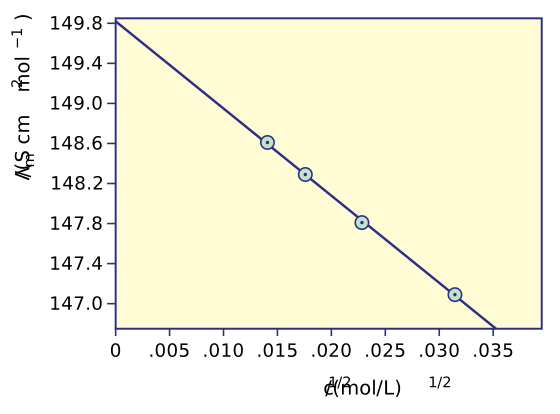
Concept: Molar Conductivity — For strong electrolytes, Kohlrausch's law states Λm=Λm0−Ac, so a plot of Λm vs c should be linear.
Step 1: Compute c for each concentration
| c (mol L⁻¹) | c (mol¹/² L⁻¹/²) | Λm (S cm² mol⁻¹) |
|---|---|---|
| 0.000198 | 0.01407 | 148.61 |
| 0.000309 | 0.01758 | 148.29 |
| 0.000521 | 0.02283 | 147.81 |
| 0.000989 | 0.03145 | 147.09 |
Step 2: Check linearity — Λm decreases uniformly as c increases, confirming a straight-line relationship (as c rises, Λm falls; equivalently Λm increases on dilution).
Step 3: Determine A (slope) and Λm0 (intercept)
Slope =−A=0.03145−0.01407147.09−148.61=0.01738−1.52≈−87.46
So A=87.46 S cm2mol−1/(mol L−1)1/2.
Extending the straight line to c=0, the graphical intercept read from the plot is Λm0=150.0 S cm2mol−1.
The plot of Λm vs c is a straight line; from it, Λm0=150.0 S cm2mol−1 and A=87.46 S cm2mol−1/(mol L−1)1/2 for KCl at 298 K.
NCERT reads Λm0=150.0 from its graphical extrapolation. A full least-squares fit of the four data points gives Λm0≈149.8 S cm2mol−1 and A≈87.5 — essentially identical; the small difference is only graphical rounding of the intercept.
For strong electrolytes like KCl, molar conductivity varies linearly with the square root of concentration (Kohlrausch's law). Plotting Λm vs c1/2 gives a straight line; the book reads its intercept as Λm0=150.0 S cm2 mol−1 and its slope gives A=87.46 S cm2 mol−1 (mol L−1)−1/2.
The key idea here is Kohlrausch's law of independent migration of ions. For strong electrolytes, as you dilute the solution, ions move more freely because interionic attractions weaken. The molar conductivity Λm therefore increases on dilution — and, plotted against the square root of concentration, it decreases linearly as c rises. This linear relationship is the hallmark of a strong electrolyte.
Why c? Because the Debye–Hückel theory shows that the ionic atmosphere dragging on a moving ion has a radius proportional to 1/c. So the retarding effect scales with c, and conductivity rises as c falls.
The equation is:
Λm=Λm0−Ac
where Λm0 is the limiting molar conductivity (at infinite dilution) and A is a constant for the electrolyte.
Let's test this with the given data.
-
Convert the data to c values.
c (mol L⁻¹) c (mol L⁻¹)1/2 Λm (S cm² mol⁻¹) 0.000198 0.01407 148.61 0.000309 0.01758 148.29 0.000521 0.02283 147.81 0.000989 0.03145 147.09 -
Plot Λm against c.
The points fall on a straight line: as c increases, Λm decreases linearly. This confirms Kohlrausch's law for KCl.
-
Find A (slope magnitude).
The slope of the line is −A:
slope=0.03145−0.01407147.09−148.61=0.01738−1.52=−87.46 S cm2 mol−1 (mol L−1)−1/2
So A=87.46 S cm2 mol−1 (mol L−1)−1/2.
- Find Λm0 (the intercept). Extending the straight line to c=0 (infinite dilution), NCERT reads the intercept from the graph as:
Λm0=150.0 S cm2 mol−1
You don't need to draw the graph perfectly in an exam — just show that the points satisfy a linear relation by computing the slope between successive pairs. If the slopes are nearly constant, the plot is a straight line.
A common mistake is to plot Λm against c instead of c. That curve is not linear — it bends. Always use c for strong electrolytes.
NCERT reads Λm0=150.0 from its graphical extrapolation. If you instead fit the four points algebraically (least squares, or point-slope from the first point: 148.61+87.46×0.01407=149.84), you get Λm0≈149.8 S cm2 mol−1 and A≈87.5 — essentially identical to the printed values; the difference is only graphical rounding of the intercept.
The plot of Λm vs c1/2 is a straight line, giving Λm0=150.0 S cm2 mol−1 and A=87.46 S cm2 mol−1 (mol L−1)−1/2 for KCl at 298 K.
Method: Kohlrausch's Law (Empirical Debye–Hückel–Onsager Plot)
Kohlrausch observed that for strong electrolytes, molar conductivity varies linearly with the square root of concentration at low concentrations:
Λm=Λm0−Ac
Here:
- Λm0 = limiting molar conductivity (intercept)
- A = Kohlrausch constant (magnitude of the slope; the slope of the line is −A)
Steps
Step 1: Compute c for each concentration
| c (mol L⁻¹) | c (mol L⁻¹)^(1/2) | Λm (S cm² mol⁻¹) |
|---|---|---|
| 0.000198 | 0.01407 | 148.61 |
| 0.000309 | 0.01758 | 148.29 |
| 0.000521 | 0.02283 | 147.81 |
| 0.000989 | 0.03145 | 147.09 |
Step 2: Plot Λm vs c
Put c on the x-axis and Λm on the y-axis. The points fall on a straight line with negative slope.
Step 3: Determine A (slope)
Take two well-separated points:
- Point 1: (0.01407, 148.61)
- Point 2: (0.03145, 147.09)
slope=0.03145−0.01407147.09−148.61=0.01738−1.52≈−87.46
Since Λm=Λm0−Ac, the constant is:
A=87.46 S cm2mol−1(mol L−1)−1/2
Step 4: Determine Λm0 (intercept)
Extend the line to c=0. NCERT reads the intercept from the graph as:
Λm0=150.0 S cm2mol−1
Final Result
- Method: Kohlrausch's empirical law (linear Λm vs c plot)
- Λm0 = 150.0 S cm² mol⁻¹
- A = 87.46 S cm² mol⁻¹ (mol L⁻¹)^(−1/2)
The straight-line nature confirms KCl behaves as a strong electrolyte at these dilutions.
NCERT reads Λm0=150.0 graphically. A least-squares fit of the four points gives Λm0≈149.8 and A≈87.5 — essentially the same; the difference is only graphical rounding of the intercept.
1. ✗ Mistake: Forgetting to convert concentration units
Students often take c directly in mol L−1 and then compute c1/2 without realising that the Kohlrausch law uses c in mol L−1 — but the square root is fine as given.
The real trap: they forget that Λm is already in S cm2 mol−1 and try to convert it unnecessarily.
✓ How to avoid:
- Check units at the start. Here, both c and Λm are given in standard units.
- Only convert if the problem explicitly asks for SI units (e.g., S m2 mol−1). For this problem, use as given.
2. ✗ Mistake: Plotting Λm vs c instead of Λm vs c1/2
This is the most common error. The Kohlrausch law is:
Λm=Λm0−Ac
So the x-axis must be c, not c.
✓ How to avoid:
- Always write the law first before plotting.
- Compute a new column: c for each concentration.
- Plot Λm on y-axis, c on x-axis.
3. ✗ Mistake: Errors in calculating c
Students sometimes:
- Take square root of the number without the unit.
- Miscalculate powers of 10 (e.g., 0.000198=0.01407, not 0.1407).
✓ How to avoid:
- Use scientific notation: 0.000198=1.98×10⁻⁴ Then c=1.98×10⁻²≈1.407×10⁻²
- Double-check each value with a calculator.
4. ✗ Mistake: Drawing a rough freehand graph and guessing intercept/slope
Students often sketch a line by eye and read Λm0 from the y-intercept inaccurately.
✓ How to avoid:
- Use graph paper or plotting software.
- Draw the best-fit straight line (not just connecting dots).
- Read Λm0 as the y-intercept (where c=0).
- Read slope =−A from two far-apart points on the line.
5. ✗ Mistake: Confusing A with the slope directly
The Kohlrausch law is:
Λm=Λm0−Ac
So the slope of the line = −A. Students often take slope = A and get sign wrong.
✓ How to avoid:
- Write the equation in y = mx + c form:
- y=Λm
- x=c
- m=−A
- c=Λm0
- So if slope =−50, then A=50.
6. ✗ Mistake: Forgetting units for Λm0 and A
Students report Λm0=150 without units, or give A in wrong units.
✓ How to avoid:
- Λm0 has same units as Λm: S cm2 mol−1
- A has units: S cm2 mol−1⋅(mol L−1)−1/2 (Often written as S cm2 mol−1⋅L1/2 mol−1/2)
7. ✗ Mistake: Not checking linearity properly
Students assume the plot is a straight line without verifying.
✓ How to avoid:
- After plotting, check if points lie close to a straight line.
- For strong electrolytes like KCl, it should be linear at low concentrations.
- If one point deviates, recheck calculation of c for that point.
Quick Summary Table
| Mistake | How to Avoid |
|---|---|
| Plotting Λm vs c | Always plot vs c |
| Wrong c values | Use scientific notation, double-check |
| Freehand inaccurate graph | Use graph paper / software, best-fit line |
| Slope = A (wrong sign) | Slope = −A |
| No units for Λm0, A | Always attach correct units |
| Not checking linearity | Verify points lie on a line |
Final tip: Before you start, write the Kohlrausch law clearly. Then compute c, plot, find intercept (Λm0) and slope (−A). This structured approach eliminates most errors.
Showing the 12 most recent of 15 on this concept.
- TG EAPCET 2026Set eng-2026-05-09-AN1 markMCQQ.KMnO4 oxidizes M2+ to M4+ in acid medium. 500 mL of 0.02 M M2+ solution requires 500 mL of x M MnO4− solution for complete oxidation. The value of x is (A) 16×10−3 (B) 8×10⁻³ (C) 4×10⁻³ (D) 2×10⁻³
›Reveal solutionSolution
This problem involves a redox titration where the gram equivalents of the oxidizing agent (KMnO4) and the reducing agent (M2+) are equal at the equivalence point. By determining the n-factors for both species and using the given concentrations and volumes, we find the unknown molarity x to be 8×10⁻³ M.
When a redox reaction reaches its equivalence point in a titration, it means that the amount of oxidizing agent added is stoichiometrically exactly enough to react with all of the reducing agent present. In terms of chemical quantities, this is most conveniently expressed using gram equivalents.
The concept of gram equivalents simplifies calculations in redox titrations because it accounts for the number of electrons transferred per mole of reactant. Instead of balancing the full redox equation, we can simply equate the gram equivalents of the oxidant and reductant.
At the equivalence point of a titration:
Gram equivalents of oxidant=Gram equivalents of reductant
Where Gram equivalents=Moles×n-factor
And Moles=Molarity×Volume (in L)
So, (Molarity×n-factor×Volume)oxidant=(Molarity×n-factor×Volume)reductant
The 'n-factor' (or valence factor) for a redox species is the number of electrons gained or lost per mole of the substance in the reaction.
-
Determine the n-factor for M2+:
The problem states that M2+ is oxidized to M4+. This means the oxidation state of M changes from +2 to +4.
The half-reaction for M2+ is:
M2+→M4++2e−
Since 2 electrons are lost per mole of M2+, its n-factor is 2.
-
Determine the n-factor for MnO4− (from KMnO4) in acid medium:
In KMnO4, the oxidation state of manganese (Mn) is +7 (since K is +1 and each O is -2, so 1+Mn+4(−2)=0⇒Mn=+7).
In acid medium, MnO4− is a strong oxidizing agent and is typically reduced to Mn2+ ions.
The half-reaction for MnO4− in acid medium is:
MnO4−+8H++5e−→Mn2++4H2O
Since 5 electrons are gained per mole of MnO4−, its n-factor is 5.
-
Calculate the gram equivalents of M2+:
Given:
Volume of M2+ solution (VM2+) = 500 mL = 0.5 L
Molarity of M2+ solution (MM2+) = 0.02 M
n-factor of M2+ (nM2+) = 2
Gram equivalents of M2+ = MM2+×VM2+×nM2+
Gram equivalents of M2+ = 0.02 M×0.5 L×2=0.02
-
Set up the equivalence condition for MnO4−:
At the equivalence point, the gram equivalents of MnO4− must be equal to the gram equivalents of M2+.
Gram equivalents of MnO4− = Gram equivalents of M2+ = 0.02
-
Calculate the molarity (x) of MnO4− solution:
Given:
Volume of MnO4− solution (VMnO4−) = 500 mL = 0.5 L
Molarity of MnO4− solution (MMnO4−) = x M
n-factor of MnO4− (nMnO4−) = 5
Gram equivalents of MnO4− = MMnO4−×VMnO4−×nMnO4−
0.02=x×0.5 L×5
0.02=x×2.5
x=2.50.02
x=2502=1251=0.008 M
This can also be written as 8×10⁻³ M.
Watch outA common mistake is to use moles directly without considering the n-factor. For example, if you tried to balance the full reaction and then use mole ratios, it would be more complex. Using gram equivalents (or normality) directly accounts for the stoichiometry of electron transfer, making the calculation simpler and less prone to error.
The value of x is 8×10⁻³ M. Comparing this with the given options:
(A) 16×10−3
(B) 8×10⁻³
(C) 4×10⁻³
(D) 2×10⁻³
✓Final answerThe value of x is 8×10⁻³ M, which corresponds to option (B).
-
- TG EAPCET 2026Set eng-2026-05-09-FN1 markMCQQ.The solubility of BaCO3 (molar mass 197 g mol−1) is 1.4×10⁻³ g∣100mL. The solubility product constant of BaCO3 is x×10−9 mol2 L−2. The value of x is (nearest integer) (A) 4.0 (B) 5.0 (C) 6.0 (D) 4.8
›Reveal solutionSolution
The solubility product is found by converting the given mass solubility to molar solubility, then squaring it (since BaCO₃ dissociates 1:1). The calculated value is 5.0×10⁻⁹, so the nearest integer is 5, corresponding to option (B).
The key idea is that for a sparingly soluble salt like BaCO₃, the solubility product Ksp is directly related to its molar solubility. Because BaCO₃ dissociates into one Ba²⁺ and one CO₃²⁻ ion, Ksp=s2, where s is the molar solubility. The trick is to carefully convert the given solubility in grams per 100 mL into moles per liter.
- Convert the given solubility to grams per liter. The solubility is 1.4×10⁻³ g per 100 mL. Since 1 L = 1000 mL, multiply by 10:
Solubility in g/L=1.4×10−3×10=1.4×10−2 g/L.
- Convert grams per liter to molar solubility (mol/L). Molar mass of BaCO₃ = 197 g/mol. So:
s=197 g/mol1.4×10−2 g/L=1971.4×10−2 mol/L.
Compute: 1.4/197≈0.0071066, so:
s≈7.1066×10⁻⁵ mol/L.
- Write the dissociation equilibrium and Ksp expression.
BaCO3(s)⇌Ba2+(aq)+CO32−(aq)
At equilibrium: [Ba2+]=s and [CO32−]=s.
Hence:
Ksp=s×s=s2.
- Calculate Ksp.
Ksp=(7.1066×10⁻⁵)2=5.050×10⁻⁹ mol2 L−2.
- Express in the required form and find x. The problem states Ksp=x×10−9. So:
5.050×10−9=x×10−9⇒x≈5.05.
The nearest integer is 5.
Watch outA common mistake is forgetting to convert from “per 100 mL” to “per liter.” Using 1.4×10⁻³ g/L directly gives a Ksp that is 100 times too small, leading to a wrong answer.
TipSince Ksp=s2 for a 1:1 salt, you can also compute s in scientific notation first: s=1971.4×10−2≈7.1×10⁻⁵, then square to get 5.0×10⁻⁹ — no need for excessive decimals.
✓Final answerThe correct option is (B).
ANSWER: B
- TG EAPCET 2026Set eng-2026-05-10-FN1 markMCQQ.The wavelength of electron in the third orbit of hydrogen atom is 6πa0. The kinetic energy of electron (in J) is equal to (Where, K=π2a02meh2, a0 = radius of first orbit of hydrogen, me = mass of electron, h = Planck's constant) (A) 36K (B) 108K (C) 72K (D) 18K
›Reveal solutionSolution
De Broglie momentum p=h/λ gives KE=2mep2=72K.
For the n=3 orbit the de Broglie wavelength is λ=6πa0 (consistent with the quantisation 2πr3=3λ, since r3=9a0).
Momentum of the electron:
p=λh=6πa0h.
Kinetic energy:
KE=2mep2=(6πa0)22meh2=72π2a02meh2.
Since K=π2a02meh2, this is
KE=72K.
✓Final answerKE=72K — option (C).
- TG EAPCET 2026Set eng-2026-05-10-FN1 markMCQQ.For a first order reaction, rate constants at 50∘C and 100∘C are 1.5×10⁷ s−1 and 4.5×10⁷ s−1 respectively. What is the approximate activation energy of the reaction (in kJmol−1)? \ (log3=0.48) (R=8.3 Jmol−1K−1) (A) 22 (B) 28 (C) 38 (D) 44
›Reveal solutionSolution
Use the two-point form of the Arrhenius equation to relate the rate constants at two temperatures. The activation energy comes out to approximately 22 kJ/mol.
The Arrhenius equation tells us how the rate constant k depends on temperature T and activation energy Ea:
k=Ae−Ea/RT
When you have rate constants at two different temperatures, the pre-exponential factor A cancels out if you take the ratio. That gives the two-point form:
lnk1k2=REa(T11−T21)
This is the direct route to Ea without needing A.
-
Convert temperatures to Kelvin.
T1=50∘C=323 K
T2=100∘C=373 K
-
Write the ratio of rate constants.
k1=1.5×10⁷ s−1, k2=4.5×10⁷ s−1
k1k2=1.5×1074.5×107=3
- Use the two-point Arrhenius equation in log base 10 form. Since the problem gives log3 (base 10), convert the natural log: lnx=2.303logx.
logk1k2=2.303REa(T11−T21)
Plug in log3=0.48:
0.48=2.303×8.3Ea(3231−3731)
- Compute the temperature difference term.
3231−3731=323×373373−323=12047950
Approximate 323×373≈120500 (close enough for an estimate).
So the term is roughly 12050050=24101.
- Solve for Ea.
0.48=2.303×8.3Ea×24101
Ea=0.48×2.303×8.3×2410
Compute step by step:
2.303×8.3≈19.115
19.115×2410≈46067
0.48×46067≈22112 J/mol
Convert to kJ/mol: Ea≈22.1 kJ/mol.
Watch outA common mistake is forgetting to convert Celsius to Kelvin — using 50 and 100 directly gives a wildly wrong answer. Also, note the problem gives log3, not ln3; using ln without the 2.303 factor would also lead you astray.
TipThe approximation 323×373≈120500 is fine here because the answer choices are spaced widely (22, 28, 38, 44). Even a rough calculation lands squarely on 22.
✓Final answerThe activation energy is approximately 22 kJmol−1, which corresponds to option (A).
-
- TG EAPCET 2025Set eng-2025-05-03-AN1 markMCQQ.The molar conductivity of acetic acid solution at infinite dilution is 390 S cm2 mol−1. What is the molar conductivity of 0.01 M acetic acid solution (in S cm2 mol−1)? (Given: Ka(CH3COOH)=1.8×10⁻⁵, assume 1−α=1) (A) 10.64 (B) 16.54 (C) 51.64 (D) 15.64
›Reveal solutionSolution
The key idea is to use the degree of dissociation α from the acid dissociation constant Ka, then apply Kohlrausch’s law to find molar conductivity at a given concentration. The final molar conductivity is approximately 16.54 S cm2 mol−1, which corresponds to option (B).
We are given the molar conductivity at infinite dilution, Λm∞=390 S cm2 mol−1, for acetic acid. For a weak electrolyte like acetic acid, the molar conductivity at a finite concentration is related to Λm∞ by Λm=αΛm∞, where α is the degree of dissociation. So the problem reduces to finding α for a 0.01 M solution using the given Ka.
Why this works:
For weak acids, the conductivity is proportional to the number of ions present. At infinite dilution, the acid is fully dissociated (α=1). At any finite concentration, only a fraction α dissociates, so the molar conductivity scales linearly with α. The value of α is obtained from the equilibrium expression for Ka.
Step-by-step solution:
- Write the dissociation equilibrium For acetic acid:
CH3COOH⇌CH3COO−+H+
Initial concentration: c=0.01 M.
At equilibrium:
[CH3COOH]=c(1−α),[CH3COO−]=cα,[H+]=cα
- Apply the acid dissociation constant expression
Ka=[CH3COOH][H+][CH3COO−]=c(1−α)(cα)(cα)=1−αcα2
Given Ka=1.8×10⁻⁵ and c=0.01 M.
- Simplify using the assumption 1−α≈1 The problem explicitly says “assume 1−α=1”. This is valid because α is very small for a weak acid at this concentration. Then:
Ka≈cα2
So:
α=cKa=0.011.8×10−5=1.8×10−3=0.0018
- Calculate α
0.0018=18×10−4=18×10−2≈4.2426×10−2=0.042426
So α≈0.0424.
- Find the molar conductivity at this concentration Using Λm=αΛm∞:
Λm=0.042426×390≈16.546
Rounding to two decimal places gives 16.54 S cm2 mol−1.
Watch outA common mistake is to forget that Λm∞ is given in S cm2 mol−1 and to use it directly without scaling by α. Another pitfall is to incorrectly compute 0.0018 — note that 0.0018=18×10−4=18×10−2, not 10−3.
TipThe assumption 1−α≈1 is safe here because α≈0.042, so 1−α=0.958, which is close to 1. If you wanted to be more precise, you could solve the quadratic α2c+Kaα−Ka=0, but the result would be nearly identical.
✓Final answerThe correct option is (B).
ANSWER: B
- TG EAPCET 2025Set eng-2025-05-03-FN1 markMCQQ.The molar conductivity of acetic acid solution at infinite dilution is 390 S cm2 mol−1. What is the molar conductivity of 0.01 M acetic acid solution (in S cm2 mol−1)? (Given: Ka (CH3COOH)=1.8×10⁻⁵, assume 1−α=1) (A) 15.64 (B) 51.64 (C) 16.54 (D) 10.64
›Reveal solutionSolution
Using the Ostwald dilution law and the relationship between molar conductivity and degree of dissociation, the molar conductivity of 0.01 M acetic acid is found to be approximately 16.54 S cm² mol⁻¹, corresponding to option (C).
Concept & Intuition
Acetic acid is a weak electrolyte — it does not fully dissociate in solution. Its molar conductivity at a given concentration is less than at infinite dilution because fewer ions are present. The degree of dissociation α is related to the acid dissociation constant Ka via Ostwald’s dilution law. Once α is known, the molar conductivity Λm is simply α×Λm∞, assuming that ionic mobilities are constant (which is reasonable at low concentrations). The problem also tells us to assume 1−α≈1, which simplifies the calculation.
Step-by-step solution
- Write the relationship between molar conductivity and degree of dissociation For a weak electrolyte, the molar conductivity at a given concentration is:
Λm=αΛm∞
where Λm∞=390 S cm2 mol−1 is the molar conductivity at infinite dilution.
- Express α using the acid dissociation constant For acetic acid:
CH3COOH⇌CH3COO−+H+
Initial concentration: c=0.01 M.
At equilibrium: [H+]=[CH3COO−]=cα, [CH3COOH]=c(1−α).
The dissociation constant is:
Ka=c(1−α)(cα)(cα)=1−αcα2
- Apply the approximation 1−α≈1 Since acetic acid is weak, α is very small, so:
Ka≈cα2
This gives:
α=cKa
- Plug in the numbers
α=0.011.8×10−5=1.8×10−3=0.0018
α=18×10−4=18×10−2≈4.2426×10−2=0.042426
- Calculate the molar conductivity
Λm=αΛm∞=0.042426×390
Λm=16.54614≈16.55 S cm2 mol−1
This matches option (C) 16.54.
Watch outA common mistake is to forget that α is dimensionless and to incorrectly use units. Also, the approximation 1−α≈1 is valid here because α ≈ 0.042, so 1−α=0.958 — the error is only about 4%, acceptable for this type of problem.
TipIf you ever need a quick check: for a weak acid, Λm≈Λm∞Ka/c. This one-step formula saves time in multiple-choice questions.
✓Final answerThe correct option is (C).
ANSWER: C
- TG EAPCET 2024Set eng-2024-05-09-FN1 markMCQQ.Identify the correct statements from the following A) At 298 K, the potential of hydrogen electrode placed in a solution of pH = 10, is −0.59 V B) The limiting molar conductivity of Ca2+ and Cl− is 119 and 76 S cm2 mol−1 respectively. The limiting molar conductivity of CaCl2 is 195 S cm2 mol−1 C) The correct relationship between Kc and Ecell⊖ is Ecell⊖=nF2.303RTlogKc (A) A, B, C (B) A, B only (C) A, C only (D) B, C only
›Reveal solutionSolution
The key idea is to check each statement using standard electrochemistry and conductivity relations: statement A uses the Nernst equation for a hydrogen electrode at pH 10, statement B applies Kohlrausch’s law of independent migration of ions, and statement C relates the standard cell potential to the equilibrium constant. Only statements A and C are correct, so the answer is option (C).
Concept and Intuition
We need to verify three independent statements.
- For A: The hydrogen electrode potential depends on [H+], which is given by pH. The Nernst equation directly gives the potential vs. SHE.
- For B: Limiting molar conductivity of a salt is the sum of the limiting molar conductivities of its ions, each multiplied by the number of ions per formula unit.
- For C: The relationship between Ecell⊖ and Kc is a standard thermodynamic equation derived from ΔG⊖=−nFEcell⊖=−RTlnKc.
Let’s examine each step by step.
- Statement A: Hydrogen electrode at pH = 10 at 298 K The hydrogen electrode reaction is 2H++2e−→H2. Under standard conditions (1 atm H2, [H+]=1 M), E⊖=0 V. For non-standard conditions, the Nernst equation at 298 K is:
E=E⊖−n0.059log[H+]21
Here n=2, so:
E=0−20.059log[H+]21=−0.059×log[H+]1=−0.059×pH
At pH = 10: E=−0.059×10=−0.59 V.
TipA common mistake is forgetting that the Nernst equation for the hydrogen electrode simplifies directly to E=−0.059×pH at 298 K.
So statement A is correct.
-
Statement B: Limiting molar conductivity of CaCl2
Kohlrausch’s law: Λm∞(CaCl2)=λ∞(Ca2+)+2⋅λ∞(Cl−)
Given: λ∞(Ca2+)=119 S cm2 mol−1, λ∞(Cl−)=76 S cm2 mol−1.
Then: Λm∞(CaCl2)=119+2×76=119+152=271 S cm2 mol−1.
The statement claims 195 S cm2 mol−1, which is wrong.
Watch outA frequent error is forgetting to multiply the chloride ion conductivity by 2 because CaCl2 has two chloride ions per formula unit.
So statement B is incorrect.
-
Statement C: Relationship between Kc and Ecell⊖
From thermodynamics: ΔG⊖=−nFEcell⊖ and also ΔG⊖=−RTlnKc.
Equating: −nFEcell⊖=−RTlnKc
Rearranging: Ecell⊖=nFRTlnKc
Converting to base-10 log: lnKc=2.303logKc, so:
Ecell⊖=nF2.303RTlogKc
This matches the given statement exactly.
At 298 K, this becomes Ecell⊖=n0.059logKc, but the general form is as written.
So statement C is correct.
Thus, only A and C are correct.
✓Final answerThe correct option is (C).
ANSWER: C
- TG EAPCET 2024Set eng-2024-05-10-FN1 markMCQQ.The molar conductivity of 0.02 M solution of an electrolyte is 124×10−4 S m2 mol−1. What is the resistance of the same solution (in ohms), kept in a cell of cell constant 129 m−1? (A) 390 (B) 130 (C) 260 (D) 520
›Reveal solutionSolution
The key is to relate molar conductivity, concentration, and cell constant to resistance via conductivity. The resistance is found to be 520 Ω, so the correct option is (D).
We are given:
- Molar conductivity, Λm=124×10−4S m2mol−1
- Concentration, c=0.02M=0.02mol/L=20mol m−3 (since 1 M = 1000 mol/m³)
- Cell constant, G∗=129m−1
We need the resistance R in ohms.
Concept and intuition:
Molar conductivity Λm is the conductivity per mole of electrolyte. Conductivity κ (in S/m) is related to Λm by κ=Λm×c. Then, resistance is found from the cell constant: R=κG∗. This is a direct chain: molar conductivity → conductivity → resistance.
-
Convert concentration to SI units.
Molarity is mol/L, but conductivity uses mol/m³.
0.02mol/L=0.02×1000=20mol/m3.
-
Find conductivity κ.
κ=Λm×c=(124×10−4)×20
Compute:
124×10−4=0.0124
0.0124×20=0.248S/m.
- Use the cell constant to find resistance. The cell constant G∗=arealength and relates conductivity and resistance:
R=κG∗
So,
R=0.248129
Compute:
129÷0.248=520.16≈520Ω.
TipAlways check units: molar conductivity in S m²/mol times concentration in mol/m³ gives S/m. Then dividing cell constant (m⁻¹) by that gives ohms (since S⁻¹ = Ω).
Watch outA common mistake is forgetting to convert M to mol/m³. Using 0.02 directly gives κ=0.000248 and R≈520,000 Ω, which is not among the options — a clue you missed the factor of 1000.
- Match with options. The calculated resistance is 520 Ω, which corresponds to option (D).
✓Final answerThe correct option is (D).
ANSWER: D
- TG EAPCET 2023Set eng-2023-05-12-AN1 markMCQQ.At 300 K, the conductivity of 0.01 mol dm−3 aqueous solution of acetic acid is 19.5×10⁻⁵ mho cm−1 and limiting molar conductivity of acetic acid at the same temperature is 390 mho cm2 mol−1. The degree of dissociation of acetic acid is (A) 5.0×10⁻⁵ (B) 5.0×10⁻² (C) 2.5×10⁻⁵ (D) 7.5×10⁻²
›Reveal solutionSolution
The degree of dissociation α is the ratio of molar conductivity at a given concentration to the limiting molar conductivity. Using κ=19.5×10⁻⁵ mho cm−1, c=0.01 mol dm−3, and Λm∘=390 mho cm2 mol−1, we find α=5.0×10⁻², which corresponds to option (B).
Concept and intuition:
For a weak electrolyte like acetic acid, the molar conductivity Λm increases as the solution is diluted, approaching a limiting value Λm∘ at infinite dilution. The degree of dissociation α tells us what fraction of the acid molecules have actually ionized. Kohlrausch’s law and the relation α=Λm/Λm∘ let us extract α directly from conductivity measurements — no equilibrium constants needed, just a ratio.
Step-by-step solution:
- Convert concentration to consistent units. The concentration is given as 0.01 mol dm−3. Since 1 dm3=1000 cm3, we have
c=0.01 mol dm−3=0.01 mol per 1000 cm3=1.0×10⁻⁵ mol cm−3.
This conversion is essential because conductivity κ is in mho cm−1 and molar conductivity will be in mho cm2 mol−1.
- Compute the molar conductivity Λm of the solution. Molar conductivity is defined as
Λm=cκ,
where κ is the measured conductivity and c is the concentration in mol cm−3.
Substituting:
Λm=1.0×10⁻⁵ mol cm−319.5×10⁻⁵ mho cm−1=19.5 mho cm2 mol−1.
- Recall the relation between degree of dissociation and molar conductivities. For a weak electrolyte, the degree of dissociation α is given by
α=Λm∘Λm,
where Λm∘ is the limiting molar conductivity (at infinite dilution). This holds because at infinite dilution the electrolyte is fully dissociated, so the ratio tells us the fraction dissociated at the given concentration.
- Plug in the values. We have Λm=19.5 mho cm2 mol−1 and Λm∘=390 mho cm2 mol−1.
α=39019.5=0.05=5.0×10⁻².
- Match with the options. The value 5.0×10⁻² corresponds to option (B).
Watch outA common mistake is forgetting to convert concentration from mol dm−3 to mol cm−3. If you use c=0.01 mol cm−3, you get Λm=19.5×10⁻³, leading to a wrong α of 5.0×10⁻⁵ — which is option (A), a tempting distractor.
TipNotice that the units of κ and Λm∘ are given in “mho” (the old unit for siemens). The calculation is unit-consistent as long as you convert concentration to mol cm−3 — the cm in κ and cm2 in Λm∘ then cancel properly.
✓Final answerThe correct option is (B).
ANSWER: B
- TG EAPCET 2023Set eng-2023-05-13-FN1 markMCQQ.The conductivity of a solution of concentration 0.1 mol L−1 of a weak monobasic acid (HA) (in Scm−1) is (Given ∧m0=400 Scm2 mol−1 and degree of dissociation (α) of HA =0.02) (A) 32×10−4 (B) 16×10−4 (C) 4×10⁻⁴ (D) 8×10⁻⁴
›Reveal solutionSolution
The conductivity κ is found from κ=αcΛm0. With α=0.02, c=0.1 molL−1, and Λm0=400 Scm2mol−1, we get κ=8×10⁻⁴ Scm−1, so the correct option is (D).
The key idea is that for a weak electrolyte, the molar conductivity at a given concentration is Λm=αΛm0, because only the dissociated fraction contributes to conduction. Conductivity κ is then κ=Λm×c (with careful unit handling). This avoids needing the full Kohlrausch law — just use the degree of dissociation directly.
-
Understand the relationship
Molar conductivity Λm is defined as κ/c, where κ is conductivity (in Scm−1) and c is concentration (in molcm−3). For a weak acid, Λm=αΛm0, because only the fraction α of molecules has dissociated into ions, each with the limiting molar conductivity Λm0.
-
Convert concentration units
Given c=0.1 molL−1. Since 1 L=1000 cm3, we have
c=0.1 molL−1=0.1×10⁻³ molcm−3=1.0×10⁻⁴ molcm−3.
This step is crucial because Λm0 is in Scm2mol−1, so c must be in molcm−3 for κ to come out in Scm−1.
- Compute the molar conductivity at this concentration
Λm=αΛm0=0.02×400 Scm2mol−1=8 Scm2mol−1.
- Find the conductivity Using κ=Λm×c:
κ=(8 Scm2mol−1)×(1.0×10−4 molcm−3)=8×10⁻⁴ Scm−1.
Watch outA common mistake is to forget converting litres to cm³. Using c=0.1 molL−1 directly gives κ=8×0.1=0.8, which is off by a factor of 1000. Always check units: Λm0 in Scm2mol−1 demands c in molcm−3.
TipYou can also think: κ=αcΛm0 directly, provided c is in molcm−3. This one formula combines both steps and is faster.
✓Final answerThe correct option is (D).
ANSWER: D
-
- TG EAPCET 2023Set eng-2023-05-13-FN1 markMCQQ.A polymer sample contains 3 molecules of molar mass 103, 3 molecules of molar mass 500 and 4 molecules of molar mass 200. What is its weight average molecular mass? (A) 530 (B) 737.7 (C) 834.4 (D) 821.6
›Reveal solutionSolution
The weight‑average molecular mass weights each molecule by its mass, so larger molecules contribute more heavily. For this sample, the result is approximately 737.7 g/mol, which corresponds to option (B).
The key idea is that weight‑average molecular mass (Mˉw) is not a simple arithmetic mean of the molar masses. Instead, it accounts for the fact that heavier molecules make up a larger fraction of the total mass of the sample. This is crucial in polymer chemistry because properties like viscosity and mechanical strength depend more on the mass of the larger chains.
The formula is:
Mˉw=∑niMi∑niMi2
where ni is the number of molecules of molar mass Mi. The numerator is the sum of (number × mass²), and the denominator is the total mass of the sample.
Let’s work through it step by step.
-
List the data clearly
- 3 molecules of M1=1000
- 3 molecules of M2=500
- 4 molecules of M3=200
-
Compute the total number of molecules (not needed for Mˉw, but good for context):
N=3+3+4=10 molecules.
-
Compute the total mass of the sample (denominator):
∑niMi=(3×1000)+(3×500)+(4×200)
=3000+1500+800=5300
- Compute the sum of (number × mass²) (numerator):
∑niMi2=(3×10002)+(3×5002)+(4×2002)
=(3×1000000)+(3×250000)+(4×40000)
=3000000+750000+160000=3910000
- Divide numerator by denominator to get Mˉw:
Mˉw=53003910000≈737.7358
Rounding to one decimal gives 737.7.
Watch outA common mistake is to compute the number‑average molecular mass (Mˉn=∑ni∑niMi) instead. That would give 105300=530, which is option (A) — a tempting distractor. Always check whether the problem asks for weight‑average or number‑average.
TipNotice that the weight‑average is always greater than or equal to the number‑average for a polydisperse sample. Here 737.7 > 530, confirming we have the right formula.
✓Final answerThe correct option is (B).
ANSWER: B
-
- TG EAPCET 2023Set ap-2023-05-11-AN1 markMCQQ.The molar conductances of sodium acetate, hydrochloric acid and sodium chloride are 91.0, 425.9 and 126.4 S cm2 mol−1 respectively at 25 ∘C at infinite dilution. What is the molar conductance of acetic acid at infinite dilution? (A) 390.5 S cm2 mol−1 (B) 461.3 S cm2 mol−1 (C) 643.3 S cm2 mol−1 (D) 43.5 S cm2 mol−1
›Reveal solutionSolution
Use Kohlrausch's law of independent migration of ions to combine the given molar conductances algebraically: ΛCH3COOH∘=ΛCH3COONa∘+ΛHCl∘−ΛNaCl∘=390.5 S cm2 mol−1.
The key insight is that at infinite dilution, each ion migrates independently and contributes a fixed amount to the total molar conductance, regardless of which other ion it's paired with. This is Kohlrausch's law.
For a weak electrolyte like acetic acid, we cannot measure the molar conductance at infinite dilution directly because it never fully dissociates. Instead, we construct it from strong electrolytes whose limiting conductances we can measure.
Think of it as an algebraic puzzle with ions. We want:
ΛCH3COOH∘=λCH3COO−∘+λH+∘
where λ∘ represents the limiting ionic conductance of each ion. We need to find a combination of the three given electrolytes that gives us exactly these two ions.
Building the combination:
-
Identify what each electrolyte contributes:
- Sodium acetate: ΛCH3COONa∘=λCH3COO−∘+λNa+∘=91.0
- Hydrochloric acid: ΛHCl∘=λH+∘+λCl−∘=425.9
- Sodium chloride: ΛNaCl∘=λNa+∘+λCl−∘=126.4
-
Construct the target combination:
We need CH3COO− and H+, but we want to eliminate Na+ and Cl−.
Start with sodium acetate (gives us CH3COO−) and add HCl (gives us H+):
ΛCH3COONa∘+ΛHCl∘=λCH3COO−∘+λNa+∘+λH+∘+λCl−∘
This has the ions we want, plus the unwanted Na+ and Cl−. But notice that NaCl contains exactly those two ions! Subtract it:
ΛCH3COONa∘+ΛHCl∘−ΛNaCl∘=λCH3COO−∘+λH+∘=ΛCH3COOH∘
- Calculate numerically:
ΛCH3COOH∘=91.0+425.9−126.4=390.5 S cm2 mol−1
TipThe pattern is always: (weak electrolyte salt) + (strong acid with H⁺) − (salt of the cation from step 1 with the anion from step 2). This eliminates the spectator ions and leaves exactly the weak electrolyte's ions.
✓Final answerThe molar conductance of acetic acid at infinite dilution is 390.5 S cm2 mol−1, option (A).
-
🎓Unlock everything free for 14 days
- ✓Full step-by-step solutions
- ✓Concept-first explanations
- ✓Methods, shortcuts & mistakes
- ✓PYQ mapping + timed mock tests
Full access for 14 days. No credit card required.