Q.Suggest a list of metals that are extracted electrolytically.
🔒You're viewing a preview — the full solution, concept, methods & PYQ mapping are locked.
🔒 Start your 14-day free trial to unlock the full solution →Concept understanding — Standard Electrode Potentials
Standard Electrode Potentials: A Number for "How Badly It Wants Electrons"
Dip a zinc rod into a zinc-salt solution and a tiny tug-of-war begins at the surface:
metal atoms tend to dissolve as ions (leaving electrons behind on the rod) while ions
from the solution tend to deposit as metal (consuming electrons). The rod ends up with
a characteristic electrical potential relative to the solution — the electrode potential. It is a direct measure of the tendency of that redox couple to gain or
lose electrons.
The Core Idea
Different couples pull electrons with very different strengths. Copper's ion grabs
them readily; zinc's barely wants them. Put a number on each couple and you can
predict, before mixing anything, who will oxidise whom.
Two conventions make the numbers comparable:
- Standard conditions. Every species at unit concentration (1 M), any gas at 1 atm, temperature 298 K. The potential measured then is the standard electrode potential, written E⊖.
- A common zero. Potentials can only be measured as differences, so one electrode is defined as the reference: the standard hydrogen electrode (SHE), 2H++2e−→H2, is fixed at exactly 0.00 V. Every E⊖ is the voltage of a couple measured against it.
By convention the values are tabulated for the reduction direction:
Oxidised form+ne−→Reduced formE⊖ (in volts, at 298 K)
Reading the Table
The standard-potential table (Table 7.1 in the Class 11 chapter) runs from
F2/F− at +2.87 V down to Li+/Li at −3.05 V.
Two rules unlock it:
- More positive E⊖ → stronger oxidising agent (the oxidised form is hungrier for electrons). F₂ tops the table; that is why fluorine oxidises almost everything.
- More negative E⊖ → stronger reducing agent (the reduced form gives electrons up most easily). Li, K, Ca, Na at the bottom are the great electron donors. A negative E⊖ means the couple is a stronger reducing agent than the H⁺/H₂ couple; a positive one, weaker.
Predicting Whether a Reaction Goes
For any proposed redox reaction, the species being reduced acts as the cathode couple
and the species being oxidised as the anode couple:
Ecell⊖=Ecathode⊖−Eanode⊖
A positive Ecell⊖ means the reaction is feasible
(spontaneous) under standard conditions; a negative one means the reverse reaction
is the spontaneous direction.
Worked feel: can Fe³⁺ oxidise iodide? E⊖(Fe3+/Fe2+)=+0.77 V is above E⊖(I2/I−)=+0.54 V, so
Ecell⊖=+0.23 V — yes. Can silver metal reduce Fe³⁺?
0.77−0.80=−0.03 V — no.
This is also the logic of the activity series: a metal displaces, from solution, …
Why this formula?
Galvanic Corrosion: Why the Key Formulas Hold
Galvanic corrosion occurs when two dissimilar metals are electrically connected in the presence of an electrolyte. The key formula that governs this is the mixed potential theory, which leads to the galvanic current and corrosion rate expressions.
Let's build the reasoning step-by-step.
1. The Core Idea: Two Electrodes, One Circuit
When metals M₁ (more active, e.g., zinc) and M₂ (more noble, e.g., copper) are connected:
- M₁ acts as the anode — it oxidizes (corrodes):
M1→M1n++ne−
- M₂ acts as the cathode — it reduces something (e.g., oxygen or H⁺):
O2+2H2O+4e−→4OH−(in neutral/alkaline)
or
2H++2e−→H2(in acidic)
The two metals are electrically connected (via a wire or direct contact), and the electrolyte completes the circuit. Electrons flow from M₁ to M₂.
2. The Mixed Potential: Why It Exists
Each metal, when alone in the electrolyte, has its own open-circuit potential (OCP) — the equilibrium potential for its half-reaction. For M₁, it's Ecorr,1; for M₂, it's Ecorr,2.
When connected, the system cannot stay at two different potentials. The entire metal couple must reach a single potential — the mixed potential Emix.
- Emix lies between Ecorr,1 and Ecorr,2.
- At Emix, the total anodic current from M₁ equals the total cathodic current from M₂ (charge conservation):
Ianode=Icathode
This is the fundamental equation of galvanic corrosion.
3. Deriving the Galvanic Current
Assume each electrode follows Butler-Volmer kinetics (for activation-controlled reactions). For the anode (M₁), the anodic current density ia at potential E is:
ia=i0,1exp(RTαaF(E−E0,1))
For the cathode (M₂), the cathodic current density ic is:
ic=i0,2exp(−RTαcF(E−E0,2))
Where:
- i0,1,i0,2 = exchange current densities
- αa,αc = transfer coefficients (typically ~0.5)
- F = Faraday constant
- R = gas constant
- T = temperature
- E0,1,E0,2 = standard reduction potentials
At the mixed potential Emix:
Igalvanic=A1⋅ia(Emix)=A2⋅ic(Emix)
Where A1 and A2 are the surface areas of the anode and cathode.
Why this holds: The net current from the anode must exactly balance the net current consumed at the cathode — otherwise, charge would accumulate, which is impossible in a steady-state circuit.
4. The Corrosion Rate Formula
The corrosion rate (mass loss per time) of the anode is given by Faraday's law:
Corrosion rate=n⋅F⋅ρIgalvanic⋅M
Where:
- M = molar mass of the anode metal
- n = number of electrons transferred per atom
- ρ = density of the metal
- F = Faraday constant (96,485 C/mol)
Why this holds: Each mole of metal oxidized releases n moles of electrons. The total charge passed Q=Igalvanic⋅t corresponds to moles of metal lost:
moles lost=nFQ=nFIgalvanic⋅t
Multiply by M/ρ to get volume or thickness loss.
5. The Area Effect: Why It Matters
From the mixed potential equation:
A1⋅ia(Emix)=A2⋅ic(Emix)
If the cathode area A2 is large relative to the anode area A1, then ia(Emix) must be large to balance the current. This means:
- Small anode + large cathode → severe galvanic corrosion (high current density on the anode). …
Concept: Standard Electrode Potentials – metals with highly negative reduction potentials (E∘≪0) cannot be reduced by chemical reducing agents; they require electrolysis.
Reasoning:
- Electrolytic extraction is used for metals that are stronger reducing agents than carbon (i.e., above aluminium in the reactivity series).
- These metals have E∘ values more negative than about −1.5 V, making chemical reduction impossible. …
Metals that are extracted electrolytically are those too reactive to be reduced by carbon or other common chemical reducing agents — typically metals high in the electrochemical series (like Na, Mg, Al, Ca, K). The key idea: electrolysis supplies the large negative reduction potential needed to force their ions to gain electrons. The final list includes sodium, magnesium, aluminium, calcium, potassium, and a few others.
Why Electrolysis? The Concept of Standard Electrode Potentials
The method used to extract a metal from its ore depends on how tightly the metal holds onto its electrons — or, more precisely, how easily its ions can be reduced. This is quantified by the standard reduction potential (E∘).
Metals with very negative E∘ values (like ENa+/Na∘=−2.71 V) are strong reducing agents themselves — their ions are extremely reluctant to accept electrons. Carbon, the common reducing agent in pyrometallurgy, simply cannot supply enough reducing power. For example, carbon can reduce zinc oxide (EZn2+/Zn∘=−0.76 V) but fails for magnesium oxide (EMg2+/Mg∘=−2.37 V).
Electrolysis solves this by using an external voltage to force the reduction at the cathode. The applied voltage must exceed the decomposition potential of the molten or dissolved compound. This is why the most reactive metals — those at the top of the reactivity series — are extracted electrolytically.
For a metal ion Mn+, the minimum voltage required is Ecell=Eanode∘−Ecathode∘ (plus overpotential). The more negative Ecathode∘, the larger the voltage needed.
Step-by-Step Reasoning
-
Identify the reactivity criterion.
Metals with E∘<−1.0 V (roughly) are almost always extracted by electrolysis. This includes groups 1 and 2, aluminium, and a few others. Carbon reduction works for metals like Zn, Fe, Pb, Cu (moderately negative to positive E∘).
-
List the common electrolytically extracted metals from the NCERT/standard syllabus.
- Sodium (Na): Extracted by electrolysis of molten NaCl (Downs process). E∘=−2.71 V.
- Magnesium (Mg): Electrolysis of molten MgCl2 (from seawater or dolomite). E∘=−2.37 V.
- Aluminium (Al): Hall–Héroult process — electrolysis of Al2O3 dissolved in molten cryolite (Na3AlF6). E∘=−1.66 V.
- Calcium (Ca): Electrolysis of molten CaCl2. E∘=−2.87 V.
- Potassium (K): Electrolysis of molten KCl (often with CaCl2 to lower melting point). E∘=−2.93 V.
- Lithium (Li): Electrolysis of molten LiCl/KCl eutectic. E∘=−3.04 V.
-
Consider borderline cases.
- Beryllium (Be): E∘=−1.85 V — extracted electrolytically from molten BeF2 or BeCl2.
- Strontium (Sr) and Barium (Ba): E∘≈−2.9 V — also electrolytic.
- Zinc (Zn): E∘=−0.76 V — usually extracted by carbon reduction (roasting then reduction), not electrolysis. However, electrorefining of zinc uses electrolysis, but that's purification, not extraction. The question asks for extraction, so Zn is excluded.
-
Watch out for aluminium — a classic exam point. …
Method: Electrochemical Series Analysis for Electrolytic Extraction
Why This Method Works
Metals are extracted electrolytically when they are too reactive to be reduced by carbon or other chemical reducing agents. The key is their standard electrode potential (E⊖): more negative values mean stronger reducing power and greater difficulty in chemical reduction.
Steps
-
Recall the electrochemical series — metals with E⊖<−0.83 V (more negative than aluminium) are typically extracted by electrolysis of their molten salts.
-
Identify the threshold: Carbon reduction works for metals with E⊖>−0.76 V (e.g., zinc, iron). Below this, electrolysis is required.
-
List metals with highly negative E⊖:
- Lithium (−3.04 V)
- Potassium (−2.93 V)
- Calcium (−2.87 V)
- Sodium (−2.71 V)
- Magnesium (−2.37 V)
- Aluminium (−1.66 V) …
Common Mistakes: Standard Electrode Potentials & Electrolytic Extraction
Mistake 1: Confusing Electrolytic with Electrochemical
The error: Students think any metal with a negative E∘ value is extracted electrolytically. This is wrong — many negative E∘ metals (like Zn, Fe) are extracted by other methods.
Why it happens: You memorise "negative E∘ = electrolysis" without understanding why.
How to avoid: Remember the reactivity-electrolysis rule:
- Only metals more reactive than carbon (roughly, above Al in the reactivity series) must be extracted electrolytically
- These have E∘ values more negative than about −1.6 V (aluminium's value), so carbon cannot reduce their oxides
Mistake 2: Including Transition Metals Like Iron or Zinc
The error: Listing Fe (E∘=−0.44 V), Zn (E∘=−0.76 V), or Ni (E∘=−0.25 V) as electrolytically extracted.
Why it happens: You see a negative E∘ and assume electrolysis is needed.
How to avoid: Check if carbon can reduce the metal oxide:
| Metal | E∘ (V) | Extraction method |
|---|---|---|
| Fe | −0.44 | Carbon reduction (blast furnace) |
| Zn | −0.76 | Carbon reduction (roasting then reduction) |
| Al | −1.66 | Electrolytic (carbon can't reduce) |
| Na | −2.71 | Electrolytic |
Key insight: Carbon can reduce oxides of metals below Al in the reactivity series.
Mistake 3: Forgetting the Hall-Héroult Process Details
The error: Saying "aluminium is extracted by electrolysis of molten Al₂O₃" but forgetting:
- Al₂O₃ is mixed with cryolite (Na3AlF6) to lower the melting point
- The electrodes are carbon (graphite)
How to avoid: For Al extraction, always mention:
- Molten Al2O3 (not aqueous — Al³⁺ would reduce water instead)
- Cryolite as flux (lowers melting point from 2072 ∘C to ∼950 ∘C)
- Carbon anodes (get consumed: C+O2−→CO2)
Mistake 4: Thinking Mg, Ca, or K Are Obtained by Chemical Reduction
The error: Claiming that reactive metals like magnesium, calcium, or potassium are extracted by carbon (or other chemical) reduction — or leaving them off the electrolytic list entirely.
Why it's wrong: Mg, Ca, and K are far too electropositive (very negative E∘: −2.37 V, −2.87 V, −2.93 V) to be reduced by carbon or any ordinary chemical reducing agent. In practice they are obtained electrolytically from their molten salts — Mg from molten MgCl2, Ca from molten CaCl2, and K from molten KCl.
The correct list: The standard metals extracted electrolytically are:
- Aluminium (Hall-Héroult process)
- Sodium (Downs cell: molten NaCl)
- Potassium (electrolysis of molten KCl)
- Magnesium (electrolysis of molten MgCl₂) …
Showing the 12 most recent of 16 on this concept.
- TG EAPCET 2026Set eng-2026-05-09-AN1 markMCQQ.What are X, Y in the following reactions? 2X2(g)+2H2O(l)→4H+(aq)+4X−(aq)+O2(g) Y2(g)+H2O(l)→HY(aq)+HOY(aq) (A) X = F, Y = I (B) X = I, Y = Cl (C) X = F, Y = Cl (D) X = Cl, Y = I
›Reveal solutionSolution
The first reaction is the vigorous oxidation of water by fluorine, so X = F. The second reaction is the disproportionation of chlorine in water, so Y = Cl. The correct option is (C).
The key is to recognise the characteristic chemistry of the halogens with water. Not all halogens behave the same way — fluorine is so oxidising it rips oxygen from water, while chlorine, bromine and iodine undergo a different kind of reaction.
- First reaction: 2X2(g)+2H2O(l)→4H+(aq)+4X−(aq)+O2(g) This is the oxidation of water to oxygen gas. For this to happen, the halogen must be a stronger oxidising agent than oxygen. Among the halogens, only fluorine (F2) is powerful enough to do this. F2 oxidises water according to:
2F2(g)+2H2O(l)→4HF(aq)+O2(g)
In aqueous solution, HF dissociates to H+ and F−, matching the given products exactly. No other halogen (Cl₂, Br₂, I₂) can displace oxygen from water — they instead dissolve to give acidic and hypohalous acid solutions.
So X = F.
- Second reaction: Y2(g)+H2O(l)→HY(aq)+HOY(aq) This is a disproportionation reaction: the same element is both oxidised and reduced. Chlorine, bromine and iodine all do this in water, but fluorine does not — it never disproportionates because it has no positive oxidation state in water. For chlorine: Cl2(g)+H2O(l)→HCl(aq)+HOCl(aq) …
- TG EAPCET 2026Set eng-2026-05-10-FN1 markMCQQ.Consider the two redox reactions, I and II I. 2Na2S2O3+I2→Na2S4O6+2NaI II. 2KMnO4+10FeSO4+3H2SO4→2MnSO4+5Fe2(SO4)3+3H2O The ratio of equivalent weights of KMnO4 and Na2S2O3 is (K = 39u; Mn = 55u; O = 16u; Na = 23u; S = 32u) (A) 1:1 (B) 2:1 (C) 1:5 (D) 5:1
›Reveal solutionSolution
The equivalent weight of a substance in a redox reaction is its molar mass divided by its n-factor (total change in oxidation state per molecule). For Na2S2O3, the n-factor is 1, and for KMnO4, it is 5. The ratio of their equivalent weights is 1:5.
The concept of equivalent weight is crucial in stoichiometry, especially for redox reactions. The equivalent weight of a substance is defined as its molar mass divided by its n-factor. For redox reactions, the n-factor represents the total change in the oxidation state of the atoms undergoing oxidation or reduction in one molecule of the substance. This factor tells us how many moles of electrons are gained or lost per mole of the substance.
Here's how we determine the equivalent weights:
-
Calculate the Molar Masses:
First, we need the molar masses of Na2S2O3 and KMnO4.
- For Na2S2O3: MNa2S2O3=(2×Na)+(2×S)+(3×O) MNa2S2O3=(2×23)+(2×32)+(3×16) MNa2S2O3=46+64+48=158 u
- For KMnO4: MKMnO4=(1×K)+(1×Mn)+(4×O) MKMnO4=(1×39)+(1×55)+(4×16) MKMnO4=39+55+64=158 u
-
Determine the n-factor for Na2S2O3 in Reaction I:
The reaction is: 2Na2S2O3+I2→Na2S4O6+2NaI
We need to find the change in oxidation state for sulfur.
- In Na2S2O3: Let the oxidation state of S be x. 2(+1)+2(x)+3(−2)=0 2+2x−6=0 2x=4⇒x=+2
- In Na2S4O6: Let the oxidation state of S be y. 2(+1)+4(y)+6(−2)=0 2+4y−12=0 4y=10⇒y=+2.5
- The change in oxidation state per sulfur atom is +2.5−(+2)=+0.5.
- Since there are two sulfur atoms in one molecule of Na2S2O3, the total change in oxidation state (n-factor) for Na2S2O3 is 2×0.5=1.
Equivalent Weight (E) = n-factorMolar Mass
- Equivalent weight of Na2S2O3: ENa2S2O3=1158=158
-
Determine the n-factor for KMnO4 in Reaction II: …
-
- TG EAPCET 2026Set eng-2026-05-10-FN1 markMCQQ.The reaction of lithium with water is less vigorous than that of sodium. It is due to I. Most negative EΘ value of Li+∣Li II. Small size of Li III. Very high hydration energy of Li+ (A) I, III only (B) II, III only (C) I, II only (D) I, II, III
›Reveal solutionSolution
The lower reactivity of lithium with water compared to sodium is due to its small size and very high hydration energy, not its electrode potential. The correct answer is (B) II, III only.
The question asks why lithium reacts less vigorously with water than sodium, even though lithium is above sodium in Group 1. At first glance, you might think lithium should be more reactive — but the trend in reactivity down Group 1 is actually the opposite of what you’d expect from ionization energy alone. The key lies in the interplay between size, hydration energy, and the actual driving force of the reaction.
The reaction of an alkali metal with water is:
2M(s)+2H2O(l)→2M+(aq)+2OH−(aq)+H2(g)
The vigour depends on how easily the metal loses an electron and how favourably the resulting ion is stabilized in water. Let’s examine each statement.
-
Statement I: Most negative EΘ value of Li+∣Li
The standard electrode potential for Li++e−→Li is −3.04 V, which is indeed the most negative among alkali metals. A more negative EΘ means a greater thermodynamic tendency to lose electrons and form ions. If this were the only factor, lithium should be the most reactive — but it isn’t. So this statement does not explain the lower vigour; in fact, it predicts the opposite. Statement I is incorrect for the given observation.
-
Statement II: Small size of Li
Lithium has the smallest atomic radius in Group 1. A small size means its valence electron is held more tightly by the nucleus (higher ionization energy), making it harder to remove compared to sodium. This directly reduces the initial step of electron transfer to water, slowing the reaction. So the small size contributes to lower reactivity. Statement II is correct.
-
Statement III: Very high hydration energy of Li+ …
-
- TG EAPCET 2026Set eng-2026-05-11-AN1 markMCQQ.Which of the following is an endothermic process? (A) Xe(g)+e−→Xe−(g) (B) O(g)+e−→O−(g) (C) Cl(g)+e−→Cl−(g) (D) I(g)+e−→I−(g)
›Reveal solutionSolution
The key idea is that adding an electron to a neutral atom releases energy (exothermic) when the atom has a high electron affinity, but requires energy (endothermic) when the added electron must enter a filled or half-filled subshell. Here, only Xe has a filled valence shell, so its electron gain is endothermic. The correct option is (A).
The relevant concept is electron affinity — the energy change when a gaseous atom gains an electron. A negative electron affinity means energy is released (exothermic), while a positive value means energy must be absorbed (endothermic). Most atoms release energy when gaining an electron because the added electron experiences a net attractive force from the nucleus. However, if the atom already has a stable, filled valence shell (like a noble gas), the extra electron must enter a higher-energy orbital, making the process energetically unfavorable.
Let’s examine each option:
-
Option (A): Xe(g)+e−→Xe−(g)
Xenon is a noble gas with a completely filled 5p6 subshell. Adding an electron forces it into the next available orbital (6s), which is much higher in energy and shielded from the nucleus. This requires energy input — the process is endothermic. Electron affinity of Xe is positive.
-
Option (B): O(g)+e−→O−(g)
Oxygen has the configuration 2s22p4. Adding an electron completes the half-filled 2p subshell to 2p5, which is energetically favorable. This releases energy (exothermic). Oxygen’s first electron affinity is negative.
-
Option (C): Cl(g)+e−→Cl−(g) …
-
- TG EAPCET 2026Set eng-2026-05-11-AN1 markMCQQ.Match the following List-1 (Transition metal) List-2 (EM2+∣M⊖ in V) A. Cr I. −1.18 B. Co II. −0.28 C. Mn III. −0.44 D. Fe IV. −0.90 The correct answer is (A) A – IV, B – I, C – II, D – III (B) A – I, B – II, C – IV, D – III (C) A – III, B – IV, C – II, D – I (D) A – IV, B – II, C – I, D – III
›Reveal solutionSolution
The standard reduction potentials for M2+∣M electrodes follow periodic trends and exceptions due to electronic configurations. The correct mapping is A–IV, B–II, C–I, D–III.
The question tests your recall of standard reduction potentials for first-row transition metals. These values are not random — they reflect the stability of the M2+ ion relative to the metal. The key is to remember that Mn2+ has a half-filled d⁵ configuration (extra stable), making it harder to reduce, so its E⊖ is more negative. Conversely, Co2+ is relatively easier to reduce.
Let’s match them step by step.
-
Cr (E⊖=−0.90 V)
Chromium has an anomalous electronic configuration: Cr is 3d54s1, and Cr2+ is 3d4. The d4 configuration is less stable, so Cr2+ is fairly easily reduced (less negative potential). The value −0.90 V is the most negative among the given options except Mn. So A matches IV.
-
Co (E⊖=−0.28 V)
Cobalt’s Co2+ is 3d7, which is relatively stable. Among the four, −0.28 V is the least negative (closest to zero), meaning Co2+ is the easiest to reduce. So B matches II.
-
Mn (E⊖=−1.18 V) …
-
- TG EAPCET 2025Set eng-2025-05-04-AN1 markMCQQ.100 mL of 0.05 M Cu2+ aqueous solution is added to 1 L of 0.1 M KI solution. The number of moles of I2 and CuI2 formed are respectively (A) 2.5×10⁻³, 5×10⁻³ (B) 5×10⁻³, 5×10⁻³ (C) 5×10⁻³, 2.5×10⁻³ (D) 2.5×10⁻³, 2.5×10⁻³
›Reveal solutionSolution
The reaction between Cu²⁺ and I⁻ produces I₂ and CuI (not CuI₂). Using stoichiometry and identifying the limiting reagent, the moles of I₂ and CuI formed are both 2.5×10⁻³, so the correct option is (D).
Concept & Intuition
This is a redox reaction between copper(II) ions and iodide ions. Cu²⁺ is reduced to Cu⁺, and I⁻ is oxidized to I₂. However, Cu⁺ is unstable in water and immediately precipitates as white CuI (copper(I) iodide) because I⁻ is present in excess. The common mistake is to think CuI₂ forms — but copper(II) iodide does not exist under these conditions; Cu²⁺ oxidizes I⁻ and the resulting Cu⁺ binds with I⁻ to form CuI. The balanced equation is:
2Cu2++4I−→2CuI↓+I2
So for every 2 moles of Cu²⁺, we get 1 mole of I₂ and 2 moles of CuI. We just need to find the limiting reagent and compute the moles.
Step-by-step solution
- Calculate initial moles of each reactant
- Cu²⁺: volume = 100 mL = 0.100 L, concentration = 0.05 M
nCu2+=0.100×0.05=0.005 mol=5×10⁻³ mol
- I⁻: volume = 1 L, concentration = 0.1 M
nI−=1×0.1=0.1 mol
- Determine the stoichiometric requirement From the balanced equation:
2Cu2++4I−→2CuI+I2
For 0.005 mol Cu²⁺, the required I⁻ is:
Required I−=0.005×24=0.01 mol
We have 0.1 mol I⁻, which is far more than needed. So Cu²⁺ is the limiting reagent.
- Calculate moles of products
- From the equation, 2 mol Cu²⁺ produce 1 mol I₂.
nI2=20.005=0.0025 mol=2.5×10⁻³ mol
- Also, 2 mol Cu²⁺ produce 2 mol CuI (1:1 mole ratio between Cu²⁺ and CuI). nCuI=0.005 mol=5×10⁻³ mol …
- Calculate initial moles of each reactant
- TG EAPCET 2025Set ap-2025-04-30-FN1 markMCQQ.Two reactions I and II are given below I.
[!FORMULA] \chemfig∗6([:270]−=−(−OH)−=−=)+SOCl2→\chemfig∗6([:270]−=−(−Cl)−=−=)+SO2+HCl
II.[!FORMULA] \chemfig∗6([:270]−=−(−Cl)−(−NO2)−=−=)+H2O300K\chemfig∗6([:270]−=−(−OH)−(−NO2)−=−=)+HCl
Correct statement regarding the reactions is (A) Both reactions I and II are feasible (B) Both reactions I and II are not feasible (C) Reaction I feasible, but Reaction II not feasible (D) Reaction I not feasible, but Reaction II feasible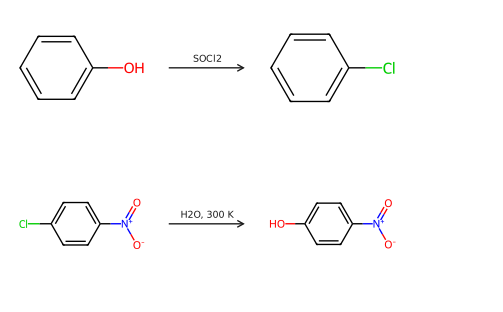
›Reveal solutionSolution
The key idea is that reaction I (phenol to chlorobenzene via SOCl₂) is not feasible because the C–O bond in phenol has partial double-bond character, making direct nucleophilic substitution impossible, while reaction II (chlorobenzene to phenol with aqueous NaOH) is not feasible under the given mild conditions (300 K) because the C–Cl bond in chlorobenzene is stabilized by resonance. Thus both reactions are not feasible, so option (B) is correct.
Concept and Intuition
The problem tests your understanding of nucleophilic aromatic substitution and the reactivity of phenol derivatives. The key is recognizing that:
- Phenol has a strong C–O bond due to resonance between the oxygen lone pair and the aromatic ring. This makes the –OH group a poor leaving group; you cannot simply replace it with Cl using SOCl₂ (which works for aliphatic alcohols).
- Chlorobenzene has a C–Cl bond that is also resonance-stabilized (the chlorine lone pairs delocalize into the ring). This makes the chlorine atom less susceptible to nucleophilic displacement under mild conditions. For hydrolysis to occur, you typically need harsh conditions (high temperature, strong base, or a catalyst).
Let’s examine each reaction step by step.
Step-by-Step Reasoning
1. Reaction I: Phenol + SOCl₂ → Chlorobenzene
-
What is attempted?
Replacing the –OH group of phenol with –Cl using thionyl chloride (SOCl₂). This is a classic method for converting aliphatic alcohols to alkyl chlorides.
-
Why does it fail for phenol?
In phenol, the oxygen’s lone pairs are conjugated with the aromatic π-system, giving the C–O bond partial double-bond character. This makes the C–O bond very strong and the –OH group a poor leaving group. SOCl₂ works by first converting –OH into a better leaving group (e.g., –OSOCl), but in phenol, the oxygen is too tightly bound to the ring for this to happen effectively.
Moreover, the mechanism for aliphatic alcohols involves an SN₂ or SN₁ pathway, but the aromatic ring does not undergo such substitution easily.
-
Conclusion: Reaction I is not feasible under normal conditions.
Watch outA common mistake is to assume that because SOCl₂ works for alcohols, it works for phenol. But phenol is not an alcohol — it’s an aromatic compound with a very different C–O bond.
2. Reaction II: Chlorobenzene + H₂O at 300 K → Phenol
-
What is attempted?
Hydrolysis of chlorobenzene to phenol using water at 300 K (about 27°C).
-
Why does it fail? …
- TG EAPCET 2024Set eng-2024-05-09-FN1 markMCQQ.Identify the correct statements from the following(i) Ti (IV) is more stable than Ti(III) and Ti(II)(ii) Among 3d – series elements (from Z = 22 to 29) only copper has positive reduction potential (M2+/M)(iii) Both Sc and Zn exhibit +1 oxidation state (A) i, ii only (B) i, iii only (C) ii, iii only (D) i, ii, iii
›Reveal solutionSolution
The question tests stability of Ti oxidation states, reduction potentials in the 3d series, and the common oxidation states of Sc and Zn. Only statements (i) and (ii) are correct, so the answer is option (A).
Concept & Intuition
This problem combines three separate ideas from transition metal chemistry:
- Stability of oxidation states depends on electronic configuration and the tendency to lose electrons. For titanium, the +4 state (empty d‑orbitals) is particularly stable.
- Reduction potential measures how easily a metal ion gains electrons. In the 3d series, most M²⁺/M couples have negative potentials; copper is the exception because of its high ionization energy and low hydration enthalpy.
- Oxidation states of Sc and Zn are governed by their d‑electron counts: Sc typically loses three electrons (Sc³⁺), and Zn loses two (Zn²⁺); +1 is not common for either.
Step‑by‑step reasoning
-
Statement (i): Ti(IV) is more stable than Ti(III) and Ti(II)
- Titanium has the electronic configuration [Ar]3d24s2.
- Ti(IV) has a noble‑gas configuration [Ar], which is highly stable.
- Ti(III) (3d1) and Ti(II) (3d2) are less stable because they can be further oxidized to the empty‑d‑shell state.
- In aqueous solution, Ti²⁺ is a strong reducing agent and Ti³⁺ is also easily oxidized.
- Conclusion: Statement (i) is true.
-
Statement (ii): Among 3d‑series elements (Z = 22 to 29) only copper has positive reduction potential (M²⁺/M)
- The standard reduction potentials for M²⁺/M in the 3d series (from Ti to Zn) are mostly negative.
- For example:
- TG EAPCET 2024Set ap-2024-05-07-FN1 markMCQQ.Identify the correct set (A) SiO2 – ionic solid – conductor – high melting point (B) SiO2 – network solid – conductor – low melting point (C) NaCl – ionic solid – insulator in solid state – high melting point (D) Fe – ionic solid – conductor – low melting point
›Reveal solutionSolution
The key is to match each substance with its correct classification (bonding type, electrical conductivity, and melting point). Only option (C) correctly describes NaCl as an ionic solid, an insulator in the solid state, and having a high melting point.
Concept & Intuition
This question tests your ability to connect a material’s internal bonding structure to its macroscopic properties. Every solid falls into one of four broad categories: ionic, metallic, covalent network, or molecular. Each category has a signature set of properties:
- Ionic solids (e.g., NaCl) are made of ions held by strong electrostatic forces. They are brittle, have high melting points, and do not conduct electricity as solids (ions are locked in place), but do when molten or dissolved.
- Covalent network solids (e.g., SiO₂ as quartz) have atoms bonded in a continuous 3D network by covalent bonds. They are very hard, have extremely high melting points, and are insulators (no free electrons or mobile ions).
- Metallic solids (e.g., Fe) have a “sea” of delocalized electrons. They are malleable, conduct electricity well, and have variable melting points (Fe’s is high, but many metals have low melting points).
- Molecular solids (e.g., ice) are held by weak intermolecular forces; they are soft, insulators, and have low melting points.
The trick is to spot which option gets all three descriptors right for the given substance.
Step-by-step reasoning
-
Examine option (A): SiO₂ – ionic solid – conductor – high melting point
- SiO₂ is not ionic; it’s a covalent network solid (each Si bonds to four O atoms in a tetrahedral lattice).
- As a network solid, it is an insulator, not a conductor.
- The “high melting point” part is correct (~1600 °C), but the first two descriptors are wrong. → Eliminate (A).
-
Examine option (B): SiO₂ – network solid – conductor – low melting point
- “Network solid” is correct for SiO₂.
- But network solids are insulators, not conductors.
- Also, SiO₂ has a high melting point, not low. → Eliminate (B).
-
Examine option (C): NaCl – ionic solid – insulator in solid state – high melting point
- NaCl is indeed an ionic solid (Na⁺ and Cl⁻ ions). …
- TG EAPCET 2024Set eng-2024-05-10-AN1 markMCQQ.The standard electrode potentials E∘ (V) for Li+/Li, Na+/Na respectively are (A) −3.04, −2.714 (B) −2.714, −3.04 (C) −3.04, −3.04 (D) −2.714, −2.714
›Reveal solutionSolution
The standard electrode potentials for Li⁺/Li and Na⁺/Na are −3.04 V and −2.714 V respectively, so the correct order is option (A).
The key here is remembering the actual numerical values from the electrochemical series. Many students get confused because lithium is above sodium in the periodic table, but its reduction potential is more negative (i.e., it is a stronger reducing agent). The standard reduction potentials are experimentally measured values, not something you deduce from periodic trends alone — though the trend does help you check consistency.
- Recall the standard reduction potentials For the half‑reaction
M++e−→M
the standard electrode potentials (at 25 °C, 1 M, 1 atm) are:
- Li⁺/Li: E∘=−3.04 V
- Na⁺/Na: E∘=−2.714 V
-
Interpret the sign and magnitude
A more negative value means the metal is more difficult to reduce (i.e., it is a stronger reducing agent). Lithium’s potential is more negative than sodium’s, so lithium is the stronger reductant — consistent with its position in the reactivity series.
-
Match to the options …
- TG EAPCET 2024Set eng-2024-05-10-AN1 markMCQQ.Two statements are given below Statement I: Molten NaCl is electrolysed using Pt electrodes. Cl2 is liberated at anode Statement II: Aqueous CuSO4 is electrolysed using Pt electrodes. O2 is liberated at cathode The correct answer is (A) Both statement I and II are correct (B) Both statement I and II are not correct (C) Statement I is correct but statement II is not correct (D) Statement I is not correct but statement II is correct
›Reveal solutionSolution
Molten NaCl really does give ClX2 at the anode, but electrolysis of aqueous CuSOX4 deposits Cu at the cathode and gives OX2 at the anode. So statement I is right, II is wrong — option (C).
The concept first. Electrolysis is not about "which ion moves where" alone; it is about which species is easiest to reduce at the cathode and easiest to oxidise at the anode. Two rules never bend:
- Cathode = reduction (electrons pushed in), anode = oxidation (electrons pulled out).
- In an aqueous solution, water itself competes with the solute ions, and the species with the more favourable discharge potential wins.
Step 1 — Molten NaCl (Statement I).
The melt contains only NaX+ and ClX−; there is no water to compete.
Cathode: NaX++eX−Na (molten sodium).
Anode: 2ClX−ClX2+2eX−.
This is exactly the Down's process, and chlorine is indeed the anode product. Statement I is correct.
Step 2 — Aqueous CuSO4 with Pt electrodes (Statement II).
Species present: CuX2+, SOX4X2−, HX2O (and traces of HX+, OHX−). …
- TG EAPCET 2024Set eng-2024-05-10-AN1 markMCQQ.Which of the following orders is correct for the property given? (A) Cr < Mn < Fe - standard electrode potential value for M3+/M2+ (B) Cr2+ < Mn2+ < Fe2+ - magnetic moments (C) VO2+ < Cr2O72− < MnO4− - oxidizing power (D) Ti < V < Cr - first ionization enthalpy
›Reveal solutionSolution
The question tests periodic trends in transition-metal properties. By analyzing each option against known chemical principles, only option (C) — the order of oxidizing power VO2+<Cr2O72−<MnO4− — is correct.
Concept and Intuition
Transition metals show subtle but systematic trends across a period. For standard electrode potentials, magnetic moments, oxidizing power, and ionization enthalpy, the key is to recall how effective nuclear charge, electronic configuration, and stability of oxidation states change from left to right. A common mistake is to assume monotonic trends where exceptions exist (e.g., Cr and Mn in ionization enthalpy). Here, we check each option carefully.
-
Option (A): Standard electrode potential for M3+/M2+
The standard reduction potential E∘ for M3++e−→M2+ does not increase smoothly from Cr to Fe.
- Cr: E∘(Cr3+/Cr2+)=−0.41 V
- Mn: E∘(Mn3+/Mn2+)=+1.51 V (very high because Mn2+ is exceptionally stable, half-filled d⁵)
- Fe: E∘(Fe3+/Fe2+)=+0.77 V So the order is Cr < Fe < Mn, not Cr < Mn < Fe. Hence (A) is false.
-
Option (B): Magnetic moments of Cr2+,Mn2+,Fe2+
Magnetic moment μ=n(n+2) Bohr magnetons, where n = number of unpaired electrons.
- Cr2+: [Ar]3d4 → 4 unpaired (high-spin) → μ≈4.90 BM
- Mn2+: [Ar]3d5 → 5 unpaired → μ≈5.92 BM
- Fe2+: [Ar]3d6 → 4 unpaired (high-spin) → μ≈4.90 BM So the order is Mn2+>Cr2+=Fe2+, not Cr2+<Mn2+<Fe2+. Hence (B) is false.
-
Option (C): Oxidizing power of VO2+,Cr2O72−,MnO4−
Oxidizing power in oxoanions increases with the oxidation state of the central metal and with the element’s position in the periodic table (higher electronegativity, more stable lower oxidation state).
- V in VO2+: oxidation state +5
- Cr in Cr2O72−: oxidation state +6
- Mn in MnO4−: oxidation state +7
Across the period, the tendency to accept electrons (oxidizing power) increases: MnO4− is the strongest, Cr2O72− intermediate, VO2+ weakest. Standard reduction potentials confirm:
- VO2++2H++e−→VO2++H2O: E∘≈+1.00 V …
-
🎓Unlock everything free for 14 days
- ✓Full step-by-step solutions
- ✓Concept-first explanations
- ✓Methods, shortcuts & mistakes
- ✓PYQ mapping + timed mock tests
Full access for 14 days. No credit card required.