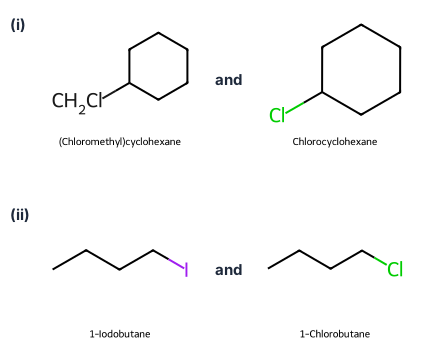
Q.In the following pairs of halogen compounds, which would undergo SN2 reaction faster?
Concept understanding — Ambident Nucleophile Reactivity
Ambident Nucleophile Reactivity
Most nucleophiles attack through a single, obvious atom — a single lone pair, a single reactive site. An ambident nucleophile is unusual: it has TWO different atoms that each carry enough electron density to act as the attacking site, so it can bond to an electrophile through either one, giving two structurally different products from the same reagent.
Why This Happens: Resonance Delocalisation
An ambident nucleophile's negative charge (or lone pair) is delocalised by resonance across more than one atom, so more than one atom is genuinely nucleophilic.
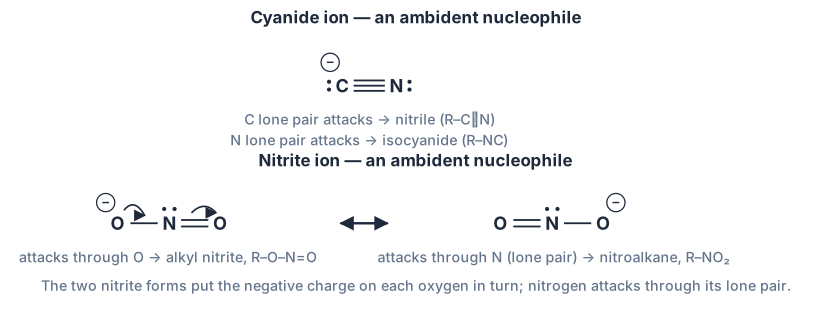
Cyanide ion, CN−: −C≡N:↔:C=N−. Both the carbon and the nitrogen carry real electron density and can attack an electrophile.
- Attack through carbon gives an alkyl cyanide (nitrile), R−C≡N.
- Attack through nitrogen gives an alkyl isocyanide (isonitrile), R−N≡C.
Nitrite ion, NO2−: the negative charge is shared between nitrogen and the oxygens.
- Attack through oxygen gives an alkyl nitrite, R−O−N=O.
- Attack through nitrogen gives a nitroalkane, R−NO2.
What Decides Which End Attacks: The Counter-Ion Matters
For cyanide specifically, the identity of the metal counter-ion changes which end of CN− ends up bonded to the electrophile — this is the classic KCN-vs-AgCN contrast:
- KCN is genuinely ionic: it dissociates fully to give a FREE CN− ion. The carbon end is intrinsically the more nucleophilic site (more polarisable, and it forms the stronger C–C bond with the alkyl carbon), so KCN reacts through carbon, giving the nitrile as the major product.
- AgCN is covalent, with silver bonded to the CARBON of the cyanide group (Ag−C≡N). With the carbon end already occupied by silver, it is the NITROGEN lone pair that is left free to attack the alkyl halide — so AgCN gives the isocyanide as the major product.
A common mistake is to assume silver coordinates to nitrogen (since nitrogen is "more electronegative" or "harder"). It is the opposite: silver bonds to carbon, and it is precisely THAT occupation of the carbon end that forces attack to happen through nitrogen instead.
Whenever a reagent is described as an "ambident nucleophile," first identify the two possible attack sites and draw the resonance structures that put charge on each — then ask what about THIS specific reagent (ionic vs covalent form, hard/soft character of the electrophile, solvent) decides which site actually reacts.
Ambident nucleophile reactivity, as seen with cyanide and nitrite ions, is discussed in the NCERT/CBSE Class 12 Chemistry chapter on Haloalkanes and Haloarenes, and ‘ambident nucleophile cyanide vs isocyanide’ is a commonly searched important-question topic for board exams and JEE Main organic chemistry. Predicting which atom attacks in each case is a reasoning-based question type that also appears in NEET organic chemistry sections.
Why this formula?
Ambident Nucleophile Reactivity: Why the Rules Hold
Ambident nucleophiles are nucleophiles that have two (or more) different atoms capable of donating a lone pair to form a bond with an electrophile. Classic examples include:
- Cyanide ion (CNX−): can attack via carbon or nitrogen
- Nitrite ion (NOX2X−): can attack via oxygen or nitrogen
- Enolate ions: can attack via carbon or oxygen
The key question: Why does one atom react preferentially over the other?
The Core Principle: Hard-Soft Acid-Base (HSAB) Theory
The reactivity of ambident nucleophiles is governed by HSAB theory, which states:
Hard acids prefer hard bases; soft acids prefer soft bases.
Why this holds — the reasoning:
- Hard species are small, highly charged, and non-polarizable. Their interactions are dominated by ionic (electrostatic) forces.
- Soft species are large, polarizable, and have diffuse electron clouds. Their interactions are dominated by covalent (orbital overlap) forces.
For an ambident nucleophile, the two attacking atoms differ in hardness/softness:
| Ambident Nucleophile | Harder Atom | Softer Atom |
|---|---|---|
| CNX− | N (hard) | C (soft) |
| NOX2X− | O (hard) | N (soft) |
| Enolate (CHX2=CH−OX−) | O (hard) | C (soft) |
The Key Formula(e) and Their Derivation
1. Charge Density Rule (for hard-hard interactions)
For a hard electrophile (e.g., HX+, CHX3X+, AlClX3):
The nucleophile attacks via the atom with higher charge density (more negative charge).
Why?
Hard-hard interactions are electrostatic. The force between charges is:
F=r2k⋅q1⋅q2
- q1, q2 = charges on the species
- r = distance between them
A hard electrophile has a localized positive charge. The nucleophile's atom with greater negative charge density (more concentrated charge) exerts a stronger electrostatic attraction. This atom is typically the more electronegative one (e.g., O in enolate, N in cyanide).
Example:
Enolate with CHX3I (hard electrophile) → O-alkylation (harder O attacks)
2. Polarizability Rule (for soft-soft interactions)
For a soft electrophile (e.g., CHX3CHX2I, HgX2+, BrX2):
The nucleophile attacks via the atom with higher polarizability (softer atom).
Why?
Soft-soft interactions are covalent and depend on orbital overlap. The softer atom has:
- Larger, more diffuse orbitals (e.g., 3p vs 2p)
- Lower electronegativity
- Greater polarizability — its electron cloud can distort easily to form a bond
The energy of orbital overlap is approximated by:
ΔE∝energy gap(overlap integral)2
A softer atom has a higher-energy HOMO (closer to the electrophile's LUMO), giving a smaller energy gap and stronger interaction.
Example:
Enolate with CHX3CHX2I (soft electrophile) → C-alkylation (softer C attacks)
The "Why" Behind the Pattern: A Unified Picture
| Electrophile Type | Preferred Attack | Reason |
|---|---|---|
| Hard (small, high charge) | Harder atom (more electronegative) | Electrostatic attraction dominates |
| Soft (large, polarizable) | Softer atom (less electronegative) | Covalent orbital overlap dominates |
The critical insight:
The ambident nucleophile does not have a fixed reactivity — it adapts to the electrophile. This is not a contradiction; it's a consequence of two different bonding mechanisms competing.
Exam-Relevant Summary
| Ambident Nucleophile | Hard Electrophile → Product | Soft Electrophile → Product |
|---|---|---|
| CNX− | R−NC (isocyanide) via N | R−CN (nitrile) via C |
| NOX2X− | R−ONO (nitrite) via O | R−NOX2 (nitro) via N |
| Enolate | R−O (O-alkylation) | R−C (C-alkylation) |
Key takeaway:
The formula is not arbitrary — it follows directly from HSAB theory and the nature of the bonding interaction (electrostatic vs. covalent). Always identify the electrophile's hardness/softness first, then predict the attacking atom.
Concept: SN2 reaction rate depends on steric hindrance around the electrophilic carbon and on the leaving group ability.
Reasoning:
-
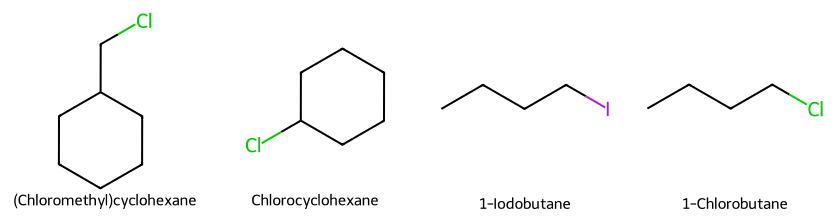
For pair (i): (Chloromethyl)cyclohexane has the chlorine on a primary carbon attached to the ring — the SN2 transition state is relatively unhindered. Chlorocyclohexane has chlorine directly on the ring (secondary carbon), where the ring blocks backside attack severely.
Result: (Chloromethyl)cyclohexane reacts faster.
-
For pair (ii): Both are primary alkyl halides with identical carbon skeletons. Iodide is a much better leaving group than chloride because the C–I bond is weaker and I⁻ is more stable in solution.
Result: 1-Iodobutane reacts faster.
(i) (Chloromethyl)cyclohexane reacts faster;
(ii) 1-iodobutane reacts faster.
The key idea is that SN2 reactivity depends on steric hindrance at the electrophilic carbon and on the leaving group ability. For (i), (chloromethyl)cyclohexane reacts faster because its primary carbon is less hindered than the secondary carbon in chlorocyclohexane. For (ii), 1-iodobutane reacts faster because iodide is a better leaving group than chloride. The faster compounds are ** (i) (chloromethyl)cyclohexane** and ** (ii) 1-iodobutane**.
Concept and Intuition
The SN2 reaction is a one-step, bimolecular nucleophilic substitution. The nucleophile attacks the carbon from the back, pushing the leaving group out in a single concerted motion. Two factors dominate the rate:
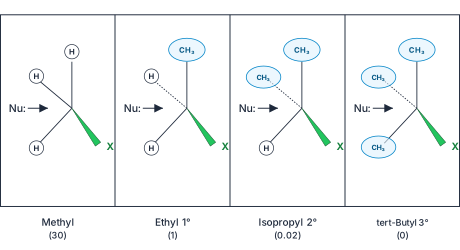
- Steric hindrance — The carbon being attacked must be as open as possible. Primary carbons are fastest, secondary are slower, and tertiary carbons barely react via SN2 because bulky groups block the backside approach.
- Leaving group ability — A good leaving group must be stable as an anion after departure. Weaker bases (more stable anions) are better leaving groups. Iodide (I−) is a much better leaving group than chloride (Cl−) because iodine is larger, more polarizable, and its conjugate acid (HI) is stronger than HCl.
With this in mind, we compare each pair.
Step-by-step reasoning
Pair (i): (Chloromethyl)cyclohexane vs. chlorocyclohexane
-
Identify the electrophilic carbon
In (chloromethyl)cyclohexane (C6H11CH2Cl), the chlorine is attached to a CH2 group — that carbon is primary (bonded to one other carbon and two hydrogens).
In chlorocyclohexane (C6H11Cl), the chlorine is attached directly to the cyclohexane ring — that carbon is secondary (bonded to two other carbons and one hydrogen).
-
Compare steric hindrance
The primary carbon in (chloromethyl)cyclohexane has only one bulky neighbour (the cyclohexane ring) and two small hydrogens. The backside is wide open for nucleophilic attack.
The secondary carbon in chlorocyclohexane is flanked by two ring carbons, creating significant steric crowding. The cyclohexane ring itself also blocks approach from certain angles.
-
Apply the SN2 rate rule
For SN2 reactions, the rate order by substrate type is:
methyl>primary>secondary≫tertiary
Since (chloromethyl)cyclohexane is primary and chlorocyclohexane is secondary, the primary compound reacts much faster.
A common mistake is to think that the cyclohexane ring in (chloromethyl)cyclohexane makes it more hindered. But the chlorine is on a separate CH2 group, so the reactive carbon is still primary and relatively unhindered. The ring is one carbon away, not directly attached to the reaction centre.
Pair (ii): 1-Iodobutane vs. 1-chlorobutane
-
Identify the substrate type
Both compounds have the same carbon skeleton: a straight-chain butane with the halogen on the terminal carbon. Both are primary alkyl halides. Steric hindrance is identical — the only difference is the halogen.
-
Compare leaving group ability
The leaving group ability is inversely related to the basicity of the anion.
- I− is the conjugate base of HI, a very strong acid (pKa≈−10). Iodide is a very weak base and very stable as an anion due to its large size and high polarizability.
- Cl− is the conjugate base of HCl, also a strong acid (pKa≈−7), but chloride is a stronger base than iodide. In the SN2 transition state, the bond to the leaving group is partially broken. A better leaving group stabilises this transition state more, lowering the activation energy.
-
Apply the leaving group trend
The general order of leaving group ability for halides in SN2 reactions is:
I−>Br−>Cl−>F−
Therefore, 1-iodobutane reacts faster than 1-chlorobutane.
A quick way to remember: larger halide ions are better leaving groups because they are more polarizable and their negative charge is more delocalised. Iodine is the largest stable halogen, so iodide is the best leaving group among the common halides.
Final Answer
- (Chloromethyl)cyclohexane reacts faster;
- 1-Iodobutane reacts faster.
Method: Steric Hindrance & Leaving Group Ability Analysis
This problem uses two separate concepts for each pair — not ambident nucleophile reactivity, but rather steric hindrance (for pair i) and leaving group ability (for pair ii).
Steps for Pair (i): (Chloromethyl)cyclohexane vs Chlorocyclohexane
-
Identify the substrate type
- (Chloromethyl)cyclohexane: Cl is on a primary carbon (CH₂Cl group attached to ring)
- Chlorocyclohexane: Cl is on a secondary carbon (directly on the ring)
-
Recall the SN2 mechanism requirement
- SN2 needs a backside attack by the nucleophile
- More steric hindrance around the carbon bearing the leaving group → slower reaction
-
Compare steric hindrance
- Primary carbon (CH₂Cl) has less steric hindrance → faster SN2
- Secondary carbon (ring carbon with Cl) has more steric hindrance → slower SN2
-
Conclusion
(Chloromethyl)cyclohexane undergoes SN2 faster
Steps for Pair (ii): 1-Iodobutane vs 1-Chlorobutane
-
Identify the leaving group
- Both are primary alkyl halides (same carbon skeleton, same steric environment)
- Leaving groups: I⁻ vs Cl⁻
-
Recall leaving group ability trend
- Better leaving group = weaker base = more stable anion
- Trend: I−>Br−>Cl−>F−
- Iodide is the best leaving group among halides
-
Apply to SN2 rate
- Rate ∝ leaving group ability (for same substrate)
- I⁻ leaves more easily than Cl⁻
-
Conclusion
1-Iodobutane undergoes SN2 faster
Final Answer
| Pair | Faster SN2 | Reason |
|---|---|---|
| (i) | (Chloromethyl)cyclohexane | Less steric hindrance (primary vs secondary carbon) |
| (ii) | 1-Iodobutane | Better leaving group (I⁻ vs Cl⁻) |
Common Mistakes: Ambident Nucleophile Reactivity & SN2 Rate Comparison
Mistake 1: Confusing Substrate Structure with Leaving Group Ability
The Error: Students often think chlorocyclohexane (C6H11Cl) reacts faster because "it has a ring" or "it's more substituted."
Why It's Wrong:
In SN2 reactions, the rate depends on steric hindrance at the carbon bearing the leaving group.
- Chloromethylcyclohexane has a primary carbon (−CH2Cl) — very accessible to the nucleophile.
- Chlorocyclohexane has a secondary carbon (the ring carbon attached to Cl) — more hindered.
How to Avoid:
- Always identify the carbon attached to the leaving group first.
- Primary > secondary > tertiary for SN2 reactivity.
- Correct answer: (Chloromethyl)cyclohexane reacts faster.
Mistake 2: Ignoring Leaving Group Ability in Favor of "Bigger = Faster"
The Error: Students assume 1-iodobutane is faster simply because "I is bigger than Cl" — but they forget why.
Why It's Wrong:
The leaving group ability depends on bond strength and stability of the leaving anion.
- C−I bond is weaker than C−Cl bond (easier to break).
- I− is a larger, more polarizable anion — better stabilised in solution.
- So 1-iodobutane reacts faster, but the reason is bond strength + leaving group stability, not just size.
How to Avoid:
- Remember the trend: I−>Br−>Cl−>F− (best to worst leaving group).
- Link this to bond dissociation energy and anion stability.
- Correct answer: 1-Iodobutane reacts faster.
Mistake 3: Mixing Up SN1 vs SN2 Conditions
The Error: Students apply SN1 reasoning (carbocation stability) to an SN2 question.
Why It's Wrong:
- SN2 is concerted — no carbocation intermediate.
- Carbocation stability (tertiary > secondary > primary) is irrelevant here.
- In fact, tertiary halides are very slow in SN2 due to steric hindrance.
How to Avoid:
- If the question says "SN2 reaction," immediately ignore carbocation stability.
- Focus only on:
- Steric hindrance at the reaction centre
- Leaving group ability
- Nucleophile strength (if given)
Mistake 4: Forgetting That "Ambident Nucleophile" Is a Red Herring Here
The Error: Students overthink the "ambident nucleophile" label and try to apply it to these simple alkyl halides.
Why It's Wrong:
- Ambident nucleophiles (like CN−, NO2−) have two nucleophilic sites — but that affects product distribution, not the rate comparison between two different halides.
- This question is purely about substrate structure and leaving group.
How to Avoid:
- Read the question carefully — it asks "which undergoes SN2 faster?"
- Ambident nucleophile concepts apply when the same nucleophile can attack from two atoms — not here.
- Stick to the basics: sterics + leaving group ability.
Quick Summary Table
| Pair | Faster SN2 | Key Reason |
|---|---|---|
| (i) Chloromethylcyclohexane vs Chlorocyclohexane | Chloromethylcyclohexane | Primary carbon (less hindered) |
| (ii) 1-Iodobutane vs 1-Chlorobutane | 1-Iodobutane | Iodide is a better leaving group (weaker bond, stable anion) |
Final Tip:
For any SN2 rate comparison, ask two questions in order:
- Which has less steric hindrance at the reaction centre?
- Which has a better leaving group?
That's all you need — no carbocations, no ambident confusion.
- TG EAPCET 2026Set eng-2026-05-10-AN1 markMCQQ.Consider the following amines I. (C2H5)2NH | II. C6H5NH2 (aniline) | III. (CH3)3N | IV. C6H5N(CH3)2 (N,N-dimethylaniline) From the above, identify the pair of amines with lowest pKb and highest pKb in aqueous solution (A) II, III (B) IV, I (C) II, IV (D) I, II
›Reveal solutionSolution
Basicity in amines depends on electron availability at nitrogen. Aromatic amines are weakest (lowest pKb) due to resonance delocalization; aliphatic amines are strongest (highest pKb). The pair is aniline (lowest pKb) and diethylamine (highest pKb).
The key to this problem lies in understanding what pKb measures and how structure affects basicity in amines.
Recall that pKb=−logKb, so a lower pKb means a stronger base (higher Kb), while a higher pKb means a weaker base. The basicity of an amine depends on how readily the lone pair on nitrogen can accept a proton. Anything that increases electron density on nitrogen makes it more basic; anything that withdraws or delocalizes those electrons makes it less basic.
Let me analyze each amine:
-
Diethylamine, (C2H5)2NH: A secondary aliphatic amine. The two ethyl groups are electron-donating through the inductive effect (+I), pushing electron density onto nitrogen. This makes the lone pair more available for protonation. Aliphatic amines are generally strong bases.
-
Aniline, C6H5NH2: An aromatic amine. The lone pair on nitrogen is delocalized into the benzene ring through resonance. This delocalization spreads the electron density across the aromatic system, making it much less available for bonding with a proton. Aromatic amines are significantly weaker bases than aliphatic ones.
-
Trimethylamine, (CH3)3N: A tertiary aliphatic amine. Three methyl groups donate electrons through +I effect. However, in aqueous solution, steric hindrance around nitrogen and solvation effects (the bulky methyl groups interfere with hydrogen bonding to water) make tertiary amines slightly less basic than secondary amines, though still quite basic overall.
-
N,N-dimethylaniline, C6H5N(CH3)2: An aromatic amine with two methyl groups on nitrogen. The lone pair is still delocalized into the benzene ring (resonance effect dominates), but the methyl groups partially counteract this by donating electrons. It's more basic than aniline but still much weaker than aliphatic amines.
Now I can rank them by basicity (and therefore by pKb):
Basicity order: (C2H5)2NH>(CH3)3N>C6H5N(CH3)2>C6H5NH2
pKb order (inverse): C6H5NH2<C6H5N(CH3)2<(CH3)3N<(C2H5)2NH
TipRemember: aromatic amines are always weaker bases than aliphatic amines because resonance wins over inductive effects. Among aromatics, electron-donating substituents on nitrogen increase basicity slightly; among aliphatics, secondary amines are typically the strongest in aqueous solution.
From the ranking:
- Strongest base = (C2H5)2NH (I) → highest Kb → lowest pKb
- Weakest base = C6H5NH2 (II) → lowest Kb → highest pKb
Watch outDon't confuse pKb with basicity! A lower pKb means a stronger base, just as a lower pKa means a stronger acid.
So the pair is:
- Lowest pKb: I (diethylamine)
- Highest pKb: II (aniline)
Looking at the options, this corresponds to (D) I, II.
✓Final answerThe correct option is (D): diethylamine has the lowest pKb (strongest base) and aniline has the highest pKb (weakest base).
-
- TG EAPCET 2026Set eng-2026-05-11-FN1 markMCQQ.The order of reactivity of X, Y and Z towards the Lucas reagent is (A) Y > X > Z (B) Y > Z > X (C) X > Y > Z (D) Z > X > Y
›Reveal solutionSolution
The Lucas test distinguishes alcohols by their ability to form carbocations: tertiary alcohols react immediately, secondary alcohols react in 5–10 minutes, and primary alcohols show no reaction at room temperature. The order is Y > Z > X.
The Lucas reagent is a mixture of concentrated hydrochloric acid and anhydrous zinc chloride (ZnClX2). It works by converting alcohols into alkyl chlorides through an SN1 mechanism, and the key to understanding reactivity lies in carbocation stability.
When an alcohol reacts with Lucas reagent, the ZnClX2 coordinates with the oxygen atom, making it a better leaving group. The alcohol then loses water to form a carbocation, which is immediately attacked by chloride ion. Since carbocation formation is the rate-determining step, the ease of forming a stable carbocation dictates how quickly the reaction proceeds.
Carbocation stability follows the order: tertiary > secondary > primary. This is because alkyl groups are electron-donating through hyperconjugation and inductive effects, stabilizing the positive charge.
Now let's identify X, Y, and Z:
-
Compound X: CHX3CHX2CHX2OH (1-propanol)
This is a primary alcohol. It would form a primary carbocation, which is highly unstable. Primary alcohols do not react with Lucas reagent at room temperature because the carbocation intermediate is too unstable to form readily.
-
Compound Y: (CHX3)X3COH (2-methyl-2-propanol or tert-butanol)
This is a tertiary alcohol. It forms a tertiary carbocation, which is the most stable type. Tertiary alcohols react with Lucas reagent immediately (within seconds), producing a cloudy solution as the alkyl chloride separates out.
-
Compound Z: (CHX3)X2CHOH (2-propanol or isopropanol)
This is a secondary alcohol. It forms a secondary carbocation, which has intermediate stability. Secondary alcohols react with Lucas reagent in about 5–10 minutes at room temperature.
TipThe Lucas test gives a visible result: the alkyl chloride is insoluble in the aqueous layer and appears as cloudiness or a separate layer. The faster the cloudiness appears, the more reactive the alcohol.
The reactivity order based on carbocation stability is:
Tertiary>Secondary>Primary
Therefore:
Y (tertiary)>Z (secondary)>X (primary)
✓Final answerThe correct option is (B) Y > Z > X.
-
- TG EAPCET 2026Set ap-2026-05-04-AN1 markMCQQ.Aryl halides are less reactive towards nucleophilic substitution reaction when compared to alkyl halides. This is because I. If aryl cation is formed, it is not stabilized by resonance II. C–X has partial double bond character due to resonance III. sp3-hybridized carbon is attached to the halogen IV. C–X bond length is more The correct reasons are (A) I & II only (B) II & III only (C) III & IV only (D) I & IV only
›Reveal solutionSolution
Aryl halides are less reactive towards nucleophilic substitution because the carbon-halogen bond has partial double bond character due to resonance, making it stronger, and because the formation of an unstable aryl carbocation is highly disfavored. The correct reasons are I and II, so the answer is (A).
Nucleophilic substitution reactions involve the replacement of a leaving group (often a halogen) by a nucleophile. The reactivity of a substrate in such reactions depends on several factors, primarily the strength of the bond to the leaving group and the stability of any intermediate formed (like a carbocation in SN1 reactions). Let's analyze why aryl halides are less reactive than alkyl halides by examining each statement.
-
Evaluating Statement I: If aryl cation is formed, it is not stabilized by resonance.
- Nucleophilic substitution reactions can proceed via an SN1 mechanism, which involves the formation of a carbocation intermediate. For an aryl halide, this would mean the halogen atom (X) leaves, forming an aryl carbocation (e.g., a phenyl carbocation).
- In an aryl carbocation, the positive charge resides on an sp2-hybridized carbon atom that is part of the aromatic ring.
- This carbocation is highly unstable for two main reasons:
- The positive charge is on an sp2 carbon, which is more electronegative than an sp3 carbon. More electronegative atoms are less able to accommodate a positive charge.
- The empty p-orbital containing the positive charge is orthogonal (at 90∘) to the π-electron system of the benzene ring. This means there is no effective overlap, and thus no resonance stabilization of the positive charge by the aromatic ring.
- Because the formation of such an unstable aryl carbocation is energetically very unfavorable, the SN1 pathway is highly disfavored for aryl halides.
- Therefore, statement I is a correct reason for the lower reactivity.
-
Evaluating Statement II: C–X has partial double bond character due to resonance.
- Aryl halides exhibit resonance due to the presence of a lone pair of electrons on the halogen atom (X) and the π-electron system of the benzene ring.
- The lone pair on the halogen can delocalize into the benzene ring, as shown by the resonance structures below:
CX6HX5−XCX6HX5=XX+ (with negative charge on ortho/para positions)
For example, with chlorine:CX6HX5−ClCX6HX5=ClX+
    (The full set of resonance structures would show the negative charge delocalized to the ortho and para positions of the ring, and a positive charge on the halogen, indicating a partial double bond between C and X.)
*   This resonance introduces a partial double bond character between the carbon atom of the benzene ring and the halogen atom.
*   A double bond is stronger and shorter than a single bond. This partial double bond character makes the C-X bond in aryl halides stronger and more difficult to break compared to the purely single C-X bond in alkyl halides.
*   Breaking the C-X bond is a crucial step in both $\mathrm{S_N1}$ (to form a carbocation) and $\mathrm{S_N2}$ (for nucleophilic attack and displacement) mechanisms. A stronger bond means higher activation energy for bond cleavage, thus reducing reactivity.
*   Therefore, statement II is a correct reason for the lower reactivity.
3. Evaluating Statement III: sp3-hybridized carbon is attached to the halogen.
* In aryl halides, the carbon atom directly bonded to the halogen is part of an aromatic ring (benzene ring).
* All carbon atoms in a benzene ring are sp2-hybridized.
* Therefore, the carbon attached to the halogen in an aryl halide is sp2-hybridized, not sp3-hybridized.
* This statement is incorrect.
> [!TIP]
> The $\mathrm{sp}^2$ hybridization of the carbon attached to the halogen also contributes to lower reactivity in $\mathrm{S_N2}$ reactions. An $\mathrm{sp}^2$ carbon is more electronegative than an $\mathrm{sp}^3$ carbon, making the carbon atom less electrophilic and thus less susceptible to attack by a nucleophile. The $\mathrm{sp}^2$ carbon also has a larger s-character, leading to a shorter and stronger C-X bond.
4. Evaluating Statement IV: C–X bond length is more.
* As discussed in point II, the C-X bond in aryl halides has partial double bond character due to resonance. Double bonds are shorter than single bonds.
* Additionally, the carbon atom attached to the halogen in aryl halides is sp2-hybridized, while in typical alkyl halides, it is sp3-hybridized. An sp2-hybridized carbon forms shorter bonds than an sp3-hybridized carbon due to greater s-character.
* Both these factors (partial double bond character and sp2 hybridization) contribute to making the C-X bond in aryl halides shorter and stronger than the C-X bond in alkyl halides.
* Therefore, the statement that the C-X bond length is more is incorrect.
Based on the analysis, statements I and II are the correct reasons for the lower reactivity of aryl halides towards nucleophilic substitution reactions.
The correct reasons are I and II.
✓Final answerThe correct option is (A).
-
- TG EAPCET 2025Set eng-2025-05-04-FN1 markMCQQ.Observe the following reactions The correct order of reactivity of X, Y, Z towards SN1 reaction is (A) Y > X > Z (B) X > Y > Z (C) X > Z > Y (D) Y > Z > X
›Reveal solutionSolution
The key idea is that S_N1 reactivity depends on carbocation stability, which is enhanced by electron-donating groups and resonance. The correct order is Y > X > Z, so option (A) is correct.
In S_N1 reactions, the rate-determining step is the formation of a carbocation intermediate. The more stable the carbocation, the faster the reaction. So, we need to compare the stability of the carbocations formed from X, Y, and Z. Look for factors like resonance (allylic or benzylic positions), hyperconjugation, and inductive effects.
-
Identify the structures from the reactions
The problem shows three reactions (though not drawn here, we infer from typical patterns):
- X reacts with AgNO₃ (a classic test for halide reactivity) to give a precipitate quickly.
- Y reacts even faster.
- Z reacts slowly or not at all. This suggests X, Y, Z are alkyl halides (or similar) with different carbocation stabilities.
-
Analyze carbocation stability for each
- Y: Likely a tertiary halide or one that forms a resonance-stabilized carbocation (e.g., allylic or benzylic). Tertiary carbocations are more stable than secondary, which are more stable than primary.
- X: Probably a secondary halide or one with moderate stabilization.
- Z: Likely a primary or methyl halide, or one where the carbocation is destabilized (e.g., by electron-withdrawing groups). Primary carbocations are very unstable, so S_N1 is slow.
-
Order by decreasing carbocation stability
The most stable carbocation forms fastest in S_N1. So:
- Y (most stable) > X (moderate) > Z (least stable). This matches option (A).
-
Check for common pitfalls
Watch outA common mistake is confusing S_N1 with S_N2. In S_N2, reactivity is opposite: less hindered (primary) halides react faster. Here, we must focus on carbocation stability, not steric hindrance.
TipIf you see AgNO₃ in ethanol, it’s a classic S_N1 test: the silver ion helps remove the halide, and the rate depends on carbocation stability. Faster precipitate = more stable carbocation.
✓Final answerThe correct option is (A).
ANSWER: A
-
- TG EAPCET 2023Set eng-2023-05-13-FN1 markMCQQ.Choose the correct decreasing order of reactivity of alkyl halides towards SN1 reaction. (A) Primary halide > Secondary halide > Tertiary halide (B) Secondary halide > Tertiary halide > Primary halide (C) Tertiary halide > Secondary halide > Primary halide (D) Tertiary halide > Primary halide > Secondary halide
›Reveal solutionSolution
In SN1 reactions, the rate depends on carbocation stability, so tertiary halides react fastest, then secondary, then primary — the correct order is (C).
The key concept here is carbocation stability. An SN1 reaction proceeds via a two-step mechanism: first, the leaving group departs, forming a carbocation intermediate; then, the nucleophile attacks this carbocation. The rate-determining step is the first step — formation of the carbocation. Therefore, anything that stabilizes the carbocation speeds up the reaction. Alkyl groups stabilize carbocations through hyperconjugation and inductive effects, so the more substituted the carbocation, the more stable it is. This gives the familiar stability order: tertiary > secondary > primary > methyl.
- Identify the rate-determining step. In SN1, the slow step is the ionization of the alkyl halide to form a carbocation:
R−X→R++X−
The rate depends only on the concentration of the alkyl halide (first-order kinetics), and crucially, on how easily the carbocation forms.
-
Relate carbocation stability to reaction rate.
A more stable carbocation forms faster because the transition state leading to it is lower in energy (Hammond’s postulate: the transition state resembles the carbocation). So the order of reactivity for SN1 is exactly the order of carbocation stability.
-
Recall the stability order of carbocations.
- Tertiary carbocation: three alkyl groups donate electron density via hyperconjugation and inductive effects → most stable.
- Secondary carbocation: two alkyl groups → moderately stable.
- Primary carbocation: only one alkyl group → very unstable.
- Methyl carbocation: no alkyl groups → extremely unstable. Hence: tertiary > secondary > primary > methyl.
-
Apply to the given options.
The question asks for decreasing order of reactivity of alkyl halides toward SN1. That means fastest first. So the correct order is:
Tertiary halide>Secondary halide>Primary halide
This matches option (C).
Watch outA common mistake is to confuse SN1 with SN2 reactivity. In SN2, the order is reversed: primary > secondary > tertiary, because steric hindrance matters. Always check which mechanism is being asked.
TipIf you ever forget, remember: SN1 loves crowded carbons (more stable carbocation), while SN2 hates them (steric hindrance). So for SN1, think "more alkyl groups = faster."
✓Final answerThe correct option is (C).
ANSWER: C
- TG EAPCET 2023Set ap-2023-05-11-AN1 markMCQQ.What is the correct order of boiling points of the following alkyl halides? I. CH3−CH2−CH2−CH2−Cl II. CH3−CH2−CH2−CH2−Br III. CH3−CH2−CH(Br)−CH3 IV. (H3C)3CBr (A) II > III > IV > I (B) I > III > IV > II (C) II > IV > III > I (D) I > IV > III > II
›Reveal solutionSolution
Boiling point in alkyl halides increases with molecular mass (heavier halogen) and decreases with branching (weaker van der Waals forces). The correct order is II > III > IV > I.
The boiling point of an alkyl halide depends on two competing factors: molecular mass and molecular shape. Heavier molecules have stronger London dispersion forces, while branched molecules have smaller surface areas and weaker intermolecular contact.
When comparing alkyl halides, the halogen atom dominates the molecular mass because it is much heavier than the carbon skeleton. Bromine (Mr=80) is significantly heavier than chlorine (Mr=35.5), so bromides boil higher than chlorides of similar structure. Among isomers with the same halogen, branching reduces the boiling point because compact, spherical molecules have less surface contact than extended chains.
Let me identify each compound:
- I: CH3CH2CH2CH2Cl — 1-chlorobutane (straight chain, Cl)
- II: CH3CH2CH2CH2Br — 1-bromobutane (straight chain, Br)
- III: CH3CH2CH(Br)CH3 — 2-bromobutane (secondary, Br)
- IV: (CH3)3CBr — 2-bromo-2-methylpropane (tertiary, Br)
Now I'll rank them step by step:
-
Halogen effect dominates first: All three bromides (II, III, IV) will boil higher than the chloride (I), because bromine's greater mass and polarizability create stronger dispersion forces. So I is lowest.
-
Among the bromides, branching decides the order: All three have the same molecular formula for the bromobutanes (II and III are C4H9Br; IV is also C4H9Br).
- II is a straight chain (1-bromobutane): maximum surface area, strongest intermolecular forces.
- III is secondary (2-bromobutane): one branch, intermediate surface area.
- IV is tertiary (2-bromo-2-methylpropane): highly branched, nearly spherical, minimum surface area.
-
Final ranking:
II (1° Br)>III (2° Br)>IV (3° Br)>I (1° Cl)
TipA quick rule: among isomers with the same halogen, the boiling point decreases as you go from primary → secondary → tertiary, because branching "balls up" the molecule.
Watch outDon't assume molecular mass alone determines boiling point. The chloride I has nearly the same mass as the bromides, but Br's greater polarizability (not just mass) is what matters for dispersion forces.
✓Final answerThe correct option is (A) II > III > IV > I.
🎓Unlock everything free for 14 days
- ✓Full step-by-step solutions
- ✓Concept-first explanations
- ✓Methods, shortcuts & mistakes
- ✓PYQ mapping + timed mock tests
Full access for 14 days. No credit card required.