Q.Explain the formation of micelles with a neat sketch.
You're viewing a preview — the full solution, concept, methods & PYQ mapping are locked.
Start your 14-day free trial to unlock the full solution →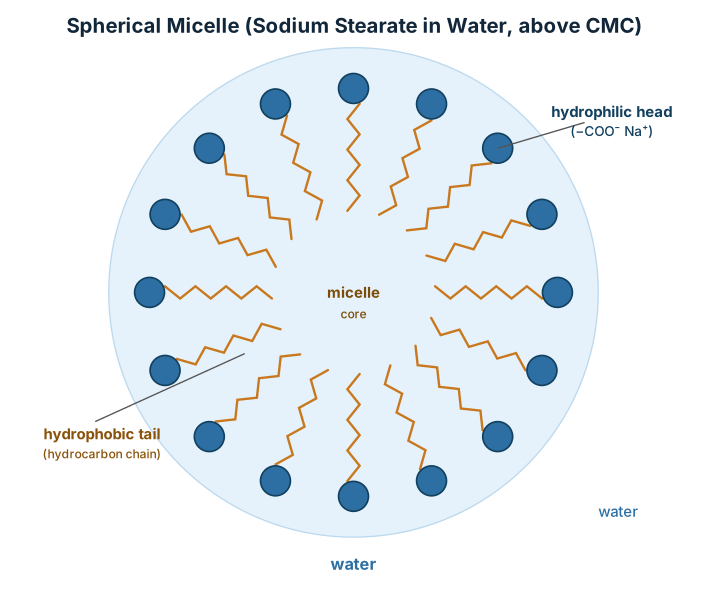
Above the critical micelle concentration, soap/detergent molecules aggregate into spherical micelles with hydrophobic tails pointing inward and hydrophilic heads facing the surrounding water.
Surface-active agents like soaps (sodium salts of long-chain fatty acids, e.g. C17H35COO- Na+) and detergents have two distinct parts in each molecule:
- A polar, hydrophilic (water-loving) head - the -COO- Na+ (carboxylate) group.
- A long, nonpolar, hydrophobic (water-repelling) tail - the long hydrocarbon chain.
At low concentration, these molecules stay dissolved/at the surface. But above a certain concentration called the critical micelle concentration (CMC), and above the Kraft temperature, the molecules aggregate to form larger colloidal particles called MICELLES.
Formation: To minimise contact of the hydrophobic tails with water, the molecules arrange themselves into a roughly spherical cluster (in aqueous medium) such that:
- All the hydrocarbon tails point INWARD, toward the centre of the sphere, huddled together away from water.
- All the polar head-groups (-COO- Na+) point OUTWARD, on the surface of the sphere, in contact with the surrounding water. …
Unlock everything free for 14 days
- Full step-by-step solutions
- Concept-first explanations
- Methods, shortcuts & mistakes
- PYQ mapping + timed mock tests
Full access for 14 days. No credit card required.