Q.In a bank, principal increases continuously at the rate of 5% per year. In how many years Rs 1000 double itself?
🔒You're viewing a preview — the full solution, concept, methods & PYQ mapping are locked.
🔒 Start your 14-day free trial to unlock the full solution →Concept understanding — Exponential Growth Rate
Exponential Growth Rate
A quantity grows exponentially when its rate of change is proportional to its current size: the more there is, the faster it grows. This differs sharply from linear growth, where a fixed amount is added each step. In exponential growth the quantity multiplies by the same factor over equal time intervals.
The differential equation
Let y(t) be the quantity and k>0 the proportionality constant. The rate law "rate of change proportional to the current amount" becomes
dtdy=ky.
This is a separable equation. Integrating,
∫ydy=∫kdt⟹log∣y∣=kt+C⟹y=y0ekt,
where y0=y(0) is the starting value. The constant k is the growth rate: a larger k means faster growth. (If k<0, the very same equation describes exponential decay.)
Reading the growth rate
Over each unit of time, y is multiplied by ek. So if the quantity doubles every unit of time, then ek=2, giving k=log2. This is how a stated doubling time is converted into the constant k.
Linear growth adds the same amount each step; exponential growth multiplies by the same factor. That is why an exponential quantity looks slow at first and then climbs steeply — the increase itself keeps getting bigger.
Where it appears …
Concept: Exponential Growth Rate — when a quantity grows continuously at a fixed percentage rate, it follows A=Pert.
We are given P=1000, r=5%=0.05 per year, and we want A=2000.
- The continuous compounding formula is A=Pert.
- Substitute: 2000=1000e0.05t.
- Divide: 2=e0.05t. Take natural log: log2=0.05t. …
Since the principal grows continuously at 5% per year, we use the exponential growth model A=Pert. Setting A=2P and r=0.05, we solve 2=e0.05t to get t=0.05log2≈13.86 years. So Rs 1000 doubles in about 13.86 years.
The key here is the phrase "increases continuously." This is not the same as simple interest or even annual compounding. Continuous growth means the principal is being updated every instant, not just at the end of each year. The natural model for this is exponential growth, where the amount after time t is given by A=Pert, with r as the annual rate (as a decimal).
Why e? Because continuous compounding is the limit of compounding more and more frequently — daily, hourly, every second — and that limit is ert. So whenever a problem says "continuously," your first thought should be the exponential function.
Now let's work through the numbers.
- Set up the equation. We start with principal P=1000. The amount after time t years is A=1000e0.05t. We want this to be double the original, so A=2000.
1000e0.05t=2000
- Simplify. Divide both sides by 1000:
e0.05t=2
- Solve for t using natural log. Take the natural logarithm of both sides. Since log(ex)=x, we get:
0.05t=log2
- Isolate t.
t=0.05log2
- Compute the value. log2≈0.693147. Dividing by 0.05 gives:
t≈0.050.693147=13.86294
So t≈13.86 years. …
Method: Continuous exponential growth/decay
Use this whenever a quantity is said to change "continuously" at a fixed percentage rate — growth of principal, population, or decay. The phrase "continuously" is the signal to model with e, not with simple or annual compounding.
Steps
Step 1: Set up the rate equation and its solution.
Continuous change at rate r means the rate of increase is proportional to the current amount:
dtdP=rP⟹P=P0ert,
where P0 is the starting amount and r is the rate written as a decimal (5% becomes 0.05).
Step 2: Impose the target condition. …
Common Mistakes
Mistake 1: Using simple interest or annual compounding.
Why it's wrong: "increases continuously" means the exponential model P=P0ert; the formulas P0(1+rt) or P0(1+r)t give different (wrong) answers here. Correct approach: model with ert whenever growth is continuous.
Mistake 2: Mishandling the percentage rate.
Why it's wrong: 5% must enter as r=0.05, not 5; using 5 makes t a hundred times too small. Correct approach: convert the percentage to a decimal before substituting. …
Showing the 12 most recent of 15 on this concept.
- TG EAPCET 2023Set eng-2023-05-12-FN1 markMCQQ.The sum of the roots of the equation e4t−10e3t+29e2t−20et+4=0 is (A) loge10 (B) 2loge2 (C) loge2 (D) 2loge10
›Reveal solutionSolution
The equation is a quartic in et; substituting x=et gives a polynomial whose roots sum to 10, so the sum of the original t-roots is loge10. The correct option is (A).
We are asked for the sum of the roots of
e4t−10e3t+29e2t−20et+4=0.
The variable t appears only inside exponentials, so a natural substitution is x=et. Then e2t=x2, e3t=x3, e4t=x4, and the equation becomes
x4−10x3+29x2−20x+4=0.
Now each positive root x of this polynomial corresponds to a root t=lnx of the original equation. The sum of the t-roots is therefore ∑lnxi=ln(∏xi). But the product of the roots of a quartic x4+a3x3+a2x2+a1x+a0=0 is (−1)4a0=a0 (here a0=4), so ∏xi=4. That would give ln4=2ln2, which is option (B). That seems too quick — but wait: we must check that every x-root is positive. If any root is negative or complex, its logarithm is not a real number, and the problem likely expects real roots only. Let’s examine the polynomial more carefully.
- Factor the polynomial in x. The quartic x4−10x3+29x2−20x+4 looks like it might factor into quadratics. Try (x2+ax+b)(x2+cx+d). Expanding:
x4+(a+c)x3+(ac+b+d)x2+(ad+bc)x+bd.
Matching coefficients:
a+c=−10,ac+b+d=29,ad+bc=−20,bd=4.
Since bd=4, possible integer pairs: (1,4), (2,2), (4,1), and negatives. Trying b=2,d=2: then a+c=−10 and ac+4=29⇒ac=25. So a and c are roots of u2+10u+25=0, i.e., u=−5 (double). Then ad+bc=a⋅2+2c=2(a+c)=−20, which matches. So the factorization is
(x2−5x+2)(x2−5x+2)=(x2−5x+2)2.
Indeed, the quartic is a perfect square:
(x2−5x+2)2=0.
- Solve for x. So x2−5x+2=0 gives
x=25±25−8=25±17.
Both roots are positive because 17≈4.123, so 5−17>0. Each root is repeated (double root), but for the sum of the t-roots we count each distinct t once? The problem says “the sum of the roots” — in an equation, repeated roots are still roots, so we count multiplicities. The polynomial in x has two distinct roots, each of multiplicity 2. So the four x-roots (with multiplicity) are:
25+17,25+17,25−17,25−17.
Their product is (25+17)2(25−17)2=(425−17)2=(48)2=22=4, consistent.
- Sum of the t-roots. Each x-root gives t=lnx. So the four t-roots (with multiplicity) are:
- TG EAPCET 2023Set ap-2023-05-11-AN1 markMCQQ.The change in the frequency of a gene that occurs merely by chance and not by selection in small population is called (A) Founder's effect (B) Genetic load (C) Gene flow (D) Sewall Wright effect
›Reveal solutionSolution
Random fluctuations in allele frequencies in small populations, independent of natural selection, are called genetic drift or the Sewall Wright effect. The answer is (D).
When populations are large, natural selection is the dominant force shaping allele frequencies. But in small populations, chance events can cause gene frequencies to drift randomly from generation to generation, even when those alleles confer no advantage or disadvantage. This phenomenon is genetic drift.
Imagine flipping a coin ten times versus a thousand times. With ten flips, you might easily get seven heads and three tails purely by chance. With a thousand flips, you'll almost certainly land close to 50-50. Small populations behave like the ten-flip scenario: random sampling of gametes during reproduction can produce large swings in allele frequency that have nothing to do with fitness.
Sewall Wright, one of the founders of population genetics, extensively studied this random sampling effect in small populations. The phenomenon is named after him: the Sewall Wright effect is synonymous with genetic drift.
Now let's see why the other options don't fit:
- Founder's effect (A) is a special case of genetic drift. It occurs when a small group breaks off from a larger population to establish a new colony. The founders carry only a subset of the genetic variation from the original population, so the new population starts with different allele frequencies. While it involves drift, it specifically describes the initial sampling event, not the ongoing random fluctuation in any small population. …
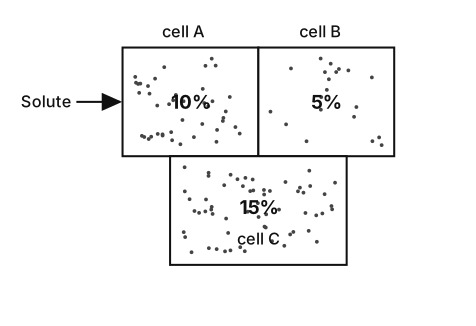
- TG EAPCET 2024Set ap-2024-05-07-FN1 markMCQQ.Identify the correct statement with reference to the diagram given below [FIGURE: Three adjoining cells drawn as boxes. Cell A (upper left) has solute concentration 10%; cell B (upper right) has 5%; cell C (below, spanning between them) has 15%. An arrow labelled "Solute" points into cell A.] (A) water moves from A to B (B) water moves from C to A (C) B has highest water potential (D) C has highest water potential
›Reveal solutionSolution
Adding solute lowers water potential, so among cells at 10 %, 5 % and 15 % solute, the most dilute one — cell B at 5 % — has the highest water potential. Water therefore flows from B, not to it. The only statement that survives is "B has highest water potential" — option (C).
The concept first: what water potential is, and which way water moves
The single idea that decides this whole question is:
Ψw=Ψs+Ψp
where
- Ψw = water potential (the free energy of water per unit volume, measured in pascals),
- Ψs = solute potential (also called osmotic potential),
- Ψp = pressure potential (turgor pressure).
Three facts follow, and they are the whole of osmosis:
Fact 1 — Pure water has the highest possible water potential, defined as Ψw=0 at standard conditions.
Fact 2 — Dissolving a solute always LOWERS water potential. The solute potential Ψs is always negative, and it grows more negative as you add more solute. Physically: solute molecules bind and immobilise water molecules, reducing the fraction of water that is free to move. Hence a solution always has Ψw<0.
more solute ⟹ Ψs more negative ⟹ Ψw lower
Fact 3 — Water moves DOWN the water-potential gradient, i.e. from a region of higher Ψw to a region of lower Ψw (from high free energy to low free energy). Nothing else decides the direction of osmosis.
A very common student error is to think "water moves towards more water" or to confuse concentration of solute with concentration of water. Say it to yourself the safe way: water moves towards the more concentrated (saltier) solution, because that is the solution with the lower water potential.
Step-by-step solution
Step 1 — Read the solute concentrations off the diagram.
Cell Solute concentration A 10 % B 5 % C 15 % Step 2 — Convert concentration into a water-potential ranking. Assuming (as such diagrams intend) that the pressure potential Ψp contributions are comparable, the ordering of Ψw is set entirely by Ψs:
- B (5 %) — least solute → Ψs least negative → Ψw HIGHEST
- A (10 %) — intermediate → Ψw intermediate
- C (15 %) — most solute → Ψs most negative → Ψw LOWEST
Ψw(B)>Ψw(A)>Ψw(C)
Step 3 — Deduce the direction of water flow. Water runs downhill in Ψw:
B ⟶ A ⟶ C
Cell C, being the most concentrated, is the sink: water flows into it from both A and B. Cell B, being the most dilute, is the source: water flows out of it.
Step 4 — Test each printed statement against this picture.
- (A) "water moves from A to B" — FALSE. A (10 %) has lower Ψw than B (5 %). Water moves the other way, B → A. …
- TG EAPCET 2023Set ap-2023-05-11-FN1 markMCQQ.Reservoir host for Trypanosoma gambiense. (A) Monkey (B) Rabbit (C) African antelope (D) Female Culex mosquito
›Reveal solutionSolution
A reservoir host is an animal that harbors a pathogen without suffering ill effects, serving as a source of infection for other susceptible hosts. For Trypanosoma gambiense, the causative agent of West African sleeping sickness, humans are the primary reservoir, but various wild and domestic animals, including African antelopes, can also act as reservoir hosts. The correct option is (C).
Concept and Intuition
To understand the role of a reservoir host, imagine a hidden pool where a disease-causing organism (pathogen) can live and multiply without causing severe illness to its host. This host, called a reservoir host, then acts as a continuous source of infection for other susceptible individuals or species. This is crucial for the pathogen's survival and spread, especially when its primary host population is low or when the pathogen needs to persist in the environment.
For parasitic diseases like trypanosomiasis, understanding the reservoir host is vital for disease control. If a pathogen can survive in animals, eradicating the disease in humans becomes much harder, as the animals can re-introduce the infection.
ImportantA reservoir host is a long-term host of a pathogen that does not get sick from the pathogen but can transmit it to other species.
Step-by-step Explanation
-
Identify the Pathogen and Disease: The question refers to Trypanosoma gambiense. This is a protozoan parasite that causes West African sleeping sickness, also known as Gambian trypanosomiasis. This disease is characterized by a chronic course, often leading to neurological symptoms if untreated.
-
Understand the Transmission: Trypanosoma gambiense is transmitted to humans and animals through the bite of an infected tsetse fly (genus Glossina). The tsetse fly acts as a biological vector, meaning the parasite undergoes part of its life cycle within the fly.
-
Primary Host and Reservoir Hosts:
- Humans are the primary hosts and the main reservoir for Trypanosoma gambiense. This means that human-to-human transmission (via the tsetse fly) is the most significant epidemiological cycle.
- However, various animals can also harbor the parasite without showing severe symptoms, thus acting as reservoir hosts. These animal reservoirs can maintain the parasite in nature, making disease control more challenging.
-
Evaluate the Options for Reservoir Hosts:
- (A) Monkey: Monkeys can be infected with Trypanosoma gambiense and can serve as reservoir hosts, particularly in sylvatic (forest) cycles.
- (B) Rabbit: Rabbits are not typically recognized as significant natural reservoir hosts for Trypanosoma gambiense. …
-
- TG EAPCET 2021Set ap-2021-08-10-FN1 markMCQQ.Match the following lists. LIST-I A) Atropa B) Computer usage in taxonomy C) Gloriosa D) Odd sepal anterior LIST-IIi) Ornamentii) Medicineiii) Fabaceaeiv) Numerical Taxonomy LIST-III I) Number and codes II) Pterocarpus III) solanaceae IV) Rhizome The correct match is: (A) ii, III (B) iv, I (C) i, IV (D) iii, II (B) ii, IV (B) iv, II (C) iii, III (D) i, I (C) iii, IV (B) i, III (C) ii, I (D) iv, II (D) i, I (B) ii, II (C) iii, IV (D) iv, III
›Reveal solutionSolution
This is a matching problem linking plants (LIST-I) to their uses (LIST-II) and families/features (LIST-III). The correct pairings are: Atropa → Medicine → Solanaceae; Computer usage in taxonomy → Numerical Taxonomy → Number and codes; Gloriosa → Ornament → Rhizome; Odd sepal anterior → Fabaceae → Pterocarpus. The only option that matches all four is (C).
The key is to recognize that each item in LIST-I must be matched with one item from LIST-II and one from LIST-III, forming a consistent triple. The question gives several rows of possible matches; we need to find the row where all four triples are correct.
Why this approach works: Instead of memorizing every plant, we use botanical knowledge: Atropa belladonna (deadly nightshade) is a medicinal plant in the Solanaceae family; Gloriosa superba (glory lily) is an ornamental plant with a rhizome; "Odd sepal anterior" is a floral characteristic of Fabaceae (pea family), which includes Pterocarpus; and computer usage in taxonomy refers to numerical taxonomy, which uses numbers and codes.
Step-by-step reasoning:
-
Atropa (A): This genus includes Atropa belladonna, a source of the drug atropine. It belongs to the family Solanaceae (LIST-III, III). Its use is Medicine (LIST-II, ii). So A → ii, III.
-
Computer usage in taxonomy (B): This is the definition of Numerical Taxonomy (LIST-II, iv), which relies on Number and codes (LIST-III, I). So B → iv, I.
-
Gloriosa (C): Gloriosa superba is a climbing lily grown as an Ornament (LIST-II, i). It propagates via a Rhizome (LIST-III, IV). So C → i, IV.
-
Odd sepal anterior (D): This floral term describes a condition where the odd sepal is in the anterior (lower) position, a characteristic of the Fabaceae family (LIST-III, II). A common example is Pterocarpus (LIST-II, iii). So D → iii, II.
Now we check the given options. The correct triplets are:
- A: ii, III
- B: iv, I
- C: i, IV
- D: iii, II
Looking at the rows, only option (C) lists these exact pairings in order:
(C) iii, IV (B) i, III (C) ii, I (D) iv, II — Wait, that’s not matching. Let’s read the options carefully. The question presents four rows of four matches each. The row that matches our triplets is the third row: …
-
- TG EAPCET 2026Set ap-2026-05-05-FN1 markMCQQ.The view of inheritance of acquired characters of Lamarck was opposed by (A) Spencer (B) Kammarer (C) Weisman (D) Hugo de Vries
›Reveal solutionSolution
Lamarck’s idea that traits acquired during an organism’s lifetime can be inherited was directly challenged by Weismann’s germ-plasm theory, which showed that only changes in reproductive cells (germ cells) are passed on. The correct opponent is (C) Weisman.
The core of this question lies in the history of evolutionary thought. Lamarck proposed that if a giraffe stretches its neck to reach leaves, that stretched neck is passed to its offspring. This is the “inheritance of acquired characters.” The key scientific counterargument came from August Weismann, who conducted a famous experiment: he cut off the tails of mice for many generations and observed that every new generation was born with full-length tails. This proved that a bodily change (acquired character) does not affect the germ cells (sperm and eggs), so it cannot be inherited.
Let’s see why each option fits or fails:
-
Herbert Spencer was a philosopher who actually supported Lamarckian ideas and coined “survival of the fittest.” He did not oppose Lamarck — he extended the concept to social evolution. So (A) is wrong.
-
Paul Kammerer was a biologist who claimed to have found evidence for Lamarckism (e.g., in midwife toads). His work was later discredited. He was a supporter, not an opponent. So (B) is wrong.
-
August Weismann is the correct answer. He proposed the germ-plasm theory, which states that hereditary information is carried only in germ cells, and somatic (body) changes are not transmitted. His tail-cutting experiment directly refuted Lamarck. So (C) is correct. …
-
- TG EAPCET 2023Set ap-2023-05-10-FN1 markMCQQ.To destroy cancer cells that have moved to other parts of the body the following therapy is useful (A) Radio therapy (B) Bio therapy (C) Chemo therapy (D) Biotechno therapy
›Reveal solutionSolution
When cancer cells spread to multiple parts of the body (metastasize), a systemic treatment is needed to reach them all. Chemotherapy, which uses drugs that travel throughout the bloodstream, is the most effective therapy for destroying these widespread cancer cells. The correct option is (C).
When cancer cells detach from the primary tumor and travel through the bloodstream or lymphatic system to establish new tumors in distant organs, this process is called metastasis. Once cancer has metastasized, it is no longer confined to a single location. To effectively treat such widespread cancer, a therapy that can reach and destroy cancer cells throughout the entire body is required. Localized treatments, which target only a specific area, would be insufficient.
Here's a breakdown of the given options:
-
Understanding the need for systemic treatment: The question describes cancer cells that "have moved to other parts of the body." This means the cancer is no longer localized to one area; it has spread. Therefore, any effective therapy must be able to reach these disseminated cells throughout the body.
-
Evaluating Radiotherapy (A): Radiotherapy uses high-energy radiation to kill cancer cells and shrink tumors. It is a localized treatment, meaning it is directed at a specific part of the body. While highly effective for treating primary tumors or isolated metastatic sites, it cannot be used to treat cancer cells spread throughout the entire body without causing severe damage to healthy tissues. Thus, it is not suitable for widespread destruction of metastatic cells.
-
Evaluating Biotherapy (B): Biotherapy, often referred to as immunotherapy or biological therapy, uses substances made from living organisms to treat cancer. These substances can work by boosting the body's immune system to fight cancer, or by directly targeting specific cancer cells or pathways. While some forms of biotherapy can have systemic effects and are used for metastatic cancer, the most general and widely applicable therapy for destroying widespread cancer cells by directly killing them is chemotherapy. Biotherapy often focuses on modulating the immune response or targeting specific molecular pathways rather than broad cellular destruction. …
-
- TG EAPCET 2025Set ap-2025-04-29-AN1 markMCQQ.If a gene has four alleles, possible number of genotypes are (A) 8 (B) 10 (C) 20 (D) 6
›Reveal solutionSolution
When a gene has multiple alleles, the total number of possible genotypes is the sum of homozygous and heterozygous combinations. For 4 alleles, there are 10 possible genotypes.
Concept and Intuition
A gene is a segment of DNA that codes for a specific trait. Alleles are different forms of the same gene. For example, a gene for flower color might have an allele for red flowers and an allele for white flowers.
An individual inherits two alleles for each gene, one from each parent. These two alleles together constitute the individual's genotype.
There are two main types of genotypes:
- Homozygous genotypes: Both inherited alleles are identical (e.g., AA or aa).
- Heterozygous genotypes: The two inherited alleles are different (e.g., Aa).
To find the total number of possible genotypes, we need to consider all unique combinations of two alleles that can be formed from the given set of alleles.
Step-by-step Derivation
Let's denote the four alleles as A1,A2,A3, and A4.
-
Identify Homozygous Genotypes:
A homozygous genotype occurs when an individual inherits two identical alleles. With four distinct alleles, we can form four homozygous genotypes:
- A1A1
- A2A2
- A3A3
- A4A4 Thus, there are 4 possible homozygous genotypes.
-
Identify Heterozygous Genotypes:
A heterozygous genotype occurs when an individual inherits two different alleles. The order in which the alleles are listed does not matter (e.g., A1A2 is the same genotype as A2A1). This is a combination problem: we need to choose 2 different alleles from the 4 available alleles.
The number of ways to choose 2 distinct alleles from 4 is given by the combination formula nCk=k!(n−k)!n!, where n is the total number of items and k is the number of items to choose.
In this case, n=4 (number of alleles) and k=2 (number of alleles in a genotype).
4C2=2!(4−2)!4!=2!2!4!=(2×1)(2×1)4×3×2×1=424=6
The 6 possible heterozygous genotypes are: * $A_1A_2$ * $A_1A_3$ * $A_1A_4$ * $A_2A_3$ * $A_2A_4$ * $A_3A_4$ … - TG EAPCET 2022Set ap-2022-07-30-FN1 markMCQQ.The following phenotypic results are obtained when a pea plant with round and yellow seeds is crossed to another pea plant with wrinkled and yellow seeds.
[!FORMULA] Round and Yellow3Round and green1Wrinkled and green1Wrinkled and Yellow3
Identify the genotypes of the plants involved in the cross. (A) Rr Yy × rrYY (B) Rr Yy × rrYy (C) Rr YY × rrYy (D) RRYy × rrYy›Reveal solutionSolution
The observed 3:1:1:3 ratio (round:wrinkled ≈ 1:1, yellow:green ≈ 3:1) points to one parent heterozygous for both traits and the other heterozygous for seed color but homozygous recessive for shape — so the cross is Rr Yy × rr Yy, option (B).
We are given a cross between two pea plants: one with round, yellow seeds and the other with wrinkled, yellow seeds. The offspring show four phenotypes in the ratio 3 round yellow : 1 round green : 1 wrinkled green : 3 wrinkled yellow. Our job is to deduce the genotypes of the parents.
Key concept: In a dihybrid cross, the ratio of phenotypes tells us the mode of inheritance for each trait separately. Here, seed shape (round vs. wrinkled) and seed color (yellow vs. green) are independent (Mendelian). Round (R) is dominant over wrinkled (r); yellow (Y) is dominant over green (y). The observed ratio is not the classic 9:3:3:1, so at least one parent is not fully heterozygous for both traits. We analyze each trait independently.
-
Analyze seed shape (round vs. wrinkled):
Count the offspring: Round = 3 (RY) + 1 (R green) = 4; Wrinkled = 1 (wrinkled green) + 3 (wrinkled yellow) = 4.
Ratio round : wrinkled = 4 : 4 = 1 : 1.
A 1:1 ratio for a single trait is the classic testcross ratio: one parent is heterozygous (Rr) and the other is homozygous recessive (rr).
Since the first parent has round seeds, it must be Rr (cannot be RR, because that would give all round). The second parent has wrinkled seeds, so it must be rr.
-
Analyze seed color (yellow vs. green):
Count: Yellow = 3 (RY) + 3 (wrinkled yellow) = 6; Green = 1 (round green) + 1 (wrinkled green) = 2.
Ratio yellow : green = 6 : 2 = 3 : 1.
A 3:1 ratio for a single trait indicates both parents are heterozygous (Yy × Yy).
Both parents have yellow seeds, so each must carry one recessive green allele: both are Yy.
-
Combine the two traits:
First parent: round and yellow → genotype Rr Yy.
Second parent: wrinkled and yellow → genotype rr Yy.
-
Check the cross: …
-
- TG EAPCET 2024Set ap-2024-05-07-AN1 markMCQQ.Identify the enzyme of the following reaction Phosphoglyceric acid + ATP Enzyme Bisphosphoglyceric acid + ADP (A) Phosphoglycero carboxylase (B) Phosphoglycero mutase (C) Phosphoglycero oxidase (D) Phosphoglycerokinase
›Reveal solutionSolution
The reaction involves the transfer of a phosphate group from ATP to phosphoglyceric acid, forming bisphosphoglyceric acid and ADP. Enzymes that catalyze such phosphate group transfers are called kinases. Therefore, the enzyme is Phosphoglycerokinase.
Enzymes are biological catalysts, and their names often reflect the substrate they act upon and the type of reaction they catalyze. Understanding this naming convention is key to identifying the enzyme in a given biochemical reaction.
In general, enzymes ending in "-ase" indicate an enzyme. The prefix often refers to the substrate or the type of reaction. For reactions involving the transfer of a phosphate group, a specific class of enzymes called kinases is involved. Kinases are responsible for phosphorylating molecules, typically using ATP as the phosphate donor.
-
Analyze the reactants and products:
- Reactants: Phosphoglyceric acid and ATP (Adenosine Triphosphate).
- Products: Bisphosphoglyceric acid and ADP (Adenosine Diphosphate).
-
Identify the change occurring:
- ATP loses one phosphate group to become ADP.
- Phosphoglyceric acid gains one phosphate group to become Bisphosphoglyceric acid (meaning it now has two phosphate groups).
- This clearly indicates the transfer of a phosphate group from ATP to phosphoglyceric acid.
-
Relate the change to enzyme classification:
- Enzymes that catalyze the transfer of a functional group from one molecule to another are classified as transferases.
- Specifically, enzymes that transfer phosphate groups are known as kinases. They typically use ATP (or sometimes GTP) as the phosphate donor.
Substrate + ATP Kinase Substrate-P + ADP
Where 'P' represents a phosphate group. …
-
- TG EAPCET 2021Set ap-2021-08-09-FN1 markMCQQ.Multiple fission in Amoeba is called (A) Schizogony (B) Gametogony (C) Sporogony (D) Sporulation
›Reveal solutionSolution
Multiple fission in Amoeba is a form of asexual reproduction where the parent cell divides into many daughter cells simultaneously, and the correct term for this process is sporulation.
The question asks for the specific name given to multiple fission in Amoeba. To answer this, we need to understand what multiple fission means and how it differs from other types of cell division. In Amoeba, multiple fission occurs under unfavorable conditions (like lack of food or drying up). The Amoeba forms a protective cyst around itself, and inside this cyst, its nucleus divides repeatedly without the cytoplasm dividing. Later, the cytoplasm divides all at once, producing many tiny daughter cells (called spores or amoebulae). This entire process is what we need to name.
Let’s look at each option and see which one fits.
-
Schizogony – This is a type of multiple fission seen in some parasites like Plasmodium (the malaria parasite). In schizogony, the nucleus divides many times, and then the cytoplasm divides to form many daughter cells (merozoites). While it is a form of multiple fission, it is not the term used for Amoeba. Schizogony is specific to certain protozoans, especially those in the phylum Apicomplexa.
-
Gametogony – This refers to the formation of gametes (sex cells). In some parasites, gametogony produces male and female gametes that fuse to form a zygote. This is a sexual process, not an asexual one like multiple fission. So this is not correct for Amoeba.
-
Sporogony – This is another type of multiple fission that produces spores, but it is typically associated with the sexual cycle of parasites like Plasmodium (after fertilization, the zygote undergoes sporogony to produce sporozoites). Again, this is not the term used for Amoeba. …
-
- TG EAPCET 2025Set ap-2025-04-30-FN1 markMCQQ.Excessive consumption of this drug causes hallucinations (A) Cocaine (B) Morphine (C) Heroin (D) Ganja
›Reveal solutionSolution
Excessive consumption of Cocaine, a powerful stimulant, is well-known to induce stimulant psychosis, which often includes paranoia, delusions, and characteristic tactile hallucinations. The correct option is (A).
The Concept: Understanding Drug Effects and Classifications
To answer this question, we need to understand the primary pharmacological effects of different drug classes, especially when consumed in excessive amounts. Drugs interact with our brain chemistry in various ways, leading to distinct effects. Hallucinations are sensory experiences that appear real but are created by the mind, often a sign of significant neurological disruption or altered consciousness. We'll look at each option and classify it to determine which one most characteristically causes hallucinations with excessive use.
Step-by-Step Analysis
-
Classifying the Drugs:
- (A) Cocaine: This is a potent stimulant. It primarily affects the central nervous system by increasing levels of dopamine, norepinephrine, and serotonin.
- (B) Morphine: This is an opioid. It acts as a powerful analgesic (painkiller) and central nervous system depressant, primarily by binding to opioid receptors.
- (C) Heroin: Also an opioid, derived from morphine. It shares similar depressant and analgesic properties, acting on the same opioid receptors.
- (D) Ganja (Cannabis/Marijuana): This is a cannabinoid. Its effects are complex and can include stimulant, depressant, and mild hallucinogenic properties, primarily due to compounds like THC interacting with cannabinoid receptors.
-
Analyzing the Effects of Excessive Consumption:
-
Cocaine (A):
- Excessive consumption of cocaine is notorious for leading to a condition known as stimulant psychosis. This severe mental state is characterized by extreme paranoia, delusions (false beliefs), and often vivid hallucinations.
- A classic type of hallucination associated with cocaine abuse is formication, a tactile hallucination where the user feels insects crawling under or on their skin (often referred to as "coke bugs"). Visual and auditory hallucinations can also occur.
- The intense overstimulation of dopamine pathways is a key factor in inducing these psychotic symptoms.
-
Morphine (B) and Heroin (C):
- As opioids, their primary effects are pain relief, euphoria, and significant central nervous system depression.
- Excessive consumption or overdose primarily leads to respiratory depression (slowed or stopped breathing), pinpoint pupils, and loss of consciousness, which can be fatal.
- While severe overdose or withdrawal can sometimes lead to delirium or confusion, hallucinations are not a characteristic or primary effect of excessive opioid consumption in the same way they are for stimulants or classic hallucinogens. Their main danger lies in suppressing vital bodily functions.
-
Ganja (D):
- Cannabis can indeed alter perception, and at high doses, or in individuals predisposed to mental health issues, it can induce paranoia, anxiety, and even transient psychotic episodes or hallucinations. …
-
-
🎓Unlock everything free for 14 days
- ✓Full step-by-step solutions
- ✓Concept-first explanations
- ✓Methods, shortcuts & mistakes
- ✓PYQ mapping + timed mock tests
Full access for 14 days. No credit card required.