Q.If 8!1+9!1=10!x, find x.
🔒You're viewing a preview — the full solution, concept, methods & PYQ mapping are locked.
🔒 Start your 14-day free trial to unlock the full solution →Concept understanding — Factorial Arithmetic
Factorial Arithmetic — From Intuition to Precision
Imagine you have 3 different books you want to arrange on a shelf. How many different ways can you line them up? You could try listing them: Book A, B, C — or A, C, B — or B, A, C — and so on. If you actually count, you'll find 6 arrangements.
Where does that 6 come from? For the first position, you have 3 choices. Once you pick one, you have 2 choices left for the second position. Then only 1 choice remains for the last spot. So the total is 3×2×1=6.
That product — multiplying a whole number by every positive integer smaller than it, all the way down to 1 — is called a factorial. It's one of the most useful shortcuts in counting.
n!=n×(n−1)×(n−2)×⋯×2×1
The symbol is an exclamation mark: n! is read as "n factorial". It only makes sense for non-negative integers.
The first few values
| n | n! | Why it matters |
|---|---|---|
| 0 | 1 | Special case (explained below) |
| 1 | 1 | Only one way to arrange one thing |
| 2 | 2 | Two ways: AB or BA |
| 3 | 6 | Three books, six arrangements |
| 4 | 24 | Four items, 24 arrangements |
| 5 | 120 | Grows fast — five books, 120 ways |
0!=1 is not a guess — it's defined to make formulas work. There is exactly one way to arrange zero objects: do nothing. Also, many formulas like n!=n×(n−1)! would break at n=1 if 0! weren't 1.
The recursive nature
Factorials have a beautiful pattern: every factorial is the current number times the previous factorial.
5!=5×4!
4!=4×3!
3!=3×2!
2!=2×1!
1!=1×0!=1×1=1
This recursive definition is often how you'll compute factorials in problems: n!=n×(n−1)!, with the base case 0!=1.
Why factorials explode so fast
Notice how quickly the numbers grow: 5!=120, 6!=720, 7!=5040, 10!=3,628,800. By 20!, you're already at 2.4 quintillion. This rapid growth is why factorials appear in probability (counting arrangements of decks of cards), combinatorics (choosing teams), and even in advanced mathematics like Taylor series.
A common mistake: thinking n! means n multiplied by something else, like n times some number. It's not — it's the product of all integers from n down to 1. Also, factorials are not defined for negative numbers or fractions in basic arithmetic.
The core idea in one sentence …
Concept: Factorial Arithmetic — rewriting factorials in terms of a common base.
We have:
8!1+9!1=10!x
Step 1: Express 9! and 10! in terms of 8!:
9!=9⋅8!,10!=10⋅9⋅8!
Step 2: Rewrite the left-hand side with denominator 10!:
The key idea is to rewrite the fractions with a common denominator using factorial arithmetic. The value of x is 100.
Why This Works
Factorials grow fast — 10! is ten times 9!, and 9! is nine times 8!. When you see sums of reciprocals of factorials, the cleanest path is to express everything over the largest factorial in the equation. Here, that's 10!. Once you do, the algebra becomes simple arithmetic.
Step-by-Step
-
Write the target denominator. We want everything in terms of 10!. Notice:
- 10!=10×9!
- 9!=9×8!
-
Convert 8!1 to denominator 10!.
Since 10!=10×9×8!, we multiply numerator and denominator:
8!1=10×9×8!10×9=10!90
- Convert 9!1 to denominator 10!. Since 10!=10×9!, we get:
9!1=10×9!10=10!10
- Add the two fractions. Now they share the denominator 10!:
8!1+9!1=10!90+10!10=10!100
- Compare with the given equation. …
Showing the 12 most recent of 16 on this concept.
- TG EAPCET 2026Set eng-2026-05-10-FN1 markMCQQ.The probability distribution of a random variable X is given below. Then the mean of X is
[!FORMULA] X=xiP(X=xi)03k212k22k2+k
(A) 97 (B) 95 (C) 910 (D) 913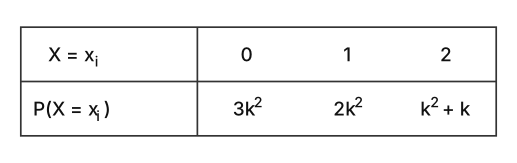
›Reveal solutionSolution
The key idea is to first find k using the fact that total probability equals 1, then compute the mean as ∑xiP(X=xi). The mean is 910, so the correct option is (C).
We are given a discrete probability distribution for X with values 0, 1, 2 and probabilities expressed in terms of k. To find the mean (expected value), we must first determine k from the condition that the sum of all probabilities is 1. Then we compute E[X]=∑xiP(X=xi).
- Set up the total probability condition. The probabilities must sum to 1:
3k2+2k2+(k2+k)=1
Simplify:
3k2+2k2+k2+k=6k2+k=1
So we have the quadratic equation:
6k2+k−1=0
- Solve for k. Factor or use the quadratic formula:
k=12−1±1+24=12−1±5
This gives two candidates:
k=124=31ork=12−6=−21
Since probabilities cannot be negative, we check:
- For k=−21, 3k2=3⋅41=43 (positive), 2k2=21 (positive), but k2+k=41−21=−41 — negative, which is impossible.
- For k=31, all probabilities are non-negative: 3⋅91=31, 2⋅91=92, 91+31=94. Sum = 31+92+94=1. Hence k=31 is the only valid value.
Watch outA common mistake is to forget that probabilities must be non-negative. Always check each probability after solving for k.
- Compute the mean E[X]. The mean is:
- TG EAPCET 2026Set eng-2026-05-11-FN1 markMCQQ.Let p be the number of ways of arranging 6 students such that 3 are around a circular table and the remaining 3 in a row. Let q be the number of ways of arranging 5 boys and 4 girls in a row such that no two boys and no two girls are together. Then pq= (A) 12 (B) 18 (C) 6 (D) 8
›Reveal solutionSolution
p=(36)⋅(3−1)!⋅3!=240 and q=5!⋅4!=2880, so pq=12 — option (A).
Compute p (arranging 6 students: 3 around a circle, 3 in a row).
From the 6 distinct students we first choose which 3 sit at the circular table: (36)=20 ways. Those 3 are arranged around the table in (3−1)!=2!=2 ways (a circular arrangement fixes one seat to remove rotational symmetry). The remaining 3 are arranged in a row in 3!=6 ways. Since the three steps are independent,
p=(36)⋅(3−1)!⋅3!=20×2×6=240.
Compute q (5 boys, 4 girls in a row, no two boys and no two girls adjacent).
"No two boys and no two girls together" forces a strictly alternating row. With 5 boys and 4 girls the only alternating pattern is …
- TG EAPCET 2026Set eng-2026-05-11-AN1 markMCQQ.1.61+6.111+11.161+… n terms = (A) 5n+1n (B) 5n+15 (C) 5n+15n (D) 5(5n+1)n
›Reveal solutionSolution
This sum telescopes after rewriting each term as a difference of fractions using the pattern of denominators. The sum simplifies to 5n+1n, which matches option (A).
We are summing a series of fractions whose denominators are products of numbers in an arithmetic progression:
1.6, 6.11, 11.16, …
Notice the first factor in each denominator increases by 5 each time: 1, 6, 11, 16, …
So the k-th term has denominator (5k−4)(5k+1).
The key idea: when a fraction has the form a⋅b1 where b−a is constant, we can rewrite it as b−a1(a1−b1). This creates a telescoping series — most terms cancel when summed.
- Identify the general term The k-th term (starting from k=1) is:
Tk=(5k−4)(5k+1)1
Check: k=1 gives 1⋅6, k=2 gives 6⋅11, etc.
- Decompose into partial fractions Since (5k+1)−(5k−4)=5, we have:
(5k−4)(5k+1)1=51(5k−41−5k+11)
This is the crucial step — it turns each term into a difference.
- Write the sum of n terms
Sn=∑k=1n(5k−4)(5k+1)1=51∑k=1n(5k−41−5k+11)
- Observe the telescoping Write out the first few terms: Sn=51[(11−61)+(61−111)+(111−161)+⋯+(5n−41−5n+11)] …
- TG EAPCET 2025Set eng-2025-05-02-AN1 markMCQQ.The constant term in the expansion of (1+x1)20(30x(1+x)29+(1+x)30) is (A) 50C20+30⋅50C29 (B) 50C19+30⋅49C19 (C) 50C20+30⋅49C20 (D) 50C20+30⋅49C19
›Reveal solutionSolution
The constant term equals 50C20+3049C19, option (D), obtained by Vandermonde convolution.
Write the product as (1+x1)20[30x(1+x)29+(1+x)30]. Since (1+x1)20=∑r(r20)x−r, the constant term picks the coefficient of xr from the second bracket for each r.
From (1+x)30: coefficient of xr is (r30), contributing
∑r(r20)(r30)=∑r(r20)(30−r30)=(3050)=(2050).
From 30x(1+x)29: coefficient of xr is 30(r−129). Using (r−129)=30r(r30) and r(r20)=20(r−119), …
- TG EAPCET 2024Set eng-2024-05-09-FN1 markMCQQ.The sum of all the 4-digit numbers formed by taking all the digits from 2, 3, 5, 7 without repetition, is (A) 331122 (B) 123312 (C) 113322 (D) 132132
›Reveal solutionSolution
The sum of all distinct 4-digit numbers formed from digits 2, 3, 5, 7 without repetition is found by noting each digit appears equally often in each place value; the total is 113322, which corresponds to option (C).
Concept and intuition
When we form all 4-digit numbers using each of the digits 2, 3, 5, 7 exactly once, we are essentially listing every permutation of these four digits. There are 4!=24 such numbers. Instead of writing them all out and adding, we use symmetry: each digit appears in the thousands place the same number of times, and similarly for hundreds, tens, and units. So we can compute the total sum by multiplying the sum of the digits by the place-value weight and the number of times each digit occupies that place.
Step-by-step reasoning
-
Count how many numbers and how often each digit appears in each position.
There are 4!=24 distinct 4-digit numbers. In any fixed position (say the thousands place), each of the four digits appears equally often. Since there are 24 numbers and 4 digits, each digit appears 24/4=6 times in each position.
-
Sum of contributions from one place value.
The sum of the digits is 2+3+5+7=17. In a given position, each digit appears 6 times, so the total sum contributed by that position (ignoring place value) is 6×17=102.
-
Apply place values.
- Thousands place: each digit’s contribution is multiplied by 1000. So total from thousands = 102×1000=102000.
- Hundreds place: multiply by 100 → 102×100=10200.
- Tens place: multiply by 10 → 102×10=1020.
- Units place: multiply by 1 → 102×1=102.
-
Add all contributions.
102000+10200+1020+102=113322 …
-
- TG EAPCET 2023Set eng-2023-05-12-AN1 markMCQQ.If (1+x)n=C0+C1x+C2x2+…+Cnxn for n∈N, then C0+2C1+3C2+…+n+1Cn= (A) n+12n−1 (B) n2n−1 (C) n+12n+1−1 (D) n2n+1−1
›Reveal solutionSolution
Integrating (1+x)n=∑Ckxk over [0,1] gives C0+2C1+⋯+n+1Cn=n+12n+1−1.
Concept — evaluating binomial sums by integration. When each coefficient Ck is divided by k+1, the sum is produced by integrating the expansion term by term, since ∫01xkdx=k+11.
Step 1 — integrate both sides of the expansion.
∫01(1+x)ndx=∫01(C0+C1x+C2x2+⋯+Cnxn)dx
Step 2 — right side (term by term).
C0+2C1+3C2+⋯+n+1Cn
Step 3 — left side. …
- TG EAPCET 2023Set eng-2023-05-13-FN1 markMCQQ.Let c0,c1,c2,…,cn be the binomial coefficients in the expansion of (1+x)n. If Sn+1=5.c0+8.c1+11.c2+… (n + 1) terms, then S11= (A) 18944 (B) 17920 (C) 20480 (D) 40960
›Reveal solutionSolution
Writing the coefficients as 5+3k gives Sn+1=2n−1(3n+10), so S11=29⋅40=20480 (option C).
The multipliers 5,8,11,… are 5+3k for k=0,1,…,n, so
Sn+1=∑k=0n(5+3k)ck=5∑k=0nck+3∑k=0nkck.
Using the standard sums for (1+x)n:
∑k=0nck=2n,∑k=0nkck=n2n−1,
we get …
- TG EAPCET 2023Set eng-2023-05-12-FN1 markMCQQ.If the term independent of x in the expansion of (x−x2k)10 is 405, then k= (A) ±1 (B) 0 (C) ±3 (D) ±5
›Reveal solutionSolution
The term independent of x occurs when the powers of x cancel. Using the binomial theorem, we find k2=9, so k=±3, which corresponds to option (C).
We are asked: for what value(s) of k does the constant term (independent of x) in the expansion of (x−x2k)10 equal 405? The key is to recall that in a binomial expansion, each term has a specific power of x, and we want the one where that power is zero.
Concept and intuition:
The binomial theorem tells us that
(a+b)n=∑r=0n(rn)an−rbr.
Here a=x=x1/2 and b=−x2k=−kx−2. So the general term is
Tr=(r10)(x1/2)10−r⋅(−kx−2)r.
The exponent of x in Tr is 21(10−r)−2r. We set this equal to 0 to find the term independent of x. Then we equate that term’s coefficient to 405 and solve for k.
Step-by-step solution:
- Write the general term
Tr+1=(r10)(x1/2)10−r(−x2k)r=(r10)x210−r⋅(−k)rx−2r.
- Combine the powers of x
x210−r−2r=x210−r−4r=x210−5r.
- Set the exponent to zero (for the term independent of x)
210−5r=0⇒10−5r=0⇒r=2.
- Find the term for r=2 T3=(210)x0⋅(−k)2=(210)k2. …
- TG EAPCET 2023Set eng-2023-05-14-AN1 markMCQQ.The term independent of x in the expansion of (1−3x+2x3)(23x2−3x1)9 is (A) 187 (B) 185 (C) 5419 (D) 5417
›Reveal solutionSolution
The key idea is to expand the second factor using the binomial theorem, then multiply by the first factor and collect terms where the total exponent of x is zero. The constant term is 5417, so the correct option is (D).
We need the term independent of x in
(1−3x+2x3)(23x2−3x1)9.
The second factor is a binomial with a fractional coefficient and a negative power of x. The constant term will come from multiplying each term of the first factor by a term from the expansion of the second factor such that the total power of x cancels.
1. Expand the second factor using the binomial theorem
Let
A=23x2,B=−3x1.
Then
(A+B)9=∑r=09(r9)A9−rBr.
Substitute back:
A9−r=(23x2)9−r=29−r39−rx2(9−r),
Br=(−3x1)r=(−1)r3r1x−r.
So the general term is
Tr=(r9)29−r39−r(−1)r3r1x2(9−r)−r.
Simplify the coefficient:
3r39−r=39−2r,
so
Tr=(r9)(−1)r29−r39−2rx18−3r.
Thus the exponent of x in Tr is 18−3r.
2. Multiply by each term of the first factor
The first factor is 1−3x+2x3. We multiply each term by Tr and look for total exponent zero.
- From 1⋅Tr: exponent is 18−3r. Set 18−3r=0⇒r=6. Term:
(69)(−1)629−639−12=(39)⋅1⋅233−3.
(39)=84, 3−3=271, 23=8. So this term is
84⋅27⋅81=21684=187.
-
From (−3x)⋅Tr: exponent is 1+(18−3r)=19−3r. Set 19−3r=0⇒r=19/3, not an integer → no contribution.
-
From (2x3)⋅Tr: exponent is 3+(18−3r)=21−3r. Set 21−3r=0⇒r=7.
Term:
2⋅(79)(−1)729−739−14. …
- TG EAPCET 2023Set eng-2023-05-14-FN1 markMCQQ.If i=−1 then ∑n=0∞(3i)n (A) 109−3i (B) 9−3i (C) 9+3i (D) 109+3i
›Reveal solutionSolution
This is a geometric series with ratio i/3; its sum is 1−i/31=109+3i, which matches option (D).
The key idea is recognizing that the infinite sum ∑n=0∞rn converges to 1−r1 when ∣r∣<1. Here r=3i, and ∣i/3∣=1/3<1, so the formula applies directly. The only twist is simplifying the complex fraction to match one of the given choices.
-
Identify the series type
The sum is ∑n=0∞(3i)n. This is a geometric series with first term 1 (when n=0) and common ratio r=3i.
-
Check convergence
The magnitude of the ratio is ∣r∣=3i=31<1, so the series converges absolutely.
-
Apply the geometric series formula
For ∣r∣<1,
∑n=0∞rn=1−r1.
Substituting r=3i:
∑n=0∞(3i)n=1−3i1.
- Simplify the complex fraction Multiply numerator and denominator by the conjugate of the denominator (or simply by 3):
1−3i1=33−i1=3−i3.
Now rationalize by multiplying numerator and denominator by 3+i:
-
- TG EAPCET 2021Set eng-2021-08-04-AN1 markMCQQ.The number of ways of selecting a committee of 30 persons from 20 boys, 20 girls and 20 teachers such that the participation of number of boys, girls and teachers in that committee is equal, is (A) (20!)(20!)(20!) (B) 60C30 (C) (10!)6(20!)3 (D) 10! 10!(20!)(20!)
›Reveal solutionSolution
The key idea is that equal participation means exactly 10 from each group, so the answer is the product of three independent selections: (1020)3, which simplifies to (10!)6(20!)3 — option (C).
The problem asks for a committee of 30 persons from three groups — 20 boys, 20 girls, 20 teachers — with the condition that the number from each group is equal. That means the committee must have the same count of boys, girls, and teachers. Since 30 divided equally among three groups gives 10 each, the committee must consist of exactly 10 boys, 10 girls, and 10 teachers.
The selection from each group is independent of the others. For the boys, we choose 10 out of 20; for the girls, 10 out of 20; for the teachers, 10 out of 20. The total number of ways is the product of these three independent choices.
-
Number of ways to choose 10 boys from 20:
This is (1020)=10!10!20!.
-
Number of ways to choose 10 girls from 20:
Similarly, (1020)=10!10!20!.
-
Number of ways to choose 10 teachers from 20:
Again, (1020)=10!10!20!.
Since the selections are independent, multiply them:
Total ways=(1020)×(1020)×(1020)=(10!10!20!)3=(10!)6(20!)3. …
-
- TG EAPCET 2021Set eng-2021-08-04-AN1 markMCQQ.In the expansion of (1+23x)−5, the coefficient of x10 is equal to the coefficient of x10 in (1+ax)n,n∈N, then na= (A) 15 (B) 18 (C) 24 (D) 21
›Reveal solutionSolution
The key idea is to expand the given binomial with a negative integer exponent using the general binomial theorem, match the coefficient of x10 to the form (1+ax)n, and then compute na. The final value is 21.
The problem asks us to compare the coefficient of x10 in two expansions. The first is (1+23x)−5, which is a binomial with a negative integer exponent. The second is (1+ax)n, where n is a natural number — a standard positive integer exponent. The condition says these coefficients are equal, and we need na.
The core concept here is the general binomial theorem. For a positive integer exponent n, we have the familiar expansion:
(1+ax)n=∑r=0n(rn)(ax)r
But for a negative integer exponent, say (1+u)−m where m is a positive integer, the expansion is an infinite series:
(1+u)−m=∑r=0∞(r−m)ur
where the binomial coefficient for a negative integer is defined as:
(r−m)=r!(−m)(−m−1)(−m−2)⋯(−m−r+1)=(−1)r(rm+r−1)
This last form is crucial — it turns the negative sign into a manageable expression.
Let’s work through it step by step.
- Expand the given expression. We have (1+23x)−5. Here u=23x and m=5. The general term in the expansion is:
Tr=(r−5)(23x)r
Using the formula (r−5)=(−1)r(r5+r−1)=(−1)r(rr+4), we get:
Tr=(−1)r(rr+4)(23)rxr
- Extract the coefficient of x10. For x10, set r=10. The coefficient is:
C1=(−1)10(1010+4)(23)10=(1014)(23)10
Since (1014)=(414)=4⋅3⋅2⋅114⋅13⋅12⋅11=1001, we have:
C1=1001⋅(23)10
- Now consider the second expansion. For (1+ax)n with n∈N, the coefficient of x10 comes from the term where r=10 (provided n≥10, otherwise the coefficient is zero — but since it must equal a non-zero coefficient, n≥10). The coefficient is:
C2=(10n)a10
- Set the coefficients equal. The problem states C1=C2, so:
1001⋅(23)10=(10n)a10
This is one equation in two unknowns (n and a), but we are not asked for them individually — only na. We need to find a way to match the structure.
- Match the form cleverly. Notice that (10n)a10 can be written as (10(10n)⋅a)10. But a more elegant approach: the coefficient in the first expansion came from a binomial with exponent −5, which suggests that the second expansion might be related by choosing n and a such that the binomial coefficient and the power of a combine to give the same numeric factor. …
🎓Unlock everything free for 14 days
- ✓Full step-by-step solutions
- ✓Concept-first explanations
- ✓Methods, shortcuts & mistakes
- ✓PYQ mapping + timed mock tests
Full access for 14 days. No credit card required.