Physics · Ch 12 — Dual Nature of Radiation and Matter
Experimental Study of Photoelectric Effect
Experimental Study of Photoelectric Effect
The Experimental Setup
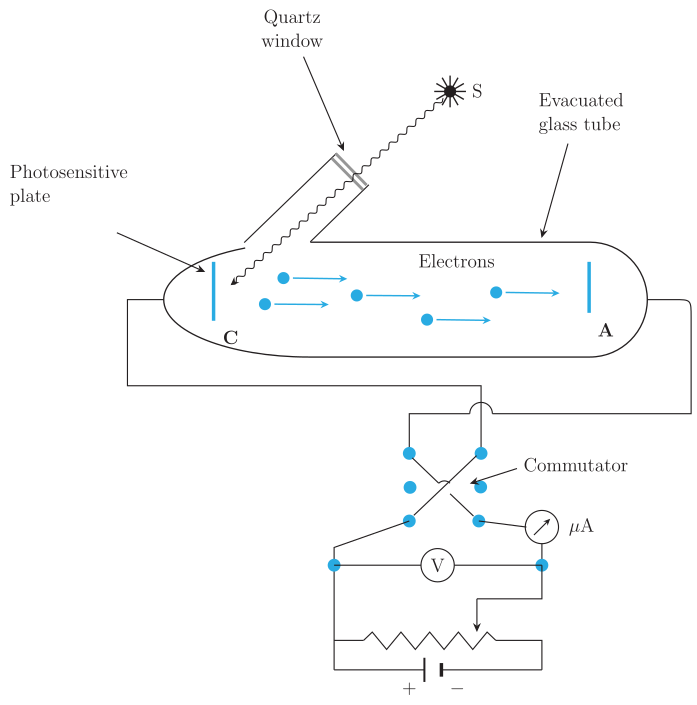
The photoelectric effect is studied using an evacuated glass or quartz tube containing two metal plates: a photosensitive plate C (the emitter) and another metal plate A (the collector). A quartz window is sealed onto the tube because quartz transmits ultraviolet radiation, which ordinary glass does not. Monochromatic light from a source S passes through this window and falls on plate C, causing electrons to be emitted.
A battery maintains a potential difference between C and A, which can be varied. A commutator allows the polarity of the plates to be reversed — so plate A can be made either positive or negative with respect to C. When A is positive, electrons emitted from C are attracted to it, and a current flows in the external circuit. The potential difference is measured by a voltmeter (V), and the resulting photocurrent is measured by a microammeter (mA).
The experiment allows us to vary three things independently:
- The intensity of the incident light (by changing the distance of the source from the emitter)
- The frequency of the incident light (by inserting coloured filters or coloured glass in the path)
- The potential difference V between the emitter C and collector A
We can also change the material of plate C to study its effect.
Variation of Photocurrent with Intensity of Radiation
When the collector plate A is kept at a fixed positive potential with respect to C, and the frequency of incident light is held constant, the photocurrent is found to be directly proportional to the intensity of the incident radiation.
For a fixed frequency and fixed accelerating potential, photocurrent intensity of incident radiation.
This means that if you double the intensity, the photocurrent doubles. The reason is straightforward: intensity is proportional to the number of photons per second falling on the surface. More photons mean more electrons are ejected per second, and since each ejected electron contributes to the current, the current increases proportionally.
Variation of Photocurrent with Potential Difference — The Stopping Potential
The experiment studies how the photocurrent changes as the potential of collector A is varied with respect to emitter C. The key observations are:
-
For a fixed frequency and fixed intensity, as the collector potential is made more and more positive, the photocurrent increases and eventually reaches a saturation value. At saturation, all emitted electrons are being collected — increasing the voltage further does not increase the current.
-
If the collector potential is made negative (i.e., A is at a lower potential than C), the electrons are repelled. Only those electrons with enough kinetic energy to overcome this retarding potential can reach A. As the negative potential is increased in magnitude, fewer electrons reach A, and the photocurrent decreases.
-
At a particular negative potential, the photocurrent becomes zero. This potential is called the stopping potential .
Here is the electronic charge and is the maximum kinetic energy of the emitted photoelectrons. The stopping potential is the minimum retarding potential that just stops the most energetic photoelectrons from reaching the collector.
The stopping potential does not depend on the intensity of incident light. If you increase the intensity, the saturation current increases, but the stopping potential remains unchanged for a given frequency.
Variation of Stopping Potential with Frequency
This is the most crucial experimental result. When the frequency of incident light is varied (keeping the cathode material fixed), the stopping potential changes. The experiment reveals:
- increases linearly with frequency .
- Below a certain threshold frequency , no photoelectrons are emitted at all, no matter how high the intensity.
This is a straight line of slope and intercept on the -axis. The slope is the same for all materials, but the intercept (and hence the threshold frequency) depends on the material.
Effect of Intensity on Stopping Potential
A critical experimental finding: the stopping potential is independent of the intensity of radiation. If you increase the intensity at a fixed frequency, the saturation current increases, but the stopping potential does not change.
This directly contradicts the classical wave theory of light, which would predict that greater intensity (greater wave amplitude) should give electrons more energy, and hence a larger stopping potential. The experimental fact that depends only on frequency, not intensity, was one of the key puzzles that led to Einstein's photon model.
Effect of Material — The Threshold Frequency
Different photosensitive materials have different threshold frequencies . For a given material, no photoelectric emission occurs if the incident frequency is below , regardless of intensity. The threshold frequency is a characteristic property of the material.
| Material | Threshold frequency (approx.) |
|----------|-----------------------------------|
| Cesium | Hz |
| Sodium | Hz |
| Zinc | Hz |
| Nickel | Hz |
The work function is the minimum energy required to eject an electron from that material.
--- …
Drawn by us to help you understand the concept clearly, and verified to make sure it's accurate. For exams, practice from your textbook's own diagram.
The experimental setup for the photoelectric effect is a beautifully simple way to probe the particle nature of light. The figure shows an evacuated glass or quartz tube containing two metal plates facing each other: plate C (the emitter) and plate A (the collector). A quartz window W is sealed into the tube so that ultraviolet light from a source S can pass through and strike plate C without being absorbed by ordinary glass.
When light of sufficiently short wavelength hits the photosensitive emitter C, electrons are ejected from its surface. These electrons are then drawn across the gap to the collector plate A by an electric field. The field is created by a battery connected in an external circuit, and its strength — and even its direction — can be controlled. A commutator allows the polarity of plates C and A to be reversed, so that A can be made either positive or negative with respect to C. A voltmeter (V) measures the potential difference between the plates, and a microammeter (µA) measures the tiny photocurrent flowing in the circuit.
The key physical idea is that by varying the potential difference, the intensity of the incident light, and its frequency, we can extract the fundamental laws of the photoelectric effect. For instance, when A is positive relative to C, electrons are attracted to it and a current flows. As we make A less positive, the current decreases — but it does not drop to zero at zero potential difference. A small current persists even when A is slightly negative, because the most energetic electrons can still overcome a small retarding field. Only when the retarding potential reaches a certain value does the current stop completely. That value is called the stopping potential .
The stopping potential is the minimum negative potential (with respect to the emitter) that must be applied to the collector to reduce the photocurrent to zero. It is a direct measure of the maximum kinetic energy of the emitted electrons.
The central formula that emerges from this experiment is Einstein’s photoelectric equation:
where:
- is the maximum kinetic energy of the emitted electrons,
- is Planck’s constant (),
- is the frequency of the incident light,
- is the work function of the emitter material (the minimum energy needed to remove an electron from its surface).
Since the stopping potential is related to by (where is the electron charge), the equation can also be written as:
This is the equation that the experimental arrangement in Fig. 11.1 is designed to verify. By measuring for different frequencies of incident light, one obtains a straight line when is plotted against . The slope of that line gives , from which Planck’s constant can be determined. The intercept on the frequency axis gives the threshold frequency , below which no photoelectrons are emitted regardless of intensity. …