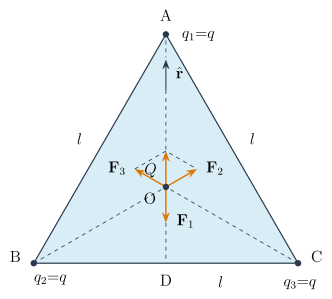
Q.Consider three charges q1, q2, q3 each equal to q at the vertices of an equilateral triangle of side l. What is the force on a charge Q (with the same sign as q) placed at the centroid of the triangle?
Concept understanding — Coulomb Force Superposition
Coulomb Force Superposition – From Intuition to Precision
Imagine you're in a room with three friends. Each friend can push or pull you. If two friends push you from the same side, you feel a stronger push — the combined effect. If one pushes from the left and another from the right, you feel the net effect, which might be smaller or even zero if they push equally hard.
This is exactly how electric forces work. When multiple charged particles are present, each one exerts its own force on a given charge. The total force that charge feels is simply the vector sum of all the individual forces — as if each other charge were acting alone, completely ignoring the presence of the rest.
That's the core idea: forces add like arrows, not like numbers.
The Precise Statement
Fnet on q0=∑i=1nFi→0=4πε01∑i=1nri02q0qir^i0
Where:
- q0 is the charge you're calculating the force on
- qi are all other charges (excluding q0 itself)
- ri0 is the distance between qi and q0
- r^i0 is a unit vector pointing from qi to q0 (or away, depending on sign convention — be consistent)
The key point: Each pair of charges interacts independently. The presence of a third charge does not alter the force between the first two. This is what "superposition" means — the forces simply layer on top of each other.
Why This Matters (and a Common Trap)
Never add the magnitudes of forces directly unless all forces are along the same line and in the same direction. Force is a vector — direction matters.
If two forces point in opposite directions, they partially cancel. If they're at right angles, the net force is found using the Pythagorean theorem, not simple addition.
Example: Three charges on a line:
- q1=+2μC at x=0
- q2=−1μC at x=3cm
- q0=+1μC at x=1cm
Step 1: Force from q1 on q0 — both positive, so repulsive. q0 is pushed to the right.
Step 2: Force from q2 on q0 — opposite signs, so attractive. q0 is pulled to the right (toward q2).
Step 3: Both forces point right. Now you add magnitudes: Fnet=F1→0+F2→0.
If q2 were also positive, the force from q2 would push q0 left, and you'd subtract.
The Deeper Reason
Coulomb's law is a linear law — the force is proportional to each charge individually. If you double q1, the force from q1 doubles, but the force from q2 stays the same. This linearity is what makes superposition possible. It's not a coincidence — it's a fundamental property of electromagnetic interactions at the classical level.
Superposition works because electric forces obey a linear inverse-square law. If the force depended on products of three charges (like q0q1q2), superposition would fail. It doesn't — and that's why we can break down any multi-charge problem into a series of two-charge calculations.
How to Use It in Exams
- Draw all charges and label distances.
- For each other charge, sketch the direction of the force on your target charge (like charges repel, opposites attract).
- Write the magnitude of each force using Coulomb's law.
- Resolve into components if forces aren't along the same line.
- Add components separately: Fnet,x=∑Fi,x, same for y, z.
- Combine components to get the net force vector.
In symmetric arrangements (e.g., an equilateral triangle with equal charges), many components cancel. Always check for symmetry before diving into heavy algebra — it can save you minutes.
One Last Check
If you place a test charge q0 at a point and there are 10 other charges around it, you calculate 10 separate Coulomb forces and add them as vectors. That's it. No extra physics, no hidden interactions. The universe, at this level, is beautifully simple: each pair talks only to each other, and you just listen to all the conversations at once.
"Coulomb's law superposition principle examples" and "electrostatics class 12 physics important questions" are frequently searched, both grounded in the Electrostatics chapter of the NCERT/CBSE Class 12 Physics curriculum. Multi-charge force problems using superposition are a near-guaranteed topic in JEE Main and NEET.
Why this formula?
Coulomb Force Superposition — Why the Formula Holds
The principle of superposition for Coulomb forces states that the net electrostatic force on a given charge due to a collection of other charges is the vector sum of the individual forces from each charge, as if the others were absent.
The Key Formula
If we have a charge q0 at position r0, and N other point charges q1,q2,…,qN at positions r1,r2,…,rN, the net force on q0 is:
Fnet=4πε01∑i=1N∣r0−ri∣2q0qir^0i
where r^0i is the unit vector pointing from qi to q0.
Why This Works — The Physical Reasoning
1. Coulomb's Law is a Two-Body Interaction
Coulomb's law describes the force between exactly two point charges. It depends only on:
- The product of their charges (q0qi)
- The inverse square of the distance between them
- The direction along the line joining them
Crucially, the force between q0 and qi does not depend on the presence of any other charges qj.
2. Forces Add as Vectors (Newton's Third Law + Linearity)
Electrostatic forces are real physical forces — they obey Newton's laws. If multiple forces act on the same charge, the net effect is the vector sum of each individual force. This is a fundamental property of forces in classical mechanics.
3. The Electric Field is Linear
A deeper reason: the electric field E obeys superposition. Since F=q0E, and E from multiple sources adds linearly, the force automatically adds linearly.
The electric field at r0 due to qi is:
Ei(r0)=4πε01∣r0−ri∣2qir^0i
Then:
Fnet=q0∑iEi=∑iFi
The Crucial Assumption (Why It's Not Trivial)
Superposition holds because Maxwell's equations are linear in the electric field. If the equations were nonlinear (e.g., if the field depended on E2), then the force from two charges together would not be the sum of the individual forces.
In electrostatics, the electric field satisfies:
∇⋅E=ε0ρ,∇×E=0
Both equations are linear — if E1 and E2 are solutions, then E1+E2 is also a solution. This linearity is the mathematical reason superposition works.
Exam-Relevant Takeaway
| Concept | Why It Holds |
|---|---|
| Superposition of forces | Coulomb force is a two-body interaction; forces add as vectors |
| Superposition of fields | Maxwell's equations are linear in E |
| Net force formula | Fnet=∑Fi — vector sum of individual Coulomb forces |
Never forget: The unit vector r^0i points from the source charge to the test charge — this determines the correct direction of each term.
Quick Example (To Cement the "Why")
Suppose q0=+1μC at the origin, q1=+2μC at (1,0), q2=−2μC at (0,1).
- Force from q1: repulsive, along +x direction
- Force from q2: attractive, along +y direction
The net force is not just the sum of magnitudes — it's the vector sum:
Fnet=F1x^+F2y^
This works because the two forces are independent — q1 doesn't "know" about q2, and vice versa. The superposition principle is simply the statement that this independence holds.
Concept: Coulomb Force Superposition — the net force on Q is the vector sum of three individual repulsive forces from q1,q2,q3.
- Each side of the equilateral triangle is l. The distance from a vertex to the centroid is 3l. So each repulsive force has magnitude:
F=4πε01(l/3)2qQ=4πε03l2qQ
-
The three forces lie along the medians, pointing away from the vertices. At the centroid, the medians are separated by 120∘.
-
Three vectors of equal magnitude, spaced 120∘ apart, sum to zero. This is true regardless of the sign of Q and q (as long as they are the same sign, all forces are either all repulsive or all attractive).
The net force on Q is 0.
The three equal repulsive forces on Q from the three vertices are equal in magnitude and spaced 120∘ apart, so their vector sum is zero. The net force on Q is 0.
The key idea is Coulomb’s law with superposition. Each vertex charge q exerts a repulsive force on Q (since both have the same sign). Because the triangle is equilateral, the centroid is equidistant from all three vertices, so each force has the same magnitude. And because the three vertices are symmetrically placed around the centroid, the three force vectors point along the medians, 120∘ apart. When three equal vectors are arranged at 120∘ intervals, they cancel exactly.
Let’s work through it step by step.
- Distance from centroid to each vertex. In an equilateral triangle of side l, the centroid is also the circumcenter. The distance from the centroid to any vertex is the circumradius:
R=3l.
(Derivation: the altitude is 23l, and the centroid divides each median in the ratio 2:1, so the distance from centroid to vertex is 32 of the altitude: 32⋅23l=3l.)
- Magnitude of each force. By Coulomb’s law, the force on Q due to a single vertex charge q is
F=4πε01R2∣qQ∣=4πε01(l/3)2qQ=4πε01l23qQ.
Since q and Q have the same sign, the force is repulsive — it points directly away from that vertex.
-
Direction of each force.
The centroid lies at the intersection of the medians. The line from a vertex to the centroid is exactly along the median. So the force from vertex A points from O away from A (straight down in the textbook figure), from B away from B (up-right), and from C away from C (up-left). These three directions are separated by 120∘.
-
Vector addition.
Place the three force vectors tail-to-tail at O. They have equal magnitude F and are spaced 120∘ apart. Their resultant is zero.
TipA quick way to see this: the sum of three equal vectors at 120∘ is zero because they form the sides of an equilateral triangle when placed head-to-tail. Alternatively, resolve each into components: the horizontal components cancel pairwise, and the vertical components also sum to zero.
Explicitly, take the direction from O toward A as the negative y-axis. Then:
- FA=−Fj^
- FB=Fsin60∘i^+Fcos60∘j^=23Fi^+21Fj^
- FC=−Fsin60∘i^+Fcos60∘j^=−23Fi^+21Fj^
Adding:
Fnet=(23F−23F)i^+(−F+21F+21F)j^=0i^+0j^=0.
A common mistake is to think the forces cancel only if Q is at the center of the triangle — but that’s exactly the centroid. Another pitfall: forgetting that the forces are repulsive and pointing away from the vertices, not toward them. If you mistakenly draw them pointing inward, they’d add to a nonzero resultant.
The net force on Q is zero: 0.
Instead of resolving each force into components, use a pure symmetry argument: the charge configuration is unchanged by a 120∘ rotation about the centroid, so the net force there must be too — and the only vector unchanged by a 120∘ rotation is the zero vector. Net force =0.
Method: Rotational-Symmetry Argument
This problem can be solved without computing a single force magnitude, just by reasoning about symmetry — often faster and less error-prone than vector addition.
-
Set up the symmetry.
The three charges q1=q2=q3=q sit at the vertices of an equilateral triangle, with Q at the centroid. Rotate the entire triangle by 120∘ about the centroid: vertex 1 moves to where vertex 2 was, vertex 2 to where vertex 3 was, and vertex 3 to where vertex 1 was.
-
Observe that the configuration looks identical after rotation.
Because all three vertex charges are equal (q1=q2=q3=q), swapping their positions this way leaves the physical charge distribution completely unchanged. An observer at the centroid cannot tell the triangle was rotated.
-
The force on Q must obey the same symmetry.
Since the source charges look identical before and after the rotation, the electric force they produce on Q (sitting exactly at the centroid, the rotation axis) must also look identical before and after — i.e., the net force vector F must map onto itself when rotated by 120∘.
-
Ask what vectors are invariant under a 120∘ rotation.
Rotating any nonzero vector by 120∘ always produces a different vector (pointing in a different direction) — 120∘ is neither 0∘ nor a multiple of 360∘. The only vector that is unchanged by such a rotation is the zero vector.
-
Conclude.
Therefore F must equal the zero vector:
Fnet on Q=0
This symmetry method generalizes well: for any n equal charges arranged symmetrically (n≥3) around a central point, the net force or field at the center is zero by the same rotational argument — no need to redo the component algebra for a square, pentagon, or hexagon of equal charges.
The net force on Q is 0.
Here are the most common mistakes students make when solving this classic Coulomb force superposition problem, along with how to avoid each.
1. Forgetting the Vector Nature of Force
The Mistake:
Students often compute the magnitude of the force from each q on Q correctly, but then simply add them as scalars (e.g., Fnet=F1+F2+F3).
Why it’s wrong:
Coulomb force is a vector. Forces from different charges point in different directions. Adding magnitudes directly ignores direction and gives an incorrect (usually larger) result.
How to Avoid:
Always draw a clear diagram showing the direction of each force vector. Use vector addition (component method or symmetry) — never scalar addition.
2. Not Using Symmetry to Simplify
The Mistake:
Students calculate all three force vectors explicitly, resolve into components, and sum — a long, error-prone process.
Why it’s wrong:
It wastes time and increases the chance of algebraic mistakes. The problem has perfect symmetry.
How to Avoid:
Recognize that the three charges are identical and placed at vertices of an equilateral triangle. The centroid is equidistant from all vertices. By symmetry, the three force vectors are equal in magnitude and spaced 120∘ apart. Their vector sum is zero.
Key result: The net force on Q at the centroid is Fnet=0.
3. Incorrect Distance Calculation
The Mistake:
Using l (side length) as the distance between a vertex charge and the centroid.
Why it’s wrong:
The distance from a vertex to the centroid of an equilateral triangle is not l. It is 3l.
How to Avoid:
Memorize or derive:
- Centroid divides the median in ratio 2:1.
- Median length =23l.
- Distance from vertex to centroid =32×median=32⋅23l=3l.
Use r=3l in Coulomb’s law.
4. Sign Confusion in Force Direction
The Mistake:
If Q and q have the same sign, students sometimes draw forces as attractive.
Why it’s wrong:
Like charges repel. All three forces on Q are repulsive and point radially outward from each vertex.
How to Avoid:
Always check: same sign → repulsion (force away from the other charge). Opposite sign → attraction (force toward the other charge). Draw arrows accordingly.
5. Assuming the Net Force is Non-Zero Without Checking
The Mistake:
After computing magnitudes, students assume the forces don’t cancel and proceed to find a non-zero resultant.
Why it’s wrong:
Symmetry guarantees cancellation. The three equal-magnitude vectors at 120∘ to each other always sum to zero.
How to Avoid:
Before doing heavy algebra, pause and check for symmetry. If the configuration is symmetric and all charges are identical, the net force at the center is zero.
Quick Summary Checklist
| Mistake | How to Avoid |
|---|---|
| Scalar addition of forces | Always use vector addition |
| Ignoring symmetry | Use symmetry to simplify first |
| Wrong distance (l instead of l/3) | Derive or memorize centroid distance |
| Wrong force direction (attraction instead of repulsion) | Same sign → repulsion |
| Assuming net force is non-zero | Check symmetry — here it’s zero |
Final takeaway: For this exact problem, the answer is zero — but only if you handle vectors, distances, and directions correctly.
Showing the 12 most recent of 31 on this concept.
- TG EAPCET 2026Set eng-2026-05-09-FN1 markMCQQ.The shift (in metre) in center of mass when the largest possible equilateral triangular plate is removed from a uniform square plate of side 2 m with one of their sides coinciding is (A) 3−23−4 (B) (4−3)(3−1) (C) 4−32−3 (D) 3−43−1
›Reveal solutionSolution
Removing the equilateral triangle (area 3) from the square (area 4) shifts the CM by 4−33−1 m.
The largest equilateral triangle whose base coincides with a side of the square has side =2 m (its height 3≈1.732<2, so it fits). Take the square as [0,2]×[0,2] with the coinciding side along y=0; the triangle has apex at (1,3).
Treat area as mass (σ=1):
- Square: M1=4, centre y1=1.
- Triangle: M2=43(2)2=3, centroid y2=33.
By symmetry the CM stays at x=1; the y-coordinate of the remaining plate:
ycm=M1−M2M1y1−M2y2=4−34(1)−3⋅33=4−34−1=4−33.
Shift from the original centre (y=1):
Δy=4−33−1=4−33−(4−3)=4−33−1 m.
✓Final answerShift =4−33−1 m — option (B).
- TG EAPCET 2026Set eng-2026-05-09-FN1 markMCQQ.In an isosceles right angled triangle ABC, the length of the two equal sides AB and AC is 10 cm. If three charges +5 μC, +20 μC and +20 μC are placed at the three vertices A, B and C of the triangle respectively, then the net electrostatic force acting on a particle of charge +2 μC placed at the midpoint of the hypotenuse BC is (A) 24 N (B) 9 N (C) 36 N (D) 18 N
›Reveal solutionSolution
The net force on the +2 μC charge at the midpoint of BC is the vector sum of the repulsive forces from A, B, and C. Due to symmetry, the forces from B and C cancel in the horizontal direction and add vertically, while the force from A points directly away from A. The result is 18 N, corresponding to option (D).
Concept and Intuition
The problem is a classic application of Coulomb’s law and vector addition. The key insight is that the midpoint of the hypotenuse in an isosceles right triangle is equidistant from B and C, and also has a special geometric relationship with vertex A. Because charges at B and C are equal (+20 μC each), the forces they exert on the test charge are symmetric. This symmetry simplifies the vector sum: the horizontal components cancel, and the vertical components add. The force from A is purely along the line from A to the midpoint. Adding these contributions gives the net force.
Step-by-step solution
- Set up coordinates and distances Place the triangle with right angle at A. Let A = (0,0), B = (10,0) cm, C = (0,10) cm. The hypotenuse BC runs from (10,0) to (0,10). Its midpoint M is at
M=(210+0,20+10)=(5,5) cm.
Distances:
- From A to M: AM=52+52=52 cm=0.052 m.
- From B to M: BM=(10−5)2+(0−5)2=25+25=52 cm=0.052 m.
- Similarly, CM=52 cm. So all three distances are equal: r=0.052 m.
- Compute individual forces using Coulomb’s law
Coulomb’s law: F=kr2∣q1q2∣, with k=9×10⁹ N m2/C2.
- Force from A:
FA=9×109×(0.052)2(5×10⁻⁶)(2×10⁻⁶)=9×109×0.00510×10−12=9×109×2×10−9=18 N.
- Force from B:
FB=9×109×(0.052)2(20×10−6)(2×10⁻⁶)=9×109×0.00540×10−12=9×109×8×10−9=72 N.
- Force from C is identical: FC=72 N.
-
Determine directions
All charges are positive, so forces are repulsive.
- FA points from M away from A. Vector from A to M is (5,5), so direction is along the line y=x away from origin. Unit vector: u^A=(21,21).
- FB points from M away from B. B is at (10,0), M at (5,5), so vector from B to M is (-5,5). Direction from M away from B is opposite: (5,-5). Unit vector: u^B=(21,−21).
- FC points from M away from C. C is at (0,10), M at (5,5), so vector from C to M is (5,-5). Direction away from C is (-5,5). Unit vector: u^C=(−21,21).
-
Vector addition
Write components:
FA=18(21,21)=(218,218)
FB=72(21,−21)=(272,−272)
FC=72(−21,21)=(−272,272)
Sum x-components:
218+272−272=218
Sum y-components:
218−272+272=218
So net force vector:
Fnet=(218,218)
Magnitude:
∣Fnet∣=(218)2+(218)2=2324+2324=324=18 N.
TipNotice that the forces from B and C exactly cancel in the horizontal direction and add to zero in the vertical direction? Actually they cancel horizontally but their vertical components are opposite — wait, check: FB has y-component −72/2, FC has +72/2, so they cancel vertically too! The only remaining contribution is from A, but A’s force is 18 N along the diagonal. So the net is exactly 18 N. This is a neat shortcut: the symmetric pair cancels completely, leaving only the force from A.
Watch outA common mistake is to forget that the distance from A to M is not 5 cm but 52 cm. Using 5 cm would give a much larger force. Always double-check geometry.
✓Final answerThe correct option is (D).
ANSWER: D
- TG EAPCET 2026Set eng-2026-05-10-FN1 markMCQQ.Four particles P, Q, R and S of masses m, m, m and 2m respectively are kept at the four corners of a square of side 2 m. The distance of centre of mass of the system of particles from the particle S is (A) 1.2 m (B) 0.8 m (C) 0.6 m (D) 0.4 m
›Reveal solutionSolution
Place the square in a coordinate system, compute the centre of mass using the weighted average of positions, then find its distance from the corner where S (mass 2m) sits. The answer is 0.4 m.
The centre of mass of a system of particles is the point where the entire mass can be thought to be concentrated for translational motion. It is found by taking a weighted average of the positions, with each mass as the weight. For a discrete set, the formula is:
RCM=∑mi∑miri
Here we have four particles at the corners of a square. The trick is to choose a convenient coordinate system so that the arithmetic is clean. Since the side length is 2 m, placing the square with its sides parallel to the axes makes the coordinates simple.
-
Set up coordinates. Let the square have side 2 m. Place corner S at the origin (0,0). Then the other corners can be placed as:
- P at (2,0)
- Q at (2,2)
- R at (0,2)
- S at (0,0)
This is a square of side 2 m, as required.
-
List masses and positions.
- P: mass m, position (2,0)
- Q: mass m, position (2,2)
- R: mass m, position (0,2)
- S: mass 2m, position (0,0)
-
Compute total mass.
M=m+m+m+2m=5m
- Find the x-coordinate of the centre of mass.
xCM=5mm(2)+m(2)+m(0)+2m(0)=5m2m2=522
- Find the y-coordinate of the centre of mass.
yCM=5mm(0)+m(2)+m(2)+2m(0)=5m2m2=522
So the centre of mass is at (522,522).
- Distance from S. S is at (0,0). The distance is simply:
d=(522)2+(522)2=2⋅254⋅2=2516=54=0.8 m
Watch outA common mistake is to forget that the side is 2 m, not 1 m. If you use side = 1, you get a different (wrong) answer. Always check the given dimensions.
TipNotice that the x and y coordinates of the CM came out equal because the mass distribution is symmetric about the line y=x (the diagonal through S and Q). This symmetry check can catch arithmetic errors.
✓Final answerThe distance of the centre of mass from particle S is 0.8 m, which corresponds to option (B).
-
- TG EAPCET 2026Set ap-2026-05-04-FN1 markMCQQ.If three electric charges each of magnitude 20 μC are placed at any three corners of a square of side 2 m, then the net electric field at the centre of the square (in 105 NC−1) is (A) 1.2 (B) 5.4 (C) 3.6 (D) 1.8
›Reveal solutionSolution
The centre lies 1 m from each corner; the two charges on a diagonal cancel, leaving the field of the single unpaired charge =1.8×10⁵ NC−1.
Geometry. For a square of side a=2 m, the diagonal is a2=2 m, so the distance from the centre to each corner is
r=2diagonal=1 m.
Field of one charge at the centre.
E=r2kq=(1)2(9×10⁹)(20×10−6)=1.8×10⁵ NC−1.
Superposition. Charges occupy three of the four corners. The two charges sitting on the same diagonal point their fields in exactly opposite directions at the centre with equal magnitude, so they cancel. The third charge has no diagonal partner, so the net field equals the field of that single charge:
Enet=1.8×10⁵ NC−1=1.8 (in units of 105 NC−1).
✓Final answerNet electric field =1.8×10⁵ NC−1 — option (D).
- TG EAPCET 2026Set ap-2026-05-04-FN1 markMCQQ.Three charges q, q and Q (q = +20 μC and Q = +10 μC) are placed on the circumference of a circle of radius 103 cm. If the distance between any two charges is same, then the total electrostatic potential energy of the system of the three charges is (A) 48 J (B) 36 J (C) 24 J (D) 12 J
›Reveal solutionSolution
The three charges form an equilateral triangle. The total electrostatic potential energy is the sum of the potential energies of all unique pairs of charges, which calculates to 24 J.
The electrostatic potential energy of a system of charges represents the total work done by an external agent to assemble these charges from infinity to their current positions. This work is stored as potential energy in the system.
For a system of multiple point charges, the total electrostatic potential energy is the algebraic sum of the potential energies of all unique pairs of charges. We consider each pair of charges independently and sum their individual potential energies.
The electrostatic potential energy U between two point charges q1 and q2 separated by a distance r is given by:
U=rkq1q2
where k=4πϵ01 is Coulomb's constant, approximately 9×10⁹ N m2/C2.
Here's how to calculate the total potential energy for the given system:
-
Determine the geometry and distance between charges:
The problem states that three charges are placed on the circumference of a circle of radius R=103 cm, and the distance between any two charges is the same. This configuration implies that the charges form an equilateral triangle inscribed within the circle.
For an equilateral triangle inscribed in a circle of radius R, the side length a (which is the distance between any two charges) is related to the radius by the formula a=R3.
Let's convert the radius to meters:
R=103 cm=103×10−2 m=3×10⁻¹ m.
Now, calculate the side length a:
a=R3=(3×10⁻¹ m)×3=3×10⁻¹ m=0.3 m.
So, the distance between any two charges is 0.3 m.
-
Identify all unique pairs of charges:
We have three charges: q1=q=+20μC, q2=q=+20μC, and q3=Q=+10μC.
There are three unique pairs in a system of three charges:
- Pair 1: (q1,q2) which are (q,q)
- Pair 2: (q1,q3) which are (q,Q)
- Pair 3: (q2,q3) which are (q,Q)
-
Apply the formula for total potential energy:
The total electrostatic potential energy Utotal is the sum of the potential energies of these three pairs:
Utotal=U12+U13+U23
Since the distance between any two charges is the same (a=0.3 m), we can write:
Utotal=akq1q2+akq1q3+akq2q3
Utotal=ak(q1q2+q1q3+q2q3)
Substituting q1=q, q2=q, q3=Q:
Utotal=ak(q⋅q+q⋅Q+q⋅Q)
Utotal=ak(q2+2qQ)
-
Substitute values and calculate:
First, convert the charges to Coulombs:
q=+20μC=20×10−6 C
Q=+10μC=10×10−6 C
The Coulomb's constant k=9×10⁹ N m2/C2.
The distance a=0.3 m.
Now, substitute these values into the expression for Utotal:
Utotal=0.39×10⁹((20×10−6)2+2(20×10−6)(10×10−6))
Utotal=(30×109)((400×10−12)+2(200×10−12))
Utotal=(30×109)(400×10−12+400×10−12)
Utotal=(30×109)(800×10−12)
Utotal=30×800×109−12
Utotal=24000×10−3
Utotal=24 J
✓Final answerThe total electrostatic potential energy of the system of the three charges is 24 J.
-
- TG EAPCET 2025Set eng-2025-05-02-AN1 markMCQQ.A charge q is placed at the centre ‘O’ of a circle of radius R and two other charges q and q are placed at the ends of the diameter AB of the circle. The work done to move the charge at point B along the circumference of the circle to a point C as shown in the figure is (A) 4πϵ01Rq2(2) (B) Zero (C) 4πϵ01Rq2(22−1) (D) 4πϵ01Rq2(21)
›Reveal solutionSolution
The work done equals the change in electrostatic potential energy of the system. Since the charge at B moves along an equipotential of the central charge, only the interaction with the other fixed charge at A changes. The result is 4πϵ01Rq2(22−1), which is option (C).
Concept and intuition:
Work done by an external agent to move a charge slowly (without gaining kinetic energy) equals the change in the system’s electrostatic potential energy. Here, we have three charges: one fixed at the centre O, one fixed at A, and one moved from B to C along the circle. The central charge creates a potential that is constant on the circle (all points are at distance R from O), so moving along the circle does no work against that central charge. The only change comes from the interaction between the moving charge and the fixed charge at A, because the distance between them changes from 2R (diameter) to 2R (chord of a right angle).
Step-by-step solution:
-
Identify the initial and final configurations.
Initially, the three charges are:
- +q at centre O
- +q at A (one end of diameter)
- +q at B (other end of diameter) Finally, the charge at B moves to point C, which is on the circumference such that ∠AOC=90∘ (since C is at the end of a perpendicular radius). So triangle AOC is right-angled at O, with OA = OC = R, hence AC = R2+R2=2R.
-
Work done = change in potential energy.
The work done by an external agent is W=Ufinal−Uinitial, where U is the total electrostatic potential energy of the system of three point charges.
-
Write the general formula for potential energy.
For three charges q1,q2,q3 at pairwise distances r12,r13,r23:
U=4πϵ01(r12q1q2+r13q1q3+r23q2q3).
- Compute initial potential energy Ui.
- Distance O–A = R, O–B = R, A–B = 2R.
- All charges are +q.
Ui=4πϵ01(Rq2+Rq2+2Rq2)=4πϵ01Rq2(2+21)=4πϵ01Rq2⋅25.
- Compute final potential energy Uf.
After moving the charge from B to C:
- O–A = R (unchanged)
- O–C = R (still on the circle)
- A–C = 2R
Uf=4πϵ01(Rq2+Rq2+2Rq2)=4πϵ01Rq2(2+21).
- Find the work done.
W=Uf−Ui=4πϵ01Rq2[(2+21)−25].
Simplify the bracket:
2−25=−21,so bracket=−21+21.
Write 21=22, then:
−21+22=22−1.
Hence
W=4πϵ01Rq2(22−1).
TipNotice that the terms involving the central charge cancel out because the moving charge stays at the same distance R from O. So you could directly compute only the change in the A–B vs A–C interaction energy:
ΔU=4πϵ01q2(2R1−2R1), which gives the same result.
Watch outA common mistake is to forget that work done by the external agent is the increase in potential energy, not the decrease. Also, some might think moving along the circle means zero work overall, but that’s only true for the central charge’s field — the charge at A creates a non-uniform potential along the circle.
✓Final answerThe correct option is (C).
ANSWER: C
-
- TG EAPCET 2025Set ap-2025-04-29-AN1 markMCQQ.When three particles each having a positive charge ‘q’ are placed at the three vertices of an equilateral triangle, then the electrostatic force between any two particles is F. If a fourth particle of charge ‘3q’ is placed at the midpoint of one of the sides of the triangle, then the net electrostatic force on the fourth particle due to the remaining three particles is (A) 3F (B) 3F (C) 4F (D) 9F
›Reveal solutionSolution
The two charges on the same side lie on a straight line through the fourth charge, so their forces are equal and opposite and cancel. Only the vertex charge opposite that side contributes, giving a net force of 4F (option C).
Set-up. Three charges q sit at the vertices A, B, C of an equilateral triangle of side a. The force between any two of them is
F=ka2q2,k=4πε01.
The fourth charge 3q is at the midpoint M of side AB.
Step 1 - Forces from A and B.
M lies on the line AB, at distance a/2 from each of A and B. Each exerts
FA=FB=k(a/2)2(q)(3q)=12ka2q2=12F.
Because A and B are on opposite sides of M along the same straight line, these two repulsive forces point in exactly opposite directions. Being equal in magnitude, they cancel completely.
Step 2 - Force from C.
The distance from M to the opposite vertex C is the altitude of the triangle:
MC=23a.
The force from C is
FC=k(23a)2(q)(3q)=k43a23q2=4ka2q2=4F.
Step 3 - Net force.
Since the A and B contributions cancel, the resultant is just the force from C:
Fnet=4F.
TipWhen a charge sits on the line joining two identical charges, those two forces are collinear; at the midpoint they are equal and opposite and cancel.
✓Final answerThe net electrostatic force on the fourth particle is 4F, which is option (C).
- TG EAPCET 2025Set ap-2025-04-30-FN1 markMCQQ.Two point charges +2μC and +8μC are placed at a distance of 15cm apart in air. At a point on the line joining these two charges where the net electric field becomes zero, a third charge of +5μC is placed. The net electrostatic force acting on +5μC charge is (A) 16N (B) 4N (C) 8N (D) Zero
›Reveal solutionSolution
The third charge is placed at the point where the fields from the two fixed charges cancel. Since the net electric field is zero there, the net force on any charge placed at that point is zero — regardless of the charge’s magnitude or sign. The answer is zero.
The key idea is deceptively simple: force on a charge equals charge times the net electric field at its location. If the net field is zero, the force is zero. The problem gives you the location — the point where the two fixed charges produce zero net field — so you don’t even need to calculate where that point is. The third charge is placed exactly there, so the force on it is zero.
Let’s walk through it carefully.
-
What the problem tells us
Two point charges, +2μC and +8μC, are 15cm apart. Somewhere on the line joining them, the net electric field is zero. That point is where the fields from the two charges are equal in magnitude and opposite in direction.
A third charge +5μC is placed at that very point.
-
The relation between field and force
The electrostatic force on a charge q in an electric field E is
F=qE.
This is a direct proportionality. If E=0 at a point, then for any charge placed there, F=0.
-
Why the field is zero at that point
Both charges are positive, so their fields point away from each charge. On the line between them, the fields are opposite in direction. There is exactly one point where their magnitudes match, cancelling each other. That point is given in the problem as the location where the third charge is placed.
-
The third charge’s effect
The +5μC charge does produce its own field, but that field does not act on itself. The force on it comes only from the fields of the +2μC and +8μC charges. Since those fields cancel at that point, the net force is zero.
Watch outA common mistake is to try to compute the force from each fixed charge on the +5μC charge separately, using Coulomb’s law, and then add them. That would give the same answer (zero), but it’s unnecessary work. The problem is designed to test whether you understand that zero net field implies zero net force — no calculation needed.
TipIf the third charge were placed anywhere else on the line, the net field would not be zero, and the force would be nonzero. The problem specifically places it at the null point to make the answer immediate.
✓Final answerThe net electrostatic force acting on the +5μC charge is zero. The correct option is (D).
-
- TG EAPCET 2024Set ap-2024-05-08-FN1 markMCQQ.Four bodies of masses 8 kg, 2 kg, 4 kg and 2 kg are placed at the four corners A, B, C and D respectively of a square ABCD of diagonal 80 cm. Distance of centre of mass of the system from the corner A is (A) 30 cm (B) 40 cm (C) 60 cm (D) 20 cm
›Reveal solutionSolution
Place the square in a coordinate system with A at the origin, use the diagonal to find the side length, then compute the centre of mass using the weighted average formula. The distance from A is 30 cm.
The centre of mass of a system of particles is the point where the entire mass can be thought to be concentrated for translational motion. For discrete masses, it’s simply the mass-weighted average of their positions. The trick here is to choose a convenient coordinate system — since the square’s geometry is symmetric but the masses are not, we can’t just guess the answer; we must calculate.
The diagonal of the square is given as 80 cm. For a square of side a, the diagonal is a2. So a2=80, giving a=280=402 cm. That’s the side length.
Now place the square with corner A at the origin (0,0). Let’s assign coordinates:
-
Set up coordinates: Let A be at (0,0). Then B is at (a,0)=(402,0), C is at (a,a)=(402,402), and D is at (0,a)=(0,402). The masses are: mA=8 kg, mB=2 kg, mC=4 kg, mD=2 kg.
-
Find the x-coordinate of the centre of mass:
Xcm=mA+mB+mC+mDmAxA+mBxB+mCxC+mDxD
The total mass is 8+2+4+2=16 kg.
Xcm=168(0)+2(402)+4(402)+2(0)=160+802+1602+0=162402=152 cm
- Find the y-coordinate of the centre of mass:
Ycm=16mAyA+mByB+mCyC+mDyD
Ycm=168(0)+2(0)+4(402)+2(402)=160+0+1602+802=162402=152 cm
So the centre of mass is at (152,152) cm from A.
- Distance from A: A is at (0,0). The distance is
(152)2+(152)2=2×(152)2?
Let’s do it carefully:
(152)2=225×2=450
So the sum of squares is 450+450=900, and the distance is 900=30 cm.
Watch outA common mistake is to forget that the diagonal is 80 cm, not the side. If you take side = 80 cm, you’ll get a different (wrong) answer. Always convert diagonal to side using a=2diagonal.
TipNotice that Xcm and Ycm came out equal — that’s because the mass distribution is symmetric about the line y=x in this coordinate system. That’s a quick sanity check.
✓Final answerThe distance of the centre of mass from corner A is 30 cm, which corresponds to option (A).
-
- TG EAPCET 2024Set ap-2024-05-08-FN1 markMCQQ.Two positive point charges of 10μC and 12μC are kept in air with a separation of 12cm. To make the distance between the charges as 4cm, the work done is (A) 24J (B) 18J (C) 9J (D) 12J
›Reveal solutionSolution
The work done to change the separation between two point charges is equal to the change in their electrostatic potential energy. The work done is 18J.
The problem asks for the work done to change the distance between two positive point charges. This work is done by an external agent against the electrostatic repulsive force between the charges. When an external agent does work to move charges against the electric field, this work is stored as electrostatic potential energy in the system.
Therefore, the work done to change the configuration of the charges is simply the difference between the final electrostatic potential energy and the initial electrostatic potential energy of the system.
The electrostatic potential energy U of a system of two point charges q1 and q2 separated by a distance r in air (or vacuum) is given by:
U=rkq1q2
where k is Coulomb's constant, k=9×10⁹N m2/C2.
The work done W by an external agent to change the separation from an initial distance r1 to a final distance r2 is:
W=Ufinal−Uinitial
W=r2kq1q2−r1kq1q2
W=kq1q2(r21−r11)
Let's calculate the work done step-by-step.
-
Identify the given values and convert units:
- Charge q1=10μC=10×10−6C=10−5C
- Charge q2=12μC=12×10−6C
- Initial separation r1=12cm=0.12m
- Final separation r2=4cm=0.04m
- Coulomb's constant k=9×10⁹N m2/C2
-
Calculate the initial electrostatic potential energy (U1):
Using the formula U=rkq1q2:
U1=0.12m(9×10⁹N m2/C2)(10−5C)(12×10−6C)
U1=0.129×109×120×10−12J
U1=0.121080×10⁻³J
U1=0.121.08J
U1=9J
- Calculate the final electrostatic potential energy (U2): Using the formula U=rkq1q2:
U2=0.04m(9×10⁹N m2/C2)(10−5C)(12×10−6C)
U2=0.049×109×120×10−12J
U2=0.041080×10⁻³J
U2=0.041.08J
U2=27J
- Calculate the work done (W): The work done by the external agent is the change in potential energy:
W=U2−U1
W=27J−9J
W=18J
✓Final answerThe work done to make the distance between the charges 4cm is 18J.
-
- TG EAPCET 2024Set eng-2024-05-09-AN1 markMCQQ.Two point charges of magnitudes −8μC and +32μC are separated by a distance of 15cm in air. The position of the point from −8μC charge at which the resultant electric field becomes zero is (A) 15cm (B) 30cm (C) 7.5cm (D) 5cm
›Reveal solutionSolution
The key idea is that the electric fields from two opposite charges cancel only on the side of the smaller charge, outside the segment joining them. Solving the distance ratio from Coulomb’s law gives the zero-field point 15 cm from the −8 µC charge, so the correct option is (A).
We have two point charges:
q1=−8μC and q2=+32μC, separated by d=15cm.
We want the point where the net electric field is zero.
Concept and intuition
Electric field vectors from a positive charge point away from it; from a negative charge, they point toward it.
Here, the charges are opposite in sign. That means the fields can cancel only outside the segment joining them, on the side of the smaller magnitude charge. Why?
- Between the charges, both fields point in the same direction (toward the negative, away from the positive), so they add, not cancel.
- On the side of the larger charge, the field from the larger charge dominates; the smaller charge’s field cannot match it.
- On the side of the smaller charge, the fields point in opposite directions, so cancellation is possible at some distance.
Thus, the zero-field point lies on the line extending from the −8μC charge away from the +32μC charge.
Step-by-step solution
-
Set up coordinates
Place q1=−8μC at x=0 and q2=+32μC at x=15cm.
Let the point where E=0 be at x=−r (to the left of q1), so its distance from q1 is r and from q2 is r+15.
-
Write the condition for zero net field
At that point, the magnitudes of the fields from each charge must be equal (since they point opposite directions):
r2k∣q1∣=(r+15)2k∣q2∣
Cancel k and substitute magnitudes:
r28=(r+15)232
- Solve the equation Divide both sides by 8:
r21=(r+15)24
Take square roots (positive distances):
r1=r+152
Cross-multiply:
r+15=2r⇒r=15cm
- Interpret the result The distance from the −8μC charge is 15cm. That matches option (A).
TipA quick check: The ratio of charges is 32:8=4:1, so distances must be in ratio 4:1=2:1. Since the larger charge is farther, the distance from the smaller charge is exactly the separation (15 cm), giving the 2:1 ratio as (15+15):15=30:15.
Watch outA common mistake is to place the zero-field point between the charges. But for opposite signs, fields point the same way between them, so they never cancel there. Always check the direction first.
✓Final answerThe correct option is (A).
ANSWER: A
- TG EAPCET 2024Set eng-2024-05-09-FN1 markMCQQ.Four identical particles each of mass ‘m’ are kept at the four corners of a square of side ‘a’. If one of the particles is removed, the shift in the position of the centre of mass is (A) 2a (B) 23a (C) 2a (D) 32a
›Reveal solutionSolution
The centre of mass of a system shifts by the vector from the original COM to the COM of the remaining particles. Removing one corner particle from a square shifts the COM by 32a toward the opposite corner, so the correct option is (D).
Concept and intuition
The centre of mass (COM) of a system of particles is the weighted average of their positions. When you remove a particle, you are effectively subtracting its contribution from the total mass and from the total moment (mass × position). The new COM is the COM of the remaining three particles. The shift is simply the vector difference between the new COM and the original COM. Because the original four particles are symmetric, their COM is at the centre of the square. Removing one particle breaks that symmetry, and the COM moves away from the removed particle toward the opposite corner. The magnitude of that shift can be found by treating the removed particle as a negative mass at its location.
Step-by-step solution
-
Set up coordinates
Place the square in the xy-plane with corners at
(0,0), (a,0), (a,a), (0,a).
All four particles have mass m, so total mass M=4m.
-
Original centre of mass
By symmetry, the COM of the four equal masses is at the centre of the square:
Rold=(2a,2a).
-
Remove one particle
Suppose we remove the particle at (0,0). The remaining three particles are at (a,0), (a,a), (0,a), each of mass m. Their total mass is 3m.
-
New centre of mass
Compute the COM of the three remaining particles:
Rnew=3mm(a,0)+m(a,a)+m(0,a)=3(a+a+0,0+a+a)=(32a,32a).
- Shift vector The shift in the position of the COM is:
ΔR=Rnew−Rold=(32a−2a,32a−2a)=(6a,6a).
- Magnitude of the shift The distance the COM moves is:
∣ΔR∣=(6a)2+(6a)2=2⋅36a2=6a2=32a.
TipA faster method: treat the removed particle as having negative mass −m at (0,0) while keeping the original four masses. The shift is then the COM of a system of mass −m at (0,0) and 4m at (2a,2a), giving the same result.
Watch outA common mistake is to think the shift is simply the distance from the removed corner to the centre (2a). That would be true if only one particle remained, but here three particles remain, so the COM moves only partway.
✓Final answerThe correct option is (D).
ANSWER: D
-
🎓Unlock everything free for 14 days
- ✓Full step-by-step solutions
- ✓Concept-first explanations
- ✓Methods, shortcuts & mistakes
- ✓PYQ mapping + timed mock tests
Full access for 14 days. No credit card required.