Physics · Ch 5 — Electrostatic Potential and Capacitance
Introduction
Introduction
Why Potential Energy Exists for Charges
In earlier chapters, you learned that conservative forces (like gravity and spring force) store work as potential energy. The Coulomb force between two stationary charges is also conservative — it follows the same inverse-square law as gravity, with mass replaced by charge. This means we can define electrostatic potential energy for a charge in an electric field, just like gravitational potential energy for a mass.
The Thought Experiment: Moving a Test Charge
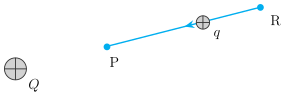
Consider a fixed charge at the origin, creating an electric field . We bring a small test charge (positive, and so small it doesn't disturb ) from point to point against the repulsive electric force .
- To move without accelerating it, we apply an external force that exactly cancels the electric force:
- The work done by this external force, , is stored entirely as potential energy of the charge .
- If the external force is removed at , the electric force pushes away, converting that stored energy into kinetic energy — total mechanical energy is conserved.
Defining Potential Energy Difference
The work done by the external force in moving from to equals the change in electrostatic potential energy:
Here:
- = potential energy at point
- = potential energy at point
- = work done by external force (against the electric field)
Key insight: This work depends only on the initial and final positions, not on the path taken. This path-independence is the hallmark of a conservative force — it makes the concept of potential energy meaningful.
The Arbitrary Zero Point
Potential energy itself is defined only up to an additive constant. Only differences in potential energy are physically significant. We can always choose a reference point where potential energy is zero.
Convenient choice: Set at infinity (). Then for any point :
That is:
The electrostatic potential energy of a charge at a point is the work done by an external force in bringing from infinity to that point, without acceleration.
Drawn by us to help you understand the concept clearly, and verified to make sure it's accurate. For exams, practice from your textbook's own diagram.
The figure shows a source charge (positive, ) fixed at the origin, represented by a circle with a plus sign (). A straight line (the path) runs from a point labelled P (lower-left end) to a point labelled R (upper-right end). A second symbol represents the test charge (also positive, ) placed on this path about two-thirds of the way from P to R. A small arrowhead on the line points backward from R toward P, indicating the direction of motion: the test charge is moved from R to P.
The physical idea is that because both and are positive, the Coulomb force on is repulsive — it pushes away from the origin. To move from R (farther from ) to P (closer to ), an external force must be applied, exactly opposite to the electric force , so that moves with infinitesimally slow constant speed (no net acceleration). The work done by this external force is stored as electrostatic potential energy of the charge at point P relative to point R.
The key formula developed from this figure is the definition of potential energy difference:
where:
- = electrostatic potential energy of at point P,
- = electrostatic potential energy of at point R,
- = work done by the external force in moving from R to P (against the electric force).
The text then extends this to define potential energy at a point by choosing infinity as the reference (where ):
Here is the work done by the external force in bringing from infinity to point P. This work is path-independent because the electrostatic force is conservative — a fact the figure’s straight-line path illustrates, but the result holds for any path.