Q.S is the surface of a lump of magnetic material.
🔒You're viewing a preview — the full solution, concept, methods & PYQ mapping are locked.
🔒 Start your 14-day free trial to unlock the full solution →Concept understanding — Magnetic Field Lines
Magnetic Field Lines
A magnet or a current-carrying wire fills the space around it with a magnetic field. We cannot see this field, so we picture it using magnetic field lines — continuous curves that map both the direction and the strength of the field at every point.
What a field line represents
The tangent to a field line at any point gives the direction of the magnetic field B there. If you place a tiny compass needle at that point, it aligns along the tangent, its north pole pointing the way the line runs. The density of the lines (how closely packed they are) represents the magnitude of B: crowded lines mean a strong field, widely spaced lines mean a weak field.
Key properties (exam essentials)
- Outside a magnet the lines run from the north pole to the south pole, but they are continuous closed loops — inside the magnet they run south to north, so every line closes on itself.
- Two field lines never intersect. If they did, a compass at the crossing point would have to point in two directions at once, which is impossible.
- Lines are crowded where the field is strong (near the poles) and spread out where it is weak.
- They form smooth, continuous curves with no free ends.
The fact that magnetic field lines always close on themselves is deep: it means there are no isolated magnetic poles (monopoles). This is Gauss's law for magnetism:
∮B⋅dA=0
The net magnetic flux through any closed surface is zero — every line that enters the surface also leaves it.
Contrast with electric field lines
Electric field lines start on positive charges and end on negative charges — they are open curves. Magnetic field lines have no such start or end; they are always closed loops. This single difference reflects that isolated electric charges exist, but isolated magnetic poles do not.
Uniform field …
Why this formula?
Magnetic Field Lines
A magnetic field line is an imaginary curve we draw to picture an invisible field. Its purpose is to encode two things at once: the direction of the field B (the tangent to the line at any point) and the strength of the field (how densely the lines are packed). They are a map, not physical objects.
The four defining rules
1. The tangent gives the field direction. At every point, B points along the tangent to the field line through that point. A compass needle placed on the line aligns with it.
2. Field lines form closed loops. Unlike electric field lines, which begin and end on charges, magnetic field lines never start or stop. This is Gauss's law for magnetism:
∮B⋅dA=0
The net flux through any closed surface is zero because isolated magnetic poles (monopoles) do not exist — every north pole is paired with a south pole. So for a bar magnet the lines emerge from the north pole outside, curve around to the south pole, and continue through the interior of the magnet back to the north, closing the loop.
3. Field lines never cross. If two lines crossed, the tangent — and hence B — would have two directions at that point. Since the field has a single, unique direction everywhere, crossings are impossible. …
The field B obeys ∇⋅B=0 everywhere, so its normal component is continuous and its lines are always continuous (closed) across the surface S (a correct, b wrong). But H=B/μ0−M, and M jumps to zero outside the material, so the surface acts like a magnetic-pole layer where H's normal component is discontinuous — the H lines cannot all be continuous (d c …
Because ∇⋅B=0 always, B-lines are continuous across the surface of a magnetic lump. But H is sourced by magnetic poles at that surface, so H-lines cannot all be continuous. Correct options: (a) and (d).
Concept understanding. The two magnetic fields obey
∇⋅B=0,B=μ0(H+M),∇⋅H=−∇⋅M.
The first says B has no sources or sinks: its field lines are always closed loops and its normal component is continuous across any boundary,
Bn,in=Bn,out.
Inside the material M=0; just outside M=0. So M drops abruptly across S, and this jump acts as an effective surface pole density σm=M⋅n^. From H=B/μ0−M, the normal component of H jumps:
Hn,out−Hn,in=Mn=M⋅n^.
Testing each option.
- (a) Lines of B are necessarily continuous across S (normal component continuous; B-lines are closed). Correct. …
Method: Boundary Conditions for B and H at a Material Surface
Use this method for any question asking whether field lines of B or H are continuous across the surface of a magnetised material.
Steps
Step 1: Start from the two governing relations
∇⋅B=0,H=μ0B−M
The first is universal — always true, everywhere, for any magnetic field, with no exceptions.
Step 2: Apply Gauss's law for magnetism at the boundary
Because ∇⋅B=0 never fails, the normal component of B is always continuous across any surface: Bn,in=Bn,out. So B field lines are always continuous — they close on themselves and never terminate anywhere, including at a material boundary.
Step 3: Track what happens to M across the boundary …
- TG EAPCET 2024Set eng-2024-05-09-FN1 markMCQQ.The most exotic diamagnetic materials are (A) Superconductors (B) Semiconductors (C) Conductors (D) Resistors
›Reveal solutionSolution
Diamagnetism arises from induced currents opposing an applied field; superconductors exhibit perfect diamagnetism (Meissner effect), expelling all magnetic flux, making them the most exotic diamagnetic materials. The correct option is (A).
The key concept here is diamagnetism — a property where a material creates an induced magnetic field in the opposite direction to an applied external field, causing repulsion. While all materials have some diamagnetic response, it is usually weak and overshadowed by paramagnetism or ferromagnetism. The "most exotic" case occurs when diamagnetism is perfect and complete, meaning the material expels all magnetic flux from its interior.
-
Understand the Meissner effect in superconductors
When a superconductor is cooled below its critical temperature, it not only loses electrical resistance but also actively expels any magnetic field from its interior. This is the Meissner effect, a hallmark of superconductivity. The result is perfect diamagnetism: the magnetic susceptibility χ=−1 (in SI units, the relative permeability μr=0). No other material achieves this — ordinary diamagnets like bismuth or water have χ≈−10−5 to −10−4.
-
Compare with other options
- (B) Semiconductors: These are typically diamagnetic or weakly paramagnetic, but their susceptibility is tiny (e.g., silicon χ≈−3.9×10⁻⁶). Not exotic.
- (C) Conductors: Normal metals (e.g., copper, silver) are diamagnetic due to core electrons, but their susceptibility is also small (χ∼−10−5). They do not expel fields.
- (D) Resistors: This is a circuit component, not a material class. Resistors are made from conductors or semiconductors, so they inherit ordinary diamagnetism at best.
-
Why superconductors are "most exotic" …
-
- TG EAPCET 2024Set eng-2024-05-10-AN1 markMCQQ.An electron falling freely under the influence of gravity enters a uniform magnetic field directed towards south. The electron is initially deflected towards (A) east (B) west (C) north (D) south
›Reveal solutionSolution
Taking down =−z^, south =−y^, east =+x^: v×B points west, and the electron's negative charge flips the force to east — option (A).
Concept. The magnetic force on a charge is F=qv×B. For an electron q=−e, so the force is opposite to v×B.
Set up axes. East =+x^, North =+y^, Up =+z^. Then
- Velocity (falling): v=−vz^,
- Field (south): B=−By^.
Cross product.
v×B=(−vz^)×(−By^)=vB(z^×y^)=vB(−x^)=−vBx^, …
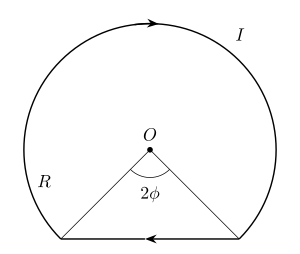
- TG EAPCET 2022Set eng-2022-07-18-FN1 markMCQQ.A current I = 5A flows along a thin wire shaped as shown in figure. The radius of curved part of the wire is equal to R = 100 mm, the angle 2ϕ = 90°. The magnitude of magnetic field at the point O is approximately [FIGURE] [Use 4πμ0=10−7 TmA−1] (A) 33.6 μT (B) 38.4 μT (C) 48.7 μT (D) 25.2 μT
›Reveal solutionSolution
Superpose the arc (θ=2π−2ϕ at the centre) and the straight chord (perpendicular distance Rcosϕ): B=4πRμ0I(2π−2ϕ+2tanϕ)≈33.6 μT — option (A).
The concept first
Biot–Savart is linear, so a bent wire is handled by chopping it into pieces whose field you already know and adding. Two standard results are all you need:
- Circular arc of radius R subtending angle θ (radians) at its centre:
B=4πRμ0Iθ.
(Check: θ=2π recovers the full loop, B=μ0I/2R.)
- Finite straight wire at perpendicular distance d, with the ends seen at angles α1,α2 from the foot of the perpendicular:
B=4πdμ0I(sinα1+sinα2).
The final, and easily missed, step is direction: here the current runs clockwise round the arc and clockwise along the chord as seen from the page, so both fields point into the page at O and the magnitudes simply add. (If they opposed, we would subtract.)
Step-by-step
- Contribution of the arc. The two radii from O to the arc's ends enclose the angle 2ϕ at the bottom; the wire's arc is therefore the major arc, subtending
θ=2π−2ϕ.
Barc=4πRμ0I(2π−2ϕ).
- Geometry of the straight chord. The chord joins the two arc ends. Drop a perpendicular from O to it: since each radius makes an angle ϕ with that perpendicular, the perpendicular distance is
d=Rcosϕ,
and the chord's half-length is Rsinϕ.
- Contribution of the chord. Each half of the chord subtends, at the foot of the perpendicular, an angle whose sine is
sinα=(Rsinϕ)2+(Rcosϕ)2Rsinϕ=sinϕ.
Both halves contribute equally, so
Bstraight=4π(Rcosϕ)μ0I(sinϕ+sinϕ)=4πRμ0I⋅cosϕ2sinϕ=4πRμ0I(2tanϕ).
- Add (both into the page). B=4πRμ0I(2π−2ϕ+2tanϕ). …
🎓Unlock everything free for 14 days
- ✓Full step-by-step solutions
- ✓Concept-first explanations
- ✓Methods, shortcuts & mistakes
- ✓PYQ mapping + timed mock tests
Full access for 14 days. No credit card required.