Q.Explain the principle and working of a nuclear reactor with the help of a labelled diagram.
You're viewing a preview — the full solution, concept, methods & PYQ mapping are locked.
Start your 14-day free trial to unlock the full solution →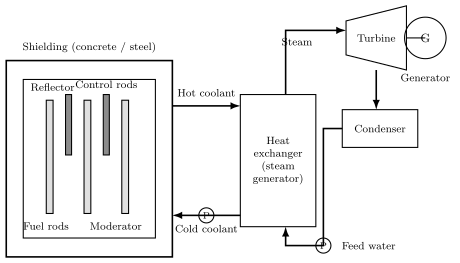
A nuclear reactor produces controlled energy from a self-sustaining chain of fission reactions, regulated by control rods and moderated/cooled/shielded by its other components.
Principle: A nuclear reactor works on the principle of a controlled, self-sustaining chain reaction of nuclear fission. When a heavy nucleus such as absorbs a slow (thermal) neutron, it splits into two lighter nuclei, releasing a large amount of energy along with 2–3 fast neutrons:
These released neutrons can go on to cause further fissions in neighbouring nuclei, sustaining a chain reaction. In a reactor, this chain reaction is deliberately kept controlled (average one neutron from each fission causing exactly one further fission, i.e., multiplication factor ) so that energy is released steadily rather than explosively as in a bomb.
Main components (working, with a labelled diagram description):
-
Fuel: Enriched uranium (with an increased proportion of fissile ), in the form of fuel rods, placed in the reactor core — this is where fission occurs.
-
Moderator: A material such as heavy water (D₂O) or graphite, surrounding the fuel rods. The neutrons released in fission are fast and are not efficient at causing further fission in ; the moderator slows them down to thermal energies (through elastic collisions) so they can efficiently cause further fissions.
-
Control rods: Rods made of neutron-absorbing material such as cadmium or boron, inserted into or withdrawn from the core. By adjusting how far the control rods are inserted, the number of neutrons available for further fission is regulated, keeping the chain reaction steady (); fully inserting the rods can shut the reactor down in an emergency.
…
Unlock everything free for 14 days
- Full step-by-step solutions
- Concept-first explanations
- Methods, shortcuts & mistakes
- PYQ mapping + timed mock tests
Full access for 14 days. No credit card required.