Q.Explain the principle and working of a nuclear reactor with the help of a labeled diagram. Calculate the energy equivalent of 1 g of substance.
You're viewing a preview — the full solution, concept, methods & PYQ mapping are locked.
Start your 14-day free trial to unlock the full solution →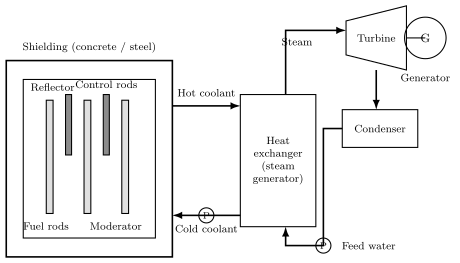
A nuclear reactor controls the fission chain reaction using a moderator (to slow neutrons) and control rods (to absorb excess neutrons), removing heat via a coolant; by Einstein's mass-energy relation, even 1 g of matter converted entirely to energy releases an enormous J.
Principle and working of a nuclear reactor
Principle: A nuclear reactor works on the principle of a controlled, self-sustaining chain reaction of nuclear fission. When a heavy nucleus like absorbs a slow (thermal) neutron, it splits into two lighter nuclei, releasing a large amount of energy along with 2–3 fast neutrons. If, on average, exactly one of these released neutrons goes on to cause another fission (multiplication factor ), the chain reaction proceeds at a steady, controlled rate, releasing energy continuously rather than explosively.
Main components (labelled diagram description):
- Fuel rods: contain the fissile material (enriched , or ), the site of fission.
- Moderator (e.g., heavy water or graphite) surrounding the fuel rods: slows down the fast neutrons released in fission to thermal (slow) speeds, since slow neutrons are far more effective at causing further fission in .
- Control rods (made of neutron-absorbing material like cadmium or boron), inserted between the fuel rods: absorb excess neutrons; by adjusting how far they are inserted, the chain reaction rate (and hence ) is precisely controlled.
- Coolant (e.g., water, heavy water, or liquid sodium), circulated through the reactor core: carries away the heat generated by fission to a heat exchanger, where it is used to produce steam that drives a turbine to generate electricity.
- Shielding (thick concrete/lead walls around the reactor core): absorbs stray radiation and protects operators/environment. …
Unlock everything free for 14 days
- Full step-by-step solutions
- Concept-first explanations
- Methods, shortcuts & mistakes
- PYQ mapping + timed mock tests
Full access for 14 days. No credit card required.