Physics · Ch 2 — Ray Optics and Optical Instruments
Reflection of Light by Spherical Mirrors
Reflection of Light by Spherical Mirrors
Reflection of Light by Spherical Mirrors
The laws of reflection hold for every point on a spherical mirror, just as they do for a plane mirror. The key difference is that the normal at a point on a curved surface is not fixed in direction — it changes from point to point.
The Normal on a Spherical Mirror
- For a spherical mirror, the reflecting surface is a part of a sphere.
- The normal at any point of incidence is the line joining that point to the centre of curvature () of the sphere.
- This is because the normal to a curved surface is perpendicular to the tangent at that point, and for a sphere, the radius is always perpendicular to the tangent.
Key Definitions
- Pole () : The geometric centre of the spherical mirror. It is the midpoint of the mirror's aperture.
- Centre of Curvature () : The centre of the sphere of which the mirror is a part.
- Principal Axis : The straight line joining the pole () and the centre of curvature (). It is the axis of symmetry of the mirror.
How the Laws Apply
- The incident ray, the reflected ray, and the normal (which is along the radius ) all lie in the same plane. …
Drawn by us to help you understand the concept clearly, and verified to make sure it's accurate. For exams, practice from your textbook's own diagram.
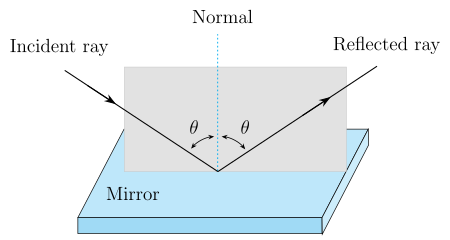
The figure shows a plane mirror drawn in perspective as a grey reflecting patch on a light base. A dashed vertical line labelled normal rises from the point where the incident ray strikes the mirror. An incident ray approaches from the upper left and meets the mirror at this point. A reflected ray leaves the same point and travels to the upper right. Both rays are drawn as straight arrows.
The key visual feature is that the incident ray, the reflected ray, and the normal all lie in the same plane — the plane of the page. The angle between the incident ray and the normal is marked and labelled angle of incidence. The angle between the reflected ray and the normal is also marked and labelled angle of reflection. The two angles are drawn equal.
Physical idea: This figure illustrates the two fundamental laws of reflection that hold for any reflecting surface — plane or curved:
- The angle of incidence equals the angle of reflection: .
- The incident ray, the reflected ray, and the normal at the point of incidence all lie in the same plane.
Key formula(s) developed from this figure:
The law of reflection is expressed as:
where:
- = angle of incidence = angle between the incident ray and the normal
- = angle of reflection = angle between the reflected ray and the normal …