Physics · Ch 2 — Ray Optics and Optical Instruments
Telescope
Telescope
Understanding the Telescope
A telescope is an optical instrument designed to make distant objects appear closer and larger. Unlike a microscope, which magnifies small nearby objects, a telescope increases the angular size of a distant object as seen by the eye. This is called angular magnification.
The telescope consists of two main lenses:
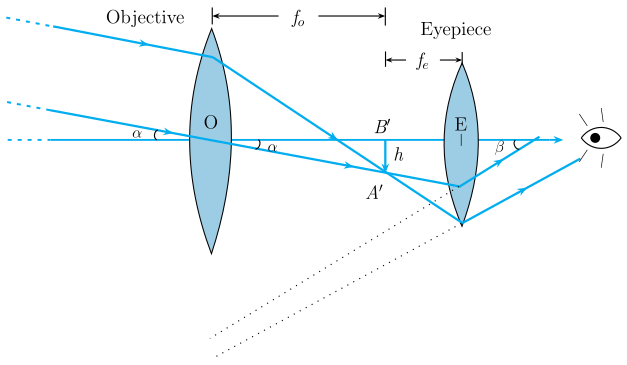
- Objective: A convex lens with a large focal length () and a large aperture. Its job is to collect light from the distant object and form a real, inverted image at its focal point.
- Eyepiece: A convex lens with a short focal length (). It acts as a simple magnifier to enlarge the real image formed by the objective.
How It Works
- Light from a distant object (effectively at infinity) enters the objective. Because the object is at infinity, the objective forms a real, inverted image at its second focal point (at distance from the objective).
- This real image is located at the first focal point of the eyepiece (or very close to it).
- The eyepiece then magnifies this image, producing a final, highly magnified, inverted image at infinity (for relaxed viewing).
The length of the telescope tube is the sum of the focal lengths of the two lenses:
Magnifying Power ()
The magnifying power of a telescope is defined as the ratio of the angle subtended at the eye by the final image () to the angle subtended at the eye by the object itself ().
For a telescope in normal adjustment (final image at infinity), the magnifying power is given by the simple ratio of the focal lengths:
Explanation of symbols:
- : Focal length of the objective lens.
- : Focal length of the eyepiece lens.
Key implication: A large magnifying power requires an objective with a very long focal length and an eyepiece with a very short focal length.
Worked Example
Consider a telescope with and .
- Magnifying power: .
- Effect on angular separation: If two stars are actually separated by (one minute of arc, which is ), through the telescope they will appear separated by an angle of .
Important Considerations for Astronomical Telescopes
- Light Gathering Power: This depends on the area of the objective. A larger diameter objective collects more light, allowing fainter and more distant objects to be observed.
- Resolving Power: This is the ability to distinguish two closely spaced objects as separate. It also depends directly on the diameter of the objective. A larger diameter gives better resolution.
Reflecting Telescopes
Modern telescopes use a concave mirror as the objective instead of a lens. These are called reflecting telescopes.
Advantages over refracting telescopes (lens-based):
- No chromatic aberration: Mirrors do not suffer from the colour-fringing effect that lenses do.
- Easier mechanical support: A mirror can be supported from its entire back surface, whereas a large lens can only be supported by its edges. This makes mirrors much lighter and less prone to distortion under their own weight.
- Cost-effective: Large mirrors are easier and cheaper to manufacture than large lenses of equivalent quality.
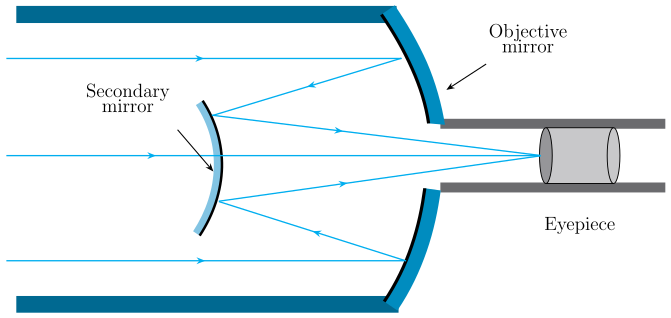
The Cassegrain Telescope (Fig. 9.26):
This is a common design for reflecting telescopes. …
Drawn by us to help you understand the concept clearly, and verified to make sure it's accurate. For exams, practice from your textbook's own diagram.
What the Figure Shows
The diagram depicts a refracting telescope in its simplest form. On the left is a large objective lens (focal length ), which has a wide aperture and a long focal length. On the right is a small eyepiece (focal length ). The two lenses are aligned along a common horizontal principal axis. The tube length is marked as , meaning the distance between the two lenses equals the sum of their focal lengths.
Parallel rays from a distant object enter the objective at a small angle relative to the principal axis. The objective forms a real, inverted image at its second focal point, which lies inside the tube. This image is located exactly at the first focal point of the eyepiece. The eyepiece then magnifies this image, and the final rays emerge at a larger angle to the axis, entering the observer's eye. The labels , , , , the eye, and the principal axis are all clearly marked.
The Physical Idea
The telescope's purpose is angular magnification — making distant objects appear larger by increasing the angle they subtend at the eye. The objective collects light from a distant object and forms a small, real image inside the tube. The eyepiece acts as a simple magnifier, allowing the eye to view this image at a much larger angle than the original angle subtended by the object. The final image is inverted, which is acceptable for astronomical observations.
Key Formula
The magnifying power of the telescope is defined as the ratio of the angle subtended at the eye by the final image () to the angle subtended by the object at the unaided eye ():
For the normal adjustment (when the final image is at infinity), the textbook derives the formula:
where: …
Drawn by us to help you understand the concept clearly, and verified to make sure it's accurate. For exams, practice from your textbook's own diagram.
What the Figure Shows
The schematic depicts a Cassegrain reflecting telescope — a design that uses mirrors instead of lenses to avoid chromatic aberration and allow for very large objectives. The figure is a cross-section along the telescope's optical axis.
- Primary mirror: A large, concave mirror at the back of the telescope tube. It has a small circular hole at its centre.
- Secondary mirror: A small convex mirror mounted near the front of the tube, facing the primary.
- Incoming light: Parallel rays from a distant object enter the tube from the left.
- Ray path: The parallel rays first strike the primary mirror, reflect, and converge toward the primary's focal point. Before they reach that point, they encounter the convex secondary mirror, which reflects them back through the central hole in the primary.
- Eyepiece: Located behind the primary mirror (to the right of the hole), it receives the converging rays and magnifies the image for the observer.
Labels in the figure: primary mirror, secondary mirror, eyepiece, and arrows indicating the direction of incoming parallel light.
Physical Idea
The Cassegrain design solves a practical problem: in a simple reflecting telescope, the observer or detector must be placed at the focal point inside the tube, blocking some incoming light. By using a convex secondary mirror, the light is folded back through a hole in the primary, allowing the eyepiece (and observer) to be placed behind the main mirror. This arrangement also provides a long effective focal length in a physically short tube — a key advantage.
Key Formula from the Textbook
The magnifying power of a telescope (including reflecting types) is given by:
where:
- is the focal length of the objective (here, the primary mirror),
- is the focal length of the eyepiece. …